
Tag Archives: Libertarian Free Will

Angus Menuge’s ontological argument against naturalism

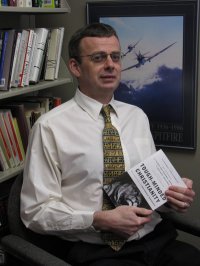
Dr. Angus Menuge
Dr. Angus Menuge

Here’s some information about Dr. Menuge:

Dr. Angus Menuge joined Concordia University Wisconsin in 1991. He earned his BA from the University of Warwick, England, and his MA and Ph.D. degrees from the University of Wisconsin-Madison, where he studied philosophy, computer science and psychology. Menuge’s dissertation was on the philosophy of action explanation, and his current research interests include philosophy of mind, philosophy of science and Christian apologetics.

In 2003, Menuge earned a Diploma in Christian Apologetics from the International Academy of Apologetics, Evangelism and Human Rights, which meets each July in Strasbourg, France. His thesis, a critique of scientific materialism, went on to become the book Agents Under Fire: Materialism and the Rationality of Science (Lanham, MD: Rowman and Littlefield, 2004).

Menuge has also edited volumes on C. S. Lewis, Christ and culture and the vocation of scientist, and has written several Bible studies. He is currently working with Joel Heck (Concordia Texas) on a collection of essays defining Lutheran education for the 21st century, entitled Learning at the Foot of the Cross (Concordia University Press, forthcoming).

A frequent speaker, Menuge has given presentations on Christianity and culture, science and vocation, philosophy of mind, C. S. Lewis, Intelligent Design and the case against scientific materialism. He is a member of the Evangelical Philosophical Society.

Dr. Menuge presented a paper at the real Evangelical Philosophical Society conference for students and professors of philosophy, and you can download the paper here in Word format. (here’s a PDF version I made)

Here is the introduction to the paper that Dr. Menuge read at the EPS conference:

The argument from reason is really a family of arguments to show that reasoning is incompatible with naturalism. Here, naturalism is understood as the idea that foundationally, there are only physical objects, properties and relations, and anything else reduces to, supervenes on, or emerges from that. For our purposes, one of the most important claims of naturalism is that all causation is passive, automatic, event causation (an earthquake automatically causes a tidal wave; the tidal wave responds passively): there are no agent causes, where something does not happen automatically but only because the agent exerts his active power by choosing to do it. The most famous version of the argument from reason is epistemological: if naturalism were true, we could not be justified in believing it. Today, I want to focus on the ontological argument from reason, which asserts that there cannot be reasoning in a naturalistic world, because reasoning requires libertarian free will, and this in turn requires a unified, enduring self with active power.

The two most promising ways out of this argument are: (1) Compatibilism—even in a deterministic, naturalistic world, humans are capable of free acts of reason if their minds are responsive to rational causes; (2) Libertarian Naturalism—a self with libertarian free will emerges from the brain. I argue that neither of these moves works, and so, unless someone has a better idea, the ontological argument from reason stands.

The paper is 11 pages long, and it is awesome for those of you looking for some good discussion of one of the issues in the area of philosophy of mind. The thing you need to know about Dr. Menuge is that he is quite strong and forceful in his writing and presentation, and to me, that is an excellent thing for a scholar to be. He reminds me of Doug Geivett, Paul Copan and William Lane Craig. Very direct, and very confrontational. You can even read an account of his debate with that radical atheist nutcase P.Z. Myers in 2008 here.

By the way, the epistemological argument from reason (P(R) on N & E is low) is the argument made by the famous Christian philosopher Alvin Plantinga. I blogged about that argument before here. You need to know BOTH of these arguments. Plantinga also spoke at the EPS apologetics conference, explaining exactly this argument.

Powerpoint slideshow

But there is more than just the paper! At the EPS apologetics conference, which is meant for lay people as well as scholars, he presented this Powerpoint slideshow, (here’s a PDF version I made) . The slides are easier to understand than the paper, but the paper is not too bad.

And here is another article by Dr. Menuge on intelligent design.

Is Luke 10:13 more of problem for Calvinists or Molinists?

Calvinism is the view that God decides whether you go to Heaven or Hell and nothing that you do affects where you end up. If God wants to save you, then he will, and you can’t resist it. If God wants to damn you, then he will, and you can’t resist that. God saves some people and not others, but not based on anything that the people themselves do. God does not want everyone to be saved.

Molinism is the view that God draws people to him, and they can resist his drawing, just like in any ordinary love relationship where the beloved is not drawn against his or her will. On Molinism, God also places people in the best time and place for them to respond to him, depending on what evidence they need. He can do this because he knows how people respond in any set of circumstances. If people go to Hell, then the people are responsible, on Molinism. But God wants everyone to be saved, but not against their will. God actualizes a world in which he is sovereign over everything that happens, and gets the outcome that he wants, but without violating free will.

So here’s a verse that I think is troubling to both sides, Luke 10:13:

13 “Woe to you, Chorazin! Woe to you, Bethsaida! For if the miracles that were performed in you had been performed in Tyre and Sidon, they would have repented long ago, sitting in sackcloth and ashes.

This verse is a problem for Molinists, because if the people in these cities would have repented if they got better miracles, then why didn’t they get the better miracles they needed? If God loves them, then why didn’t he give them better miracles?

And this verse is a problem for Calvinists, because it shows that people do have free will to respond to evidence that God allows them to see. Why would evidence matter on Calvinism, since God can just flip the person’s switch (or not). If God wanted those people to repent, he could just do it without having to care about evidence, since he is the one who decides whether they believe in him or not, totally apart from their free will.

Angus Menuge explains the ontological argument from reason

Dr. Angus Menuge
Dr. Angus Menuge

Here’s some information about Dr. Menuge:

Dr. Angus Menuge joined Concordia University Wisconsin in 1991. He earned his BA from the University of Warwick, England, and his MA and Ph.D. degrees from the University of Wisconsin-Madison, where he studied philosophy, computer science and psychology. Menuge’s dissertation was on the philosophy of action explanation, and his current research interests include philosophy of mind, philosophy of science and Christian apologetics.

In 2003, Menuge earned a Diploma in Christian Apologetics from the International Academy of Apologetics, Evangelism and Human Rights, which meets each July in Strasbourg, France. His thesis, a critique of scientific materialism, went on to become the book Agents Under Fire: Materialism and the Rationality of Science (Lanham, MD: Rowman and Littlefield, 2004).

Menuge has also edited volumes on C. S. Lewis, Christ and culture and the vocation of scientist, and has written several Bible studies. He is currently working with Joel Heck (Concordia Texas) on a collection of essays defining Lutheran education for the 21st century, entitled Learning at the Foot of the Cross (Concordia University Press, forthcoming).

A frequent speaker, Menuge has given presentations on Christianity and culture, science and vocation, philosophy of mind, C. S. Lewis, Intelligent Design and the case against scientific materialism. He is a member of the Evangelical Philosophical Society.

Dr. Menuge presented a paper at the real Evangelical Philosophical Society conference for students and professors of philosophy, and you can download the paper here in Word format. (here’s a PDF version I made)

Here is the introduction to the paper that Dr. Menuge read at the EPS conference:

The argument from reason is really a family of arguments to show that reasoning is incompatible with naturalism. Here, naturalism is understood as the idea that foundationally, there are only physical objects, properties and relations, and anything else reduces to, supervenes on, or emerges from that. For our purposes, one of the most important claims of naturalism is that all causation is passive, automatic, event causation (an earthquake automatically causes a tidal wave; the tidal wave responds passively): there are no agent causes, where something does not happen automatically but only because the agent exerts his active power by choosing to do it. The most famous version of the argument from reason is epistemological: if naturalism were true, we could not be justified in believing it. Today, I want to focus on the ontological argument from reason, which asserts that there cannot be reasoning in a naturalistic world, because reasoning requires libertarian free will, and this in turn requires a unified, enduring self with active power.

The two most promising ways out of this argument are: (1) Compatibilism—even in a deterministic, naturalistic world, humans are capable of free acts of reason if their minds are responsive to rational causes; (2) Libertarian Naturalism—a self with libertarian free will emerges from the brain. I argue that neither of these moves works, and so, unless someone has a better idea, the ontological argument from reason stands.

The paper is 11 pages long, and it is awesome for those of you looking for some good discussion of one of the issues in the area of philosophy of mind. The thing you need to know about Dr. Menuge is that he is quite strong and forceful in his writing and presentation, and to me, that is an excellent thing for a scholar to be. He reminds me of Doug Geivett, Paul Copan and William Lane Craig. Very direct, and very confrontational. You can even read an account of his debate with that radical atheist nutcase P.Z. Myers in 2008 here.

By the way, the epistemological argument from reason (P(R) on N & E is low) is the argument made by the famous Christian philosopher Alvin Plantinga. I blogged about that argument before here. You need to know BOTH of these arguments. Plantinga also spoke at the EPS apologetics conference, explaining exactly this argument.

Powerpoint slideshow

But there is more than just the paper! At the EPS apologetics conference, which is meant for lay people as well as scholars, he presented this Powerpoint slideshow, (here’s a PDF version I made) . The slides are easier to understand than the paper, but the paper is not too bad.

And here is another article by Dr. Menuge on intelligent design.