Tag Archives: Jesus

Is belief in the Jesus of the Bible needed in order to be rightly related to God?

Here’s a good introductory lecture on the topic by Chad Gross, who blogs at Truthbomb Apologetics.

You can see the footnotes for his article on his blog.

For those who don’t want to watch the video, here’s a good thought from J. Warner Wallace at Please Convince Me.

Excerpt:

A “just” God does justice, which means to punish or reward appropriately. In the Western tradition, we punish people for the actions they commit, but the extent of punishment is dependent also on the person’s mental state, and a person’s mental state is reflective of his or her beliefs. Premeditated murder is worse than manslaughter, and is punished more severely, and a hate crime is a sentencing enhancement that adds more punishment to the underlying crime. In both examples, a person’s beliefs are at play: the premeditated murderer has reflected on his choices and wants the victim dead; a hate crime reflects a belief that the rights of a member of the protected group are especially unworthy of respect. So, considering a person’s beliefs may well be relevant, especially if those beliefs have motivated the criminal behavior.

But the challenger’s mistake is even more fundamental. He is wrong to assert that people are condemned for not accepting the gospel. Christians believe that people are condemned for their sinful behavior – the “wages of sin is death” – not for what they fail to do. The quoted challenge is like saying that the sick man died of “not going to the doctor.” No, the person died of a specific condition – perhaps cancer or a heart attack – which a doctor might have been able to cure. So too with eternal punishment. No one is condemned for refusing to believe in Jesus. While Jesus can – and does – provide salvation for those who seek it, there is nothing unjust about not providing salvation to those who refuse to seek it. After all, we don’t normally feel obliged to help someone who has not asked for, and does not want, our assistance. So too the Creator has the right to withhold a gift – i.e. eternity spent in His presence – from those who would trample on the gift, and on the gift-giver.

The quoted assertion also demonstrates an unspoken belief that we can impress God with our “kind” or “generous” behavior. This fails to grasp what God is – a perfect being. We cannot impress Him. What we do right we should do. We don’t drag people into court and reward them for not committing crimes. This is expected of them. They can’t commit a murder and then claim that punishment is unfair, because they had been kind and generous in the past. When a person gets his mind around the idea of what perfection entails, trying to impress a perfect Creator with our “basic goodness” no longer seems like such a good option.

If you want to hear a debate featuring exclusivists versus pluralists, I’ve got a podcast and a summary of a good debate on this issue between Chris Sinkinson and John Hick. You can’t find a more prominent pluralist than John Hick, except for maybe Paul Knitter, who is featured in a debate with Harold Netland in the new “Debating Christian Theism” book that is just out with Oxford University Press.

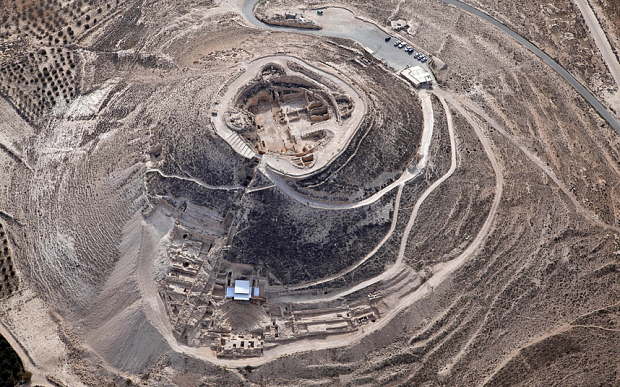
Archaeologists discover entrance to Herod’s palace near Bethlehem

Herod's palace
Herod’s palace

Baptist Press reports on the story.

Full text:

Israeli archeologists have uncovered an impressive entrance to Herod’s palace at Herodium. Located only three miles southeast of Bethlehem, Herodium played an important part in the events surrounding the early life of Christ.

The December announcement by Hebrew University archeologists Roi Porat, Yakov Kalman and Rachel Chachy dovetails well with the seasonal interest in the nativity accounts of Luke and Matthew in the New Testament.

While both Luke and Matthew wrote that King Herod governed Judea during the era of Jesus’ birth at Bethlehem (Luke 1:5, Matthew 2:1), they included nothing concerning Herod’s massive palace/fortress complex at nearby Herodium.

Herodium, like Herod’s other isolated palace/fortress complexes at Masada and Machaerus, was built on a mountain. To enhance its impressive scale, Herod artificially extended the height of the hill to make it the tallest mountain in the Judean desert.

While the site included the usual Herodian luxuries such as a palace, bathhouse, theatre and garden, Herodium was essentially a fortress, a place where Herod could find refuge if his people revolted.

Herod’s fear of a Jewish revolt led him to establish many fortresses in both urban centers (he maintained two in Jerusalem itself) and in isolated rural areas away from the urban centers.

A small community close to the fortress housed the construction teams and, later, the garrison soldiers and palace servants. The servants who waited on the king indeed worked in an impressive palace.

The newly uncovered entranceway apparently was still being constructed near the time of the monarch’s death.

As shown in one of the photographs, the entryway included three levels of arches in a 65-foot corridor that was 19 feet across and 65 feet in height leading to the palace’s courtyard. Curiously enough, the nearly completed entrance was abruptly stopped and backfilled around the time of Herod’s death. The archeologists speculated that the now-aging Herod instead sought to convert the entire palace into a memorial mound for his upcoming burial at the site.

Indeed, Herod’s plans for Herodium unfolded as Jesus was born and as He spent His early life in nearby Bethlehem. When the magi arrived in Jerusalem and announced they had come to worship the “king of the Jews,” Herod sent them to Bethlehem after learning the location of the Messiah’s birthplace from the chief priests and learned scholars. The monarch hoped to ascertain from the magi which of the town’s small children was the designated royal candidate. Then Herod hoped to execute the child (Matthew 2:1-8, 2:16).

When the magi failed to return with this information, Herod ordered his soldiers into Bethlehem to murder all children age 2 and under. Warned to flee to Egypt, the holy family escaped Herod’s plans, but an undisclosed number of children were killed by Herod’s soldiers. Although never stated in the biblical account, the soldiers who carried out the old king’s infamous order were either stationed in Jerusalem (seven miles from Bethlehem) or in the closer post at Herodium. In fact, Herodium overlooked Bethlehem and could have functioned as a convenient headquarters for Herod’s deadly operation.

While the holy family resided in Egypt, another Herodium connection to the early life of Christ took place. After a long and terribly painful illness, Herod died. His surviving eldest son (Herod had murdered his three oldest sons), Archelaus, then buried him in Herodium at a pre-selected tomb and gave his father an elaborate funeral at the site and spared no expense, according to the Jewish historian Josephus (Jewish War, 1,673).

Israeli archeologist Ehud Netzer claimed to have found Herod’s tomb and damaged sarcophagus (stone coffin) in 2007 at Herodium, but in 2013 and 2014 other archeologists have raised doubts about the tomb and the sarcophagus. Israeli archeologists Joseph Patrich and Benjamin Arubas largely based their doubts on the modest tomb site and the unimpressive sarcophagus. They believe that the mega-maniacal Herod would have commissioned a larger tomb and a more elaborate sarcophagus.

With Herod now buried in Herodium and with Archelaus eventually ruling over much of his father’s former kingdom as an “ethnarch” (“ruler of the people”), the New Testament noted the change in political leadership (Matthew 2:19-22). The change prompted Joseph to consider a move back to Judea (perhaps back to Bethlehem itself where the family had lived for about two years), but his misgivings about a Judea under the rule of an already unpopular Archelaus and a warning in a dream led him to reconsider. The decision was a wise one. A return to Bethlehem in the “shadow of Herodium” and the nearby royal city of Jerusalem placed the holy family at potential risk.

Instead, Joseph took his family back to Nazareth in Galilee (Matthew 2:22-23). Galilee was governed by Herod Antipas, the younger brother of Archelaus. At the time, this Herodian ruler, with the title of “tetrarch” (“ruler over a fourth”), was regarded as a milder alternative to the volatile Archelaus. Located far away from the recent unpleasant associations connected to Herodium and the slaughter of the children in Bethlehem, Joseph and Mary would raise Jesus in the peaceful surroundings of Nazareth.

The recent archeological find in Herodium and the continuing dispute concerning Herod’s tomb and sarcophagus calls attention to the background story of the early life of Christ as detailed in the Gospel of Matthew. Perhaps some further archeological discoveries at Herodium will uncover additional information about the familiar nativity narrative.

I liked this article on Baptist Press so much, I pasted it here in full – because of the links between history and the Bible. It’s also reported in secular news sources like NBC News and the UK Telegraph.

When I read stories like this, it really makes me question people who think that the New Testament books were not intended to be history. I think the default view has to be that the authors intended to write history, and then we do the work to see which parts pass historical tests – i.e. – how early, how many sources, how many eyewitnesses, etc. And, do we have archaeological evidence to corroborate the narrative.

What is the meaning and significance of Christmas for Christians?

It’s the time of year when we explain what Christianity is about.

God exists

Basically, we know from a variety of scientific arguments that the universe was created and fine-tuned for life by an intelligent agent that existed causally prior to the beginning of the universe, because this agent brought the universe into being. Our purpose as humans is to enter into a two-way loving relationship with this Creator/Designer of the universe. This is the only way that we can ultimately be happy and fulfilled.

We avoid God

Now, when you look at human experience, none of us is interested in finding out about the character of this Creator/Designer, because we are afraid that if we find out too much about him then we will have our freedom to do as we please constrained by the demands of a relationship with an all-powerful, all-good being. Just knowing that such a person exists and has a character distinct from our own is enough to cause us to flee from him so that we can stay autonomous from the obligations of the moral law that he expects us to follow.

Christians believe that this universal desire to avoid an all-powerful, all-good God who will judge us is a result of bad behaviors inherited by us from the very first rebellion against God by our ancestors. Ever since that rebellion, the capability for relating to God has been lost, because we no longer have the ability to stop our rebellion against God. Christians call the first rebellion of our ancestors “The Fall of Man”.

What does this rebellion look like for us today? Well, we want to do whatever we want, in order to be happy, and to ignore God’s demands. We want to have happy feelings, including security, community and being morally good, all without a relationship with God. We want to acquire and rearrange matter for our selfish ends without acknowledging and honoring the Creator/Designer of that matter. And, of course, we would like other people to affirm, voluntarily or involuntarily, that our rebellion against God is really the height of moral goodness.

Additionally, some people imagine that God, if he exists at all, must desire our happiness. And of course when their needs are not met by this invented God, then they become even more bitter at God, and eventually decide that God could not really exist since their selfish needs are not being met by him. It never seems to occur to us humans that some pain and suffering may be permitted by God in order to turn our attention away from pleasure and security in this life, and back towards a relationship with him.

This is the mess we find ourselves in. This propensity for turning away from God and trying to pursue selfish happiness and security apart from a relationship with God is what the Bible calls “sin”. Every single one of us deserves severe punishment for refusing to pursue a genuine two-way love relationship with the God who is there. That is the mess we are in before Jesus appears to address this problem.

Jesus saves the day

I cannot say much about how Jesus solves the problem of rebellion against God, because that is really the story of Easter, and today we are dealing with the story of Christmas. But I can say that the solution to the problem requires that God step into history to communicate with his creatures and to perform actions in order to be reconciled with them. That is the message of Christmas: God is stepping into history to do something to end our rebellion. Easter is the story of what he does.

This is talked about in the Bible in John 1, for example.

John 1:1-5:

1In the beginning was the Word, and the Word was with God, and the Word was God.

2He was with God in the beginning.

3Through him all things were made; without him nothing was made that has been made.

4In him was life, and that life was the light of men.

5The light shines in the darkness, but the darkness has not understood it.

You can substitute the word “Word” there for Logos, which really means logic or reason or wisdom. This is a person with a divine nature, identified with the eternal being of God, who exists causally prior to the creation of the universe, who is going to take on an additional human nature, including a human body. (Christians believe that there is one divine “what” being and three divine “who” persons). Software engineers, you can think of Jesus having two natures as multiple inheritance in C++.

And it continues in John 1:10-14:

10He was in the world, and though the world was made through him, the world did not recognize him.

11He came to that which was his own, but his own did not receive him.

12Yet to all who received him, to those who believed in his name, he gave the right to become children of God—

13children born not of natural descent, nor of human decision or a husband’s will, but born of God.

14The Word became flesh and made his dwelling among us. We have seen his glory, the glory of the One and Only, who came from the Father, full of grace and truth.

Here the word grace doesn’t mean like a graceful ballet dancer. It means an instance of mercy received from a superior. A person (a “who”) identified with the divine being (a “what”) has decided to make us a top-down offer of mercy.

The same message of God stepping into history is found in the Christmas carols that people sing at Christmas.

Christmas carols

Here’s the best one, “O, Holy Night“, and it says:

O holy night! The stars are brightly shining.
It is the night of the dear Savior’s birth.
Long lay the world in sin and error pining,
Till He appeared and the soul felt its worth.

When we were in rebellion, we had lost our most valuable capacity – the capacity of being in a direct relationship with God. And if the newborn baby Jesus can accomplish his mission (and he did), then we are going to regain that capacity for a direct relationship with God.

Now look at “Hark! The Herald Angels Sing“, which one of my favorites:

Hark! The herald angels sing,
“Glory to the newborn King!
Peace on earth and mercy mild,
God and sinners reconciled.”

Basically, as I often say, there are only two kinds of people in the world. There are people who are willing to respond to the offer of a relationship with God, with all the little sacrifices and compromises that a relationship entails, and then there are people who are not willing to respond. For the people who are willing to respond, the appearance of Jesus is the best thing that could possibly happen, because now we are finally going to have a chance to deal directly with God, face-to-face, to find out what he is like, and change ourselves to be more like him, with his help.

And that is why people celebrate Christmas. It’s the anniversary of the birth of Jesus. It is the story of God stepping into history to be reconciled with his rebellious creatures. It’s the story of the divine Logos subjecting himself to the life of a creature in order to rescue us from our sinful, self-destructive rebellion. This love for undeserving creatures is above and beyond the call of duty. We didn’t love him, but instead he loved us first, and he loved us enough to come down here and suffer with us so that we could be reconciled with God.

MERRY CHRISTMAS!