
Tag Archives: Israel

Is Obama’s nuclear deal with Iran good for our national security?

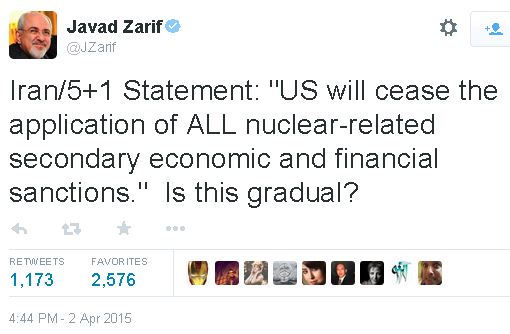
Iran chief negotiator: all sanctions will stop
Iran’s chief negotiator: all the sanctions cease immediately

This is the top article on the Wall Street Journal right now. It’s written by two former Secretaries of State, Henry Kissinger and George P. Shultz.

They are assessing the Iran deal:

While Iran treated the mere fact of its willingness to negotiate as a concession, the West has felt compelled to break every deadlock with a new proposal. In the process, the Iranian program has reached a point officially described as being within two to three months of building a nuclear weapon. Under the proposed agreement, for 10 years Iran will never be further than one year from a nuclear weapon and, after a decade, will be significantly closer.

[…]Progress has been made on shrinking the size of Iran’s enriched stockpile, confining the enrichment of uranium to one facility, and limiting aspects of the enrichment process. Still, the ultimate significance of the framework will depend on its verifiability and enforceability.

[…]Under the new approach, Iran permanently gives up none of its equipment, facilities or fissile product to achieve the proposed constraints. It only places them under temporary restriction and safeguard—amounting in many cases to a seal at the door of a depot or periodic visits by inspectors to declared sites. The physical magnitude of the effort is daunting. Is the International Atomic Energy Agency technically, and in terms of human resources, up to so complex and vast an assignment?

In a large country with multiple facilities and ample experience in nuclear concealment, violations will be inherently difficult to detect. Devising theoretical models of inspection is one thing. Enforcing compliance, week after week, despite competing international crises and domestic distractions, is another. Any report of a violation is likely to prompt debate over its significance—or even calls for new talks with Tehran to explore the issue. The experience of Iran’s work on a heavy-water reactor during the “interim agreement” period—when suspect activity was identified but played down in the interest of a positive negotiating atmosphere—is not encouraging.

Compounding the difficulty is the unlikelihood that breakout will be a clear-cut event. More likely it will occur, if it does, via the gradual accumulation of ambiguous evasions.

When inevitable disagreements arise over the scope and intrusiveness of inspections, on what criteria are we prepared to insist and up to what point? If evidence is imperfect, who bears the burden of proof? What process will be followed to resolve the matter swiftly?

The agreement’s primary enforcement mechanism, the threat of renewed sanctions, emphasizes a broad-based asymmetry, which provides Iran permanent relief from sanctions in exchange for temporary restraints on Iranian conduct. Undertaking the “snap-back” of sanctions is unlikely to be as clear or as automatic as the phrase implies. Iran is in a position to violate the agreement by executive decision. Restoring the most effective sanctions will require coordinated international action. In countries that had reluctantly joined in previous rounds, the demands of public and commercial opinion will militate against automatic or even prompt “snap-back.” If the follow-on process does not unambiguously define the term, an attempt to reimpose sanctions risks primarily isolating America, not Iran.

The gradual expiration of the framework agreement, beginning in a decade, will enable Iran to become a significant nuclear, industrial and military power after that time—in the scope and sophistication of its nuclear program and its latent capacity to weaponize at a time of its choosing. Limits on Iran’s research and development have not been publicly disclosed (or perhaps agreed). Therefore Iran will be in a position to bolster its advanced nuclear technology during the period of the agreement and rapidly deploy more advanced centrifuges—of at least five times the capacity of the current model—after the agreement expires or is broken.

That doesn’t sound like a good deal to me.

It sounds like we are trading permanent relief from sanctions. Those sanctions were built up over years of negotiations with the UN countries. Sanctions that are not easy to “snap back” if Iran breaks the deal, because they require negotiations with many different UN countries again – it won’t be automatic. That’s the “asymmetry” they are talking about in the article. Iran can break the agreement unilaterally, or just block the inspections, and the sanctions will stay off until we get agreement with the UN countries.

Here’s the former Democrat campaign worker, and now State Department spokeswoman Marie Harf:

She is confused by all the “big words” that these two Secretaries of State used in the article above.

But it gets worse!

Here’s the latest from the Times of Israel. (H/T Director Blue via ECM)

It says:

Iran will begin using its latest generation IR-8 centrifuges as soon as its nuclear deal with the world powers goes into effect, Iran’s foreign minister and nuclear chief told members of parliament on Tuesday, according to Iran’s semi-official FARS news agency.

If accurate, the report appears to make a mockery of the world powers’ much-hailed framework agreement with Iran, since such a move clearly breaches the US-published terms of the deal, and would dramatically accelerate Iran’s potential progress to the bomb.

Iran has said that its IR-8 centrifuges enrich uranium 20 times faster than the IR-1 centrifuges it currently uses.

According to the FARS report, “Iran’s foreign minister and nuclear chief both told a closed-door session of the parliament on Tuesday that the country would inject UF6 gas into the latest generation of its centrifuge machines as soon as a final nuclear deal goes into effect by Tehran and the six world powers.”

It said that Foreign Minister Mohammad Javad Zarif and Atomic Energy Organization of Iran (AEOI) head Ali Akbar Salehi made the promise when they briefed legislators on the framework agreement, and claimed the move was permitted under the terms of the deal.

Oh, I guess was wrong. This is a good deal! For Iran.

Sigh. I guess if you want to be even more horrified by the Iran deal, you can listen to an interview that Hugh Hewitt did with Wall Street Journal columnist Bret Stephens, and there’s a transcript as well for those who would rather read about the incompetence of the Obama administration rather than hear about the incompetence of the Obama administration.
Did Republican senators do anything wrong by writing a letter to Iran’s leaders?

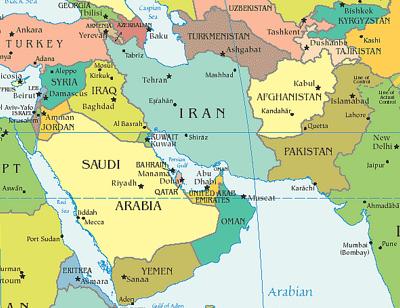
Map of the Middle East

Stephen Hayes is the foreign policy expert for the Weekly Standard and he has some facts that undermine the left-wing media narrative.

He appeared on the Special Report panel, and thanks to Newsbusters, you can see the video of it on their web site, and read the transcript.

Hayes also had a longer form article posted at The Weekly Standard:

In a tweet this morning, NBC News senior political editor Mark Murray writes: “With GOP Senators’ Iran Move, Politics Goes Beyond the Water’s Edge.” 47 Republican Senators sent to the Supreme Leader of Iran reminding him that Congress is not bound by deals that Congress does not approve. The article Murray links to describes this as “stunning” and “unprecedented” and implies that the letter constitutes a breach of protocol so significant that it ends the long tradition of bipartisan foreign policy.

This is utterly preposterous.

The only way to reach such a conclusion is to ignore efforts by Democrats to undermine George W. Bush.

In September 2002, David Bonior, the second-ranking Democrat in the House of Representatives, flew to Baghdad in an attempt to undermine George W. Bush’s case for war in Iraq on a trip paid for by Saddam Hussein’s regime. Bonior, accompanied by Representatives Jim McDermott and Mike Thompson, actively propagandized for the Iraqi regime. McDermott, asked whether he found it acceptable to be used by the Iraqi regime, said he hoped the trip would end the suffering of children. “We don’t mind being used,” he said.

In 2004, the Democratic Party offered its full embrace of Michael Moore’s fantastical conspiracy theory,Fahrenheit 9/11. Minority Leader Tom Daschle, DNC chairman Terry MacAullife and assorted Democratic heavyweights flocked to a special screening of the film in Washington, DC, where they offered unreserved praise.

In 2007, House Speaker Nancy Pelosi traveled to Damascus, Syria, in an open attempt to undercut White House efforts to isolate Syrian dictator Bashar Assad. Pelosi amplified Assad’s claims that he was ready for peace talks with Israel and wanted Syria to rejoin the international community.

The letter from Senate Republicans provides a stark contrast from these efforts. It is a straightforward, fact-based description of the U.S. constitutional system and the role Congress plays in international agreements and treaties.

It takes a selective reading of that history to conclude that this letter, as opposed to previous efforts by congressional Democrats, means the end of bipartisan foreign policy.

I think it’s wonderful that Republicans are doing everything possible to try to put the brakes on the Obama administration’s efforts to lift sanctions on Iran so that they can proceed to develop nuclear weapons at a faster pace. As you know, the Obama administration was accused by former U.N. ambassador John Bolton of leaking details of a planned strike on Iranian nuclear assets by Israel. So we know exactly where their allegiance lies, here. (This article says it was actually Hillary Clinton who did the leaking that scratched the strike plan) This is not a mystery – we need to judge the Obama administration by their actions.

I had to post on this because one of my co-workers asked me to respond to this story, as well as tell him the Republican alternative to Obamacare (he is not into health care policy that’s to the right of center). Here’s the alternative to Obamacare, you. (That’s Wall Street Journal, Newsmax overview of the plan here) Those are recent articles, but you can find the official policy explained in detail on Paul Ryan’s Congressional web site.

58 Democrats boycott Benjamin Netanyahu’s address to Congress on Iran

Israeli prime minister Benjamin Netanyahu spoke before the U.S. Congress on Tuesday, and below you can find a round-up of reactions.

Here’s The Daily Signal summarizing why Netanyahi opposes the deal:

Netanyahu made the case before Congress that the White House’s efforts to negotiate a deal with Iran have about as much in common with the Camp David Accords as an SNL skit has with a State of the Union Address. The administration’s proposal is anything but a realistic plan for peace.

A real peace plan would demonstrate that all sides were committed to not adding more nuclear weapons powers to the Middle East. The deal as it stands does the opposite—it preserves the nuclear option for Iran—and as result will prompt other regional powers to hedge their bets and prepare to go nuclear as well rather than live in Tehran’s nuclear shadow.

The proposed multi-year moratorium doesn’t end concerns that Iran will build a bomb and put nuclear warheads on long-range missiles. Rather, under the agreement, Tehran can walk up to the edge of becoming a declared armed-nuclear state with a robust missile force and sit there. That hardly sets the condition for sure peace in our time.

Meanwhile, even the shaky stalemate proposed by the agreement rests on the assumption that Tehran won’t follow North Korea’s path to breakout status by cheating on the agreement and then abrogating the deal when it no longer suits the regime.

At the same time the price for Obama’s peace comes pretty high. Tehran demands significant and immediate sanctions relief. That means more money for a corrupt regime with one of the world’s worst human records to perpetuate strangled hold over the people of Iran.

Obama’s deal also means more money for Tehran to prop-up the likes of Hezbollah, Assad, Hamas, the Houthi rebels in Yemen and murderous unaccountable Shia militias in Iraq (which are as big a threat to the future of the country as ISIS). As one of the world’s premier state-sponsors of terrorism, enabling and emboldening Iran’s efforts to reshape the region by force of arms and slaughtering innocents doesn’t make the prospects for peace in the region any brighter.

All the partisan controversy and vitriol over Netanyahu’s speech cannot obscure that the White House has no good answers to the legitimate concerns he raised.

Breitbart News summarizes how the speech was received:

Prime Minister Benjamin Netanyahu delivered a passionate, inspiring, thoughtful, and “game changing” speech before the American Congress which lasted for about 45 minutes, during which time he was applauded 43 times, often for 15 seconds at a time. His words elicited many standing ovations.

The only other foreign leader to have spoken to Congress three times was Winston Churchill, the British Prime Minister. In honor of that, Speaker of the House, John Boehnerplans to present Netanyahu with a bust of Churchill.

Netanyahu received wild applause when he said: “The world should demand that Iran do three things. First, stop its aggression against its neighbors in the Middle East. Second, stop supporting terrorism around the world. And third, stop threatening to annihilate my country, Israel, the one and only Jewish state.”

Israel’s Prime Minister again received rather thunderous applause and a standing ovation when he noted that Holocaust survivor Elie Wiesel was in the audience—and when he said: “My friend, standing up to Iran is not easy. Standing up to dark and murderous regimes never is. Elie, your life and work inspires to give meaning to the words, ‘never again!’ And I wish I could promise you, Elie, that the lessons of history have been learned. I can only urge the leaders of the world not to repeat the mistakes of the past.”

At this point Congress outdid itself in term of applause and a standing ovation.

PM Netanyahu was greeted with a thunderous ovation when he first arrived and again after he was introduced.

And here’s Dennis Prager, writing at Investors Business Daily, explaining why Obama refused to meet with Netanyahu:

The prime minister of Israel is at the forefront of the greatest battle against evil in our time — the battle against violent Muslims. No country other than Israel is threatened with extinction, and it is Iran and the many Islamic terror organizations that pose that threat.

It only makes sense, then, that no other country feels the need to warn the world about Iran and Islamic terror as much as Israel.

That’s why, when Benjamin Netanyahu speaks to the United Nations about the threat Iran poses to his country’s survival and about the metastasizing cancer of Islamist violence, he unfortunately stands alone.

Virtually everyone listening knows he is telling the truth. And most dislike him for it. Appeasers hate those who confront evil.

Given that this president is the least likely of any president in American history to confront evil — or even identify it — while Benjamin Netanyahu is particularly vocal and eloquent about both identifying and confronting evil, it is inevitable that the former will resent the latter.

Here is the list of 58 Democrats (House and Senate) who walked out of the speech.

And a number of top Democrats — including Vice President Joe Biden, whose job description includes the title President of the Senate — didn’t attend.

[…]At least 50 Democratic House members and eight senators who caucus with the Democrats said in recent weeks they wouldn’t attend the speech, many in protest to a move that they say is an affront to the president.

The full transcript of the speech has been posted by The Weekly Standard.