Tag Archives: Islamic Extremism

Mulcair and Trudeau want convicted Canadian terrorists to retain citizenship

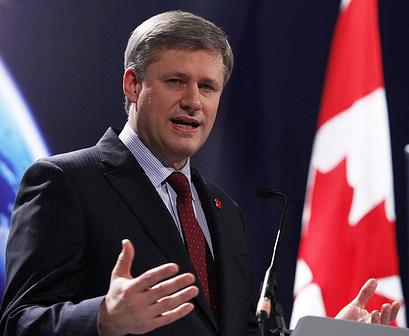
Prime Minister Stephen Harper

This is from the National Post, one of Canada’s two national newspapers.

Excerpt:

The government used its new power to revoke the citizenship of convicted terrorists for the first time on Friday against the imprisoned ringleader of the 2006 al-Qaida-inspired plot to detonate truck bombs in downtown Toronto.

Zakaria Amara was notified in a letter sent to the Quebec penitentiary where is he serving a life sentence that he is no longer a Canadian. He still holds citizenship in Jordan and could be deported there following his release from prison.

[…]Legislation that came into force in May, over the opposition of the NDP and Liberals, allows the government to revoke the citizenship of Canadians who have been convicted of terrorism offences — provided they hold citizenship in a second country.

The law also applies to dual citizens convicted of treason and spying for foreign governments, as well as members of armed groups at war against Canada. A little more than half-a-dozen Canadians have been notified so far that the government was considering revoking their citizenship.

Now, you would think that a law like this would be common sense, but in Canada, you’d be wrong. Two-thirds of the electorate are pro-terrorism in Canada, owing largely to mass immigration from Muslim countries, and and an education system that is anti-Western civilization in a suicidal way. And the leaders of the two socialist opposition parties reflect that suicidal view.

More:

NDP leader Tom Mulcair has said he would scrap the citizenship revocation law, and on Friday Liberal leader Justin Trudeau repeated his pledge to repeal it. “The bill creates second-class citizens,” he said. “No elected official should ever have the exclusive power to revoke Canadian citizenship. Under a Liberal government there will be no two-tiered citizenship. A Canadian is a Canadian is a Canadian.”

Let’s find out exactly who we are talking about here:

Amara emerged in 2005 as one of two leaders of a terrorist group that trained on a rural property north of the city and, inspired by al-Qaida, began planning attacks they thought would convince Canada to withdraw its troops from Afghanistan.

Amara led a faction that was acquiring the components for large truck bombs that were to be detonated during the morning rush hour outside the Toronto Stock Exchange and the Canadian Security Intelligence Service office beside the CN Tower. An Ontario military base was also to be attacked.

Justice Bruce Durno called the plot “spine chilling” and said “the potential for loss of life existed on a scale never before seen in Canada. It was almost unthinkable without the suggestion that metal chips would be put in the bombs. Had the plan been implemented it would have changed the lives of many, if not all Canadians forever.”

Under the liberal governments of the 1980s and 1990s, Canada experienced mass immigration from countries that had no understanding of nor allegiance to Western democratic ideals. This was desired in order to build a majority that would support bigger government, higher taxes, and more dependency. No effort was made to teach incoming immigrants to value democracy and Judeo-Christian values as the source of Canadian success. There were several terrorist attack in Canada during Harper’s 8 year run. If Canada elects leftists, these will continue. Only now, government will not have the tools they need to protect the public from their past immigration laxity. Be warned, Canadians.

Can we trust Democrats to take national security and foreign policy seriously?

First part of the clip is here on The Weekly Standard:

Q I just want to go back to your statement about the extremists want to incite a religious war against Islam and they failed. There have been a lot of questions raised about why you have chosen not to associate yourself with the language that was used by the French President when he said we’re at war with radical Islam, and instead you have chosen a formulation where you say you want to capture individuals who commit violence based on their warped view of Islam. Is the reason you don’t want to call it “radical Islam” or use the word “war” because you’re afraid of playing into the extremists’ desires to incite a religious war on Islam? Is that the reason you’ve gone to great lengths to come up with this different formulation?

MR. EARNEST: Well, Mara, there certainly — it does seem clear that these terrorists — let’s call them what they are — these terrorists are individuals who would like to cloak themselves in the veil of a particular religion. But based on the fact that the religious leaders of that religion have roundly condemned their actions, those religious leaders have indicated that their actions are entirely inconsistent with Islam. I think the fact that the majority of victims of terror attacks that are carried out by al Qaeda and adherents to their particular brand of violence, that the majority of them are Muslim I think is a pretty clear indication that this is not a matter of the world being at war with Islam. The world and the United States — as we’ve discussed before in the context of ISIL — is at war with these individuals, these violent extremists who carry out these acts of terror and try to justify it by invoking this religion.

Q Right. But the leader of France, your ally in this effort, has put a name on this ideology, which he calls “radical Islam.” You have bent over backwards to not ever say that. There must be a reason.

MR. EARNEST: I think the reason is twofold. One is I certainly wouldn’t want to be in a position where I’m repeating the justification that they have cited that I think is completely illegitimate, right? That they have invoked Islam to try to justify their attacks.

Transcript for the second part of the clip is from Fox News:

MACCALLUM: You know, every time we see this exchange, it seems like the answer is so tortured like it’s so difficult to say what everybody around the world seems to feel so clearly it is and what the leaders have said in Canada and Australia and Paris where they have felt it so potently and personally. They’ve all said quite clearly that the battle is against Islamic extremism. Why is it so hard to say?

HARF: Well, it’s not hard to say, but it’s not the only kind of extremism we face. I would recommend to folks looking at this administration’s counterterrorism record, I would remind people that more terrorists who claim to — to do acts of violence in the name of Islam has been taken off the battlefield in this administration than under any previous one because of our counterterrorism operations and our efforts that we put in place.

But that’s not the only way that you counter this kind of extremism. Much of it Islamic, you’re absolutely right, but some of it not. So we’re gonna focus on all the different kinds of extremism with a heavy focus on people who do this in the name of Islam, we would say falsely in the name of Islam, but there are other forms of extremism.

(CROSSTALK)

MACCALLUM: Let me ask you this —

HARF: — that are also important.

MACCALLUM: — tell me, what other forms of extremism are particularly troubling and compelling to you right now?

HARF: Well, look, there are people out there who want to kill other people in the name of a variety of causes. Of course, Martha, we are most focused on people doing this in the name of Islam. As we’ve talked about with ISIL, part of our strategy to counter this extremism is to have other moderate Muslim voices to stand up and say, they don’t represent our religion. They speak for their religion more than we do certainly, and we need those voices to stand up in addition to all the other efforts we’re undertaking.

MACCALLUM: All right. I just think a lot of other countries probably listen to the way we’re talking about this and scratch their heads and wonder why it’s so hard to spit it out in a lot of these — these conversations.

Mike McCaul — Chairman Mike McCaul said we — we don’t see a lead agency. There’s no line item in the budget. There are no metrics to measure success. I don’t think we have a strategy. We don’t have a common definition for what this is. And, you know, obviously he’s a critic, but there are people even former administration officials who say we’ve been working on this for a long time but we — we’re not sure whether or not we’re getting anywhere.

HARF: Well, I think when you hear the president who’s talked about our counterterrorism operations, as has people liked John Brennan, the director of the CIA,  the director of National Intelligence, they very clearly said that we have had some success against Al Qaeda core, naming specific leaders we’ve taken off the battlefield, against AQAP, naming specific leaders we’ve taken off the battlefield. But more broadly speaking, it’s bigger than that.

So, talking about how you counter this extremist narrative, that’s a tougher challenge but it’s one we’re committed to certainly, and I think other countries around the world look at the U.S. and the success we have had and how aggressive we have been and they know how committed we are to it.

MACCALLUM: But I think the world is looking for a leader, you know, someone in the van of Winston Churchill or FDR who says, “Look, we know what we’re facing here. This is a global war. This is, you know, girls taken by Boko Haram. This is 132 students massacred in Pakistan. This is people who are going out for coffee in Australia. This is people who were come — just showing up for work in Paris.”

And there’s a common thread here of radical Islamic extremism and until President Obama or John Kerry or someone else in their position stands up and says, “Look, we know we’re facing a global threat of radical Islamic extremism. We must band together and we must fight it.” That’s what everybody is longing to hear, it appears, Marie. Where is that message?

HARF: Well, I — I — I think all of these leaders have made very clear the serious threats we face. If you look at the president’s speech at West Point, if you look at the things Secretary Kerry has said. It’s not as easy as — as defining at the way you just did. We have to look at each threat individually. All of those threats you just mentioned are from different groups and different places.

We voted for left-wing ideologues and they are going to get us killed because they are afraid to offend our enemies. God help us all.