Tag Archives: Human Rights

MUST-READ: Rex Murphy attacks the Canadian Human Rights Commissions

Another National Post column by Rex Murphy.

Excerpt:

There’s a trial going on in B.C. right now, under the insanely diluted and degraded understanding of the once-noble concept of “human rights,” giving full anguished adjudication – complete with lawyers and a tribunal chairman – over a heckling spat, already three years old, at a Vancouver supper/comedy club called, surely by the gods of irony, Zesty’s.

The good old days, when all a comedian had to worry about was flop-sweat, bad timing and where his or her next joke was coming from, are long gone. Nowadays, thanks to the infinitely expanding reach of bureaucratic commissions, a couple of bad-tempered moments at Zesty’s have summoned up the Mr. McGoos of the B.C. Human Rights Commission. It is currently determining whether a lesbian patron’s human rights were violated by a journeyman comic’s obnoxious heckling of her – brought on, he says, by her equally obnoxious heckling of him. The comic in question is Guy Earle.

It’s a case remarkably similar – in its gutting of common sense, its ability to bring on a puzzled frown from anyone who first hears of it – to that of the owner of a St. Catharines, Ont., fitness club. He recently was taken before the Ontario Human Rights Commission by a prospective member who, while awaiting “gender reassignment surgery,” claimed the right to undress in the club’s women’s locker room. The women objected. The owner denied. The member filed a complaint. That case, after much financial injury and anguish, was summarily dropped. No apology, no redress, no nothing for the owner.

Is Canada a serious country? Do we staff close to a dozen offices, provincial and federal, spend nearly $200-million across the great expanse of the country, to explore the human rights implications of rude heckling in comedy clubs? Or, the human right to undress in the locker room of your choice? For this, did the great armies of the West storm the beaches of Normandy? For this, did Solzhenitsyn and Sharansky endure their endless nights of hell in the gulag?

By some crude osmosis, or just from the luxuriant carelessness of our pampered lives, we have overturned one of the great concepts of all human law. The concept of human rights, as experience and history inform us, is protection from the state’s power, not oversight, interference and punishment by the state’s power.

The core concept of human rights is the protection of the irreducible safety and dignity of the individual from the massive and arbitrary power of the state. Not, the state wandering in, with its apparatus and procedures, its boards and tribunals into the doings, or speech, of the individual.

[…]If we go out into the other world, the world that doesn’t have quite as many comedy clubs, we see what real human rights are.

A man standing alone in front of a tank in Tiannamen Square – there’s a human rights moment. The multitudinous horror of ethnic cleansing, raging warfare in the Congo, the nightmare of North Korea, the acid-tossing at schoolgirls by the Taliban – there are people all over this world trembling at the might of the state, seeing their lives foreshortened or ruined, subject to unspeakable horrors at the hands of warlords and tyrants and revengeful dictatorships — these are the fields of real human-rights violations.

Read the whole thing. It’s really hard to excerpt from a column this fine. It seems as though some Canadians still have some fight left in them.

UPDATE: There is also a follow-up column in the National Post.

Excerpt:

Just as human rights laws were written largely by advocates who profit from finding racism when none exists, employment legislation has been written by left wing advocates with an interest in the perpetration of unions and the emasculation of corporate power. The resultant risk is not merely that of Canadians becoming infantilized; it is the risk of employers becoming too complacent or timorous to resist the increasing encroachments of the nanny state. It is also the risk of an environment wherein the best thinkers and innovators depart to more commodious jurisdictions. Many employers, particularly small businesses, are crippled by legislation that pits employers against the resources of the state. Canadians might never have agreed to this legislation had they realized its implications.

In a current case, because of arcane labour laws applying to the non-residential construction industry, an elevator installation company was unionized without a vote, despite the fact only two of its seven employees had signed union cards. And those two immediately renounced their union memberships. Although the Labour Board was aware the union lacked a single supporter, it certified the company.
Worse still, the employer was bound to a collective agreement in which it had no input. The agreement was negotiated by major players in the industry.

Smaller employers, such as this one, will cease operating if they are forced to pay the same wages and benefits.

It’s not just that the secular leftists take away human rights like the right to free speech. They also attack business and the free market itself. And that means that Canadians are actually losing jobs because of political correctness.
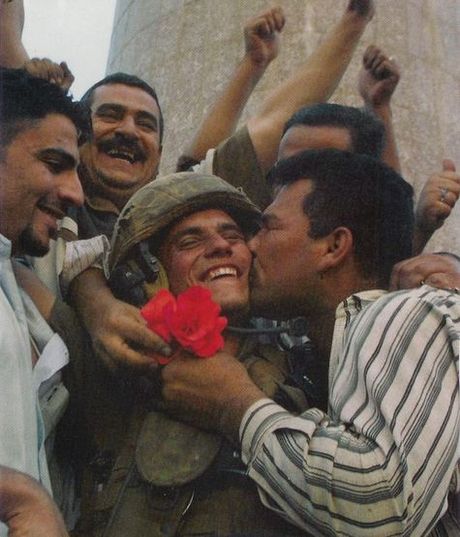
Should we be proud of our victory in Iraq?

Here’s a blog post from David Bellavia. (H/T Curby Graham)

Excerpt:

Another page in the scrapbook has a clear acetate pouch. Stuffed inside is a thick, folded sheet of blue paper. An Iraqi ballot I stole on January 30th 2005.

The sound of mortar fire fills my ears. The desk dissolves. Suddenly, I’m kneeling on a road, a palm grove to my front. Iraq. Election Day 2005.

The bullets are flying.

My squad runs through the searing heat and forms a wall of flesh and Kevlar between the incoming fire and the citizens standing in line behind us. They’ve turned out in their finest clothes to wait for the opportunity to cast a vote. For most, this moment is a defining one in their lives. They’ve never had a voice before. This means something to them, and they have used the moment as an object lesson for their children. They appear nervous and take photos. The kids stand with them in line, viewing first hand this revolution in Iraqi civics.

As they came to line up earlier that morning, the men thanked us and clasped their hands over their heads, striking a triumphant pose. Some of the women cried. The kids were on their best behavior.

The gunfire began that afternoon. Insurgents started to shoot them. My unit ran to the road and formed a protective position between the killers and the citizens going to the polls. As we scanned the palm grove in front of us, bullets cracked and whined, then mortars start thumping around us. My squad pushed into the palm grove. I stayed on the road, overseeing their movement and coordinating the heavy fire from the Bradleys.

The firefight ebbs. The mortar fire ceases. A few last stray rounds streak past. A cry from behind causes me to turn. Lying in the road is a young Iraqi woman. I run over to help. She’s caught a round just below her temple. Her stunning beauty has been ruined forever.

She cries, “Paper! Paper” over and over until the ambulance arrives to take her away. An old lady emerges from the schoolhouse-turned voting site, sheets of blue paper in hand. She gives one to the wounded girl, who clutches it to her like a prized possession even as the ambulance carries her away.

The ballot was her voice. All she wanted was a chance to exercise it, just once, before she died.

Read the whole thing. We all have to do something to try to understand what our men and women in uniform sacrifice to give us our freedoms. Whether that involves reading books, reading military blogs, (like Blackfive, This Ain’t Hell and Michael Yon), sending donations to Soldier’s Angels, or thanking a returning veteran for his service. We have to talk to them and listen to their stories.

What does the end of the universe tell us about the meaning of life?

Details of a recent scientific discovery from the Canberra Times.

Excerpt:

The universe is running out of usable energy and the end is nearer than expected, according to Australian National University astronomers.

[…]PhD student Chas Egan and his supervisor Charley Lineweaver from the ANU Research School of Astronomy and Astrophysics calculated how run-down the universe was and found it was 30 times more dilapidated than previously thought.

In doing so they measured the universe’s entropy a gauge of how ”disorderly” the cosmos is and how close it is to its cold, lifeless end.

[…]Mr Egan said all the processes that occurred in the universe increased its entropy.

”When you leave any isolated system it gets more and more disorderly,” he said.

[…]Scientists believe that end will take the form of a ”heat death”.

”All the matter currently in stars and planets will be spread out homogenously through space and it will be cold and dark and nothing will be able to live and no processes will go on.

More details of the discovery from the Australian newspaper The Age.

Excerpt:

The findings, to be published in the Astrophysical Journal, have implications not just for Earthlings but for any extraterrestrial life as well.

”We’re not just talking about our solar system or our galaxy, we’re talking about our universe,” he said.

”These constraints apply to all life forms that might be in the universe.”

What implications does this discovery have on the question of meaning and purpose in life? If nothing that we do now will survive the end of the universe, then what reason do we have to do anything?

Atheist and Christian responses to the end of the universe

We can get BOTH SIDES of the question from this clip of a formal debate featuring Christian scholar William Lane Craig and atheist writer Christopher Hitchens.

The question being debated is: “Is there objective meaning and purpose in life without God?”. Hitchens and Craig agree that without God, the universe will cool down and all life will die. And they both agree that if there is no God, then there is no objective meaning and purpose in life.

Hitchens says that he can arbitrarily choose a purpose for his life that makes him happy and fulfilled. But notice that this purpose is an arbitrary personal preference. Someone who chooses mass murder or slavery, and has the power to carry it out with impunity, has as much right to choose that purpose as Hitchens does to choose his.

What can we conclude from the atheist view of purpose and meaning?

What does it say about atheism that there is no way to distinguish between William Wilberforce and Josef Stalin? They were both just doing what made them happy, and there is no way either of them ought to have acted, and no objective moral standard by which to praise or condemn them. Some people admire Wilberforce. Some people admire Stalin. No one is right or wrong, because the choice of life purpose is arbitrary, on atheism. So long as you are happy, and the majority of people in your time and place applaud you, anything is permissible.

What would you think of a person whose every action is designed to maximize their pleasurable feelings in this life? What would you make of a person who believed that other people were just bags of atoms, with no human rights and no free will? What would you make of a person who thought that other people were just objects to be used (or dispersed) in whatever way made them feel happiest? What does a selfish attitude do to enterprises like marriage and parenting?

Is it any surprise that we have killed 50 million unborn babies as a result of our own irresponsible search for pleasure? Sex is fun, but taking responsibility for the decision to have sex is not fun. So we kill innocent people who are weaker than us in order to maximize our pleasure in this life. And why not? On atheism, there is no objective meaning in life, no objective purpose to life, and no objective moral standard of right and wrong.