A new investigation reveals that Bill and Hillary Clinton took in at least $100 million from Middle East leaders. Can such a financially and ethically compromised candidate truly function as our nation’s leader?
The investigation by the Daily Caller News Foundation has uncovered a disturbing pattern of the Clintons’ raising money for the Clinton Foundation from regimes that have checkered records on human rights and that aren’t always operating in the best interests of the U.S. By the way, the $100 million we mentioned above doesn’t appear to include another $30 million given to the Clintons by two Mideast-based foundations and four billionaire Saudis.
All told, it’s a lot of money.
“These regimes are buying access,” Patrick Poole, a national security analyst who regularly writes for PJ Media, told the DCNF. “You’ve got the Saudis. You’ve got the Kuwaitis, Oman, Qatar and the UAE (United Arab Emirates). There are massive conflicts of interest. It’s beyond comprehension.”
[…]Meanwhile, former U.S. Attorney Joseph E. diGenova told the Caller that he believes the FBI has launched a second, possibly more serious investigation into possible political corruption involving the Clinton Foundation. This is potentially explosive, given that the Clintons seem to have run their charity in a way that lines their own pockets.
The question is an open one: Did the oil-rich Mideast nations give lavishly to the Clinton Foundation in an effort to influence future U.S. policy? And what about Bill Clinton’s business partnership with Sheikh Mohammed bin Rashid Al Maktoum, Dubai’s authoritarian ruler, from 2003 to 2008? Clinton took away some $15 million in “guaranteed payments” from the deal, his tax records show.
[…]In just the past three years, after her stint as the nation’s top diplomat, Hillary Clinton spoke to dozens of deep-pocket firms on Wall Street, typically charging $250,000 a pop to hear her wit and wisdom — despite her bitter condemnations of Wall Street during her campaign.
All told, she took in an estimated $22 million from these speeches — an extraordinary amount, given the growing consensus among foreign-policy thinkers that Clinton was one of the worst secretaries of state ever.
Now, I thought that Hillary Clinton was supposed to be all concerned about women’s rights and blah blah blah. Why then is she taking in all this money from the leaders of all these Middle East (Muslim) countries, some of whom do not treat women very well at all? And why isn’t the mainstream media covering this story?
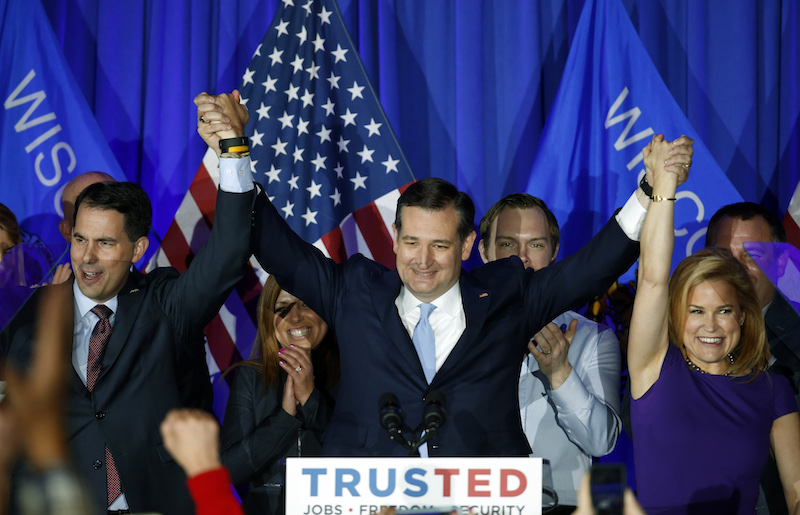
Wisconsin Governor Scott Walker, Texas Senator Ted Cruz, and Heidi Cruz
A lot of people are asking me what Cruz chances are to defeat Trump and win the nomination. I’m going to look at three columns, one from radically leftist CNN, one from the radically leftist Washington Post, and one from National Review. I found both of these stories at the Conservatives 4 Ted Cruz news aggregator, by the way. I check that site at least twice a day, and so should you.
The first one is from David Gergen at CNN. David Gergen is a senior political analyst for CNN and has been a White House adviser to four presidents. A graduate of Harvard Law School, he is a professor of public service and co-director of the Center for Public Leadership at the Harvard Kennedy School.
His headline is “Ted Cruz: Now the odds-on favorite”:
With his decisive victory in Wisconsin, Sen. Ted Cruz has not only shaken up the Republican presidential race, but heading into the homestretch, he has suddenly become the odds-on favorite to win the nomination in Ohio.
With 16 primaries and caucuses remaining, Donald Trump has to win 70% of the delegates to secure the 1,237 needed to win a first ballot at the Republican convention. Several states are coming up that are more favorable territory for Trump than Cruz, especially New York and Pennsylvania where Trump still has significant leads.
Even so, winning more than two thirds of the remaining delegates is a daunting challenge for him. In the 36 primaries and caucuses leading up to Wisconsin, Trump won only 46% of the delegates. And now he heads down a tough homestretch with Cruz seizing the momentum.
In a year crammed with surprises, no one can say for sure what will unfold in Cleveland, Ohio. But there are two likely outcomes: First, Cruz and Trump have each vowed to vote against a change in the GOP’s Rule 40. That’s an obscure provision that requires any candidate to win at least eight primaries and caucuses before he or she can be nominated.
Trump and Cruz will be the only two people in Cleveland with that distinction. They should also have enough delegate strength between them to block a rewrite of Rule 40. In other words, potential candidates like John Kasich, Paul Ryan and Mitt Romney won’t be eligible even if many delegates think them likely to fare better against Hillary Clinton — the race could narrow to Trump vs. Cruz.
If Trump then falls short on the first ballot, there will be a donnybrook. But it is now becoming apparent that Cruz is much better prepared to win that fight. Trump has run a campaign long on the outside game of televised rallies but short on the inside game of quietly piling up delegates.
By contrast, Cruz has been superlative playing to the inside. Just look at how craftily he captured delegates away from Trump a few days ago in North Dakota. (The capacity of the Obama team to play the inside game so well helped to propel them past Hillary Clinton in 2008.)
In a first ballot, delegates must vote for the candidate to whom they are pledged but thereafter, of course, may vote for someone else. Signs increasingly point to the fact that Republican party regulars pledged to Trump are ready to bolt on a second or third ballot. With Cruz the only other man in the race, that almost certainly means they will drift — rush? –toward the Texan, and he will take the crown.
That’s an accurate analysis. The most likely scenario now is that Cruz capitalizes on his momentum to deny Trump the delegates he needs to get to 1,237 before the convention, then wins the nomination on round 2 or later, when the GOP delegates from each state become “unbound”. And Cruz is already reaching out to the delegates to make sure that they choose him in round 2 and later rounds, as they free up.
Can Cruz win a contested convention?
Now, I’m going to balance that with something hilarious from moderate conservative Pulitzer Prize–winning syndicated columnist George Will, writing in National Review.
Will’s column is entitled “Ted Cruz Is Surging by Design”:
People here at Ted Cruz’s campaign headquarters are meticulously preparing to win a contested convention, if there is one. Because Donald Trump is a low-energy fellow, Cruz will be positioned to trounce him in Cleveland, where Trump’s slide toward earned oblivion would accelerate during a second ballot.
[…]For months Cruz’s national operation has been courting all convention delegates, including Trump’s. Cruz aims to make a third ballot decisive, or unnecessary.
On the eve of Wisconsin’s primary, the analytics people here knew how many undecided voters were choosing between Cruz and Trump (32,000) and how many between Cruz and John Kasich (72,000), and where they lived. Walls here are covered with notes outlining every step of each state’s multistage delegate-selection process. (Cruz’s campaign was active in Michigan when the process of selecting persons eligible to be delegates began in August 2014.) Cruz’s campaign is nurturing relationships with delegates now committed to Trump and others. In Louisiana’s primary, 58.6 percent of voters favored someone other than Trump; Cruz’s campaign knows which issues are particularly important to which Trump delegates, and Cruz people with similar values are talking to them.
[…]Usually, more than 40 percent of delegates to Republican conventions are seasoned activists who have attended prior conventions. A large majority of all delegates are officeholders — county commissioners, city council members, sheriffs, etc. — and state party officials. They tend to favor presidential aspirants who have been Republicans for longer than since last Friday.
Trump is a world-class complainer (he is never being treated “fairly”) but a bush-league preparer. A nomination contest poses policy and process tests, and he is flunking both.
Regarding policy, he is flummoxed by predictable abortion questions because he has been pro-life for only 15 minutes, and because he has lived almost seven decades without giving a scintilla of thought to any serious policy question. Regarding process, Trump, who recently took a week-long vacation from campaigning, has surfed a wave of free media to the mistaken conclusion that winning a nomination involves no more forethought than he gives to policy. He thinks he can fly in, stroke a crowd’s ideological erogenous zones, then fly away. He knows nothing about the art of the political deal.
The nomination process, says Jeff Roe, Cruz’s campaign manager, “is a multilevel Rubik’s Cube. Trump thought it was a golf ball — you just had to whack it.” Roe says the Cruz campaign’s engagement with the granular details of delegate maintenance is producing a situation where “the guy who is trying to hijack the party runs into a guy with a machine gun.”
Cruz graduated at the top of his classes at Princeton and Harvard Law. He clerked for Court of Appeals Justice J. Michael Luttig and Supreme Court Chief Justice William Rehnquist. Insofar as this primary election is a contest based on hard work and preparation, Cruz will win it. And then he’s going to beat Hillary.
There seems to be a lot of talk among Democrats and native young people to the effect that European countries have less “income inequality” thanks to bigger government, higher taxes, and more social spending. Is there a downside to this?
The battle over the assumed success of European socialism continues. Many European countries like Sweden have gained a reputation as being very wealthy in spite of their highly regulated and taxed economies. From there, many assume that the rest of Europe is more or less similar, even if slightly poorer. But if we look more closely at the data, a very different picture emerges, and we find that the median household in the US is better off (income-wise) than the median household in all but three European countries.
[…]Using the BEA’s regional price parity index, we can take now account for the different cost of living in different states…
[…]We now see that there’s less variation in the median income levels among the US states. That makes sense because many states with low median incomes also have a very low cost of living. At the same time, many states with high median incomes have a very high cost of living.
Now that we’ve accounted for the low cost of living in Mississippi, we find that Mississippi ($26,517) is no longer the state with the lowest median income in real terms. New York ($26,152) is now the state with the lowest median income due to its very high cost of living.
This has had the effect of giving us a more realistic view of the purchasing power of the median household in US states. It is also more helpful in comparing individual states to OECD members, many of which have much higher costs of living than places like the American south and midwest. Now that we recognize how inexpensive it is to live in places like Tennessee, Florida, and Kentucky, we find that residents in those states now have higher median incomes than Sweden (a place that’s 30% more expensive than the US) and most other OECD countries measured.
Once purchasing power among the US states is taken into account, we find that Sweden’s median income ($27,167) is higher than only six states: Arkansas ($26,804), Louisiana ($25,643), Mississippi ($26,517), New Mexico ($26,762), New York ($26,152) and North Carolina ($26,819).
We find something similar when we look at Germany, but in Germany’s case, every single US state shows a higher median income than Germany. Germany’s median income is $25,528. Things look even worse for the United Kingdom which has a median income of $21,033, compared to $26,517 in Mississippi.
Meanwhile, Colorado ($35,059) has a median income nearly identical to Switzerland ($35,083), and ten states (Connecticut, Iowa, Maryland, Minnesota, New Hampshire, North Dakota, South Dakota, Utah, Virginia, and Washington State) show higher median incomes than Switzerland. Luxembourg ($38,502), on the other hand, shows a median income higher than every state except New Hampshire ($39,034).
None of this analysis should really surprise us. According to the OECD’s own numbers (which take into account taxes and social benefits, the US has higher median disposable income than all but three OECD countries. Sweden ranks below the US in this regard, as does Finland and Denmark.
The fact that the median level in the US is above most OECD countries thus makes it no surprise that most of these countries then rank below most US states. The US states that have income level above the median US level will, not surprisingly, outpace many OECD countries by a considerable margin.
What’s going on here? Well, it turns out that when you have fewer regulations on business, lower business taxes, and an emphasis on working rather collecting welfare, that people have more money in their pockets and a better standard of living. The trouble with Europe is that too many able-bodied people can get by without working. In the United States, we put more emphasis on making your own way, earning your own pay, and spending or saving your money as you please.
In America, the system is geared towards equipping each person to serve their fellows in the private sector workplace. More people working means more wealth is produced, and more wealth produced means that people have a higher standard of living. You wouldn’t have a higher standard of living in a country where most people didn’t work, and just relied on the few who did work. There isn’t enough to go around in society where most people don’t work.



 WINTERY KNIGHT