Tag Archives: Free Trade

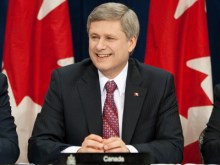
Canadian prime minister Stephen Harper interviewed by Larry Kudlow

Canadian Prime Minister Stephen Harper

Larry Kudlow sat down with Canadian prime minister Stephen Harper and had a conversation about Canada’s economic situation and policies. (Video here)

Kudlow first asks Harper about the banking situation in Canada. Harper says that the banks are run much more tightly in Canada. Harper explains that there are no bailouts planned for Canadian banks because Canadian banks are private institutions.

KUDLOW: Let me begin with an interesting subject here, banking. Everybody’s talking about banking. The Canadian banks appear to be in much better shape than the American banks. They have fewer toxic assets. Their losses aren’t nearly as bad. No one’s talking about bankruptcy up there. I want to learn from our northern cousins. What can you tell us? Why are Canadian banks looking better than our banks?

HARPER: Well first of all I can tell you, it is true. We have, I think, the only banks in the western world where we’re not looking at bailouts or anything like that.

KUDLOW: No TARP money sir, if I’m not mistaken? No TARP money?

HARPER: We haven’t got any TARP money. We’ve gone in and done some market transactions with our banks to improve liquidity. But I think the reasons are really complex, Larry. You know, first of all, our banks are private. We don’t have a Fannie Mae or Freddie Mac equivalent mucking around in the system.

KUDLOW: Is that a lesson right there Prime Minister?

HARPER: Well, I think my observation is those are institutions with a difficult private/public mix. And sometimes private/ public mixes have benefits and sometimes they have the worst of both worlds. We don’t have anything like that. We do have though, a strong system of regulation, and activist regulators, who go and meet with the sector. But they’re macro, prudential kind of regulations. They don’t try and micromanage banks’ decisions. We try and establish good oversight and transparency.

KUDLOW: Do you have leverage and borrowing ratios that might have been enforced? Because that’s clearly one of the breakdowns here in the states?

HARPER: Well, we do have leverage ratios. What’s ironic is that our own banks had not actually achieved those ratios. They were actually working under them. Part of what we…

KUDLOW: They were under leveraged?

HARPER: They were under leveraged.

KUDLOW: Wait, wait. Canadian banks were under leveraged?

HARPER: Under what they could have been.

KUDLOW: I didn’t know there was such a thing on this entire planet earth.

HARPER: Well I think part of what we have done is through the system of regulation we’ve had, we’ve encouraged a fairly cautious culture in the banks. For example, our banks, when they sign mortgages, largely hold those mortgages rather than trading them. So they have a lot more interest in the underlying quality of those mortgages. And we avoided the sub-prime kind of problem.

Kudlow goes on to quiz Harper on individual income tax rates, corporate income tax rates, tax cuts, Canadian energy production, carbon emissions, protectionism/free trade and auto-union bailouts. If you want to know what it is like to have an F.A. Hayek-admiring economist running your country, (BA and MA in Economics from the University of Calgary), read the whole thing!

UPDATE: More interviews with Stephen Harper with CNN, Wall Street Journal and Fox Business are here!

Vladimir Putin tells America that socialism doesn’t work

Found this transcript of Putin’s remarks in the Wall Street Journal. The story was linked over on John Lott’s blog.

Putin opposes protectionism:

We must not revert to isolationism and unrestrained economic egotism. The leaders of the world’s largest economies agreed during the November 2008 G20 summit not to create barriers hindering global trade and capital flows. Russia shares these principles.

Putin opposes state intervention in the economy:

Excessive intervention in economic activity and blind faith in the state’s omnipotence is another possible mistake.

True, the state’s increased role in times of crisis is a natural reaction to market setbacks. Instead of streamlining market mechanisms, some are tempted to expand state economic intervention to the greatest possible extent.

Putin opposes big government:

The concentration of surplus assets in the hands of the state is a negative aspect of anti-crisis measures in virtually every nation.

In the 20th century, the Soviet Union made the state’s role absolute. In the long run, this made the Soviet economy totally uncompetitive. This lesson cost us dearly.

Putin opposes wealth redistribution and welfare:

Nor should we turn a blind eye to the fact that the spirit of free enterprise, including the principle of personal responsibility of businesspeople, investors and shareholders for their decisions, is being eroded in the last few months. There is no reason to believe that we can achieve better results by shifting responsibility onto the state.

Putin opposes bailouts and deficit spending:

And one more point: anti-crisis measures should not escalate into financial populism and a refusal to implement responsible macroeconomic policies. The unjustified swelling of the budgetary deficit and the accumulation of public debts are just as destructive as adventurous stock-jobbing.

Putin goes on to give recommendations on how to solve the problem.

I can’t believe that America and the USSR have switched places. What is the world coming to? Obama has unilaterally plunged us into bankruptcy and angered the entire world with his naive protectionism. How could we have been so ignorant as to have elected someone with no knowledge of economics whatsoever? During an economic crisis!

Obama’s anti-free-trade policy angers the world

Well, I thought that Obama was too smart to enact protectionist policies, but it looks like he does indeed mean to try to plunge the USA into a new depression, just like Hoover did when he signed the Smoot-Hawley Tariff Act in 1930. What protectionism says to consumers is this: working families must pay more for inferior products manufactured by government’s favored special interest groups, (e.g. – unions). The standard of living of consumers of those protected products will be reduced, because consumers are overpaying for something that they could get cheaper elsewhere.

What this means that those of us who prefer to use our dollars for purchases that are important to our worldviews (e.g. – Christianity), is that we will have less purchasing power to spend on charity, private schools, apologetics resources, or anything else we want to buy to express our values. Money is the fuel that people use to live out their worldviews in the public square. The more money is wasted by government, the less money we have for our individual priorities. And the way that a secular government spends money is never as good as the way an informed Christian individual will spend it.

Reactions to Obama’s “Buy American” plan worldwide have been swift and alarming:

Over at Pat Toomey’s Club for Growth, Andrew Roth notes that India is angered at the prospect of having their exports taxed. The headline from Reuters India is “Policymakers sound alarm over protectionism“. We can expect to pay more for goods imported from other countries, because they will retaliate against our tariffs. More consumer purchasing power is lost!

Over at William J. O’Neill’s Investors Business Daily, an editorial describes how firms such as GE and Caterpillar faces job losses because they are denied access to cheap foreign steel. By the way, if you haven’t clicked on the IBD podcasts over there on the rightmost column, what are you waiting for? Those are the best podcasts on the Internet!

Over at the Cato Institute blog, Daniel Ikenson notes that the American Steel industry has been enjoying record profits, and that the steel tarrifs supported by Obama’s plan cause other companies to lose exports to foreign nations, because businesses here are forced to pay too much for steel that they could get cheaper abroad.

It was Adam Smith who first explained so long ago:

It is a maxim of every prudent master of a family, never to attempt to make at home what it will cost him more to make than to buy. The tailor does not attempt to make his own shoes, but buys them of the shoemaker. The shoemaker does not attempt to make his own clothes but employs a tailor.… What is prudence in the conduct of every private family can scarce be folly in that of a great kingdom. If a foreign country can supply us with a commodity cheaper than we ourselves can make it, better buy it of them with some part of the produce of our own industry employed in a way in which we have some advantage. (Adam Smith, The Wealth of Nations, Book IV, Chapter II)

A more complete explanation of the effects of imposing tariffs on imports can be found in Robert P. Murphy’s new introductory book to free market capitalism, The Politically Incorrect Guide to Capitalism. A review of this book is here. Another good book analyzing free market capitalism applied to a number of different areas including crime and abortion, is Freedomnomics by John R. Lott. A review of this book, by the eminent economist Walter Williams, is here.