
Tag Archives: Free Enterprise

The pilgrims experiment with communism before the second Thanksgiving

The First Thanksgiving
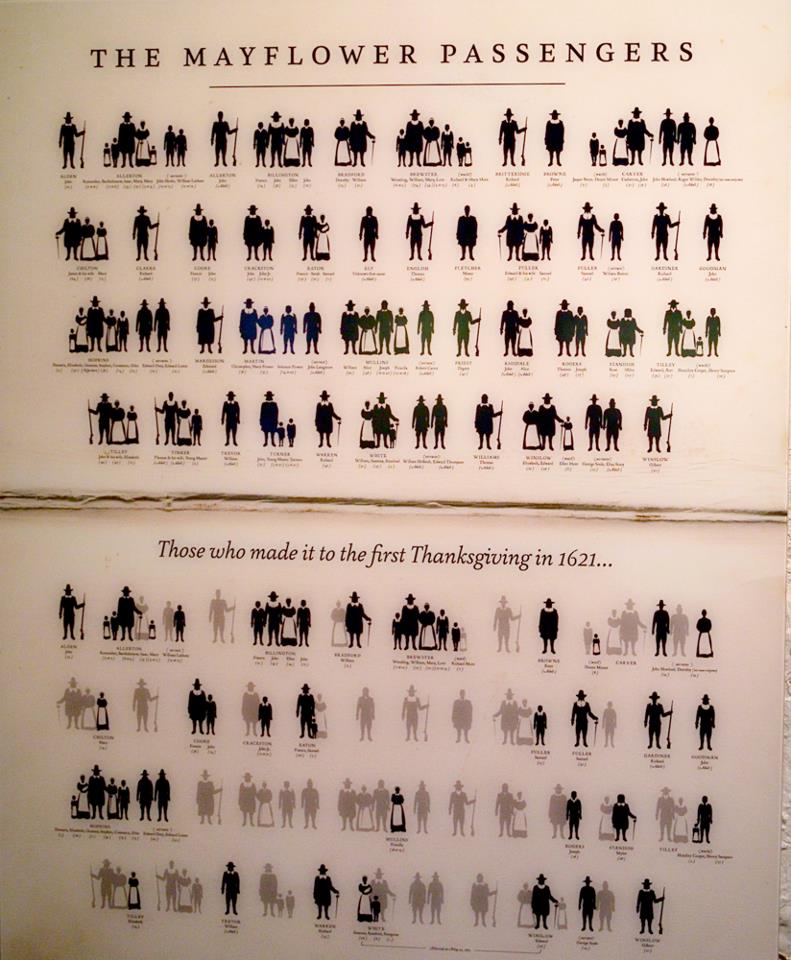
Less than half the original pilgrims made it to the the first Thanksgiving

Here’s an article from The Stream about the second Thanksgiving, by Dante Witt. I like this article because it tells us so much about the character of the United States of America. Why are we so conservative about economics?

She briefly retells the story of how the pilgrims were helped by Squanto, which I blogged about in a previous Thanksgiving Day post, then she talks about the troubles they had next.

Excerpt:

Although Squanto’s farming techniques worked better than their old ones, the pilgrims still could not produce enough food. Was it bad luck? Bad soil? No. The Mayflower pilgrims were part of a joint stock company which stipulated that the pilgrims would pool their resources, and receive a share of the profit.

The strategy turned out to be deeply misguided, working about as well as various communist economic schemes hundreds of years later. The sad state of the colony after two years of communism, wrote William Bradford, “may well evidence the vanity of that conceit of Plato’s and the other ancients applauded by some of later times; that the taking away of property and the bringing of community into a commonwealth would make them happy and flourishing; as if they were wiser than God” (p. 121).

So the pilgrims amended their contract so that each family was now responsible for its own provision. The difference was stark. Bradford explained:

This had good success, for it made all hands very industrious, so that more corn was planted than could have been by any other means the Governor could use, and saved him a great deal of trouble, and gave far better content. The women now went willingly into the field, and took their little ones with them to set corn; which before would allege weakness and inability; whom to have compelled would have been thought great tyranny and oppression.

In fact, it’s estimated the colonists planted about six times the crops they would have planted otherwise.

That shows where Americans get their views of economics, but what about the praying and the gratitude?

More:

With new farming techniques and an amended government, the pilgrims did all they humanly could to ward off starvation. But they could not control the weather. A drought settled on the colony and threatened to kill the corn before the harvest. Recognizing with the Psalmist that “except the Lord build the house, they labor in vain that build it,” the colonists turned to God. According to Bradford, they “set apart a solemn day of humiliation to seek the Lord by humble & fervent prayer, in this great distress.” What was the outcome?

And he was pleased to give them a gracious & speedy answer, both to their own & the Indians admiration, that lived amongst them. For all the morning, and greatest part of the day, it was clear weather & very hot, and not a cloud or any sign of rain to be seen, yet toward evening it began to overcast, and shortly after to rain, with such sweet and gentle showers, as gave them cause of rejoicing, & blessing God. It came, without either wind, or thunder, or any violence, and by degrees in that abundance, as that the earth was thoroughly wet and soaked therewith. Which did so apparently revive & quicken the decayed corn & other fruits, as was wonderful to see, and made the Indians astonished to behold. (p. 131)

Seeing the speedy results of the Puritans’ prayers, an Indian named Hobanak said, “Now I see that the Englishman’s God is a good God, for he hath heard you, and sent you rain, and that without storms and tempests and thunder, which usually we have with our rain, which breaks down our corn, but yours stands whole and good still; surely your God is a good God.” (pp. 64-5)

Then William Bradford again proclaimed a day of Thanksgiving to God, the forerunner of the American tradition of Thanksgiving.

So, this story explains why the United States has this character that values the free enterprise system, hard work, individual achievement, prayer, and gratitude. These are the values that make us American, that made us into such a great nation.
Who is better on health care? Republicans (Ted Cruz) or Democrats (Bernie Sanders)?

I noticed that the Democrats are trying to focus on health care in the 2018 mid-terms, so I thought I would re-post a debate on health care between Ted Cruz and Bernie Sanders. I think debates are always a good idea, because you have to listen to both sides. If you can’t watch the full debate, there’s a good article summarizing the main points further down.

Here is the full video:

It’s 90 minutes long. No commercials. This was basically a debate of similar substance to the William Lane Craig debates, where actual economic evidence was continuously produced in order to show who was telling the truth, and who was just trying to be popular by saying what people who are uneducated at economics want to hear. In short: there was a clear winner and loser in this debate, and it was clear all the way through, and was reinforced over and over every time evidence was produced. The person producing the evidence would turn his back on the camera, and return to his podium to get the evidence. That person won the debate by being grounded in reality.

Also, the questions were excellent, especially from the small business owners who were impacted by Obamacare. The moderators were biased towards Sanders, but not excessively.

For those who cannot watch, there is an article at the Daily Signal.

Full text:

In a prime-time debate on CNN this week, Sens. Bernie Sanders, I-Vt., and Ted Cruz, R-Texas, discussed “The Future of Obamacare” in America. Cruz, a leading critic of the law, used the moment to outline the law’s failures.

Here are four things Cruz said about Obamacare:

1) “Now, nobody thinks we’re done once Obamacare is repealed. Once Obamacare is repealed, we need commonsense reform that increases competition, that empowers patients, that gives you more choices, that puts you in charge of your health care, rather than empowering government bureaucrats to get in the way. And these have been commonsense ideas.”

2) “Indeed, I don’t know if the cameras can see this, but in 70 percent of the counties in America, on Obamacare exchanges, you have a choice of one or two health insurance plans, that’s it … It’s interesting. You look at this map, this also very much looks like the electoral map that elected Donald Trump. It’s really quite striking that the communities that have been hammered by this disaster of a law said enough already.”

During one of the more powerful moments in the debate, Cruz held up aHeritage Foundation chart showing viewers how many counties in the U.S. have access to only one or two insurers under Obamacare. Additionally, only 11 percent of counties have access to four or more insurance providers.

3) “Whenever you put government in charge of health care, what it means is they ration. They decide you get care and you don’t. I don’t think the government has any business telling you you’re not entitled to receive health care.”

The U.S. should not envy other health care systems, especially Canada and the United Kingdom, Cruz said. He referred to a governor from Canada who came to the U.S. specifically to have heart surgery.

4) “That’s why I think the answer is not more of Obamacare, more government control, more of what got us in this mess. Rather, the answer is empower you. Give you choices. Lower prices. Lower premiums. Lower deductibles. Empower you and put you back in charge of your health care.”

Obamacare is burdening Americans. The average deductible for a family on a bronze plan is $12,393, according to a HealthPocket analysis. According to aneHealth report, the average nationwide premium increase for individuals is 99 percent and 140 percent for families from 2013-2017.

I really recommend you watch this debate, because it these things were done on a weekly or monthly basis, then people would be able to think critically about what they are presented with from the mainstream media, Hollywood elites and liberal academics.

How much does the average American corporation make in profit?

How much profit does the average American corporation make?

A while back, there was a story about how Americans vastly overestimate how many people in the USA are homosexual. According to Gallup polls in 2011, Americans estimated that 25% of the people in America were homosexual. In 2015, it was 23%. The actual number is about 3%. So it’s very clear that Americans can have wildly inaccurate perceptions about reality. Why are Americans so wrong? I think it’s because they see a lot of gay people in high profile areas, particularly in the entertainment industry.

I thought about this failure to perceive reality when I saw a story about how much profit Americans think that corporations make. My guess was that the average corporation makes about 5-10% profit margin. I know this because I used to buy and sell stocks regularly and that’s one of the numbers I would look at. Most Americans own stocks, so I thought they most Americans would know the number as well. But it turns out that American perceptions of corporate profits are wildly off the mark.

Check out this article from the prestigious American Enterprise Institute:

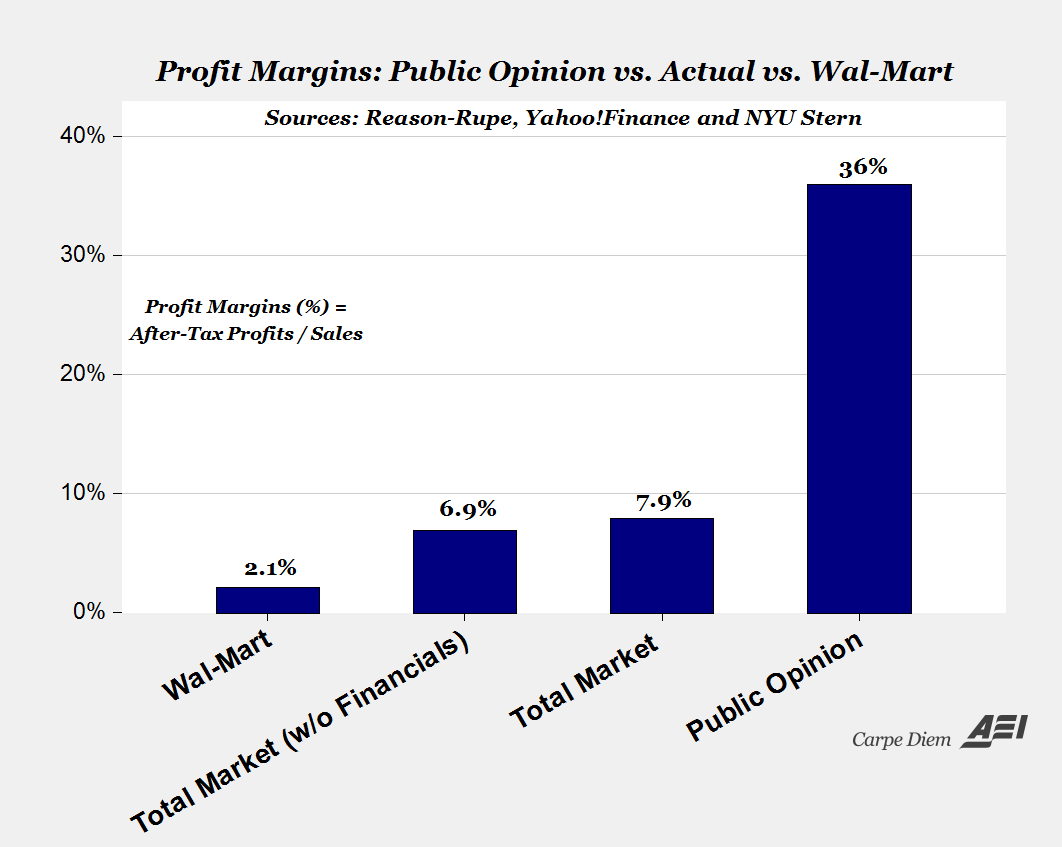
When a random sample of American adults were asked the question “Just a rough guess, what percent profit on each dollar of sales do you think the average company makes after taxes?” for the Reason-Rupe poll in May 2013, the average response was 36%! That response was very close to historical results from the polling organization ORC International polls for a slightly different, but related question: What percent profit on each dollar of sales do you think the average manufacturer makes after taxes? Responses to that question in 9 different polls between 1971 and 1987 ranged from 28% to 37% and averaged 31.6%.

How do the public’s estimates of corporate profit margins compare to reality? Not surprisingly they are off by a huge margin. According to this NYU Stern database for more than 7,000 US companies (updated in January 2018) in many different industries, the average profit margin is 7.9% for all companies and 6.9% for more than 6,000 companies excluding financials (see chart above).

[…]“Big Oil” companies make a lot of profits, right? Well, that industry (Integrated Oil/Gas) had a below-average profit margin of 5.6% in the most recent period analyzed, and separately, the Production and Exploration Oil/Gas industry is losing money, reflected in a -6.6% profit margin. For the general retail sector, the average profit margin is only 2.3% and for the grocery and food retail industry, it’s even lower at only 1.6%. And evil Walmart only made a 2.1% profit margin in 2017 (first three quarters) which is less than the industry average for general retail, possibly because grocery sales now make up more than half of Walmart’s revenue and profit margins are lower on food than general retail.

Sometimes, the government makes MORE from the sale of goods or services than the company that does ALL the work:

Interestingly, Walmart’s profit margin of 2.1% is actually less than one-third of the 6.5% the average state/local government takes of each dollar of Walmart’s retail sales for sales taxes. Think about it – for every $100 in sales for Walmart, the state/local governments get an average of $6.50 in sales taxes (and as much as $10.12 in Louisiana and $9.45 in Tennessee, see data here), while Walmart gets only $2.10 in after-tax profits!

I think that Americans are getting their false anti-corporation views from listening to the mainstream media. The mainstream media is overwhelmingly leftist according to recent studies of their political donations. I think that the anti-corporate views of the average American comes from their uncritical consumption of mainstream media propaganda. They think they are getting objective news reporting, but what they’re really getting is socialist propaganda.

Here is a short little video that explains more about profit margins, and what would happen if a socialist like Bernie Sanders were put in charge of a corporation:

If you’d like to help with this problem of anti-business economic illiteracy, please watch the video and share it, or share the AEI article, which contains the video. America will be a better country when Americans have accurate, informed beliefs about important issues.