
Tag Archives: Foreign Policy

Does Obama want to snuggle with theocratic Iranian mullahs?

The problem with progressives is that they never met an evil that they didn’t want to appease. Consider the fact that in Iran, you can be imprisoned for blogging. And do you know what happens in Iranian prisons? If you answered “you die”, give yourself a gold star! First, consider this story from Celestial Junk (H/T Free Canuckistan!) which links to this Beitbart article.

Excerpt:

A young Iranian blogger jailed in Tehran’s notorious Evin prison for insulting supreme leader Ayatollah Ali Khamenei has died, his lawyer told AFP on Thursday.

…The blogger, aged around 25, was sentenced in February to 30 months in jail for insulting Khamenei and Ayatollah Ruhollah Khomeini, founder of the Islamic Republic.

Sayafi was first arrested in April last year and released on bail after 41 days before being detained again this year.

Iran has launched a crackdown on bloggers and Internet users deemed to be hostile to the authorities and their Islamic values.

The Jerusalem Post notes that Freedom House is promising to launch an investigation.

“Omidreza Mirsayafi’s death illustrates the dangerously inhospitable environment in which bloggers operate in Iran,” said Jennifer Windsor, Freedom House executive director. “Mirsayafi should never have been subjected in the first place to the cruel conditions found in Iran’s most notorious prison. At a time when President Obama is attempting to engage Iran, it is essential that the United States see Iran’s regime beginning to demonstrate a greater respect for human rights.

But here’s President Teleprompter reaching out to Iran:

Excerpt: (Stop the ACLU has the transcript)

My administration is now committed to diplomacy that addresses the full range of issues before us, and to pursuing constructive ties among the United States, Iran and the international community. This process will not be advanced by threats. We seek instead engagement that is honest and grounded in mutual respect.

Remember how progressives think: good is evil and evil is good. Everyone is morally equivalent. Just imagine, (they say), if everyone were the same then there would be no more wars! If we just appease the good Iran and unilaterally disarm the evil USA, then the world will be at peace.

George W. Bush knew the difference between good and evil, and was not afraid to act to defend liberty abroad. And 2 wars only cost us about 500 billion dollars. Meanwhile, Obama is going to spend several trillion dollars over the next few years driving us into a socialist depression. Bush spends a little money and liberty increases. Obama spends tons of money and liberty decreases.

Then again, maybe Obama isn’t as much of a naive dove as I think he is. His unilateral trade war with the entire world is going great! Look, John Lott is reporting progress in the trade war against Mexico. Yeehaw! Cowboy communism!

UPDATE: In my RSS reader, I spied this IBD podcast and here’s the transcript of it.
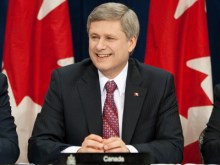
Round-up of US media interviews with Stephen Harper

Canadian Prime Minister Stephen Harper

I spotted this round-up of media interviews with Stephen Harper on the Canadian blog Blue Like You. I’ve already blogged about the CNBC interview with optimistic Larry Kudlow here. That interview focused on economic policy.

In the Fox Business interview with Alexis Glick, (video here), she explains how Canada was able to avoid the subprime lending crisis.

Immediately after I talked to the vice chairman of the Swedish central bank, I interviewed — in a “First on Fox Business” — Canadian Prime Minister Stephen Harper about a lot of things: Everything from his meeting with President Obama last week, to NAFTA to the “Buy American” clause in the stimulus to carbon emissions and the Canadian Sands to the banking system. Why has Canada’s banking system withstood the financial crisis while other countries banking systems like the U.S. are in such dire straits? In 2008, the World Economic Forum ranked Canada’s banking system the healthiest in the world. The U.S. was ranked 40th. Canada’s system has much stronger federal regulations and lower mandatory leverage ratios. Canada’s firms never engaged in subprime mortgage lending. For over a decade, Canada has posted budget surpluses; only in the last quarter did they enter into a recession. What is working? What lessons could we learn from them? Take a look. Prime Minister Harper is very impressive.

Canada does not believe in forcing banks to make loans based on ACORN’s vision of social justice. I explained how Democrats like Carter and Clinton forced banks to make these loans and how Republicans tried in vain to stop them, here.

The Wall Street Journal interview was more focused on foreign policy. You may have heard of Harper’s recent free trade deal with Peru. But did you know that Canada also signed a free trade deal with Colombia?

But the mention of Canadian and American political opposition to free-trade agreements with Colombia has sparked a change in the PM’s unflappable manner. For a fleeting moment, what sounds a lot like frustration emerges. “I’m not going to say it’s a perfect government, but we have a government in Colombia that is democratically elected, that has increased democratic norms, that has taken on the insurgency, that is moving that country forward economically and politically. And it is in a hemisphere where we have an increasing number of real serious enemies and opponents.”

Meanwhile, the economically-illiterate, protectionist ACORN lawyer rejected a free trade deal with Colombia.

And did know that Canada has been taking a leading role in foreign policy?

Since establishing a minority government in January 2006, this prime minister and his Conservative Party have restored Canada’s international prestige by increasing military funding and tenaciously supporting Canada’s dangerous NATO mission in the Afghan province of Kandahar. No NATO ally has put more on the line against the Taliban, and Mr. Harper seems to sense not just the opportunity but the need for Canada to capitalize on it. There is a vacuum in conservative leadership in North America and on the world stage, and Mr. Harper is stepping into it. His objective would appear to be the restoration of liberal-democratic resolve against tyranny.

You want Reaganesque? I’ll give you Reaganesque:

An unreliable NATO has implications for Canada not least because Russia is once again becoming a menace. The Kremlin’s claim to the Arctic seabed can be discounted, he argues, because it is being pursued through the United Nations Law of the Sea Treaty. But other provocations are worrisome. “They are testing our airspace more frequently than they have been doing in a long, long time,” he says. “It’s the aggression in the Arctic, aggression more generally, an aggression that is increasingly troublesome just to be troublesome.”

Check this out: 2 CF-18 fighters intercepted a Russian bomber that was snooping near Canadian airspace just last week. Look, if Obambi wants to focus on increasing welfare and nationalizing health care, then maybe Canadians will have to pick up the slacker’s slack.

I rarely say this, but I am going to say it for this WSJ interview: READ. THE. WHOLE. THING.

UPDATE: Welcome, Canadian visitors from Blue Like You! Thanks for the link Joanne! I’ve just blogrolled you! I am hoping Stephen Harper gets his majority soon, so he can get rid of those pesky HRCs that keep going after Ezra Levant.

UPDATE 2: I noticed in the comments on Blue Like You that they referenced this interview from CNN with Wolf Blitzer. Here is the video and a news article from the National Post. Ooops. I think the commenter Allison meant a more recent CNN interview with Fareed Zakaria which is here.

UPDATE 3: Welcome visitors from Post-Darwinist! Thanks for linking to me,  Denyse!

Democrats are weak on military policy and counter-terrorism

I was browsing over at The Anchoress and I came across this post which describes how Democrat Senator Dianne Feinstein has inadvertently leaked that the USA launches Predator missions from Pakistan. This may cause the government to lessen their cooperation with American military efforts in the region because a significant amount of the population of Pakistan will not react well to this news.

This sort of error is not the exception but the rule with Democrats. Democrats have a reputation for not taking defense and counter-terrorism seriously. According to this post over at the American Thinker, the 9/11 tragedy was mostly due to a failure in intelligence caused by a “wall” between different intelligence-gathering organizations.

Gorelick, an appointee of Bill Clinton, is the one who constructed the wall of separation that kept the CIA and the FBI from comparing notes and therefore invading the privacy of nice young men like, say, Muhammed Atta and Zacarius Moussaoui. While countless problems were uncovered in our intelligence operations in the wake of 9-11, no single factor comes close to in importance to Jamie Gorelick’s wall.

In fact, it was Gorelick’s wall, perhaps more than any other single factor, that induces some people to blame Clinton himself for 9-11 since he appointed her and she acted  consistent with his philosophy of “crime fighting.” She put the wall into place as Deputy Attorney General in 1995.

George W. Bush’s bold action abroad gave us 7 years free from terrorist attacks on American assets. If there is one thing that deters future attacks, it is military invasions of countries that support and/or harbor terrorists. They understand military force. For Bush, one terrorist attack was enough to get us to respond with force.

As a result of the Bush doctrine of invading states suspected of developing and/or proliferating WMDs, Libya discontinued its weapons program and invited inspectors to come in and cart away all of its research equipment. That was the Bush doctrine – which Libya believed only because they saw that we were willing to back up our demands with force. We can have peace if our enemies believe that we have the will to go to war, and that our enemies fear that they will lose that contest.

Contrast George W. Bush’s immediate response to terrorism with Democrat Bill Clinton. According to Byron York, we had four terrorist attacks during Clinton’s presidency.

So Clinton talked tough. But he did not act tough. Indeed, a review of his years in office shows that each time the president was confronted with a major terrorist attack — the February 26, 1993, bombing of the World Trade Center, the Khobar Towers attack, the August 7, 1998, bombing of U.S. embassies in Kenya and Tanzania, and the October 12, 2000, attack on the USS Cole — Clinton was preoccupied with his own political fortunes to an extent that precluded his giving serious and sustained attention to fighting terrorism.

How did Clinton respond to these four attacks? According to this interview with Richard Miniter, President Clinton was much less aggressive than Bush was, during his two terms. Bush’s administration did not fear public opinion, but Clinton’s administration did. Miniter lists sixteen of the Clinton administration’s failures to treat terrorism as a serious threat. Below, I cite my favorites. Read the whole list!

Lopez: In sum, how many times did Bill Clinton lose bin Laden?

Miniter: Here’s a rundown. The Clinton administration:

4. Did not militarily react to the al Qaeda bombing in Riyadh, Saudi Arabia.

7. Objected to Northern Alliance efforts to assassinate bin Laden in Afghanistan.

8. Decided against using special forces to take down bin Laden in Afghanistan.

11. Clumsily tipped off Pakistani officials sympathetic to bin Laden before a planned missile strike against bin Laden on August 20, 1998. Bin Laden left the camp with only minutes to spare.

12-14. Three times, Clinton hesitated or deferred in ordering missile strikes against bin Laden in 1999 and 2000.

15. When they finally launched and armed the Predator spy drone plane, which captured amazing live video images of bin Laden, the Clinton administration no longer had military assets in place to strike the archterrorist.
16. Did not order a retaliatory strike on bin Laden for the murderous attack on the USS Cole.

When you look at the facts, we begin to understand why Democrats perform so poorly on national security issues. Remember John Kerry’s global test? Kerry thought that our national security should be partly based on world opinion. (Ironically, Kerry voted against the first war in Iraq, when the whole world supported us in the liberation of Kuwait).

Republicans, on the other hand, believe in peace through strength.

In foreign policy, Reagan sought to achieve “peace through strength.” During his two terms he increased defense spending 35 percent, but sought to improve relations with the Soviet Union. In dramatic meetings with Soviet leader Mikhail Gorbachev, he negotiated a treaty that would eliminate intermediate-range nuclear missiles. Reagan declared war against international terrorism, sending American bombers against Libya after evidence came out that Libya was involved in an attack on American soldiers in a West Berlin nightclub.

The differences between the two parties could not be more clear. Weakness provokes war. Wars start when our enemies believe that they can strike us with impunity. Military strength, and the will to use it, deter aggression.