Tag Archives: Energy Policy

Obama introduces cap and trade scheme in budget

I was browsing over at Nice Deb and found this story about the budget that really upset me. I am really beginning to fear for the future of the American economy. I don’t think we can handle all of these bad decisions in such a short period. We may be looking at a new Depression.

Nice Deb cites this article from Human Events as follows:

The Department of Energy estimates that S. 2191, the Warner-Lieberman cap-and-trade proposal, will increase the cost of coal for power generation by between 161% and 413%. DOE estimates GDP losses (see chart) over the 21-year period they forecast, at between $444 billion and $1.308 trillion, with particular damage to the manufacturing sector…

Winegarden estimates that this bill could increase unemployment by 2.7% or about 4 million jobs. In fact, companies are already preparing to avoid increased level and volatility of American energy prices by setting up factories and partnerships in countries which won’t be subject to cap-and-trade restrictions…

In addition, we can expect 1 trillion dollars in new taxes. Here are the individual tax hikes from an ABC News article that Nice Deb links to in her post:

On people making more than $250,000:

$338 billion – Bush tax cuts expire
$179 billlion – eliminate itemized deduction
$118 billion – capital gains tax hike

Here are some of the tax hikes on businesses from the same post. I picked the ones that are specifically going to affect energy production.

$5.3 billion – excise tax on Gulf of Mexico oil and gas
$3.4 billion – repeal expensing of tangible drilling costs
$62 million – repeal deduction for tertiary injectants
$49 million – repeal passive loss exception for working interests in oil and natural gas properties
$13 billion – repeal manufacturing tax deduction for oil and natural gas companies
$1 billion – increase to 7 years geological and geophysical amortization period for independent producers

Oil and gas? Isn’t that what people use to heat their homes and power their vehicles?

UPDATE: The Anchoress says that the price hikes on individuals making $250,000 or more also apply to small businesses, as well as individuals! Bye-bye jobs!
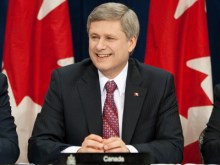
Canadian prime minister Stephen Harper interviewed by Larry Kudlow

Canadian Prime Minister Stephen Harper

Larry Kudlow sat down with Canadian prime minister Stephen Harper and had a conversation about Canada’s economic situation and policies. (Video here)

Kudlow first asks Harper about the banking situation in Canada. Harper says that the banks are run much more tightly in Canada. Harper explains that there are no bailouts planned for Canadian banks because Canadian banks are private institutions.

KUDLOW: Let me begin with an interesting subject here, banking. Everybody’s talking about banking. The Canadian banks appear to be in much better shape than the American banks. They have fewer toxic assets. Their losses aren’t nearly as bad. No one’s talking about bankruptcy up there. I want to learn from our northern cousins. What can you tell us? Why are Canadian banks looking better than our banks?

HARPER: Well first of all I can tell you, it is true. We have, I think, the only banks in the western world where we’re not looking at bailouts or anything like that.

KUDLOW: No TARP money sir, if I’m not mistaken? No TARP money?

HARPER: We haven’t got any TARP money. We’ve gone in and done some market transactions with our banks to improve liquidity. But I think the reasons are really complex, Larry. You know, first of all, our banks are private. We don’t have a Fannie Mae or Freddie Mac equivalent mucking around in the system.

KUDLOW: Is that a lesson right there Prime Minister?

HARPER: Well, I think my observation is those are institutions with a difficult private/public mix. And sometimes private/ public mixes have benefits and sometimes they have the worst of both worlds. We don’t have anything like that. We do have though, a strong system of regulation, and activist regulators, who go and meet with the sector. But they’re macro, prudential kind of regulations. They don’t try and micromanage banks’ decisions. We try and establish good oversight and transparency.

KUDLOW: Do you have leverage and borrowing ratios that might have been enforced? Because that’s clearly one of the breakdowns here in the states?

HARPER: Well, we do have leverage ratios. What’s ironic is that our own banks had not actually achieved those ratios. They were actually working under them. Part of what we…

KUDLOW: They were under leveraged?

HARPER: They were under leveraged.

KUDLOW: Wait, wait. Canadian banks were under leveraged?

HARPER: Under what they could have been.

KUDLOW: I didn’t know there was such a thing on this entire planet earth.

HARPER: Well I think part of what we have done is through the system of regulation we’ve had, we’ve encouraged a fairly cautious culture in the banks. For example, our banks, when they sign mortgages, largely hold those mortgages rather than trading them. So they have a lot more interest in the underlying quality of those mortgages. And we avoided the sub-prime kind of problem.

Kudlow goes on to quiz Harper on individual income tax rates, corporate income tax rates, tax cuts, Canadian energy production, carbon emissions, protectionism/free trade and auto-union bailouts. If you want to know what it is like to have an F.A. Hayek-admiring economist running your country, (BA and MA in Economics from the University of Calgary), read the whole thing!

UPDATE: More interviews with Stephen Harper with CNN, Wall Street Journal and Fox Business are here!