Tag Archives: Economics

Jonah Goldberg explains why we should export capitalism

Column from USA Today.

Excerpt:

In one NPR vignette, a mango farmer needs a small canal from a river abutting her property if she wants to expand her crop beyond two meager trees. Technology “Sumerians probably took for granted 5,000 years ago” could transform this single mother and her kids from “some of the poorest people on earth to much better off,” according to reporter Adam Davidson. But despite a surplus of both cheap ditch-digging labor and aid agencies, she can’t get a loan to build it.

“This is what kept striking us in Haiti, just a little upfront investment and people could be living so much better,” added fellow correspondent Chana Joffe-Walt.

Instead, Haitians themselves explain, most aid agencies spend much of their energies trying to justify their own existence rather than helping Haitians help themselves. There are important lessons here for U.S. policymakers, not just in regard to Haiti (hardly a national security priority) but also for such places as Afghanistan and Iraq, particularly now that President Obama has announced the combat phase of the Iraq project is coming to an end.

The “root causes” crowd always had a point about the effects of poverty on political stability. Where their case truly fell apart is in the remedy: economic planning from above. For decades, the “international community” bet on big-ticket state-run make-work jobs and white elephants. The West, including America, is expert at pouring aid into poor countries; it’s less adept at teaching poor countries how to stop being poor.

Capitalism and foreign investment work better than foreign aid. We should feel good when what we do produces good results. We should not fel good when we cause harm out of our uninformed good intentions. Results matter. We need to try different ideas and then stick with what works. Capitalism works.
Paul Ryan discusses economics at the liberal Brookings Institute

The video, including slides and audio, is here.

He outlines our economic crisis and two ways to deal with it – prosperity or austerity.

The Brookings Institute is a respected left-of-center think tank. I cite them occasionally, because they do quality research.

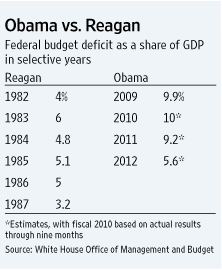
Comparison of budget deficit and GDP under Reagan and Obama

Here’s a nice article from the Wall Street Journal.

Excerpt:

Democrats have been running Congress for nearly four years, and President Obama has been at the White House for 18 months, so it’s not too soon to ask: How’s that working out? One devastating scorecard came out Friday from the White House, in the form of its own semi-annual budget review.

The message: Tax revenues are smaller, spending is greater, and the deficits are thus larger than the White House has been saying. No wonder it dumped the news on the eve of a sweltering mid-July weekend.

[…]As a share of the economy, the White House now says the deficit in fiscal 2010, which ends on September 30, will be even larger than in 2009: 10%. That’s after a full year of economic growth, given that the recovery began last summer. More remarkable still, the deficit will barely fall in fiscal 2011, declining only to 9.2% of GDP in the second year of a recovery that ought to be gaining steam.

Let’s compare Obama and Reagan.

To put this in historical context, consider the nearby table that compares deficits as a share of GDP under Presidents Reagan and Obama. The 1981-82 recession was comparable in severity to the one Mr. Obama inherited and reached similar heights of unemployment. The deficits that resulted from that recession were the source of huge political consternation, with Democrats, the press corps and even some senior Reagan aides insisting that only a huge tax increase could save the country from ruin.

Yet as the table shows, the Reagan deficits never reached more than 6% of GDP, and that happened only in 1983, the first year of economic recovery. As the 1980s expansion continued, the deficits fell, especially as the pace of spending slowed in the latter part of Reagan’s second term.

[…]The Obama deficits are double that, and more than one-third higher than even the Gipper’s worst year. What explains this? Part of it is that Democrats are simply spending much more, sending outlays as a share of GDP above 25% for the first time since World War II. The White House now says outlays will be higher in 2011, at 25.1% of GDP, than at the height of the stimulus in 2009 and 2010.

[…]The other explanation for the record Obama deficits is that revenues have been so anemic, thanks to the lackluster economic recovery. In the Reagan years, revenues as a share of GDP never fell lower than 17.3%, despite (or we would say because of) his pro-growth tax cuts. In 2010, by contrast, the White House now says tax revenues will hit an astonishing low of 14.5% of GDP, rising only to 15.8% in 2011, even with the huge tax increase that hits on January 1, 2011.

Tax cuts worked, and government spending failed. Next time, let’s do what works – not what feels good.