
Tag Archives: Diplomacy

Obama’s decision to retreat in Iraq is a disaster for American foreign policy

Let’s see what everyone thinks about Obama’s decision withdraw 40,000 troops from Iraq, effectively handing control of much of the Middle East to Iran.

Disregards the advice of his own generals

From the Wall Street Journal.

Excerpt:

No doubt this will be politically popular—at least in the short-term. Mr. Obama can say he honored a campaign pledge, Congress will move to spend the money on domestic programs, and a war-weary American public will be relieved to carry fewer overseas burdens. Or at least Americans will feel such relief as long as this total withdrawal doesn’t cost the hard-fought political and strategic gains that our intervention has won.

There are serious risks in this complete withdrawal. Iraq has made great progress in providing its own security, with some 600,000 Iraqi troops gradually taking the handoff from U.S. forces. But the Iraqis still lack vital military assets in intelligence and logistics, not to mention naval and air power. Mr. Obama said the U.S. will continue to discuss “how we might help Iraq train and equip its forces,” but this is no substitute for a more robust, long-term presence of the kind we retain in South Korea and Japan 60 years after the end of the Korean War.

The U.S. commander in Iraq, General Lloyd Austin, had requested between 15,000 and 18,000 troops, before reducing it to 10,000 under pressure. Such a U.S. presence would reassure Iraq and its neighbors of our continuing commitment to the region. It would help play the role of honest broker among Iraq’s ethnic factions as it continues to build a more durable political system.

And above all it would reduce Iran’s ability to meddle in Iraq, building local militias on the Hezbollah model with a goal of making its neighbor a Shiite vassal state. Iran’s Quds force—the same outfit that wanted to assassinate a Saudi ambassador on U.S. soil—is the biggest winner from Mr. Obama’s pullout.

Bungled negotiations

From Foreign Policy magazine. (H/T The Washington Post)

Excerpt:

“Iraq is not a normal country, the security environment is not normal, the embassy is not a normal embassy,” said Marisa Cochrane Sullivan, managing director at the Institute for the Study of War, who traveled to Iraq this summer and has been sounding the alarm about what she saw as the mishandling of the negotiations ever since.

For more evidence that the administration actually wanted to extend the troop presence in Iraq, despite today’s words by Obama and McDonough, one only has to look at the statements of Defense Secretary Leon Panetta.

In July, Panetta urged Iraqi leaders to, “Dammit, make a decision” about the U.S. troop extension. In August, he told reporters that, “My view is that they finally did say, ‘Yes.'” On Oct. 17, he was still pushing for the extension and said, “At the present time I’m not discouraged because we’re still in negotiations with the Iraqis.”

Sullivan was one of 40 conservative foreign policy professionals who wrote to Obama in September to warn that even a residual force of 4,000 troops would “leave the country more vulnerable to internal and external threats, thus imperiling the hard-fought gains in security and governance made in recent years at significant cost to the United States.”

She said that the administration’s negotiating strategy was flawed for a number of reasons: it failed to take into account Iraqi politics, failed to reach out to a broad enough group of Iraqi political leaders, and sent contradictory messages on the troop extension throughout the process.

“From the beginning, the talks unfolded in a way where they largely driven by domestic political concerns, both in Washington and Baghdad. Both sides let politics drive the process, rather than security concerns,” said Sullivan.

Emboldens Syria and their puppet-master, Iran

From National Review.

Excerpt:

The announcement of our total withdrawal comes just weeks after the revelation of an Iranian plot to execute the Saudi ambassador to the U.S. on our soil. It comes as Iran’s key Arab ally, the Assad regime in Syria, is rocked by a revolt. Just as Tehran’s dangerousness is put in stark relief and as events in Syria threaten to deal it a strategic setback, it gets this windfall.

[…][Obama’s] commanders on the ground wanted to keep more than 20,000 troops in Iraq (the administration had bid this number down to several thousand, perhaps convincing Iraqi political players that cutting a painful deal on immunity wouldn’t have enough of a corresponding upside). Such a force would have enhanced our political leverage in Baghdad, checked Iran’s already considerable influence, ensured against a return of al-Qaeda, and helped keep a lid on Arab–Kurdish tensions in the north. Now, we’ll simply have to hope for the best. Deputy National Security Advisor Dennis McDonough said Iraq is “secure, stable, and self-reliant.” It is none of these things. Its government is still inchoate and it is not capable of defending itself from Iran in the air or on the ground.

Our pullout is a bonanza for Tehran. Its militias were already active in Iraq. Now, it can use Iraq for bases for its proxy forces to spread its tentacles in the rest of the Persian Gulf. Independent ayotollahs in Iraq will have an incentive to keep their heads down. Political decisions of the Iranian-influenced Shiite bloc running the country are sure to begin to tilt more and more Iran’s way. Our diplomatic leverage will diminish, even as maintain our largest embassy in the world in Baghdad. The Iranians will crow in Iraq and throughout the region that they were right that the Americans would eventually leave.

We expended a great deal of blood and treasure to topple Saddam Hussein, and then to establish enough order so that George W. Bush’s successor would only have to consolidate our gains. President Obama is careless enough to risk throwing it all away, and shameless enough to call it success.

For those who are not aware of the looming storm in the Middle East, you should read in full this article from the Washington Times. It is authored by Frank Gaffney, the President of the Center for Security Policy. He covers several troubling data points in Libya, Egypt, Afghanistan, Iraq, China, Russia and Mexico. As if that were not bad enough, it looks as if the debt limit super-committee is now deadlocked in negotiations, which will trigger automatic cuts to our defense budget, at the worst possible moment.
Iran, the Zetas drug cartel and our porous Southern border

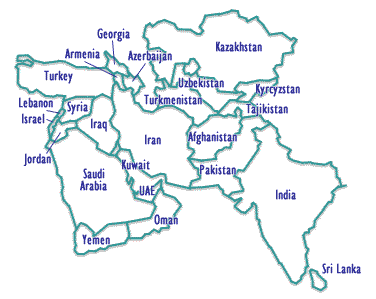
Map of the Middle East

Here’s an excellent assessment of the threat from the American Enterprise Institute.

Excerpt:

The revelation that the Iranian Revolutionary Guards Corps and its Quds Force had plotted to kill Saudi Arabia’s ambassador to the United States–by blowing him up as he dined at a Washington restaurant–is a stark reminder of the nature of the Tehran regime and its ambitions. But perhaps the most disturbing aspect of the story is that Iran’s thugs are developing a strategic partnership with Mexico’s most violent thugs: Los Zetas may only be the second-largest drug cartel in the Drug Enforcement Administration’s rankings, but they’re probably the most lethal. The gang is said to have formed around a platoon’s worth of deserters from Mexico’s special operations forces, and became the elite troops of another Mexican drug organization, the Gulf Cartel. The leader of that cartel got himself arrested, and the Zetas moved out on their own.

[…]The alliance with the Zetas is only the tip of the Iranian iceberg in Latin America. As Roger Noriega and Jose Cardenas have recently written, “Iran has made the Western Hemisphere a priority….The real game changer has been the alliance developed between Iran’s Mahmoud Ahmedinejad and Venezuela’s Hugo Chavez.” In addition to the Quds Force, Iran often operates through Hezbollah, which has established networks in the Lebanese communities that have long-standing enclaves in the trading and port cities of South America. In addition to Chavez, Iran has established closer ties to the Bolivian government of Evo Morales’s and Rafael Correa’s regime in Ecuador.

[…]We underestimate the Quds-Zeta partnership at our peril. The distinction between law enforcement and warfare is increasingly blurred; the Mexican government claims it had a hand in exposing the plot and it was a DEA agent who foiled the attack. While the Obama administration was right to bring charges against the operatives who plotted to kill the Saudi ambassador, this is a response to symptoms, not the disease. The larger problem is the maturing anti-America coalition governments and extremely rich, powerful, and violent groups; thinking of these organizations simply as criminals obscures their political interests–in keeping governments like Mexico’s or Colombia’s weak, in securing sanctuary, in access to the “international commons,” and the like. An appropriate response demands an integrated strategy. The biggest danger is not “militarizing” U.S. policy but in failing to address the fundamental security issues at stake.

The Obama administration’s lack of concern about border security is very disturbing, but they don’t dare to offend their open-borders constituency for a little thing like national security. Even so, the best defense might be a good offense – but is Obama willing to go on the offensive? Not so much. Instead, Obama seems to be resigned to letting Iran have nuclear weapons.

Excerpt:

Khamenei probably approved a strike in Washington because he no longer fears American military might. Iran’s advancing nuclear-weapons program has undoubtedly fortified his spine, as American presidents have called it “unacceptable” yet done nothing about it. And neither George W. Bush nor Barack Obama retaliated against Iran’s murderous missions in Iraq and Afghanistan.

President Obama has clearly shown he wants no part—or any Israeli part—in a preventive military strike against Iran’s nuclear sites. And Mr. Obama has pulled almost all U.S. troops out of Iraq and clearly wants to do the same in Afghanistan. Many Americans may view that as a blessing, but it is also clearly a sign that Washington no longer has the desire to maintain hegemony in the Middle East.

That’s an invitation to someone like Khamenei to push further, to attack both America and Iran’s most detested Middle Eastern rival, the virulently anti-Shiite Saudi Arabia. In the Islamic Republic’s conspiracy-laden world, the Saudis are part of the anti-Iranian American Arab realm, which is currently trying to down Iran’s close ally, Bashar al-Assad’s Syria, and squash the Shiites of Bahrain. Blowing up the Saudi ambassador in Washington would be an appealing counterstroke against the two foreign forces that Khamenei detests most.

The Obama administration will be tempted to respond against Iran with further unilateral and multilateral sanctions. More sanctions aren’t a bad idea—targeted sanctions against the Revolutionary Guards and the sale of gasoline made from Iranian crude can hurt Tehran financially. But they will not scare it. The White House needs to respond militarily to this outrage. If we don’t, we are asking for it.

The longer Obama leaves this, the worse the eventual war in the Middle East is going to be. We should at the very least be pursuing aggressive covert operations against Syrian and Iranian targets. I hope everyone remembers the slap on the wrist that Obama is giving Iran now, so that when we get attacked more and more, with more dangerous weapons, the correct people get the blame.

John Bolton assesses Obama’s Syrian foreign policy

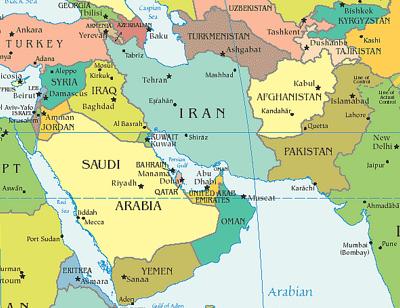
Political map of the Middle East

From the NY Post, an editorial former UN ambassador John Bolton.

Excerpt:

The end of the Khadafy regime in Libya has focused new attention on the rebels in Syria — as has last week’s belated call by President Obama for the ouster of Bashar al-Assad. But it will take a more radical Obama course correction to make a real difference. After six months of bloodshed, with thousands dead, and only mild White House responses earlier, this belated pronouncement is likely too little too late.

Here’s one of the five reasons why Obama has failed in Syria:

Third, Obama has never understood Iran’s domineering role in Syria. Beyond the Ba’ath Party’s historical propensity for brutality and repression, long ago perfected by Bashar’s father, Iran’s increasingly hegemonic position has virtually ensured that he will not contravene Tehran’s will.

Given Iran’s use of Syria to fund and arm Hezbollah, Hamas and other terrorist groups, and its likely use of Syria to hide aspects of its nuclear-weapons program, Iran was never going to permit “reform.”

Indeed, the administration needs to face Iran’s influence across the region. Syria’s and Hezbollah’s murderous intervention has rendered Lebanon virtually prostrate yet again. Hamas’s indiscriminate terrorism against Israel has destroyed the prospects for Palestinian unity and a responsible path to statehood and representative government. Now, with Mubarak’s fall in Egypt, Hamas can conspire in public with its parent organization, the Muslim Brotherhood, to radicalize Egyptians as well as Palestinians.

Obama either didn’t comprehend this relationship, or was simply unwilling to cross the Iranians because of his ethereal hopes to negotiate with Tehran to end its nuclear-weapons program. White House mistakes continue to allow Iran to prevail in Syria.

I wrote before that I thought that we should not be fighting in Libya, but that Syria was a much better place for non-violent actions to de-stabilize the Assad regime.

I hope that John Bolton will be the Secretary of State or Secretary of Defense in 2012.