
Tag Archives: Defense Spending

Thinking practically about the gospel with an illustration from a war movie

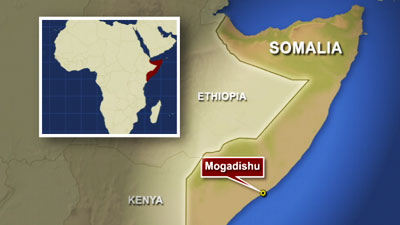
The city of Mogadishu, in Somalia, Africa

First, let’s get an overview that helps us understand the context and goals of the mission we are going to discuss.

The scene is set in Somalia, Africa, in 1992. There a civil war between two warlords: Ali Mahdi and Mohammed Farah Aidid. The war has destroyed agricultural operations, and the people are starving. The United Nations are trying to help, but Aidid hijacks the food from UN aircraft so that he can use the food to gain control of the people. Hundreds of thousands of Somalis are dying of starvation. The UN requests American military forces to secure the air-dropped supplies so they can be distributed to the starving people.

In December 1992, President George H.W. Bush answers the call, sending 25,000 troops to Somalia to protect the food from the Somali warlords. However, in 1993, Bill Clinton is elected. He orders that the number of U.S. troops be reduced to 12,000. Following an attack by Aidid on Pakistani peace-keepers, the U.N. issues a resolution to capture those responsible. The U.S. armed forces have the arms and training to battle evil, so they get the call to capture Aidid and his lieutenants.

In late August 1993, Task Force Ranger is deployed to Mogadishu to capture Aidid and his lieutenants at the Olympic Hotel. The U.S. force consists of 440 troops from the Army Rangers and Army Delta Force special forces, commanded by General William Garrison. Garrison requested light armored units (Bradley Infantry Fighting vehicles) that would offer more protection than the unarmored HMMWV Humvees. Garrison was denied the light armor by the Clinton administration. Garrison requested heavier air support (AC-130 Spectre gunships) that would offer better fire support than the UH-60 Blackhawk miniguns. Garrison was denied the air support by the Clinton administration. The Clinton administration did not want the American forces to appear too heavily armed for the peace-keeping role.

The actual mission turned out to be much harder than it needed to be, because of the resources denied by the Clinton administration. Although the Aidid lieutenants were captured, Aidid himself escaped. Eighty-four American soldiers were wounded. Eighteen American soldiers were killed, and their bodies were dragged through the streets of Mogadishu. This was shown over and over by the media, and it undermined American resolve to help the Somali people. As a result, Clinton had the excuse he needed to retreat the American military.

(Source: Nova Online)

Two heroes lost their lives

Today, I want to talk about two of the men who lost their lives in Operation Gothic Serpent. They are Master Sergeant Gary I. Gordon and Sergeant First Class Randall D. Shughart – a Delta Force sniper team.

Here is a clip from the movie Blackhawk Down, which shows what happened to them:

The pilot of the downed Blackhawk was protected by the two men who volunteered to go in after him. They requested that they be inserted at the crash site, even though they knew that reinforcements were likely not going to be there in time to save them. They made the request to go and help the pilot three times before being allowed to go in. Their first two requests were denied by their commanding officer, because it the odds against their survival were so overwhelming. The rescued pilot was later released by his captors, and the two heroes were awarded the Medal of Honor for their brave actions.
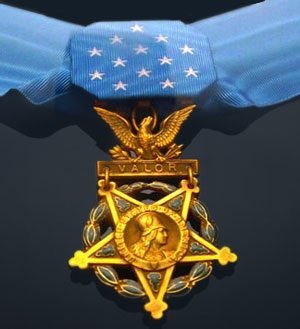
A Congressional Medal of Honor

Here is a description of the requirements to be awarded a Medal of Honor:

The Medal of Honor is the highest military decoration that may be awarded by the United States government. It is presented by the President of the United States, in the name of Congress, and is conferred only upon members of the United States Armed Forces who distinguish themselves through conspicuous gallantry and intrepidity at the risk of life above and beyond the call of duty:

  • While engaged in action against an enemy of the United States;
  • While engaged in military operations involving conflict with an opposing foreign force; or
  • While serving with friendly foreign forces engaged in an armed conflict against an opposing armed force in which the United States is not a belligerent party.

You can read the official details of their actions.

The point of this post

It is important for Christians to be familiar with real-world examples of people giving their lives in order to save the lives of others. When we see real-world examples of self-sacrifice, it helps us to understand what Jesus really achieved for us, and what he must have felt making that hard choice to volunteer to go in and rescue us. In general, my philosophy when it comes to the Bible is to make every effort to connect what the Bible says to the real world. We must not push Christianity into some far-off world of piety and feelings. We must make connections to real evidence and real life, so that what the Bible says becomes practical, and so that we have a deep friendship with and sympathy for God revealed in Jesus Christ. In real life, being willing to give your life to save someone else is hard. Understanding how that really happens will help us to value what Jesus has done for us.

Bible verses

I saw this verse on the ground outside the Airborne & Special Operations Museum in Fayetteville, NC, where I went for my summer vacation this year. (Thanks to my friend Curby who hosted me)

Isaiah 6:8:

Then I heard the voice of the Lord saying, “Whom shall I send? And who will go for us?”

And I said, “Here am I. Send me!”

Here is the picture I took (yes, that is my running shoe):
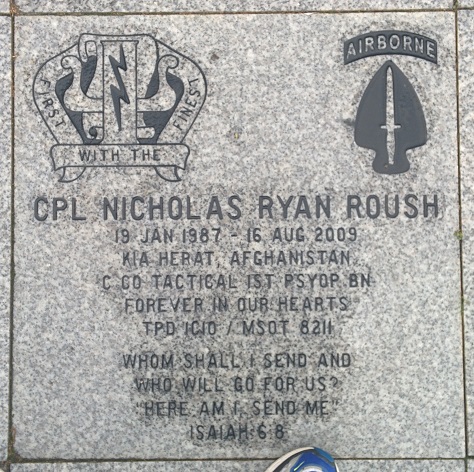
“Here am I, send me” Isaiah 6:8

When confronted with an opportunity to imitate Christ in his self-sacrifice, we should think less about ourselves and our own desires, and take the opportunity to serve others effectively. We do not do what makes us happy, and we do not pursue fun and thrills. We do what heals, we do what helps others. We do not push away our responsibility to imitate Christ by caring for those in danger. Christianity is not just about “not doing bad things”. It’s the good things you do because of your relationship with Jesus that show your real allegiance, and give you the experience of being a Christian in deed.

And here is another good verse:

John 15:13:

13 Greater love has no one than this: to lay down one’s life for one’s friends.

If you get a chance to watch the movie Blackhawk Down, then do so. I highly recommend it. You can also read the book that the movie is based on.

I love the Medal of Honor books by Edward F. Murphy. He writes about all the people who have been awarded the Medal of honor in different wars: World War II, the Korean War, and the Vietnam War.

What can Winston Churchill teach us about deterring aggression?

Winston Churchill on appeasement

Famous economist Thomas Sowell explains.

He writes:

Despite Churchill’s legendary status today, he was not merely ignored but ridiculed at the time, when he was repeatedly warning in vain. Knowing that his warnings provoked only mocking laughter in some quarters, even among some members of his own party, he said on March 14, 1938 in the House of Commons, “Laugh but listen.”

Just two years later, with Hitler’s planes bombing London, night after night, the laughter was gone. Many at the time thought that Britain itself would soon be gone as well, like other European nations that succumbed to the Nazi blitzkrieg in weeks (like France) or days (like Holland).

How did things get to such a desperate situation, with Britain alone continuing the fight, and struggling to survive, against the massive Nazi war machine that now controlled much of the material resources on the continent of Europe?

Things got that desperate by following policies strikingly similar to the policies being followed by the Western democracies today, including some of the very same notions and catchwords being used today.

Just recently, a State Department official in the Obama administration said that Americans have remained safe in a nuclear age, not because of our own nuclear arsenal but because “we created an intricate and essential system of treaties, laws and agreements.”

If “treaties, laws and agreements” produced peace, there would never have been a Second World War. The years leading up to that monumental catastrophe were filled with international treaties and arms control agreements.

The Treaty of Versailles, which ended the First World War, imposed strong restrictions on Germany’s military forces — on paper. The Washington Naval Agreements of 1922 imposed restrictions on all the major naval powers of the world — on paper. The Kellogg-Briand pact of 1928 created an international renunciation of war — on paper.

The Munich agreement of 1938 produced a paper with Hitler’s signature on it that British Prime Minister Neville Chamberlain waved to the cheering crowds when he returned to England, and said that it meant “Peace for our time.” Less than a year later, World War II began.

Winston Churchill never bought any of this. He understood that military deterrence was what preserved peace. With England playing a leadership role in Europe, “England’s hour of weakness is Europe’s hour of danger,” he said in the House of Commons in 1931.

[…]While Russia and China increased the share of their national output that went to military spending in 2014, the United States reduced its share. Churchill deplored the “inexhaustible gullibility” of disarmament advocates in 1932. That gullibility is still not exhausted in 2015.

“Not one of the lessons of the past has been learned, not one of them has been applied, and the situation is incomparably more dangerous,” Churchill said in 1934. And every one of those words is more urgently true today, in a nuclear age.

Here’s another article by Thomas Sowell that explains it more.

Excerpt:

In France, after the First World War, the teachers’ unions launched a systematic purge of textbooks, in order to promote internationalism and pacifism.

Books that depicted the courage and self-sacrifice of soldiers who had defended France against the German invaders were called “bellicose” books to be banished from the schools.

Textbook publishers caved in to the power of the teachers’ unions, rather than lose a large market for their books. History books were sharply revised to conform to internationalism and pacifism.

The once epic story of the French soldiers’ heroic defense against the German invaders at Verdun, despite the massive casualties suffered by the French, was now transformed into a story of horrible suffering by all soldiers at Verdun— French and German alike.

In short, soldiers once depicted as national heroes were now depicted as victims— and just like victims in other nations’ armies.

[…]France, where pacifism and internationalism were strongest, became a classic example of how much it can matter.

During the First World War, France fought on against the German invaders for four long years, despite having more of its soldiers killed than all the American soldiers killed in all the wars in the history of the United States, put together.

But during the Second World War, France collapsed after just six weeks of fighting and surrendered to Nazi Germany.

At the bitter moment of defeat the head of the French teachers’ union was told, “You are partially responsible for the defeat.”

Charles de Gaulle, Francois Mauriac, and other Frenchmen blamed a lack of national will or general moral decay, for the sudden and humiliating collapse of France in 1940.

Is the same thing happening in our public schools? Are our children taught to think that wars can be prevented by unilaterally disarming?

The lesson we need to learn from history is that the way to stop wars is by making the people who want to start them understand that there will be a price to pay if they start a war. That means that we need a certain amount of military power, and that we should have demonstrated that we are willing to use it. That is counter-intuitive to people on the left who cannot imagine that evil tyrants really are evil tyrants. They want to believe that problems can be solved with talk, but history teaches that talk is cheap.

Obama is skipping over half of his daily intelligence briefings (PDBs)

From the liberal Washington Post:

President Obama is touting his foreign policy experience on the campaign trail, but startling new statistics suggest that national security has not necessarily been the personal priority the president makes it out to be. It turns out that more than half the time, the commander in chief does not attend his daily intelligence meeting.

The Government Accountability Institute, a new conservative investigative research organization, examined President Obama’s schedule from the day he took office until mid-June 2012, to see how often he attended his Presidential Daily Brief (PDB) — the meeting at which he is briefed on the most critical intelligence threats to the country. During his first 1,225 days in office, Obama attended his PDB just 536 times — or 43.8 percent of the time. During 2011 and the first half of 2012, his attendance became even less frequent — falling to just over 38 percent. By contrast, Obama’s predecessor, George W. Bush almost never missed his daily intelligence meeting.

I asked National Security Council spokesman Tommy Vietor about the findings, and whether there were any instances where the president attended the intelligence meeting that were not on his public schedule. Vietor did not dispute the numbers, but said the fact that the president, during a time of war, does not attend his daily intelligence meeting on a daily basis is “not particularly interesting or useful.”

Please see my previous post on Obama’s top 10 foreign policy failures.

Let’s review the most important one:

Failure #1: No Results In Slowing Or Stopping Iran’s Nuclear Weapons Program

Today, Iran is on the cusp of nuclear weapons capability. Such a capability in the hands of the world’s top terrorist sponsoring state poses the greatest threat facing the United States and our friends and allies, and it risks sparking a nuclear arms race across the Middle East.

Despite promising to “do everything in his power” to stop Iran, four years of President Obama’s irresolute policies have failed to slow the progress of Iran’s program. In fact, that progress has sped up:

  • Fastest Rate Of Enrichment Ever. In 2009, Iran’s enrichment rate of low-enriched uranium was 56 kilograms per month.  That jumped to 116 kilograms per month from November 2011 to February 2012. The enrichment rate now stands at 158 kilograms per month, the fastest rate ever.[1]
  • More Spinning Centrifuges. The total number of spinning centrifuges has gone from 3,936 to 10,477 during Obama’s term. The growth rate of spinning centrifuges went from 112 centrifuges per month before Obama came into office to 152 centrifuges per month during his term.[2]
  • Fordow Underground Enrichment Facility Nearing Completion. The fortified underground facility is 70 percent complete. The number of centrifuges installed has gone from 1,064 in May to 2,140 today. The facility’s limit is 3,000 centrifuges.[3]

The Iranian program has gotten to this point because President Obama has squandered all credibility with the ayatollahs:

  • A Failed Engagement Policy. President Obama offered the ayatollahs “no preconditions” talks, which were rebuffed. The latest round of multilateral talks has produced no results.
  • Refrained From Supporting The Green Movement. When asked during a press conference, President Obama shamefully refused to voice support for Iranian dissidents in 2009 as they were being killed in the streets, saying he did not want to “meddle” in Iran’s affairs.
  • A Weak Sanctions Policy. President Obama opposed and sought to water down crippling sanctions on Iran’s Central Bank until he was forced into them by Congress and our European partners.[4] He then undermined those sanctions by issuing waivers to 20 of the top importers of Iranian oil, including China.[5]
  • Abandoned Missile Defense. He abandoned a European missile defense system meant to protect against Iranian missiles.
  • Undermined The Credibility Of The Military Option. His administration has given the Iranians no reason to believe it is serious about a military option. The administration has repeatedly talked down the effectiveness and advisability of the military option, and seems to have devoted more energy toward preventing an Israeli strike on Iran than toward preventing an Iranian nuclear weapons capability. Obama officials leaked that the administration has focused its efforts on explaining to Israel “the dangers of an Israeli attack” on Iran and has attempted to “make the decision to attack as hard as possible for Israel.”[6] And the President himself, after boldly stating to AIPAC that the United States “has Israel’s back,” changed his tune two days later by saying his statement was “not a military doctrine.”

In the face of such irresolution, the ayatollahs are pressing forward toward nuclear weapons capability without fear of repercussion because they do not believe we are serious.

And now we know why. He’s played golf over a 100 times. He’s in over his head.