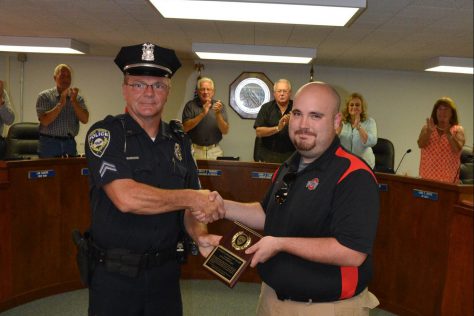
An Ohio man with a concealed carry permit was presented Monday with a Citizens Award of Valor for coming to the aid of police officer under attack last year.
Cpl. Michael Wheeler of Ohio’s Mount Vernon Police Department told Inside Edition that he owes his life to Dylan DeBoard, the man who saved him.
“Every time I see him, I let him know how much I appreciate what he did,” he said.
According to Wheeler, he was attacked last year by a homeless man who later admitted to being high on crystal meth. While he was attempting to subdue his attacker, the man knocked Wheeler to his back and straddled him. He ripped away his microphone and reached for his gun.
Wheeler said that in his 14-year career he’s “never been in that situation before.”
“I’ve always been able to take control of a situation,” he said.
According to Wheeler, all of a sudden, the man stopped struggling with him. He looked up to see a man with a gun.
“I didn’t know if he was pointing at me or [the attacker],” Wheeler said.
Then the man with the gun — DeBoard — announced that he was a concealed carry holder. Wheeler was then able to use his attacker’s hesitation to flip him over and handcuff him.
The officer said he is thankful for the opportunity to honor DeBoard for his actions. “I wish a lot more of society would do what he did,” he added. “There were people standing around, but they were just watching. I kept wondering why people didn’t do anything.”
I think the reason why the other bystanders were not doing anything is because they were not armed, they were not trained to use a firearm, and they did not have moral clarity. We have lost moral clarity because we surround ourselves with nonsense on television where celebrity is more important than heroic character.
First, let’s talk about the training factor. To get a concealed carry permit in Ohio, you have to complete a course on handgun safety, pass a written test and you also have to pass a marksmanship test. This is because the evaluators do not want you to bring disrepute on legal firearm ownership because you aren’t qualified to use the tool you are carrying responsibly. The safety and accuracy test is quite difficult, depending on the state – you might be asked to hit 4″ targets at 5, 10 and 15 yards, for example, with 20 out of 25 rounds fired. That’s not easy!
Previously, I blogged about a report that showed that concealed-carry permit holders commit crimes at a lower rate than police officers. This is because the people who get these permits are careful not to do anything to lose them. They want to be safe, but they are also there to watch out for others. It is very important that we recognize that there are some people in our society who make poor choices (e.g. – drug use), and that we need the ability to defend ourselves and others from them.
Concealed-carry permit holders are nearly the most law-abiding demographic of Americans, a new report by the Crime Prevention Research Center says—comparing the permit holders foremost with police.
“Indeed, it is impossible to think of any other group in the U.S. that is anywhere near as law-abiding,” says the report, titled “Concealed Carry Permit Holders Across the United States 2016.”
From 2007 through 2015, permits issued by state and local governments increased by 215 percent, to more than 14 million Americans, according to the data.
The study compared permit holders to police, who committed 703 crimes from 2005 to 2007, and 113 of those were firearm violations.
[…]The study refers to Texas and Florida, which it says mirror most other states, to compare permit holders with police and the overall population. It used data from 1987 through 2015.
“We find that permit holders are convicted of misdemeanors and felonies at less than a sixth the rate for police officers,” the report says. “Among police, firearms violations occur at a rate of 16.5 per 100,000 officers. Among permit holders in Florida and Texas, the rate is only 2.4 per 100,000.10. That is just one-seventh of the rate for police officers.”
Did you know that? It is very difficult to get a concealed carry permit, and the people who get them don’t want to lose them, because they’d be losing their ability to defend themselves. That’s why they are so informed about how to use their firearms safely in a law-abiding manner.
Although there is opposition to gun ownership in certain circles, the academic literature is quite clear and decisive. Legal ownership of firearms reduces rates of violent crime. Whenever laws that allow law-abiding citizens to carry firearms for self-defense, violent crime rates decrease. Whenever laws are passed that restrict law-abiding citizens from owning and carrying firearms for self-defense, violent crime rates increase.
The peer-reviewed research
Whenever I get into discussions about gun control, I always mention two academic books by John R. Lott and Joyce Lee Malcolm.
Tracing the history of gun control in the United Kingdom since the late 19th century, this article details how the government has arrogated to itself a monopoly on the right to use force. The consequence has been a tremendous increase in violent crime, and harsh punishment for crime victims who dare to fight back. The article is based on the author’s most recent book, Guns and Violence: The English Experience (Harvard University Press, 2002). Joyce Malcom is professor of history at Bentley College, in Waltham, Massachusetts. She is also author of To Keep and Bear Arms: The Origins of an AngloAmerican Right (Harvard University Press, 1994).
Upon the passage of The Firearms Act (No. 2) in 1997, British Deputy Home Secretary Alun Michael boasted: “Britain now has some of the toughest gun laws in the world.” The Act was second handgun control measure passed that year, imposed a near-complete ban on private ownership of handguns, capping nearly eighty years of increasing firearms restrictions. Driven by an intense public campaign in the wake of the shooting of schoolchildren in Dunblane, Scotland, Parliament had been so zealous to outlaw all privately owned handguns that it rejected proposals to exempt Britain’s Olympic target-shooting team and handicapped target-shooters from the ban.
And the result of the 1997 gun ban:
The result of the ban has been costly. Thousands of weapons were confiscated at great financial cost to the public. Hundreds of thousands of police hours were devoted to the task. But in the six years since the 1997 handgun ban, crimes with the very weapons banned have more than doubled, and firearm crime has increased markedly. In 2002, for the fourth consecutive year, gun crime in England and Wales rose—by 35 percent for all firearms, and by a whopping 46 percent for the banned handguns. Nearly 10,000 firearms offences were committed.
[…]According to Scotland Yard, in the four years from 1991 to 1995 crimes against the person in England‟s inner cities increased by 91 percent. In the four years from 1997 to 2001 the rate of violent crime more than doubled. The UK murder rate for 2002 was the highest for a century.
I think that peer-reviewed studies – from Harvard University, no less – should be useful to those of us who believe in the right of self-defense for law-abiding people. The book by economist John Lott, linked above,compares the crime rates of all U.S. states that have enacted concealed carry laws, and concludes that violent crime rates dropped after law-abiding citizens were allowed to carry legally-owned firearms. That’s the mirror image of Dr. Malcolm’s Harvard study, but both studies affirm the same conclusion – more legal firearm ownership means less crime.
Another shooting, another son of divorce. From Adam Lanza, who killed 26 children and adults a year ago at Sandy Hook School in Newtown, Conn., to Karl Pierson, who shot a teenage girl and killed himself this past Friday at Arapahoe High in Centennial, Colo., one common and largely unremarked thread tying together most of the school shooters that have struck the nation in the last year is that they came from homes marked by divorce or an absent father. From shootings at MIT (i.e., theTsarnaev brothers) to the University of Central Florida to the Ronald E. McNair Discovery Learning Academy in Decatur, Ga., nearly every shooting over the last year in Wikipedia’s “list of U.S. school attacks” involved a young man whose parents divorced or never married in the first place.
[…]The social scientific evidence about the connection between violence and broken homes could not be clearer. My own research suggests that boys living in single mother homes are almost twice as likely to end up delinquent compared to boys who enjoy good relationships with their father. Harvard sociologist Robert Sampson has written that “Family structure is one of the strongest, if not the strongest, predictor of variations in urban violence across cities in the United States.” His views are echoed by the eminent criminologists Michael Gottfredson and Travis Hirschi, who have written that “such family measures as the percentage of the population divorced, the percentage of households headed by women, and the percentage of unattached individuals in the community are among the most powerful predictors of crime rates.”
Why is fatherlessness such a big deal for our boys (almost all of these incidents involve boys)? Putting the argument positively, sociologist David Popenoe notes that “fathers are important to their sons as role models. They are important for maintaining authority and discipline. And they are important in helping their sons to develop both self-control and feelings of empathy toward others, character traits that are found to be lacking in violent youth.” Boys, then, who did not grow up with an engaged, attentive, and firm father are more vulnerable to getting swept up in the Sturm und Drang of adolescence and young adulthood, and in the worst possible way.
So where do fatherless children come from? It turns out that government programs incentivize women to make them.
Dr. Michael Tanner of the libertarian Cato Institute explains how welfare causes fatherlessness in his testimony to Congress:
Welfare contributes to crime in several ways. First, children from single-parent families are more likely to become involved in criminal activity. According to one study, children raised in single-parent families are one-third more likely to exhibit anti-social behavior.(3) Moreover, O’Neill found that, holding other variables constant, black children from single- parent households are twice as likely to commit crimes as black children from a family where the father is present. Nearly 70 percent of juveniles in state reform institutions come from fatherless homes, as do 43 percent of prison inmates.(4) Research indicates a direct correlation between crime rates and the number of single-parent families in a neighborhood.(5)
As Barbara Dafoe Whitehead noted in her seminal article for The Atlantic Monthly:
The relationship [between single-parent families and crime] is so strong that controlling for family configuration erases the relationship between race and crime and between low income and crime. This conclusion shows up time and again in the literature. The nation’s mayors, as well as police officers, social workers, probation officers, and court officials, consistently point to family break up as the most important source of rising rates of crime.(6)
At the same time, the evidence of a link between the availability of welfare and out-of-wedlock births is overwhelming. There have been 13 major studies of the relationship between the availability of welfare benefits and out-of-wedlock birth. Of these, 11 found a statistically significant correlation. Among the best of these studies is the work done by June O’Neill for the U.S. Department of Health and Human Services. Holding constant a wide range of variables, including income, education, and urban vs. suburban setting, the study found that a 50 percent increase in the value of AFDC and foodstamp payments led to a 43 percent increase in the number of out-of-wedlock births.(7) Likewise, research by Shelley Lundberg and Robert Plotnick of the University of Washington showed that an increase in welfare benefits of $200 per month per family increased the rate of out-of-wedlock births among teenagers by 150 percent.(8)
The same results can be seen from welfare systems in other countries. For example, a recent study of the impact of Canada’s social-welfare system on family structure concluded that “providing additional benefits to single parents encourages births of children to unwed women.”(9)
The secular left in this country believes that fathers need to be separated away from their children, and that’s why they support welfare programs that redirect money from husbands in intact families to single mothers. They believe that fathers are harmful because they set boundaries on children, and judge them and punish them when they act immorally. To the secular left, boundaries, judgments and punishments on children are bad, and must be stopped. So how can the secular left discourage men from marrying and teaching their own children morality? Well, they can tax married men, and they can give the money to single mothers.
Not only is crime caused by fatherlessness, but poverty is. as well.
Census data and the Fragile Families survey show that marriage can be extremely effective in reducing child poverty. But the positive effects of married fathers are not limited to income alone. Children raised by married parents have substantially better life outcomes compared to similar children raised in single-parent homes.
When compared to children in intact married homes, children raised by single parents are more likely to have emotional and behavioral problems; be physically abused; smoke, drink, and use drugs; be aggressive; engage in violent, delinquent, and criminal behavior; have poor school performance; be expelled from school; and drop out of high school.[19] Many of these negative outcomes are associated with the higher poverty rates of single mothers. In many cases, however, the improvements in child well-being that are associated with marriage persist even after adjusting for differences in family income. This indicates that the father brings more to his home than just a paycheck.
The effect of married fathers on child outcomes can be quite pronounced. For example, examination of families with the same race and same parental education shows that, when compared to intact married families, children from single-parent homes are:
More than twice as likely to be arrested for a juvenile crime;[20]
Twice as likely to be treated for emotional and behavioral problems;[21]
Roughly twice as likely to be suspended or expelled from school;[22] and
A third more likely to drop out before completing high school.[23]
The effects of being raised in a single-parent home continue into adulthood. Comparing families of the same race and similar incomes, children from broken and single-parent homes are three times more likely to end up in jail by the time they reach age 30 than are children raised in intact married families. [24] Compared to girls raised in similar married families, girls from single-parent homes are more than twice as likely to have a child without being married, thereby repeating the negative cycle for another generation.[25]
Finally, the decline of marriage generates poverty in future generations. Children living in single-parent homes are 50 percent more likely to experience poverty as adults when compared to children from intact married homes. This intergenerational poverty effect persists even after adjusting for the original differences in family income and poverty during childhood.[26]
People on the left claim that poverty causes crime, but they don’t look for the root cause of poverty. The root cause of poverty is the decline of marriage, which produces fatherless children.



 WINTERY KNIGHT