
Tag Archives: Corruption

Who halted the FBI investigation of Hillary’s private unsecure e-mail server?

Is Barack Obama focused on protecting the American people?

That’s the question I’ve been asking myself: who killed the FBI investigation of Hillary’s e-mail server and the Clinton Foundation?

Former attorney general Michael Mukasey has an answer to the question in the Wall Street Journal.

First a quick review of the facts:

Nonetheless, in July [FBI director Comey] announced that “no reasonable prosecutor” would seek to charge [Hillary Clinton] with a crime, although Mrs. Clinton had classified information on a private nonsecure server—at least a misdemeanor under one statute; and although she was “extremely careless” in her handling of classified information such that it was exposed to hacking by hostile foreign nations—a felony under another statute; and apparently had caused the destruction of emails—a felony under two other statutes. He then told Congress repeatedly that the investigation into her handling of emails was closed.

Those decisions were not his to make, nor were the reasons he offered for making them at all tenable: that prosecutions for anything but mishandling large amounts of classified information, accompanied by false statements to investigators, were unprecedented; and that criminal prosecutions for gross negligence were constitutionally suspect.

Members of the military have been imprisoned and dishonorably discharged for mishandling far less information, and prosecutions for criminal negligence are commonplace and entirely permissible. Yet the attorney general [Loretta Lynch], whose decisions they were, and who had available to her enough legal voltage to vaporize Mr. Comey’s flimsy reasons for inaction, told Congress she would simply defer to the director.

That July announcement of Mr. Comey, and that testimony by Attorney General Loretta Lynch, also had a history.

When the FBI learned that two of the secretary’s staff members had classified information on their computers, rather than being handed grand-jury subpoenas demanding the surrender of those computers, the staff members received immunity in return for giving them up. In addition, they successfully insisted that the computers not be searched for any data following the date when Congress subpoenaed information relating to its own investigation, and that the computers be physically destroyed after relevant data within the stipulated period was extracted.

The technician who destroyed 30,000 of Mrs. Clinton’s emails after Congress directed that they be preserved lied to investigators even after receiving immunity. He then testified that Clinton aides requested before service of the subpoena that he destroy them, and that he destroyed them afterward on his own initiative.

Why would an FBI director, who at one time was an able and aggressive prosecutor, agree to such terms or accept such a fantastic story?


Yes, why did Comey stop the FBI investigation of Hillary Clinton given all of these facts?

Mukasey explains who called off the investigation and why:

The search for clues brings us to an email to then-Secretary Clinton from President Obama, writing under a pseudonym, that the FBI showed to Ms. Abedin. That email, along with 21 others that passed between the president and Secretary Clinton, has been withheld by the administration from release on confidentiality grounds not specified but that could only be executive privilege.

After disclosure of those emails, the president said during an interview that he thought Mrs. Clinton should not be criminally charged because there was no evidence that she had intended to harm the nation’s security—a showing required under none of the relevant statutes. As indefensible as his legal reasoning may have been, his practical reasoning is apparent: If Mrs. Clinton was at criminal risk for communicating on her nonsecure system, so was he.

That presented the FBI director with a dilemma that was difficult, but not complex. It offered two choices. He could have tried to proceed along the course marked by the relevant laws. The FBI is powerless to present evidence to a grand jury, or to issue grand-jury subpoenas. That authority lies with the Justice Department, headed by an attorney general who serves, as her certificate of appointment recites, “during the pleasure of the President of the United States for the time being.”

[…]Instead, Mr. Comey acceded to the apparent wish of President Obama that no charges be brought. 

Obama would have wanted the FBI investigation stopped because if the Department of Justice decided that Clinton “was at criminal risk” for communicating on Clinton’s nonsecure system, then so was he. Fortunately for Obama, he appointed Loretta Lynch as attorney general, and we know she won’t prosecute Democrats, because she refused to go after the IRS for persecuting conservative organizations ahead of the 2012 election, so that Obama would win.

So, did Obama know that he was communicating to Secretary Clinton on an unsecure private e-mail server?

"We need to clean this up" = We need to cover this up
“We need to clean this up” = We need to cover this up

His own staff sent e-mails confirming that he knew.

The far-left New York Times reports:

In a March 2015 interview, President Obama said that he had learned about Hillary Clinton’s use of a private email server as secretary of state “the same time everybody else learned it, through news reports.”

But that assertion concerned aides of Mrs. Clinton, who knew that the president himself had received emails from the private address, according to a hacked email made public on Tuesday by WikiLeaks.

“We need to clean this up — he has emails from her — they do not say state.gov,” Cheryl D. Mills, a top aide, wrote to John D. Podesta, another senior adviser, on March 7, 2015.

Two days later, Mr. Obama’s spokesman, Josh Earnest, tried to clarify the president’s remarks, saying that he had, in fact, exchanged emails with Mrs. Clinton through her private account.

And far left CNN confirms:

A top Hillary Clinton adviser said President Barack Obama’s answer on Clinton’s private email use as secretary of state needed “clean up,” according to hacked emails from her campaign chairman released Tuesday.

In a March 2015 email chain, Cheryl Mills, a top legal adviser and longtime member of Clinton’s inner circle, told campaign Chairman John Podesta of an interview in which Obama said he learned about Clinton’s private email setup from news reports.

“We need to clean this up — he has emails from her — they do not say state.gov,” Mills wrote to Podesta.

So, who ordered the FBI to stop investigating Hillary’s private e-mail server? Who ordered the Department of Justice not to proceed with the criminal investigation? Obama was the one with the authority to call it off, and Obama had a reason for calling it off: he was at risk of criminal charges himself.
Report: Clinton ally funded campaign of wife of FBI lead of e-mail probe

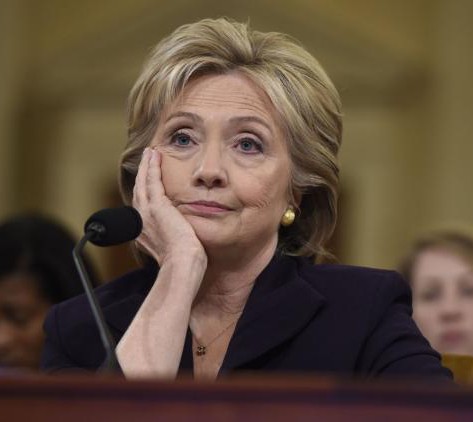
Hillary Clinton look bored about the deaths of 4 Americans who asked for her help

Here is a story that is sure to set back the Hillary Clinton campaign. (H/T Dad)

The Wall Street Journal reports:

The political organization of Virginia Gov. Terry McAuliffe, an influential Democrat with longstanding ties to Bill and Hillary Clinton, gave nearly $500,000 to the election campaign of the wife of an official at the Federal Bureau of Investigation who later helped oversee the investigation into Mrs. Clinton’s email use.

Campaign finance records show Mr. McAuliffe’s political-action committee donated $467,500 to the 2015 state Senate campaign of Dr. Jill McCabe, who is married to Andrew McCabe, now the deputy director of the FBI.

The Virginia Democratic Party, over which Mr. McAuliffe exerts considerable control, donated an additional $207,788 worth of support to Dr. McCabe’s campaign in the form of mailers, according to the records. That adds up to slightly more than $675,000 to her candidacy from entities either directly under Mr. McAuliffe’s control or strongly influenced by him. The figure represents more than a third of all the campaign funds Dr. McCabe raised in the effort.

Mr. McAuliffe and other state party leaders recruited Dr. McCabe to run, according to party officials. She lost the election to incumbent Republican Dick Black.

[…]Among political candidates that year, Dr. McCabe was the third-largest recipient of funds from Common Good VA, the governor’s PAC, according to campaign finance records.

[…]Mr. McAuliffe has been a central figure in the Clintons’ political careers for decades. In the 1990s, he was Bill Clinton’s chief fundraiser and he remains one of the couple’s closest allies and public boosters. Mrs. Clinton appeared with him in northern Virginia in 2015 as he sought to increase the number of Democrats in the state legislature.

Dr. McCabe announced her candidacy in March 2015, the same month it was revealed that Mrs. Clinton had used a private server as secretary of state to send and receive government emails, a disclosure that prompted the FBI investigation.

Do you ever wonder why the FBI declined to prosecute Clinton, even though less connected people were prosecuted and convicted for the same crimes? Maybe because this McCabe guy was very high up in the agency:

At the time the investigation was launched in July 2015, Mr. McCabe was running the FBI’s Washington, D.C., field office, which provided personnel and resources to the Clinton email probe.

That investigation examined whether Mrs. Clinton’s use of private email may have compromised national security by transmitting classified information in an insecure system. A review of Mrs. Clinton’s emails concluded that 110 messages contained classified information. Mrs. Clinton has said she made a mistake but that she never sent or received messages that were marked classified.

At the end of July 2015, Mr. McCabe was promoted to FBI headquarters and assumed the No. 3 position at the agency. In February 2016, he became FBI Director James Comey’s second-in-command.

As deputy director, Mr. McCabe was part of the executive leadership team overseeing the Clinton email investigation…

Naturally, the article contains lots of denials and disclaimers from the Clinton camp. Readers will have to make up their minds for themselves.

The smoking gun: State Department pressured FBI to unclassify Clinton e-mails


Hillary Clinton look bored about the deaths of 4 Americans who asked for her help

The far left Washington Post reports:

FBI official Brian McCauley had been trying for weeks to get his contact at the State Department to approve his request to put two bureau employees back in Baghdad.

Around May 2015, Patrick Kennedy finally called back.

“He said: ‘Brian. Pat Kennedy. I need a favor,’ ” McCauley recalled in an interview Tuesday. “I said: ‘Good, I need a favor. I need our people back in Baghdad.’ ”

Then Kennedy, a longtime State Department official, explained what he wanted: “There’s an email. I don’t believe it has to be classified.”

The email was from Hillary Clinton’s private server, and Kennedy wanted the FBI to change its determination that it contained classified information.

[…]The purported “quid pro quo” between McCauley and Kennedy was first reported over the weekend by Fox News and the Weekly Standard and confirmed Monday when the FBI released dozens of interview summaries from its criminal investigation into Clinton’s use of a private email server while she was secretary of state.

The interview summaries showed that Kennedy lobbied multiple bureau officials to change their minds about ­classifying one email on Clinton’s server. At the time, the State Department was reviewing ­Clinton’s emails for release under the Freedom of Information Act and had sent several to the FBI for review.

Fox News and the Weekly Standard first reported on the story because they are not in the tank for Hillary Clinton.

Fox News notes that the FBI dragged their feet on releasing the e-mails showing the quid pro quo proposal:

“Left to their own devices the FBI would never have provided these [records] to Congress and waited until the last minute. This is the third batch because [the FBI] didn’t think they were relevant,” Chaffetz said.

And the Weekly Standard had all the details:

The FBI official spoke with Kennedy and Kennedy raised the possibility of keeping at least one Clinton email from public disclosure by obtaining a “B9” exemption under the Freedom of Information Act, a rarely used exemption that refers to “geological and geophysical information and data.” One email in particular concerned Kennedy and, according to the FBI summary, providing a B9 exemption “would allow him to archive the document in the basement of the department of state never to be seen again.” The FBI official told Kennedy that he would look into the email if Kennedy would authorize a pending request for additional FBI personnel in Iraq.

A summary of an interview with the section chief of the FBI records management division provides further evidence of Kennedy’s attempts to have the classification of some sensitive emails changed. The FBI records official, whose job includes making determinations on classification, told investigators that he was approached by his colleague in international operations after the initial discussion with Kennedy. The FBI records official says that his colleague “pressured” him to declassify an email “in exchange for a quid pro quo,” according to the interview summary. “In exchange for making the email unclassified State would reciprocate by allowing the FBI to place more agents in countries where they are presently forbidden.” The request was denied.

The Weekly Standard outlines a few more cases where Kennedy pressured the FBI to mark e-mails as not classified.

More:

Kennedy has been a central figure in the Benghazi and email controversies. He was involved in the controversial decisions not to bolster security at the Benghazi diplomatic outpost despite repeated requests for addition security. And although Kennedy is responsible for ensuring State Department compliance with federal records requirements, he communicated regularly with Clinton using her private email. In a sworn deposition in connection with Freedom of Information Act litigation brought by Judicial Watch, Kennedy testified that he exchanged dozens of emails with Clinton and never thought to ask how the private emails would be archived in a manner consistent with federal law. “It’s not something that I ever focused on,” Kennedy testified.

He never thought to ask. It was not something that he ever focused on.

Of course, this is the same FBI that declined to prosecute Clinton for actions that would have been prosecuted if anyone else had committed them – and others have indeed been prosecuted.