
Tag Archives: Conservative

New study: conservatives are more likely to be happily married than progressives

If you want a very happy marriage, don't be a progressive
If you want a very happy marriage, don’t be a progressive

New study from social science researchers W. Bradford Wilcox and Nicholas Wolfinger.

It’s written up in The Federalist.

Excerpt:

In the General Social Survey (GSS), one of the best barometers of American society, ideology is measured by asking respondents to rate their political attitudes on a liberal-conservative continuum (1 = extremely liberal, 7 = extremely conservative). We coded those men and women answering 1 to 3 as “liberal,” those answering with a 4 as “moderate,” and those answering 5 to 7 as “conservative.”

Figure 1 indicates that conservatives are significantly more likely to be married than are moderates and liberals. In fact, they are about 15 percentage points more likely to be married than their liberal fellow citizens. Moreover, this relationship remains strong after controlling for race or ethnicity, age, sex, and… income and education.

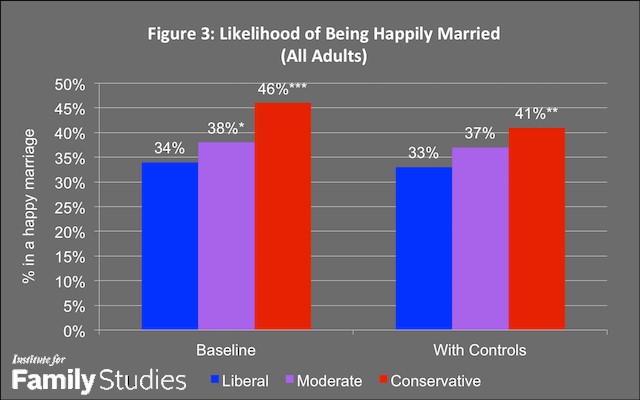
[…]Figure 3 examines the effects of political ideology on the chances of being in a very happy marriage among all Americans, not just those who are currently married, as Figure 2 depicted. Figure 3 shows that in the baseline model, conservatives are 12 percentage points more likely to be in happy marriages than are liberals. This gap persists, albeit to a diminished extent, after controlling for race or ethnicity, age, sex, income, and education. After adjusting for these differences between General Social Survey respondents, conservatives are about eight percentage points more likely than liberals to be in a happy marriage.

So basically, if you are a leftist, then you are much less likely to be happily married. And if you are a conservative, then you are much more likely to be happily married.

Why?

The answer lies in the design of marriage. Marriage is not about two people moving in together so that they can feel good about doing whatever they want to do. Marriage is a design that works best with a man and a women who are equipped at the worldview level with the capacity for resilient, self-sacrifice love.

Progressives are not equipped for the kind of self-denial, self-control, and self-sacrifice that marriage requires. They don’t believe in God, generally, so they don’t believe in objective morality. And if you don’t believe in objective morality, then there is no foundation there for self-sacrificial love, and honoring moral obligations when it goes against your self-interest. Atheism as a worldview doesn’t have the foundation for the kinds of behaviors that marriage entails. And that’s why you see Peter Atkins, Richard Dawkins, Richard Carrier, Michael Shermer, etc. divorcing their wives. The atheist worldview and the atheist community do not enable the sort of character that is suited for the design of marriage.

In contrast, conservatives typically do have a rationally-grounded morality. They tend to believe in God, and so the rightness of following the moral law when it goes against their self-interest makes sense to them. They think that there is a design to marriage, and design for the flourishing of children. They are more likely to be able to compromise and solve problems in order to keep a commitment going. There is an “ought to do” there in the conservative worldview that is objective – it exists independent of their feelings. The obligations to override selfishness is there regardless of how unfair life seems – it is resilient to challenges.

One of the ways you can tell how serious someone is about their religion, and therefore their morality, is by looking at the person’s church attendance. Church attendance is typically not as fun as other things you can do in life. So people who go are indicating that they put their relationship with God and their dedication to following the moral law above their own self-interest. So does that tendency help religious people to stay married?

Yes it does:

Brad Wilcox, director of the National Marriage Project at the University of Virginia, agrees there’s been some confusion.

“You do hear, both in Christian and non-Christian circles, that Christians are no different from anyone else when it comes to divorce and that is not true if you are focusing on Christians who are regular church attendees,” he said.

Wilcox’s analysis of the National Survey of Families and Households has found that Americans who attend religious services several times a month were about 35% less likely to divorce than those with no religious affiliation.

Nominal conservative Protestants, on the other hand, were 20% more likely to divorce than the religiously unaffiliated.

“There’s something about being a nominal ‘Christian’ that is linked to a lot of negative outcomes when it comes to family life,” Wilcox said.

So the bottom line is that marriage is a moral enterprise. It works better when each spouse has a worldview and a community that recognizes objective, prescriptive morality. And objective, prescriptive morality has no rational foundation in a non-theistic worldview. Progressives tend to be non-theists, so of course they are going to struggle with any enterprise that requires them to set aside their natural self-centeredness in order to honor moral obligations to another person.

New study: leftists have less self-control than conservatives

Dina tweeted this article from the UK Daily Mail, and it’s worth a look.

It says:

In three studies, US scientists tested the abilities of two groups: undergraduates who considered themselves politically conservative and ‘liberals’.

They classed conservatives as those who endorse traditional values and the status quo, while liberals ‘endorse egalitarian ideals and progressive change’.

They found that the conservatives were better at ‘regulating their attention’ and persisting with tasks.

And they found the difference between the two groups was linked to how closely they believed in free will.

The authors wrote in the Proceedings of the National Academy of Sciences: ‘Three studies document a clear difference in self-control as a function of political ideology, as political conservatism (versus liberalism) was consistently related to greater self-control.’

[…]The researchers from the universities of Cincinatti, Indiana and Florida said their research followed on from previous studies that found conservatives tended to be more studious at university than their left-wing counterparts.

The authors suggest that a belief that success is down to one’s own efforts rather than being pre-determined is key to academic success.

Explaining findings that conservative students do better at university, they suggest it ‘could be that conservatives believe they have greater control over their performance and thus expend greater self control in their academic pursuits.’

This is interesting. The theistic view is that human beings are non-physical souls, and the non-physical souls tell the body what to do. Since the non-physical soul is not material, it’s behavior is not governed by fixed physical processes. This is in contrast with the naturalistic view, which is that you are your body, there is no free will, and no personal responsibility.

Isn’t it interesting that the people who do believe in free will also believe in personal responsibility, and this causes them to take more responsibility for their own choices? I cannot imagine how a person can deny free will, yet this is the natural outworking of saying “nature is all there is”.

For those who don’t like the Daily Mail, you can read about the study here in Science Daily.

What is it like to be a conservative in Silicon Valley?

This article comes to us from my favorite far-left new source, The Nation.

They write:

Deep in Silicon Valley, where the free market reigns and the exchange of ideas is celebrated, a subset of tech workers are hiding their true selves. Working as programmers and software engineers, they don’t want the stigma that comes with revealing who they really are.

They’re the tech company employees, startup founders, and CEOs who vote for and donate to Republican candidates, bucking the Bay Area’s liberal supremacy. Fearing the repercussions of associating with a much-maligned minority, they keep their political views fiercely hidden.

“It’s a liberal echo chamber,” Garrett Johnson, a co-founder of Lincoln Labs, which was started in 2013 to connect the right-of-center outsiders in Silicon Valley, told National Journal. “People have been convinced that Silicon Valley is reflexively liberal or progressive. And so their response is to conform.”

[…]Rather than ruffle feathers—or worse—Republicans who work there often just keep quiet. 

[…]One startup CEO who has worked in Silicon Valley for more than a decade says that while it’s popular to talk politics in the workplace, the underlying assumption is that everyone has similar views.

The CEO, who generally votes Republican and donates to GOP candidates—he spoke on background to conceal his right-leaning views—said that in 2012, “you wouldn’t want to say you’re voting for Romney in the election.” At the same time, openly expressing one’s support for Obama was “incredibly common.”

His opposition to raising the minimum wage is just one area where he diverges with most of his colleagues. “If you say something like, ‘We need a higher minimum wage,’ you don’t get critiqued,” he said. But he would never reveal his more conservative outlook on the matter.

“They can’t fathom that somebody disagrees with them,” he said. “And I disagree with them. So I’m not going to open up that box.”

I was chatting by e-mail with a well known atheist who sometimes links to me. He still thinks that atheism is a good thing, and he has no idea who he has thrown in with. For example, he had never heard of Brendan Eich, who is mentioned in the article.

It says:

The consequences for being outed for conservative views can be dire. In a highly public controversy last year, newly-hired Mozilla CEO Brendan Eich, who is registered as an independent in California, stepped down after critics attacked his 2008 donation to support Proposition 8, the anti-same-sex marriage law in California. Eich, who declined to comment for this story, faced an internal uprising from within the Mozilla community, as well as boycotts from other tech companies, and quit after just two weeks on the job.

Previously, he had written about his support for same-sex marriage. The same same-sex marriage that got Brendan Eich forced out as CEO.

The atheist blogger assured me not to worry – even though people are being fired, fined, and thrown into prison for taking conservative positions. He is a very smart fellow, but I just think he doesn’t know what’s really going on. I’ve been following these issues in other countries for years, and I know how far his side will go to squash ours. He ought to know too, if he looked back far enough.