
Tag Archives: Climate Change

New study: new climate change model finds IPCC model predictions too hot

Here is a report on a new study on global warming, from Phys.org.

They write:

A major peer-reviewed climate physics paper in the first issue (January 2015: vol. 60 no. 1) of the prestigious Science Bulletin (formerly Chinese Science Bulletin), the journal of the Chinese Academy of Sciences, exposes elementary but serious errors in the general-circulation models relied on by the UN’s climate panel, the IPCC. The errors were the reason for concern about Man’s effect on climate. Without them, there is no climate crisis.

The IPCC has long predicted that doubling the CO2 in the air might eventually warm the Earth by 3.3 °C. However, the new, simple model presented in the Science Bulletinpredicts no more than 1 °C warming instead – and possibly much less. The model, developed over eight years, is so easy to use that a high-school math teacher or undergrad student can get credible results in minutes running it on a pocket scientific calculator.

The paper, Why models run hot: results from an irreducibly simple climate model, by Christopher Monckton of Brenchley, Willie Soon, David Legates and Matt Briggs, survived three rounds of tough peer review in which two of the reviewers had at first opposed the paper on the ground that it questioned the IPCC’s predictions.

When the paper’s four authors first tested the finished model’s global-warming predictions against those of the complex computer models and against observed real-world temperature change, their simple model was closer to the measured rate of global warming than all the projections of the complex “general-circulation” models:

Next, the four researchers applied the model to studying why the official models concur in over-predicting global warming. In 1990, the UN’s climate panel predicted with “substantial confidence” that the world would warm at twice the rate that has been observed since.

[…]The measured, real-world rate of global warming over the past 25 years, equivalent to less than 1.4° C per century, is about half the IPCC’s central prediction in 1990.

[…]The new, simple climate model helps to expose the errors in the complex models the IPCC and governments rely upon. Those errors caused the over-predictions on which concern about Man’s influence on the climate was needlessly built.

So what are the specific errors in the IPCC model?

These:

Among the errors of the complex climate models that the simple model exposes are the following –

The assumption that “temperature feedbacks” would double or triple direct manmade greenhouse warming is the largest error made by the complex climate models. Feedbacks may well reduce warming, not amplify it.

The Bode system-gain equation models mutual amplification of feedbacks in electronic circuits, but, when complex models erroneously apply it to the climate on the IPCC’s false assumption of strongly net-amplifying feedbacks, it greatly over-predicts global warming. They are using the wrong equation.

Modellers have failed to cut their central estimate of global warming in line with a new, lower feedback estimate from the IPCC. They still predict 3.3 °C of warming per CO2 doubling, when on this ground alone they should only be predicting 2.2 °C – about half from direct warming and half from amplifying feedbacks.

Though the complex models say there is 0.6 °C manmade warming “in the pipeline” even if we stop emitting greenhouse gases, the simple model – confirmed by almost two decades without any significant global warming – shows there is no committed but unrealized manmade warming still to come. There is no scientific justification for the IPCC’s extreme RCP 8.5 global warming scenario that predicts up to 12 °C global warming as a result of our industrial emissions of greenhouse gases.

Once errors like these are corrected, the most likely global warming in response to a doubling of CO2 concentration is not 3.3 °C but 1 °C or less. Even if all available fossil fuels were burned, less than 2.2 °C warming would result.

Conclusion:

Dr Willie Soon, an eminent solar physicist at the Harvard-Smithsonian Center for Astrophysics, said: “Our work suggests that Man’s influence on climate may have been much overstated. The role of the Sun has been undervalued. Our model helps to present a more balanced view.”

I think it’s a credit to the scientific enterprise that they grilled this paper with peer-review, and then allowed it to stand, even though if it becomes widely-known and accepted, it will dry up their grant money. They rely on a crisis in order to obtain research money, and what this new, simpler model shows is that there is no crisis. It’s bad for the scientists’ wallets, but good for science as a whole. Respect++.
How reliable is NASA’s pronouncement of 2014 as the warmest year on record?

The Federalist throws ice water on global warming alarmism. (H/T Blake)

Excerpt:

If 2014 is supposed to be “hotter” than previous years, it’s important to ask: by how much?

You can spend a long time searching through press reports to get an actual number on this—which is a scandal unto itself. Just saying one year was “hotter” or “the hottest” is a vague qualitative description. It isn’t science. Science runs on numbers. You haven’t said anything that is scientifically meaningful until you state how much warmer this year was compared to previous years—and until you give the margin of error of that measurement.

The original NASA press release did not give those figures—and most press reports just ran with it anyway. This in itself says a lot. When it comes to global warming, “journalism” has come to mean: “copying press releases from government agencies.”

But a few folks decided to do some actual journalism, and Britain’s Daily Mail reports that

the NASA press release failed to mention…that the alleged ‘record’ amounted to an increase over 2010, the previous ‘warmest year’, of just two-hundredths of a degree—or 0.02C. The margin of error is said by scientists to be approximately 0.1C—several times as much.

Pause for a moment to digest that. The margin of error was plus or minus one tenth of a degree. The difference supposedly being measured here is two hundredths of a degree—five times smaller than the margin of error. The Daily Mail continues:

As a result, GISS’s director Gavin Schmidt has now admitted NASA thinks the likelihood that 2014 was the warmest year since 1880 is just 38 per cent. However, when asked by this newspaper whether he regretted that the news release did not mention this, he did not respond.

This is not exactly a high point in the employment of the scientific method.

If we take into account this margin of error, the most we can say is that 2014 was, so far as we know, just as warm as 2005 and 2010. There is no significant difference between these years. And that gives the lie to claims of runaway global warming.

I got curious about whether Judith Curry had written anything recent about this story, and she has.

She writes:

Berkeley Earth has published a nice analysis of their 2014 data [link].  Summary of their main findings:

1. The global surface temperature average for 2014 was nominally the warmest since the global instrumental record began in 1850; however, within the margin of’error, it’s tied with 2005 and 2010 and so we can’t be certain it set a new record.

2. For the land, 2014 was nominally the 4th warmest year since 1753

3. For the sea, 2014 was the warmest year on record since 1850

4. For the contiguous United States, 2014 ranked nominally as the 38th warmest year on record since 1850.

Some other statements of interest:

Several European countries  set all time records for high annual average temperature, as did the continent of Europe as a whole

The margin of uncertainty we achieved was remarkably small (0.05C with 95% confidence).This was achieved, in part, by the inclusion of data from over 30,000 temperature stations, and by the use of optimized statistical methods. Even so, the highest year could not be distinguished. That is, of course, an indication that the Earth’s average temperature for the last decade has changed very little. 

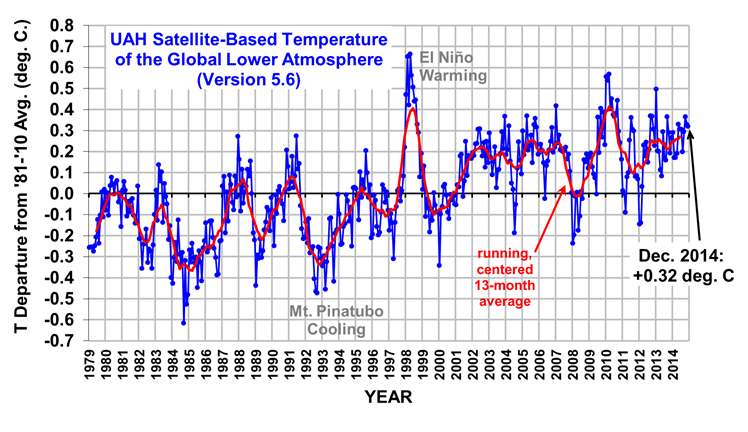
Meanwhile, the ‘warmest year’ is noticeably missing in the satellite data sets of lower atmospheric temperatures.  Roy Spencer reports that 2014 was third warmest year since 1979, but just barely.

Interesting that temperature sensors in European countries reported higher temperatures.

Dr. Curry is Professor and former Chair of the School of Earth and Atmospheric Sciences at the Georgia Institute of Technology. She has previously testified to Congress as an expert on climate change.

Roy Spencer does not think that land-based measurements of temperature are as reliable as satellite-based measurements. Do the satellite-based measurements confirm what NASA said?

He writes:

Most thermometers measure temperature where people live, and people tend to build stuff that warms the local environment around the thermometer.

Called the urban heat island (UHI) effect, most of the warming occurs long before the thermometer site actually becomes “urban”. For instance, if you compare neighboring thermometers around the world, and also compare their population densities (as a rough indication of UHI influence), it can be easily demonstrated that substantial average UHI warming occurs even at low population densities, about ~1 deg. F at only 10 persons per sq. km!

This effect, which has been studied and published for many decades, has not been adequately addressed in the global temperature datasets, partly because there is no good way to apply it to individual thermometer sites.

[…]For a “record” temperature to be statistically significant, it has to rise above its level of measurement error, of which there are many for thermometers: relating to changes in location, instrumentation, measurement times of day, inadequate coverage of the Earth, etc. Oh…and that pesky urban heat island effect.

A couple hundredths of a degree warmer than a previous year (which 2014 will likely be) should be considered a “tie”, not a record.

[…]Our satellite estimates of global temperature, which have much more complete geographic coverage than thermometers, reveal that 2014 won’t be even close to a record warm year.

In fact, the satellite and thermometer technologies seem to be diverging in what they are telling us in recent years, with the thermometers continuing to warm, and the satellite temperatures essentially flat-lining.

Here’s the graph:

UAH Global Temperature up to 2014
UAH Global Temperature up to 2014, as measured by satellites

It records the temperatures from satellites, which cannot be tampered with as easily as temperature sensors that are placed in urban areas. What we have here is a plateau, and not the hockey stick that was predicted by the global warming alarmists.

Obama administration to push for more government control in 2015

Here’s a rundown on some of the planned regulations, courtesy of Fox News. (H/T Dad)

Excerpt:

The Obama administration is trying to get fossil-fuel fired power plants to reduce carbon dioxide emissions by 30 percent from 2005 levels by 2030.

The EPA proposed the rules last year and is set to finalize them by summer 2015.

[…]Among them is a controversial EPA proposal to expand regulatory power over streams and wetlands. The agency, set to finalize the rule in April, estimates it could impose costs of between $162 million to $278 million per year…

[…][D]etractors claim it is an opening for the EPA to claim authority over countless waterways, including streams that only show up during heavy rainfall. Critics warn this could create more red tape for property owners and businesses if they happen to have even small streams on their land.

Rep. Lamar Smith, R-Texas, chairman of the House Science, Space, and Technology Committee, has called it an effort to “control a huge amount of private property across the country.”

In another EPA initiative, the agency is looking to October to finalize sweeping ozone regulations.

In proposing the limits on smog-forming pollution linked to asthma and respiratory illness in November, EPA Administrator Gina McCarthy argued that the public health benefits far outweigh the costs and that most of the U.S. can meet the tougher standards without doing anything new.

“We need to be smart — as we always have — in trying to find the best benefits in a way that will continue to grow the economy,” McCarthy said. Of reducing ozone, she added: “We’ve done it before, and we’re on track to do it again.”

But business groups panned the proposal as unnecessary and the costliest in history, warning it could jeopardize a resurgence in American manufacturing.

[…]The rules are estimated to cost industry anywhere between $3.9 billion and $15 billion by 2025. That price tag would exceed that of any previous environmental regulation in the U.S. Environmental groups are pushing for stricter limits still.

On other fronts, the Federal Communications Commission could move in a matter of months to propose new “net neutrality” rules. Obama weighed in on that debate late last year, urging the FCC to regulate the Internet like other utilities.

The White House is calling for an “explicit ban” on deals between broadband Internet providers and online services like Netflix, Amazon or YouTube to move their content faster, a potential new source of revenue for cable companies.

[…]Meanwhile, the National Labor Relations Board has issued new rules for so-called “ambush” union elections — speeding up elections and requiring employers to give unions contact information for workers. The rules take effect in April.

These regulations will have nasty effects on job-creating companies and that will work its way down to consumers, who will have to eat the costs. But at least the social engineers will feel really good about themselves, and without having to do the hard work of creating products and services that people will actually pay their own money for of their own free choice.

The very funny thing about this is how unionized blue-collar Democrats complain that they cannot compete with countries abroad, then vote in the very people that make them uncompetitive. You can bet that leaders in other low-cost countries do not pass laws to make them less competitive. And that’s why everything is manufactured abroad. Democrat voters bring these problems on themselves by electing socialists who hamstring American industry.