Dr. George Yancey did a presentation at the Reasonable Faith group at UT Dallas.
Here’s the lecture: (40 minutes)
About the speaker:
Dr. George Yancey is a Professor of Sociology at the University of North Texas. He is the author of Christian works such as One Body, One Spirit: Principles of Successful Multiracial Churches (InterVarsity Press), Beyond Racial Gridlock: Embracing Mutual Responsibility (InterVarsity Press), co-author of United by Faith: The Multiracial Congregation as an Answer to the Problem of Race (Oxford University Press) and co-author of Transcending Racial Barriers (Oxford University Press). He has also authored several research articles on the topics of interracial marriage and multiracial churches. Along those lines he is also the author of Multiracial Families (Routledge) which explores the current literature on different aspects of interracial families and Neither Jew Nor Gentile (Oxford University Press) which explores racial issues on Protestant college campuses.
His BS and MS are in economics. His PhD is in sociology.
Summary of the lecture:
Is discrimination against Christians real?
Which groups draw the most animosity?
What are the characteristics of those who most oppose conservative Christians?
What do cultural progressives think about conservative Christians?
Is the animosity against conservative Christians reasonable, or is it hatred / fear?
What kinds of stereotypes dominate animosity towards Christians?
Does animosity towards Christians affect hiring decisions in academia?
Why is the problem of Christianophobia not being addressed?
I was thinking about this lecture, and I was thinking, what would I do if I ran into one of these people who were really angry with me and wanted to feed me to lions, gas me, or murder me in other nasty ways. And I guess my only answer would be to speak to them and have them defend their beliefs without allowing them to pigeonhole me with a label. Maybe just focus on one particular issue like media bias or the origin of the universe, and try to focus on evidence rather than state my conclusion. Come to think of it, if you can name people on both sides and give evidence for both sides, that seems to work really well.
The more secular and left-wing the opponent, the more you have to stick with discussing ONLY evidence, and never say your view. So, you can say “how do you work this cosmic microwave background radiation in with your worldview?” but you can’t say, “I’m a conservative evangelical Christian, and you should come to church with me”. The secular progressives seem to be very concerned that Christians vote blindly for political leaders that restrict their freedoms, so again, don’t talk about policies, talk about the reasons on both sides for those policies. For example, do this “what is the morally significant difference between an unborn human and a born human that confers a right to life?” rather than “I’m pro-life and you should be pro-life too, or I’ll put you in jail”.
I have had conversations with people on the secular left who could not name a single reason for any of my beliefs. For example, gun ownership – they had no idea that people own guns for self-defense. Or capital punishment – they had no idea that there is a deterrent effect on other people contemplating violence crimes. They simply cannot express the view of their opponents or the reasons why their opponents hold those views. Maybe that’s partly their fault for being lazy and insular, but it might also be our fault, too, for not knowing the reasons. I know that when I explain the reasons to them (on both sides) and say that this is the evidence that needs to be debated, then they do often calm down. I think that their perception that we are irrational and faith-based scares them.
I think it’s a good idea to become aware of what the research says about secular progressive attitudes towards Christians so that we know how to act around them to avoid setting them off. When you are dealing with people who have this extreme hatred of you, you probably want to chip away at them rather than just be who you are right up front. There doesn’t seem to be a lot of tolerance here, which is so strange coming from the crowd that talks the most about tolerance. We are the only ones who they think it’s ok to fire, fine, imprison, etc.
Dr. George Yancey recently did a presentation at the Reasonable Faith group at UT Dallas.
Here’s the lecture: (40 minutes)
About the speaker:
Dr. George Yancey is a Professor of Sociology at the University of North Texas. He is the author of Christian works such as One Body, One Spirit: Principles of Successful Multiracial Churches (InterVarsity Press), Beyond Racial Gridlock: Embracing Mutual Responsibility (InterVarsity Press), co-author of United by Faith: The Multiracial Congregation as an Answer to the Problem of Race (Oxford University Press) and co-author of Transcending Racial Barriers (Oxford University Press). He has also authored several research articles on the topics of interracial marriage and multiracial churches. Along those lines he is also the author of Multiracial Families (Routledge) which explores the current literature on different aspects of interracial families and Neither Jew Nor Gentile (Oxford University Press) which explores racial issues on Protestant college campuses.
His BS and MS are in economics. His PhD is in sociology.
Summary of the lecture:
Is discrimination against Christians real?
Which groups draw the most animosity?
What are the characteristics of those who most oppose conservative Christians?
What do cultural progressives think about conservative Christians?
Is the animosity against conservative Christians reasonable, or is it hatred / fear?
What kinds of stereotypes dominate animosity towards Christians?
Does animosity towards Christians affect hiring decisions in academia?
Why is the problem of Christianophobia not being addressed?
I was thinking about this lecture, and I was thinking, what would I do if I ran into one of these people who were really angry with me and wanted to feed me to lions, gas me, or murder me in other nasty ways. And I guess my only answer would be to speak to them and have them defend their beliefs without allowing them to pigeonhole me with a label. Maybe just focus on one particular issue like media bias or the origin of the universe, and try to focus on evidence rather than state my conclusion. Come to think of it, if you can name people on both sides and give evidence for both sides, that seems to work really well.
The more secular and left-wing the opponent, the more you have to stick with discussing ONLY evidence, and never say your view. So, you can say “how do you work this cosmic microwave background radiation in with your worldview?” but you can’t say, “I’m a conservative evangelical Christian, and you should come to church with me”. The secular progressives seem to be very concerned that Christians vote blindly for political leaders that restrict their freedoms, so again, don’t talk about policies, talk about the reasons on both sides for those policies. For example, do this “what is the morally significant difference between an unborn human and a born human that confers a right to life?” rather than “I’m pro-life and you should be pro-life too, or I’ll put you in jail”.
I have had conversations with people on the secular left who could not name a single reason for any of my beliefs. For example, gun ownership – they had no idea that people own guns for self-defense. Or capital punishment – they had no idea that there is a deterrent effect on other people contemplating violence crimes. They simply cannot express the view of their opponents or the reasons why their opponents hold those views. Maybe that’s partly their fault for being lazy and insular, but it might also be our fault, too, for not knowing the reasons. I know that when I explain the reasons to them (on both sides) and say that this is the evidence that needs to be debated, then they do often calm down. I think that their perception that we are irrational and faith-based scares them.
I think it’s a good idea to become aware of what the research says about secular progressive attitudes towards Christians so that we know how to act around them to avoid setting them off. When you are dealing with people who have this extreme hatred of you, you probably want to chip away at them rather than just be who you are right up front. There doesn’t seem to be a lot of tolerance here, which is so strange coming from the crowd that talks the most about tolerance. We are the only ones who they think it’s ok to fire, fine, imprison, etc.
There are three posts in the series, and I think these are all worth reading.
Let’s see the introduction to the series from the first post.
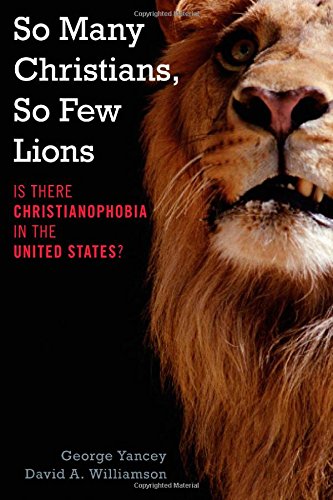
Over the next three blog entries, I am going to discuss the content of my latest book –So Many Christians, So Few Lions – Christianophobia in the United States. Actually the book has not come out yet, but will officially come out later this month. Obviously the focus of the book will be the nature of anti-Christian attitudes in the United States. In this first entry, I look at the contours of a basic level of animosity towards conservative Christians in the United States. My next entry will qualitatively explore the nature of Christianophobic attitudes. In my final entry I will consider the implications of this work, as well as other research and social events, for what it means about this type of anti-religious bigotry. For the balance of these blog entries, I will define Christianophobia as unreasonable hatred or fear of Christians.
Here’s a snippet that explains which segment of our society is opposed to Christians who take the Bible seriously:
In another research project that I am currently working on, we asked college teachers how they would define a fundamentalist and how they would see a fundamentalist as different from other Protestants. Beyond basic stereotypical descriptions, these individuals tended to label fundamentalists as those who believed the Bible to be the literal word of God. According to the 2012 ANES, about a third of Americans have such a belief. If the respondents in the ANES use a similar definition of fundamentalism then the animosity exhibited by them is not directed at an extreme Christian fringe but against a substantial portion of the population.
What is as important as the extent of this animosity is who tends to possess this animosity. Those who listed Christian fundamentalists a standard deviation below the mean of the other groups are 79.4 percent white, 47.6 percent with a bachelor degree, 64.5 percent make at least $50,000 a year and 29.2 percent make at least $100,000 a year. All of these numbers are significantly higher than the percentages in the population without this animosity. Thus, those with anti-Christian hostility are whiter, better educated and wealthier than others in our society. These are majority group qualities indicating that those with anti-Christian animosity have more per-capita social power than the average person.
Remember that we not only explored animosity towards conservative Christians but also animosity towards other social groups. I found that those with relative hostility towards atheists are older, non-white, undereducated, political conservatives. Those with relative hostility towards Muslims tend to be older, nonblack political conservative males. Those with relative hostility towards Mormons are younger, non-whites political progressives. This provides some complexity to this discussion of potential religious bias and bigotry. For example, there appear to be just as many people with anti-Muslim hostility as there are with hostility towards conservative Christians. However those with potential Islamophobia do not seem to have a great deal of per-capita political power, unlike those with potential Christianophobia.
Here’s a snippet that discusses whether the group identified in post one dehumanize Christians:
Several researchers and social thinkers have written about dehumanization. But the best conceptualization of dehumanization comes from Nick Haslem. He identified two types of dehumanization: animalistic and mechanical. A cursory reading of the answers from the respondents indicates that animalistic dehumanization fits their responses better than mechanical dehumanization. He identified five qualities of animalistic dehumanization – lack of culture instead of civility, coarseness instead of refinement, amorality instead of moral sensibility, irrationality instead of logic and childlikeness instead of maturity.
I do not have the space to explore all five of these qualities within the answers of my respondents (I did such an exploration in the book). But I will look at the last characteristic which is the notion that Christians are childlike instead of mature. Indeed my respondents tended to paint a picture of Christians being immature individuals led by powerful, manipulative leaders.
The leaders are deceptive and power hungry individuals who invoke “God” in a political sense to rally their supporters…They play to people’s emotions, daily. (Female, aged 26-35 with Bachelor degree)
Their movement’s leaders are the worst type of manipulative authoritarian scum and their millions of followers are sad, weak people who are all too willing to give up their self-respect and liberty for a fantasy. (Male, aged 26-35 with Bachelor degree)
In this way the respondents take away the agency of Christians by suggesting that they are weak individuals unable to resist the desires of evil leaders. Rather the respondents support an image of Christians as being children misled by bad parents.
This type of stereotyping fits quite well with some of the insults that my respondents used in describing Christians. For example, some variation of the term “brainwash” came up 137 times, from 125 respondents. Almost every time the term was used, it was to note the inability of Christians to think for themselves. For example, a female, aged 56-65 with a bachelor degree wrote, “I believe that this group is in general poorly educated and often brainwashed to the point of seeing no perspective but their own. Many allow themselves to become tools of charismatic, self serving leaders because they have been deprived of the education and tools to ever think otherwise.” This respondent, like many other respondents, have a stereotype of Christians reflecting them as unthinking imbeciles. It is a dehumanizing stereotype creating an image of Christians as not having full human capacities.
Beyond the notion of brainwashing, 66 of our respondents use the terms sheep and 5 of our respondents used the term lemmings to describe Christians as well.
[…]These numbers seem low considering that I have a sample of almost three thousand respondents; however, it should be noted that these comments comparing Christians to animals are unprompted. (It is also instructive to consider which terms were not used at all. For example, ape or gorilla was not used by any of the respondents to describe conservative Christians.) Closed ended questions providing respondents with the opportunity to characterize conservative Christians in animalistic terms would likely garner a nontrivial level of support. The comments about Christians as passive animals, combined with the relative willingness of the respondents to use the term brainwashed, occur often enough to provide some confidence that characterizations of Christians as unthinking passive followers are accepted within subcultures with high levels of Christianophobic animosity. If there is any doubt that there is an animalistic element to the type of dehumanizing occurring among my respondents, the use of these animals clearly indicates that Christians are not always seen as human.
Here’s a snippet showing how this bias against Christians manifests itself:
It is well established that academics tend to be more politically progressive and secular than the general population. It is obvious that they are highly educated. So academia theoretically should be a place where we would find a higher than normal level of Christianophobia. This Christianophobia may manifest in discrimination against conservative Christians. A few years ago I conducted research suggesting that this is the case. I found that academics were willing to discriminate against a prospective candidate for an academic position if they found out that the candidate is a conservative Protestant. In fact, they were more willing to discriminate against conservative Protestants than against any other social group included in my survey. Their willingness to discriminate against those Protestants was even more powerful than their willingness to discriminate against political conservatives. Religious intolerance trumps potential political intolerance among academics.
Of course simply because academics state that they are open to discriminating against conservative Protestants does not mean that they actually engage in such discrimination. A survey is not sufficient evidence. However, Rothman and Lichter conducted research documenting that academics with socially conservative beliefs tend to be located in lower status occupational positions even after controlling for demographic variables and their level of productivity. If conservative Protestants are more likely to have socially conservative beliefs than other academics, a reasonable belief, then this research suggests systematic evidence that there are occupational disadvantages in academia to having conservative Christian beliefs. Since academics have a willingness to discriminate against those Christians, this disadvantage cannot merely be due to their inability to do science, as the common stereotype of Christians seems to imply, but discrimination from academics who may be motivated by Christianophobia is likely an important factor.
Buy the book if you find this a useful tool for your own discussions.
You may also like to watch this lecture featuring Dr. Yancey.

 WINTERY KNIGHT