Tag Archives: Chile

American hero and his private corporation save 33 Chilean miners

Here’s the setup from Canada Free Press.

Excerpt:

Things looked grim for the miners when the San Jose mine collapsed on Aug. 5.  It was going to take painstaking patience and a marvel of engineering to bring the men, trapped 2,100 feet below, to the surface.

When it became clear that all 33 miners trapped in the mine were alive, an emergency call went out to find the expertise to save them and was answered by the Mission Woods, Kansas Layne Christensen Company, who sent their most experienced drillers to the rescue.

Although they’ve shunned the publicity, the heroes in this rescue mission are ones of epic proportion.  They include two drillers Jeff Hart and Matt Staffel, who had been drilling water wells in Afghanistan to support U.S. troops stationed there.  Assisting the drillers were two Spanish-speaking drilling helpers, Doug Reeves and Jorge Herrera from Layne’s western region in the U.S.

(Layne’s Latin American affiliate) “Geotec operations manager James Stefanic said he quickly assembled “a top of the line team” of drillers who are intimately familiar with the key equipment, including engineers from two Pennsylvania companies—Schramm Inc., which makes the T130 drill, and Center Rock Inc., which makes the drill bits.” (Michelle Malkin, Oct. 12, 2010.)

From Investors Business Daily.

Excerpt:

The leadership of Chile President Sebastian Pinera, believing fiercely in globalization and free markets, and not believing in limits, seemed to make a critical difference.

Pinera refused to shut out foreign expertise. As the world focused on Chile’s miners underground, the rescue operation above was characterized by an Apollo 13-like sense of mission. Failure was not an option.

That gave the mission an international flavor a la “Star Trek.” Unlike President Obama, who invoked the Jones Act to spurn foreign offers of help in April’s Gulf oil spill, or Russia’s Vladimir Putin, who said “nyet” to American naval rescue ships after the Kursk nuclear sub sank in Arctic waters in 2000, leaving 29 to die at a depth of 650 feet, Pinera brought in the best brains outside his country to improve the odds of success.

Among companies responding was Schramm Inc., the Pennsylvania-based manufacturer of drilling rigs, which produced the drills that first reached the miners and then carved out their rescue path, with UPS shipping a 13-ton product from the Keystone State in just two days.

Another Pennsylvania company, Center Rock, provided the drill bit. Texas’ Techint came up with steel tubes that made the shaft safe. Geotec Broyles Bros.’ American engineers operated the drill, and Maryland-based Zephyr Technology provided the medical monitors during the rescue.

Argentine, Canadian and Australian companies also had roles, as did NASA. The result was a showcase of mostly American engineering that didn’t take any credit away from Chile.

Pinera also grasped the importance of just being on hand and transparent. The Chileans communicated clearly with both the miners and the outside world about what was happening. One of the first three holes drilled by rescuers was for communication.

Pinera spent a lot of time at the remote desert site. He was there when the incredible discovery of life was made, and he assured the miners the long wait for their rescue was strictly geological and logistical — not bureaucratic. He gave everyone hope by being engaged and involved.

Michelle Malkin writes:

In a different day and age, Jeff Hart would be the most famous American in our country right now. He would be honored at the White House. Schoolchildren would learn of his skill and heroism. But because Jeff Hart works in an industry under fire by the Obama administration, more people in Chile will celebrate this symbol of American greatness than in America itself. Jeff Hart is a driller based in my home state of Colorado. The father of two has been drilling water wells in Afghanistan at U.S. Army bases. When the San Jose Mine in Chile collapsed in August, he flew to lend his renowned expertise to the rescue effort. As part of an amazing three-way race to the trapped miners, Hart drilled for 33 days straight and was first to reach the caved-in workers. The AP recounts the story – and what strikes me again and again is how the world turned to American ingenuity and American fortitude and American equipment and American enterprise to get the job done…

Government cannot solve problems. Academic elites in the humanities cannot solve problems. Left-wing union thugs shouting slogans cannot solve problems.

Entrepreneurs and engineers solve problems. Capitalism solves problems. Businesses solve problems. America solves problems.
Colombia’s war on terrorism and Chile’s war on poverty

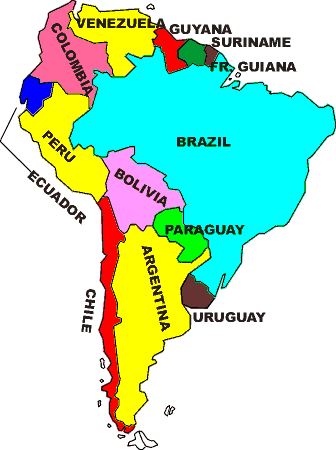
Map of South America

A magnificent column about Colombia’s war on FARC.

Excerpt:

When Juan Manuel Santos came into office as Colombia’s president and emphasized economic issues over the fight against terrorist guerrillas, he was suspected of going soft on those he had combated as minister of defense under the previous administration. Little did his critics know that he was planning the “coup de grace” against the Revolutionary Armed Forces of Colombia (FARC).

The devastating Sept. 22 attack on FARC headquarters in Colombia’s central Meta province all but signifies the end of the five-decade-old conflict. It will take a little while for the official end to be declared, but this war is pretty much over.

[…]For decades, politicians, academics, human rights activists and journalists on both sides of the Atlantic failed to see that there was nothing romantic, “bien-pensant” or Robin Hoodesque about an organization that killed, maimed, kidnapped and extorted for a totalitarian objective.

Colombia’s solitude was such that even the U.S. began to lose faith in its ally a couple of years ago, refusing to approve a free-trade agreement that Bogota had negotiated at a major political cost.

Colombians did not give up and continued to reclaim territory for civilian rule. Much like the defeat of Venezuela’s Cuba-inspired terrorist guerrillas in the 1960s, Colombia’s victory against FARC is the result of civilians awakening to the evil of totalitarian terror.

We get to hear about spectacular military feats, but how many outside Colombia realize that peasants, factory workers, teachers, students and others joined the struggle to defeat FARC, beautifully symbolized by the hundreds of thousands who took to the streets inside Colombia and around the world in 2008 to clamor for the end of terror?

There are still many challenges ahead. The lesson in courage and perseverance that Colombians have given us suggests they are ready to meet them.

I wish that we could sign a free trade deal with them like Canada’s conservative government. Canada is led by a conservative business-friendly economist, and they are very supportive of capitalist democracies like Colombia. Stephen Harper is Canada’s prime minister. He has economics degrees from the University of Calgary. Like Santos, he is very, very tough on terrorism – favoring increased defense spending to protect Canadian interests abroad. And guess what? Canada also has a free trade agreement with another South American country – Chile.

And Chile is also doing very well, even after the massive earthquake.

Excerpt:

Chile’s peso rose to a 27-month high after a report showed the country’s industrial growth accelerated to the fastest since 2006.

The peso appreciated 0.2 percent to 485.23 per U.S. dollar at 11:43 a.m. New York time, from 486.17 yesterday. The currency touched 483.61, the strongest since June 11, 2008. The peso has risen 13 percent during the quarter and 3.6 percent this month.

Chile’s economy is accelerating after the fifth-largest earthquake in a century struck in February, delaying its recovery from a 2009 recession.

“Retail sales grew and industrial production was better than expected,” said Roberto Melzi, a strategist at Barclays Capital in New York.

Retail sales expanded 13 percent in August from a year earlier, and industrial output grew 6.9 percent, the National Statistics Institute said in Santiago. That’s the most since January 2006. Industrial production shrank 17 percent after the 8.8-magnitude Feb. 27 earthquake and its accompanying tsunami, which caused damage worth more than a sixth of Chile’s gross domestic product.

Chile and Colombia are my two favorite South American countries. Both are led by conservative business-friendly economists. Chile’s president Sebastián Piñerahas a Masters and a Ph.D in economics from Harvard, and is successful in the private sector. The Colombian President Juan Manuel Santos specializes in business and economics, with graduate degrees from Harvard and the London School of Economics.

Why is it so cold in South America? Is it global warming?

Consider this post from Watts Up With That.

Excerpt:

A brutal and historical cold snap has so far caused 80 deaths in South America, according to international news agencies. Temperatures have been much below normal for over a week in vast areas of the continent. In Chile, the Aysen region was affected early last week by the worst snowstorm in 30 years. The snow accumulation reached 5 feet in Balmaceda and the Army was called to rescue people trapped by the snow.

In Argentina, the snow in the region of Mendoza, famous for its winery, was described by local meteorologists as the heaviest in a decade. The temperature in the morning of July 16th was the lowest in the city of Buenos Aires since 1991: -1.5C. The cold snap caused a record demand for energy and Argentina had to import electricity from Brazil. Many industries in Argentina were shut down due to gas shortage.

It snowed in nearly all the provinces of Argentina, an extremely rare event. It snowed even in the western part of the province of Buenos Aires and Southern Santa Fe, in cities at sea level.

And more from a different Watts Up With That post. A map!

It’s global warming!!!

A brutal and historical cold snap has so far caused 80 deaths in South America, according to international news agencies. Temperatures have been much below normal for over a week in vast areas of the continent. In Chile, the Aysen region was affected early last week by the worst snowstorm in 30 years. The snow accumulation reached 5 feet in Balmaceda and the Army was called to rescue people trapped by the snow.

In Argentina, the snow in the region of Mendoza, famous for its winery, was described by localimagemeteorologists as the heaviest in a decade. The temperature in the morning of July 16th was the lowest in the city of Buenos Aires since 1991: -1.5C. The cold snap caused a record demand for energy and Argentina had to import electricity from Brazil. Many industries in Argentina were shut down due to gas shortage.

It snowed in nearly all the provinces of Argentina, an extremely rare event. It snowed even in the western part of the province of Buenos Aires and Southern Santa Fe, in cities at sea level.

The most famous beach of Argentina, Mar del Plata, was whitened by the snow in the morning of July 15th, a scene only seen in recent memory in 1991, 2004 and 2007.