Tag Archives: Canada

Crime in Canada reaches lowest level in 40 years due to Conservative party policies

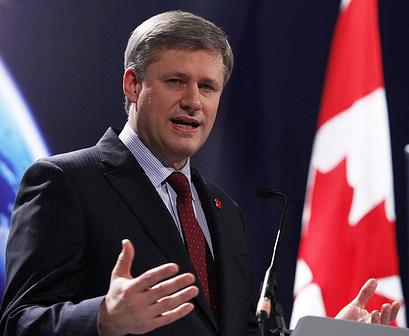
Prime Minister Stephen Harper

From the National Post.

Excerpt:

New figures show Canada’s crime rate dipped to its lowest level in 40 years last year, the very year the federal government enacted some of its harshest tough-on-crime policies.

Just under two million criminal incidents were reported to police in 2012, about 36,000 fewer than the previous year, according to a Canadian Centre for Justice Statistics study on police-reported crime.

The decline is primarily attributed to decreases in non-violent crimes. In fact, 2012 marked the ninth consecutive year that both the volume and severity of crime was down.

According to the study, 543 homicides were reported across the country, 55 fewer than in 2011. Youth crime was also down.

“As a result, the homicide rate fell to its lowest level since 1966,” the report concluded.

Relaxing gun control laws was also likely a factor:

Although crime rates have been falling for years, the federal government passed a controversial omnibus crime bill early last year. It set a number of mandatory minimum penalties for drug trafficking and sex crimes against children and got tough on pot producers, young offenders, Canadians imprisoned abroad seeking a transfer to a Canadian institution and ex-cons seeking a pardon.

The government also scrapped the controversial long gun registry last year.

A gun registry is nothing but a promise that the government will confiscate weapons later. When the registry goes away, people feel safer about buying guns. The more citizens who are legally armed, the worse it is for criminals.

I’m posting this to show that unlike our own government, some governments are actually doing things that work to solve problems. But all of this goes back to qualifications. Stephen Harper has the BA and MA in Economics. He is an economist, so he understands how laws and policies influence human behavior. That’s why when he makes a policy, he gets the results he wants to get. He actually knows what he is doing. He is actually doing work that he knows how to do. It can happen.
Is environmentalism good for the environment?

Although I am not a global warming alarmist, I am concerned with conservation. So, all things being equal, I think it’s a good idea not to pollute the environment unnecessarily. Now, you might think that environmentalists agree with me on that.

Let’s take a look at this article by Bret Stephens from the Wall Street Journal where he writes about how a train that was transporting shale oil was derailed and then exploded. (H/T Dennis Prager)

Excerpt:

The derailed 72-car train belonged to a subsidiary of Illinois-based multinational Rail World, whose self-declared aim is to “promote rail industry privatization.” The train was carrying North Dakota shale oil (likely extracted by fracking) to the massive Irving Oil refinery in the port city of Saint John, to be shipped to the global market. At least five people were killed in the blast (a number that’s likely to rise) and 1,000 people were forced to evacuate. Quebec’s environment minister reports that some 100,000 liters (26,000 gallons) of crude have spilled into the Chaudière River, meaning it could reach Quebec City and the St. Lawrence River before too long.

Now the question is, why is it that trains are used instead of pipelines, when pipelines are safer than trains?

Let’s see why:

The reason oil is moved on trains from places like North Dakota and Alberta is because there aren’t enough pipelines to carry it. The provincial governments of Alberta and New Brunswick are talking about building a pipeline to cover the 3,000-odd mile distance. But last month President Obama put the future of the Keystone XL pipeline again in doubt, telling a Georgetown University audience “our national interest will be served only if this project does not significantly exacerbate the problem of carbon pollution.”

[…]Like water, business has a way of tracing a course of least resistance. Pipelines are a hyper-regulated industry but rail transport isn’t, so that’s how we now move oil. As the Wall Street Journal’s Tom Fowler reported in March, in 2008 the U.S. rail system moved 9,500 carloads of oil. In 2012, the figure surged to 233,811. During the same period, the total number of spills went from eight to 69. In March, a derailed train spilled 714 barrels of oil in western Minnesota.

Predictable, you would think. And ameliorable: Pipelines account for about half as much spillage as railways on a gallon-per-mile basis. Pipelines also tend not to go straight through exposed population centers like Lac-Mégantic. Nobody suggests that pipelines are perfectly reliable or safe, but what is? To think is to weigh alternatives. The habit of too many environmentalists is to evade them.

Investors Business Daily has more on the benefits of pipelines:

Railways suffer spills 2.7 times more often than pipelines, according to the Washington-based Association of American Railroads. If that seems self-serving, the State Department, citing a 2012 study from the free-market Manhattan Institute, said trains spill 33 times more oil than pipelines.

[…]”The evidence is so overwhelming that railroads are far less safe than pipelines,” says Charles Ebinger, director of the Brookings Institution’s energy security initiative.

Brookings is a left-leaning think tank, and they agree: pipelines are safer than trains.

It does make sense, I think, for Christians and conservatives to ask ourselves sensible questions about the environment. How do we make air clean enough? How do we make water clean enough? How do we avoid impacting nature unnecessarily? But I think this story about the train should help us realize that fundamentalist environmentalists are not the best people to be making these sorts of policy decisions. These decisions should be made by rational thinkers, who can consider all sides of an issue and think critically about the needs of everyone concerned. This is not a problem for secular leftist idealists who are more motivated by blind faith than by facts.

Canada repeals Section 13 law that criminalized politically incorrect speech

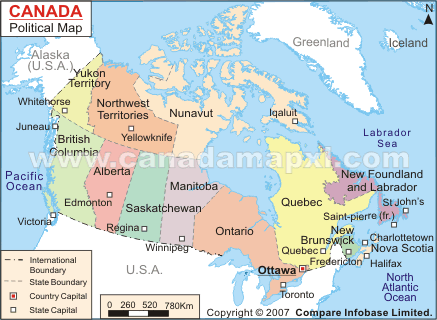
Canada Political Map

Sun News reports on some good news up north.

Excerpt:

An Alberta MP has succeeded in his bid to repeal a section of the Canadian Human Rights Act long seen by free-speech advocates as a tool to squelch dissenting opinions.

Conservative MP Brian Storseth saw the Senate give third and final reading late Wednesday to his Bill C-304 which repeals Section 13 of the Human Rights Act, an act that had been used to, among other things, attack the writings of Sun News Network’s Ezra Levant and Maclean’s columnist Mark Steyn.

Section 13 ostensibly banned hate speech on the Internet and left it up to the quasi-judicial human rights commission to determine what qualified as “hate speech.” But, unlike a court, there was no presumption of innocence of those accused of hate speech by the commission. Instead, those accused had to prove their innocence.

With elimination of Section 13, producing and disseminating hate speech continues to be a Criminal Code violation but police and the courts will adjudicate rather than human rights tribunals.

Storseth drafted his bill in 2011 and enjoyed support from the highest levels in cabinet.

“Our government believes Section 13 is not an appropriate or effective means for combating hate propaganda,” Justice Minister Rob Nicholson said in late 2011. “We believe the Criminal Code is the best vehicle to prosecute these crimes.”

Last summer, Storseth’s bill cleared the House of Commons in a free vote and, now that it’s through the Senate, it will get royal assent and Section 13 should soon disappear.

Brian Lilley comments: (H/T Blazing Cat Fur)

To put it bluntly, the means you can’t take someone through the federal human rights apparatus over hurt feelings via a blog post or a Facebook comment.

Now the bill is passed and will become law but like many acts of Parliament it will not come into force for a year.

Still after a long hard battle to restore free speech in Canada, this is a victory.

Canada just became a little more free. Congratulations to Stephen Harper and the Conservative Party of Canada for undoing a harmful policy enacted by the radical left.