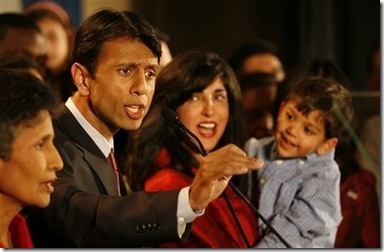
Tag Archives: Bobby Jindal

Republican governors Bobby Jindal and Tim Pawlenty cut off ACORN funds

Two candidates for the Presidency in 2012 make their case.

Bobby Jindal: (H/T Michelle Malkin)

Louisiana Governor Bobby Jindal today cut off state funding for the community activist group ACORN.

Jindal has also blocked any state agency for entering into contracts with the organization.

The executive order also cuts off any future state funding of ACORN, on the heels of a series of embarrassing incidents for the organization.

The governor’s action follows a subpoena of documents from the group’s national headquarter office in New Orleans.

According to Jindal’s executive order, “ACORN’s actions make clear that financial involvement with ACORN is contrary to the public policy of the State of Louisiana and the best interests of its citizens.”

Tim Pawlenty:

Minnesota Gov. Tim Pawlenty (R.) sent a letter Wednesday afternoon to the director of the Minnesota Commission of Management and Budget ordering him to stop all state funding to ACORN (the Association of Community Organizations for Reform Now).

Meanwhile, the Republican governor of California launches an investigation of ACORN operations. (H/T Hot Air)

And what about the lovely Michele Bachmann?

Well, naturally I am concerned more my favorite politician Michele Bachmann, who is also willing to running for the Presidency in 2012. And I think it may be a good time now to remind you all that she was attacking ACORN before attacking ACORN was cool. You can send her a donation, if you like!

She was fighting to cut off ACORN funding in JUNE of 2009.

And she’s much prettier than those other candidates, too!

Bobby Jindal explains the right way to lower health care costs

Bobby and Supriya Jindal

Governor Bobby Jindal is a wizard with health care policy!

Here he is writing in the Wall Street Journal about how to cut health care costs without rationing care:

Consumer choice guided by transparency. We need a system where individuals choose an integrated plan that adopts the best disease-management practices, as opposed to fragmented care. Pricing and outcomes data for all tests, treatments and procedures should be posted on the Internet. Portable electronic health-care records can reduce paperwork, duplication and errors, while also empowering consumers to seek the provider that best meets their needs.

Aligned consumer interests. Consumers should be financially invested in better health decisions through health-savings accounts, lower premiums and reduced cost sharing. If they seek care in cost-effective settings, comply with medical regimens, preventative care, and lifestyles that reduce the likelihood of chronic disease, they should share in the savings.

Medical lawsuit reform. The practice of defensive medicine costs an estimated $100 billion-plus each year, according to the American Academy of Orthopaedic Surgeons, which used a study by economists Daniel P. Kessler and Mark B. McClellan. No health reform is serious about reducing costs unless it reduces the costs of frivolous lawsuits.

Insurance reform. Congress should establish simple guidelines to make policies more portable, with more coverage for pre-existing conditions. Reinsurance, high-risk pools, and other mechanisms can reduce the dangers of adverse risk selection and the incentive to avoid covering the sick. Individuals should also be able to keep insurance as they change jobs or states.

Pooling for small businesses, the self-employed, and others. All consumers should have equal opportunity to buy the lowest-cost, highest-quality insurance available. Individuals should benefit from the economies of scale currently available to those working for large employers. They should be free to purchase their health coverage without tax penalty through their employer, church, union, etc.

Pay for performance, not activity. Roughly 75% of health-care spending is for the care of chronic conditions such as heart disease, cancer and diabetes—and there is little coordination of this care. We can save money and improve outcomes by using integrated networks of care with rigorous, transparent outcome measures emphasizing prevention and disease management.

Refundable tax credits. Low-income working Americans without health insurance should get help in buying private coverage through a refundable tax credit. This is preferable to building a separate, government-run health-care plan.

These are conservative solutions – they will preserve out liberty and prosperity.

Bobby Jindal is my pick for Secretary of Health and Human Services in 2012, if he isn’t elected President. So remember his name!

Round-up of recent Republican legislative initiatives

Tom Coburn

The Maritime Sentry had this post about Senator Tom Coburn’s Patient’s Choice Act.

“The Patients’ Choice Act of 2009,” transforms health care in America by strengthening the relationship between the patient and the doctor; using choice and competition rather than rationing and restrictions to contain costs; and ensuring universal, affordable health care for all Americans.

Tom Coburn is a medical doctor, not an ACORN lawyer who sues banks to force them to make risky loans. Commenter ECM sent me this article he wrote for the left-wing Huffington Post, in which he explains his new bill.

Marsha Blackburn

Congresswoman Blackburn urged the Senate not to pass the Democrat health care bill, citing the experience gleaned from Tennessee’s own bankrupt single-payer system.

In 1995, the state implemented TennCare, a health program modeled after Medicaid. While it covered more uninsured adults, the budget-busting program grew at a 1.5-percent annual rate, with costs skyrocketing from $2.5 billion in 1995 to $8 billion by 2004, Blackburn said.

“This program started to consume every new dollar that was generated in the state,” Blackburn said. Additionally, Tennessee residents who already had private health insurance were dropping their plans to get on the free health program, she said. “We started hearing stories of individuals trying to buy ‘uninsurable’ letters so they could get on TennCare.”

By 2005, Tennessee Gov. Phil Bredesen cut 170,000 adults from the program and reduced benefits for thousands more to get a handle on the soaring costs. “Our experience with trying to do universal coverage ended up being a disaster,” he recently told the AP.

Don’t forget about Mitt Romney’s socialized health care plan in Massachusetts, which is also bankrupt. When you make something “free” demand skyrockets, and the people who are being taxed to pay for it stop working or leave. That’s reality.

Lamar Alexander

Senator Lamar Alexander introduced a bill last week to distribute the government’s newly acquired stock in GM and Chrysler to taxpaying Americans.

“Instead of the Treasury owning 60 percent of shares in the new GM and 8 percent of Chrysler, you would own them, if you were one of about 120 million individuals who paid taxes on April 15,” Alexander explained. “This is the fastest way to get the stock out of the hands of Washington and back into the hands of the American people in the marketplace where it belongs. The stock certificates would be in your name, not that of your government.”

…“It would be helpful to GM and Chrysler if they had 120 million Americans interested in their success.”

And Senator Mike Johanns urges oversight on the TARP money already redistributed to the Obama’s union special interests, who desperately need it to pay for their underfunded pensions. In contrast, Democrat Barney Frank called GM’s CEO to complain about a GM warehouse closing in his home state. (Recall that Obama called the mayor of Detorit to assure him that GM would not be moving their headquarters out of Detroit). The Road to Serfdom.

Mike Pence

Congressman Mike Pence introduces the American Energy Act, a bill to increase clean domestic energy production.

The bill has 4 main objectives:

  • Increase production of American-made energy in an environmentally-sound manner.
  • Promote new, clean and renewable sources of energy such as nuclear, clean-coal-technology, wind and solar energy.
  • Encourage greater efficiency and conservation by extending tax incentives for energy efficiency and rewarding development of greater conservation techniques and new energy sources.
  • Cut red-tape and reduce frivolous litigation.

Good idea since gas prices are up $1.00 per gallon from the beginning of the year.

Bobby Jindal

Bobby Jindal, my pick in 2012 for President, is championing EIGHT bills to get tough on criminals.

Here are two of them:

  • House Bill 445 will, as reported by the Baton Rouge Advocate, “suspend a license for two years the first time a driver refuses to take a Breathalyzer test [and] a subsequent refusal would strip a driver’s license for four years.”
  • Senate Bill 166 would, as stated in the New Orleans Times-Picayune, “change the offense of driving with a suspended license for a previous DWI-related conviction from a traffic law violation to a violation of the criminal code.”

The rest are here, addressing child abuse, child welfare, sexual misconduct by teachers, monitoring of sex offenders, and more!