
Tag Archives: Basic Economics

Wages of low-income workers have risen faster than middle and high income workers

In Trump's America, low-wage workers see the highest wage increases
In Trump’s America, low-wage workers see the highest wage increases

By now, everyone has heard about how the unemployment rate is at a record low. Not only that, but the unemployment rates for women, blacks and hispanics are also at record lows. But did you know that wages have been increasing at the highest rate for low-income workers? That’s right. It’s low-wage workers who are seeing their incomes go up the most.

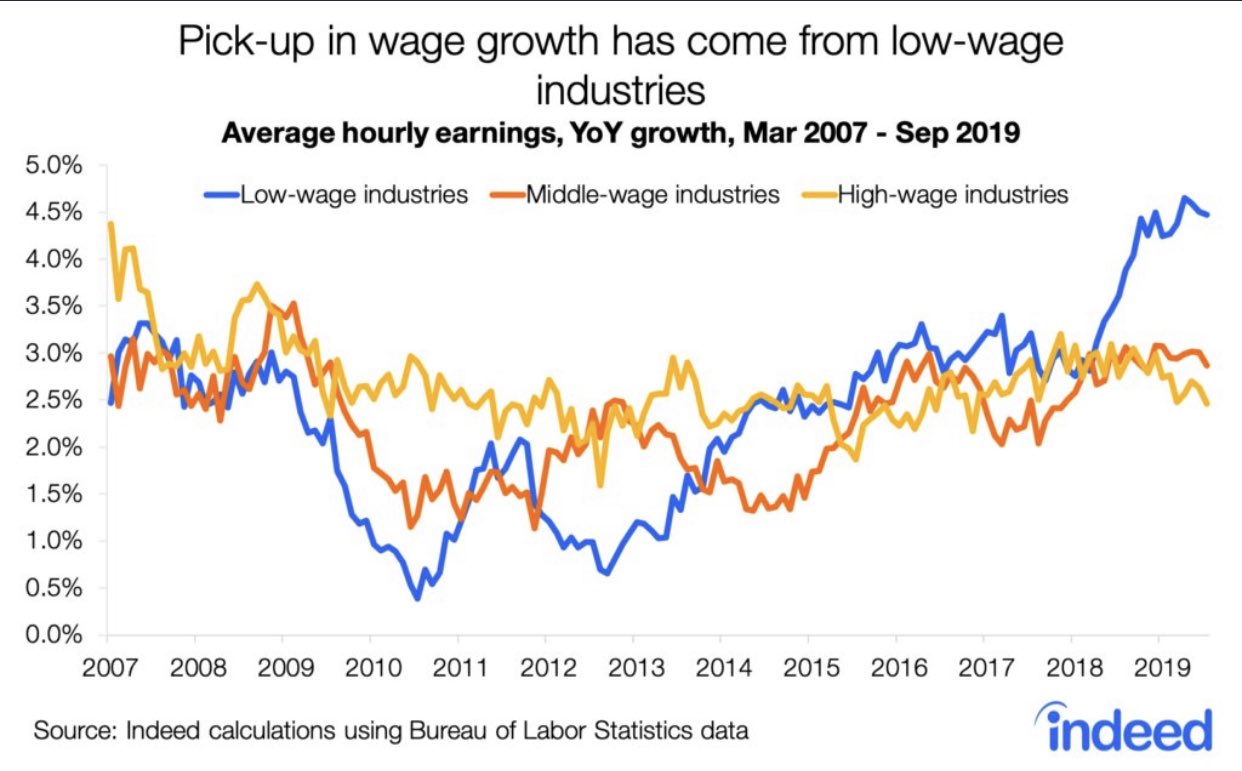
Here’s an analysis done by an economist at Indeed.com, one of the largest online job boards:

The US economy added 130,000 jobs in August, and the unemployment rate was flat at 3.7%.

After this report, we can all take a breath, but not a big one. While we are still seeing many of the disconcerting trends of the past few months, the labor market continues to grow at a healthy rate.

Before assuming that the total job growth number in August is skewed because of Census hiring, remember that these are real jobs taken by real workers. Even if you remove government hiring, which accounts for around 34,000 jobs, this is still a number that is high enough to keep up with population growth. This month’s report reflects a slowing labor market but not necessarily one heading straight for a recession.

Wage growth strongest for low-wage industries

At this point in the expansion, we’d expect wage growth to pick up, but it is continuing to stall. In fact, wage growth continues to be strongest for workers in lower-wage industries. Labor force participation grew in the month, signaling a labor market still drawing workers off the sidelines. Job seekers are still benefiting from this job market, but let’s not count on this lasting forever.

That analysis was done in August of this year, and as you may have heard, the numbers since then have been even better.

CNBC explained:

The jobs market turned in a stellar performance in November, with nonfarm payrolls surging by 266,000 and the unemployment rate falling to 3.5%, according to Labor Department numbers released Friday.

Those totals easily beat the Wall Street consensus. Economists surveyed by Dow Jones had been looking for solid job growth of 187,000 and saw the unemployment rate holding steady from October’s 3.6%.

[…]In addition to the robust November gains, revisions brought up totals from the two previous months. September’s estimate went up 13,000 to 193,000 and the initial October count increased by 28,000 to 156,000. Those changes added 41,000 to the previous tallies and brought the 2019 monthly average to 180,000, compared with 223,000 in 2018.

So my point here is simple. Democrats are mad because they lost the election, and they really aren’t interested in whether president Trump is doing a good job or a bad job. The thing is, president Trump is doing a terrific job if all you care about is numbers. I understand that Democrats love their New York infanticide, their Seattle mayor pedophilia, their Democrat FBI agent adultery, their black face Virginia governor, their Clinton-funded Steele dossier, etc. But for the rest of us who just want to have a job, keep what we earn, and spend it how we want, this has been a great presidency.

It’s not just low unemployment and increased wages. Conservatives are happy about a never-ending stream of conservative judges filling up vacancies on federal courts.

Far-left Politico is not too happy about this:

The Senate confirmation of Lawrence VanDyke and Patrick Bumatay to the 9th U.S. Circuit Court of Appeals this month brought to nine the number of appointments President Donald Trump has made to the 29-member bench that serves as the last stop for nearly all legal complaints lodged in nine Western states. Democratic-appointed judges now hold a three-seat majority, compared with 11 at the start of Trump’s presidency.

If the trend continues, it represents a major shift in the liberal wing of the judiciary, meaning lawsuits for progressive causes won’t find a friendly ear as easily as they have. The circuit has been the go-to venue for activist state attorneys eager to freeze Trump policies on health care, immigration and other social issues. It ruled against Trump’s weakening of Obamacare’s contraceptive mandate, as well as multiple versions of his travel ban.

It’s now weighing the administration’s overhaul of the federal family planning program, the “public charge” rule that denies green cards for individuals who participate in programs like Medicaid — and it could take up the “conscience rule” allowing health providers to opt out of providing care on religious or moral grounds.

[…]The 9th Circuit isn’t the only court whose makeup has changed through Trump’s conservative nominees and McConnell’s singular focus on confirming judges. The 1st Circuit in Boston and 3rd Circuit in Philadelphia now have Republican-appointed majorities.

[…]A 9th Circuit panel of four Democratic appointees and seven Republican appointees in July allowed the administration’s overhaul of the Title X federal family planning program to take effect. The policy bars clinics that provide or refer patients for abortions from receiving program funds for reproductive health services like STD screenings and contraception and prompted Planned Parenthood to quit over the change. Another 9th Circuit panel this year ruled in favor of letting Trump’s Justice Department distribute grants to cities that use the money to crack down on illegal immigration.

[…]The Trump administration will likely seek a reversal of two separate lower court injunctions against the health provider conscience rule and has been asked by DOJ to freeze a recent nationwide hold on Trump’s order to deny legal immigrants entry to the U.S. if they can’t cover their health care costs.

If you have some time, and you want to really understand why the Democrats are so angry, I really recommend this recent show featuring Andrew Klavan:

And I also wanted to reflect on what the booming Trump economy has meant to me personally. I made more money from my mutual funds this year than I earned as a senior software engineer! I understand that “orange man bad” and “impeach the m*th*rf#$%&r. But I cannot deny that I am doing well financially, and it’s very clear from economists that this is directly the result of massive tax cuts, deregulation, and smart trade policies.

Politics isn’t about how you feel, and how you look to your friends. It’s more important than that. We need to have policies that solve problems for people who are struggling to get their American dream. Donald Trump has delivered those policies, and the results are not subject to debate. We have the numbers, and the numbers are very, very good.

What determines the prices of goods and services in a market economy?

Basic Economics: Prices are set by supply and demand
Basic Economics: In a free market, prices are set by supply and demand

A few days ago, I posted the meme above on the blog’s Facebook page. The meme makes fun of unionized public school teachers, who feel entitled to the same salary and benefits as doctors, software engineers, etc. in the private sector. I thought that all Americans were familiar with basic economics. But judging from some of the comments to the meme, that is not the case. This post will help.

So, the point of this meme is simple, it’s to point out that the teachers who belong to teacher unions are ignorant of basic economics, specifically, the law of supply and demand. As we’ll see in a minute, this is literally lesson 1 of Economics 101.

When there is more demand for a product or service than there is a supply for it, then prices go up. When there is more supply for a product or service than there is a demand for it, prices go down.

A good place to see this explained is in a book by famous black economist Thomas Sowell. Thomas Sowell has written many books, but he wrote one book in particular for people who have no knowledge of basic economics. It’s called “Basic Economics: A Citizen’s Guide to the Economy“. And the first few chapters explain how prices are set by supply and demand:

  1. What is Economics?
  2. The Role of Prices
  3. Price Controls
  4. An Overview of Prices

Most people who commented on the meme had some knowledge of basic economics, and how prices are determined.

Here’s Bruce:

Wages–the prices of labor–are set by free people bidding in an open market for the labor of people willing to work. They are not set by an emperor weighing abstractions. There are 3.7 million teachers working in the US, and only about 5000 professional athletes.

And Chris:

My coworkers and I (we are fintech people with highly specialized knowledge and computer skills) were talking about some computer-related consultants who are so specialized and so good that they command hundreds (if not thousands of dollars per hour). The top of the top cyber security guys, who do presentations at conferences on threats and vectors? Yeah, thousands if not tens of thousands of dollars per hour.

So far, so good. But others argued that the prices of goods and services are determined by a sinister cabal of politicians and other elites, who paid athletes lots of money in order to distract the masses with “bread and circuses”. Now, I know what you’re thinking. How does paying athletes MORE get people to care about sports? It doesn’t. Actually, it’s the (widespread) demand to see the performance of (scarce) elite athletes that causes the wages of those athletes to increase. It’s not a conspiracy – it’s free people making choices about what they want to buy in a free market.

It turns out that there are two views of how wages are set in an economy:

The labor theory of value (LTV) is a theory of value that argues that the economic value of a good or service is determined by the total amount of “socially necessary labor” required to produce it.

LTV is usually associated with Marxian economics… The LTV is central to Marxist theory, which holds that the working class is exploited under capitalism, and dissociates price and value. Marx did not refer to his own theory of value as a “labour theory of value”.

Mainstream neoclassical economics tends to reject the need for a LTV, concentrating instead on a theory of price determined by supply and demand.

Marxists economists believe that the value of a good or service is determined by the social utility of the work produced. But classical (“free market”) economists believe that value is determined by the scarcity of the good or service relative to the demand from consumers.

So, a Marxist economist might say “teaching English is valuable because it is relevant and meaningful”. But, a classical economist would say “conducting a security audit on distributed point-of-sale system is valuable, because few people can do it, but many people want it”.

So, the conspiracy theorists view of economics, which asserts that teachers should be paid more than software engineers and doctors, is actually based on Marxist (atheistic) assumptions. And yet many of the people who hold to the conspiracy view of prices fancy themselves to be Christians and conservatives.

I’ve noticed that school teachers and non-STEM university students and professors are very likely  to hold to the conspiracy theory view of prices and wages. Robert Nozick wrote a paper about why this happens. It turns out that “wordsmiths” (his word) are conditioned by their performance in the classroom to expect success in the free market economy. But when they find that their “brilliance” in English poetry, Medieval history, or lesbian dance theory has no value to anyone else, they fall in with these Marxist assumptions and conspiracy theory views of the economy. It’s a coping mechanism for people who value academic acclaim more than doing something useful for their neighbors.

Consider this article from College Pulse about a survey of 10,590 undergraduate students:

Students with certain majors are far more likely than their peers to approve of socialism. Philosophy majors, in particular, have a positive view of socialism. Nearly 8 in 10 (78%) say they view the economic system favorably, followed by 64% of anthropology majors, and 58% of both English and international relations majors. Accounting and finance majors are least likely to view socialism positively (20% and 22% respectively).

Do you know what accounting and finance students have to study? Basic economics.

I noticed that the practical commenters who were trying to explain why teachers earn less than software engineers all had some experience working for a living in the private sector. A couple of them mentioned how studying economics on their own had led them to a correct understanding of how the economy works. That’s what happened to me, as well.

As soon as I got my first job as a software engineer, and finished my study of Christian apologetics, the very next thing I studied was economics. It was Dr. Jay Richards who got me interested in it, when I heard him speaking about economics in an apologetics lecture for Stand to Reason. I contacted him, and he recommended the works of two famous economists, F. A. Hayek and Thomas Sowell. And that’s what I want to recommend to you, too. Our continued liberty and prosperity depends on ordinary Americans taking the time to educate themselves about basic economics.

Will raising the minimum wage cause job creators to lay off employees?

Basic economics: when you raise the price of something, people buy less of it
Basic economics: if you raise the price, then people will buy less of it

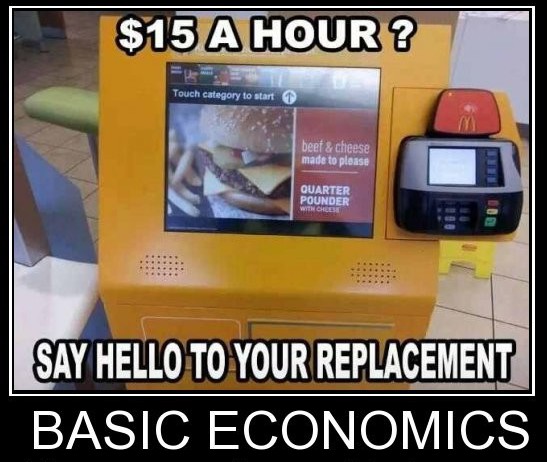
Right now, all the candidates for President from the Democrat party are competing with one another to see who can buy the most votes using taxpayer money. One popular Democrat policy to buy votes is to raise the minimum wage. Democrats reason that minimum wage increases are great, because workers will have more money to buy stuff. What could go wrong?

Well, I want to talk about this policy from a theoretical point of view, then give an example of how it works in practice.

Abstract from a National Bureau of Economic Research study:

We estimate the minimum wage’s effects on low-skilled workers’ employment and income trajectories. Our approach exploits two dimensions of the data we analyze. First, we compare workers in states that were bound by recent increases in the federal minimum wage to workers in states that were not. Second, we use 12 months of baseline data to divide low-skilled workers into a “target” group, whose baseline wage rates were directly affected, and a “within-state control” group with slightly higher baseline wage rates. Over three subsequent years, we find that binding minimum wage increases had significant, negative effects on the employment and income growth of targeted workers.

[…]Over the late 2000s, the average effective minimum wage rose by 30 percent across the United States. We estimate that these minimum wage increases reduced the national employment-to-population ratio by 0.7 percentage point.

That comes out to 1.4 million workers who lost their jobs, thanks to minimum wage mandates.

Why does it hurt young and unskilled workers most? Because those workers don’t produce as much as older, more experienced workers. So, if all the salaries go up, employers keep the most experienced employees and lay off the youngest, and least experienced employees. This is why the youth unemployment rates of socialist countries in Europe are so much higher than the overall unemployment rate. And just to be clear, minorities are disproportionately harmed by minimum wage laws, since they are the ones who are often trying to move up through those entry-level jobs.

Here’s an example of how this works in reality, from San Francisco, a Democrat-run city.

ABC News reports:

San Francisco’s minimum wage is currently $11.05 an hour. By July of 2018, the minimum wage in San Francisco will be $15 an hour. That increase is forcing Borderlands Bookstore to write its last chapter now.

[…]Borderlands was turning a small profit, about $3,000 last year. Then voters approved a hike in the minimum wage, a gradual rise from $10.75 up to $15 an hour.

“And by 2018 we’ll be losing about $25,000 a year,” he said.

It’s an unexpected plot twist for loyal customers.

“You know, I voted for the measure as well, the minimum wage measure,” customer Edward Vallecillo said. “It’s not something that I thought would affect certain specific small businesses. I feel sad.”

That was in 2018, but strangely enough, Democrat voters haven’t learned their lesson. They still think you can vote people more money, and not ask where the money is coming from.

Shawn sent me this story about Seattle, another Democrat-run city.

Excerpt:

Restaurants Unlimited, a Seattle-based chain with restaurant locations in 47 US cities, announced on Sunday it was seeking Chapter 11 protection, citing “progressive” wage laws.

The company, which has operated since the Lyndon Johnson Administration, said rising labor costs—part of a national trend of government-mandated minimum increases—were part of its decision.

“Over the past three years, the company’s profitability has been significantly impacted by progressive wage laws along the Pacific coast that have increased the minimum wage,” Chief Restructuring Officer David Bagley said in court filings, The Seattle Times reports. “As a large employer in the Seattle metro market, for instance, the company was one of the first in the market to be forced to institute wage hikes.”

[…]BLS data show that New York City experienced its sharpest decline in restaurant jobs since 9/11 following its passage of a $15 minimum wage law. In California, a local newspaper recently detailed how an entire business district virtually disappeared following the city’s aggressive minimum wage push.

Restaurants Unlimited’s announcement came a day before the Congressional Budget Office released a report estimating that a House bill designed to raise the federal minimum wage to $15 an hour would cost 1.3 million jobs.

Now, you might say to me “But Wintery, Democrats are the party of the little guy, why would they vote for something that would leave workers unemployed?” And there are two answers to that. First, Americans who work for a living tend to not look to the government for support. Second, Americans who work for a living tend to dislike when their taxes are raised to pay for people who aren’t working. Democrats are the party of higher taxes and bigger government. They always oppose letting people keep what they earn, and they always want the government to take free market solutions to health care, etc. so they can use the provision of health care to buy votes. So for them, kicking 1.3 million people out of work is a benefit.

When it comes to economics, we know what works. Trump cut taxes, and unemployment for all races is at a record low. If you want to reverse that, and have more people unemployed, living off taxpayer’s, then vote for Democrats.