Tag Archives: Armed Forces

Meet four heroes of the D-Day invasion of Normandy on June 6th, 1944

I thought it might be a good idea to write up something about D-Day in order to help people understand some of our military history, and to put the spotlight on some real heroes. I don’t regard artists, athletes, dancers, singers, actors, or other celebrities as heroes. It really alarms me that so many people know more about these fake heroes than they do about real ones.

Weakness emboldens aggressors

For one thing, many people don’t understand how British and American libertarian isolationism made World War 2 into a much bigger mess than it needed to be. As historian Victor Davis Hanson explains in the lecture I linked below, the Allied nations were much stronger and better equipped than the Axis nations before the war started. The Axis nations developed better weapons after the war started. But Germany and Japan didn’t think that the Allied nations would do anything if they were aggressive. We know this from their writings and correspondence. They thought that British and Americans were just too scared of war to stop them.

Germany and Japan tested their hypothesis out by re-arming and annexing territory from their neighbors. Britain and America were led by libertarian isolationists, so they didn’t fight back. The aggressors correctly understood that libertarian isolationists didn’t have the will to oppose them, even if they were weaker than the Allies. But the more they re-armed and annexed territory, the stronger they became. The Allied nations waited too long to confront them. And that’s why World War 2 was much harder to win than it needed to be.

Here’s a very good lecture about the causes of World War 2 by an actual military historian, Victor Davis Hanson:

So, that’s the first point I wanted to make: libertarian isolationism causes wars. Although libertarians claim to oppose war, they actually cause war, due to their weakness in the face of evil. So who stops wars? People who favor a strong defense, and show a willingness to fight back against aggression are the ones who REALLY oppose wars. This is called “peace through strength”, and you can see it in action in the Cold War, where Ronald Reagan defeated the Soviet Union by making their aggression costly.
Heroes of D-Day

My second concern was to promote the real heroes of D-Day, over the fictional heroes of movies, fiction, music, dancing, sports, and other entertainment nonsense.

Here are the four heroes I chose:

  • Major John Howard
  • Lieutenant Colonel Benjamin Vandervoort
  • Brigadier General Norman Cota
  • Major Richard Winters

Let’s take a look at each of them.

John Howard

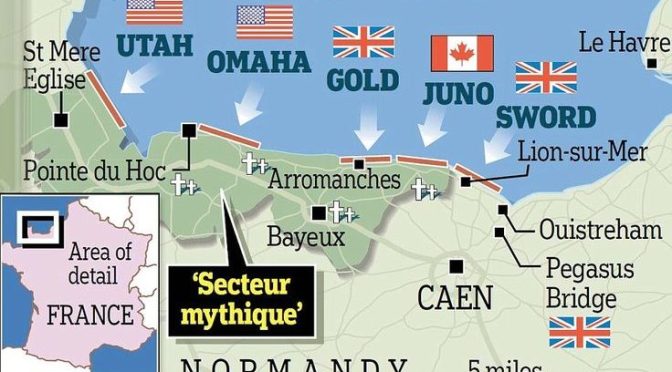
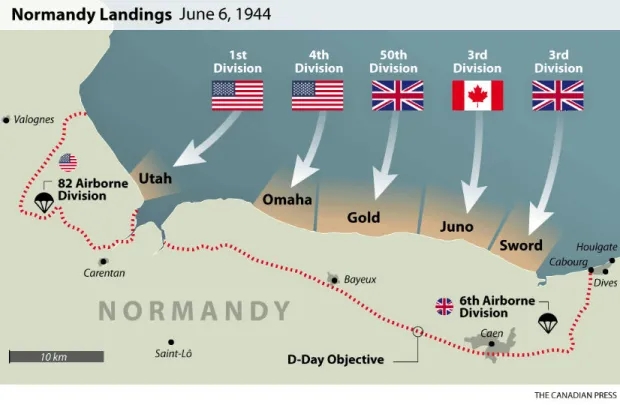
Major John Howard led elements of the British 6th Airborne Division to take two vital bridges southeast of Sword beach. He did this in order to prevent German socialist counterattacks coming from the east. After they took the bridges, they had to repulse German tanks with nothing more than their useless PIAT (Projector Infantry Anti-Tank) grenade launchers. The PIAT was nothing more than a grenade launcher powered by a coiled spring. It was very inaccurate, and only effective to 50 yards. But that’s all the British paratroops had to stop tanks, and they made it work. You can read about him in this book by Stephen E. Ambrose, entitled: “Pegasus Bridge: June 6, 1944“. This New York Times article tells the story in brief. He also is played by Richard Todd in the famous movie “The Longest Day“.

Benjamin Vandervoort

Lt. Col. Ben Vandervoort served with the 82nd Airborne Division. I read about how he lead an infantry attack against German Tiger tanks (!) and infantry in Stephen E. Ambrose’s book “Citizen Soldiers: The U.S. Army from the Normandy Beaches to the Bulge to the Surrender of Germany“.  Ben Vandervoort broke his ankle during the D-Day landing, but he insisted that the medic just “lace it up tight” so that he could supervise the attacking and holding of Ste. Mere Eglise, southwest of Utah beach, against a vastly superior enemy force.  This article tells about how he defended against elite German SS infantry and heavy Tiger tanks at Trois-Ponts, during the Battle of the Bulge. He was outgunned and outnumbered 20 to 1, and had just a few lightly-armed soldiers, two weak 57mm anti-tank guns and some bazookas. He is portrayed by John Wayne in the famous movie “The Longest Day“.

Norman Cota

Brig. General Norman Cota is my favorite person in World War 2. At 51 years old, he nevertheless landed at  D-Day, and rallied terrified Army Rangers to follow him up the bluff, by telling them that Rangers ought to lead the way. “Rangers Lead The Way” later became the motto of the Army Rangers. He always led from the front, demonstrating how to attack a German machine gun position in a farmhouse to a group of American soldiers who were pinned down. He actually grabbed a bunch of grenades and led the assault team against a heavy machine gun! You can read about him in this short article and in Stephen E. Ambrose’s “D-Day: June 6, 1944: The Climactic Battle of World War II“. He is portrayed by Robert Mitchum in the famous movie “The Longest Day“.

Richard Winters

Major Richard Winters served in the 101st Airborne Division. Winters led an assault against a superior force of heavy machine guns and 105mm field guns. His tactics were so brilliant that they are still studied at West Point today. You can see Richard Winters and Carwood Lipton in the HBO “Band of Brothers” series, or read this book by Stephen E. Ambrose entitled “Band of Brothers: E Company, 506th Regiment, 101st Airborne, from Normandy to Hitler’s Eagle’s Nest“, which is the basis for that series.

I hope this convinces you that military heroes are far more important than the “heroes” of fiction and entertainment. It’s alarming to me that people invest more and have more respect for characters in Hollywood science fiction movies, and other such make-believe nonsense. We need to be rooted in reality. In reality, men who fight and die fighting evil to protect your freedoms are the real heroes. People who take military history seriously are able to give respect and gratitude where it is due – a very important part of being a mature, moral human being.
Why I admire people in the armed forces more than famous entertainers

I’ve noticed that many Christians can tell me a lot about famous entertainers. It doesn’t matter if it’s singers, musicians, actors, athletes, etc., they seem to know details of their biographies, achievements, etc. And it doesn’t really matter if those people are Christians, or whether they have performed actions consistent with a Christian worldview in their private lives.

Anyway, speaking for myself, I mostly admire two kinds of people. The first kind is the kind I blog about here all the time: Christian scholars engage non-Christians intellectually using logic and evidence. The second kind, as you can tell from my reading list, is people who distinguish themselves in conflict with those who oppose the principles and policies that allow me to live out my Christian life. And I am especially interested when people who are fighting evil (imperialists, Nazis, socialists, communists, leftists, etc.) exhibit Christ-like character in risking their lives to save others, or in giving their lives to save others.

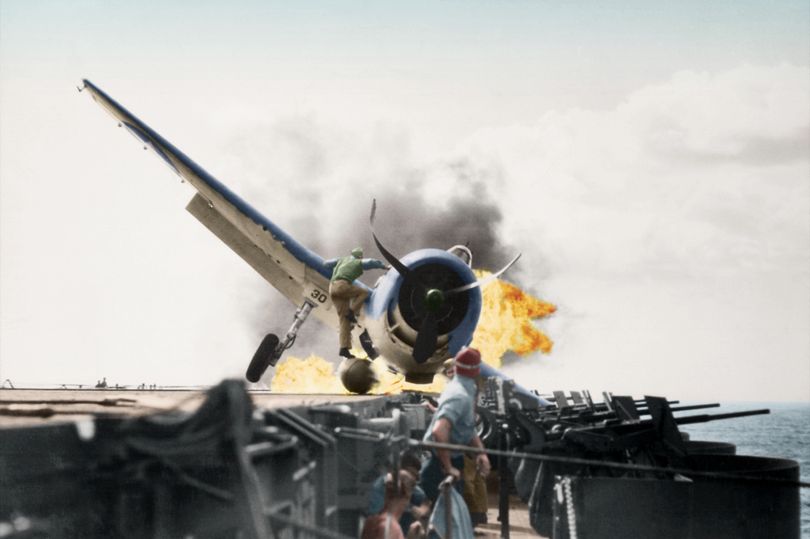
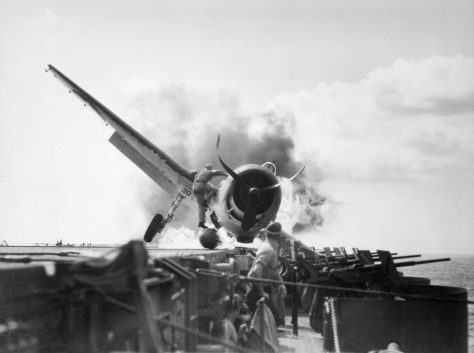
Lt. Walt Chewning charges unto burning F-6F Hellcat to save trapped pilot

I have a war story to tell you that happened on November 10th, 1943.

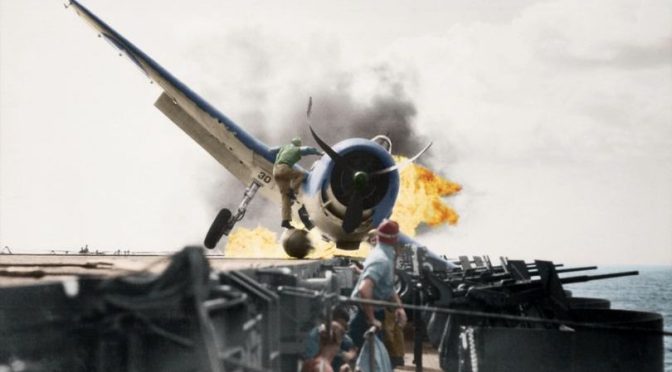
Lieutenant (later Lieutenant Commander) Walter Lewis Chewning of Cynwyd, Pennsylvania, steps on the burning fuel tank of an F6F-3 Hellcat flown by Ensign (later Lieutenant) Byron Milton Johnson of Potter, Nebraska to effect a successful rescue of the pilot on November 10, 1943. Johnson had flown out to USS Enterprise from Barbers Point, Hawaii, enroute to Makin Atoll in the Gilberts to support the United States Army invasion, which occurred on November 20, 1943. The afternoon of November 10, Johnson took off in F6F Hellcat Number 30 for a routine training exercise. He immediately developed engine trouble and requested an emergency landing. He was waved off three times as he struggled to maintain control, but his tail hook caught the third arresting gear wire, and Johnson’s Hellcat was slammed into the deck, coming to rest in the port catwalk. The plane came to rest on its external belly fuel tank, which started to leak. As the engine vibrated horribly as the propeller bent itself on the deck, sparks ignited the fuel. The hard landing had jammed Johnson’s canopy closed, shearing the retaining pin; he could not exit the plane. Chewning, who had joined the ship October 2, 1943 as Enterprise new catapult officer, scrambled out of the catwalk and came through the smoke. Stepping on the burning belly tank, he forced open the canopy and pulled Johnson to safety.

He received the two highest non-combat medals available:

Chewning was awarded the Navy and Marine Corps Medal for his actions.

He was a well-educated and accomplished person before joining the Navy:

Chewning played soccer and Lacrosse at Cornell while studying Mechanical Engineering, breaking his rib and left ankle in one game. He graduated in 1936 and studied at the Massachusetts Institute of Technology before joining the Navy in January 1941. He was the assistant to the Chief Engineer at the Naval Aircraft Factory in Philadelphia, Pennsylvania before joining USS Enterprise. He served as Enterprise’s catapult officer until December 1944, when he transferred to Dutch Harbor Naval Air Station in Alaska as ordinance officer. Chewning served in the Navy until December 1949; he also was awarded the Bronze Star. After the war he assisted research and development for various aeronautical companies, the United States Air Force, and the fledgling National Aeronautics and Space Administration. Motion picture film of the crash, taken from Enterprise’s bridge, was shown as part of the television program “Victory at Sea” on January 25, 1953. Chewning and Johnson gave interviews to several newspapers about the accident after the program aired.

I found a colorized version of the picture above here:

Lt. Walt Chewning charges unto burning F-6F Hellcat to save trapped pilot

This image was colourized from the original by Paul Reynolds.

What I thought was interesting about Chewning was how he had everything going for him in terms of his education and career, but he chose to join the Navy anyway, in order to defend his country from Japanese imperialism. Those who understand how the Japanese treated prisoners and conquered peoples will know which side of that conflict was good, and which side was evil. Chewning wasn’t some sort of loser who took risks for fun and thrills. It had to be a risk where the prize was worth the risk. And he had the humility to consider others better than himself, so that their life was worth the risking of his own.

I just think that it’s important for young Christians to have the right kind of heroes. The heroes who are promoted to young Christians by the cultural elites are not usually the right role models. And there is a reason for that. The secular leftists don’t want young Christians to be emulating people who excel according to the standards of the Christian worldview. We are in a religion where self-sacrificial love is the centerpiece. Taking trouble on yourself for someone else. Doing your job, when it goes against your own self-interest.

Meet four heroes of the D-Day invasion of Normandy on June 6th, 1944

I thought it might be a good idea to write up something about D-Day in order to help people understand some of our military history, and to put the spotlight on some real heroes. I don’t regard artists, athletes, dancers, singers, actors, or other celebrities as heroes. It really alarms me that so many people know more about these fake heroes than they do about real ones.

Weakness emboldens aggressors

For one thing, many people don’t understand how British and American libertarian isolationism made World War 2 into a much bigger mess than it needed to be. As historian Victor Davis Hanson explains in the lecture I linked below, the Allied nations were much stronger and better equipped than the Axis nations before the war started. The Axis nations developed better weapons after the war started. But Germany and Japan didn’t think that the Allied nations would do anything if they were aggressive. We know this from their writings and correspondence. They thought that British and Americans were just too scared of war to stop them.

Germany and Japan tested their hypothesis out by re-arming and annexing territory from their neighbors. Britain and America were led by libertarian isolationists, so they didn’t fight back. The aggressors correctly understood that libertarian isolationists didn’t have the will to oppose them, even if they were weaker than the Allies. But the more they re-armed and annexed territory, the stronger they became. The Allied nations waited too long to confront them. And that’s why World War 2 was much harder to win than it needed to be.

Here’s a very good lecture about the causes of World War 2 by an actual military historian, Victor Davis Hanson:

So, that’s the first point I wanted to make: libertarian isolationism causes wars. Although libertarians claim to oppose war, they actually cause war, due to their weakness in the face of evil. So who stops wars? People who favor a strong defense, and show a willingness to fight back against aggression are the ones who REALLY oppose wars. This is called “peace through strength”, and you can see it in action in the Cold War, where Ronald Reagan defeated the Soviet Union by making their aggression costly.

Heroes of D-Day

My second concern was to promote the real heroes of D-Day, over the fictional heroes of movies, fiction, music, dancing, sports, and other entertainment nonsense.

Here are the four heroes I chose:

  • Major John Howard
  • Lieutenant Colonel Benjamin Vandervoort
  • Brigadier General Norman Cota
  • Major Richard Winters

Let’s take a look at each of them.

John Howard

Major John Howard led elements of the British 6th Airborne Division to take two vital bridges southeast of Sword beach. He did this in order to prevent German socialist counterattacks coming from the east. After they took the bridges, they had to repulse German tanks with nothing more than their useless PIAT (Projector Infantry Anti-Tank) grenade launchers. The PIAT was nothing more than a grenade launcher powered by a coiled spring. It was very inaccurate, and only effective to 50 yards. But that’s all the British paratroops had to stop tanks, and they made it work. You can read about him in this book by Stephen E. Ambrose, entitled: “Pegasus Bridge: June 6, 1944“. This New York Times article tells the story in brief. He also is played by Richard Todd in the famous movie “The Longest Day“.

Benjamin Vandervoort

Lt. Col. Ben Vandervoort served with the 82nd Airborne Division. I read about how he lead an infantry attack against German Tiger tanks (!) and infantry in Stephen E. Ambrose’s book “Citizen Soldiers: The U.S. Army from the Normandy Beaches to the Bulge to the Surrender of Germany“.  Ben Vandervoort broke his ankle during the D-Day landing, but he insisted that the medic just “lace it up tight” so that he could supervise the attacking and holding of Ste. Mere Eglise, southwest of Utah beach, against a vastly superior enemy force.  This article tells about how he defended against elite German SS infantry and heavy Tiger tanks at Trois-Ponts, during the Battle of the Bulge. He was outgunned and outnumbered 20 to 1, and had just a few lightly-armed soldiers, two weak 57mm anti-tank guns and some bazookas. He is portrayed by John Wayne in the famous movie “The Longest Day“.

Norman Cota

Brig. General Norman Cota is my favorite person in World War 2. At 51 years old, he nevertheless landed at  D-Day, and rallied terrified Army Rangers to follow him up the bluff, by telling them that Rangers ought to lead the way. “Rangers Lead The Way” later became the motto of the Army Rangers. He always led from the front, demonstrating how to attack a German machine gun position in a farmhouse to a group of American soldiers who were pinned down. He actually grabbed a bunch of grenades and led the assault team against a heavy machine gun! You can read about him in this short article and in Stephen E. Ambrose’s “D-Day: June 6, 1944: The Climactic Battle of World War II“. He is portrayed by Robert Mitchum in the famous movie “The Longest Day“.

Richard Winters

Major Richard Winters served in the 101st Airborne Division. Winters led an assault against a superior force of heavy machine guns and 105mm field guns. His tactics were so brilliant that they are still studied at West Point today. You can see Richard Winters and Carwood Lipton in the HBO “Band of Brothers” series, or read this book by Stephen E. Ambrose entitled “Band of Brothers: E Company, 506th Regiment, 101st Airborne, from Normandy to Hitler’s Eagle’s Nest“, which is the basis for that series.

I hope this convinces you that military heroes are far more important than the “heroes” of fiction and entertainment. It’s alarming to me that people invest more and have more respect for characters in Hollywood science fiction movies, and other such make-believe nonsense. We need to be rooted in reality. In reality, men who fight and die fighting evil to protect your freedoms are the real heroes. People who take military history seriously are able to give respect and gratitude where it is due – a very important part of being a mature, moral human being.