

Tag Archives: Appeasement

Thomas Sowell explains how liberal pacifism causes wars

Thomas Sowell

I just finished reading Thomas Sowell’s “Intellectuals and Society” and I really recommend it. I mean – this is the book of the year from 2010. If you have no interest at all in economics and politics, you should definitely buy this book and read it. If you have never read anything about conservative economics and policy, then this is the place to start. It covers a little bit of economics, a little bit of jurisprudence, a little bit of education, a little bit of foreign policy… you name it – it’s in there. And in plain English. Thomas Sowell is my favorite economist, and the economist favored most by all conservatives. I own about a DOZEN of his books. He’s that good.

I wanted to talk to you about what was in chapter 7 “Intellectuals and War” and chapter 8 “Intellectuals and War: Repeating History”. So I searched and searched and found a summary of Sowell’s arguments in those chapters.

Here’s an article from Townhall.

Excerpt:

On the international scene, trying to assuage aggressors’ feelings and look at the world from their point of view has had an even more catastrophic track record. A typical sample of this kind of thinking can be found in a speech to the British Parliament by Prime Minister Neville Chamberlain in 1938: “It has always seemed to me that in dealing with foreign countries we do not give ourselves a chance of success unless we try to understand their mentality, which is not always the same as our own, and it really is astonishing to contemplate how the identically same facts are regarded from two different angles.”

Like our former ambassador from the Carter era, Chamberlain sought to “remove the causes of strife or war.” He wanted “a general settlement of the grievances of the world without war.” In other words, the British prime minister approached Hitler with the attitude of someone negotiating a labor contract, where each side gives a little and everything gets worked out in the end. What Chamberlain did not understand was that all his concessions simply led to new demands from Hitler — and contempt for him by Hitler.

What Winston Churchill understood at the time, and Chamberlain did not, was that Hitler was driven by what Churchill called “currents of hatred so intense as to sear the souls of those who swim upon them.” That was also what drove the men who drove the planes into the World Trade Center.

Pacifists of the 20th century had a lot of blood on their hands for weakening the Western democracies in the face of rising belligerence and military might in aggressor nations like Nazi Germany and imperial Japan. In Britain during the 1930s, Labor Party members of Parliament voted repeatedly against military spending, while Hitler built up the most powerful military machine in Europe. Students at leading British universities signed pledges to refuse to fight in the event of war.

All of this encouraged the Nazis and the Japanese toward war against countries that they knew had greater military potential than their own. Military potential only counts when there is the will to develop it and use it, and the fortitude to continue with a bloody war when it comes. This is what they did not believe the West had. And it was Western pacifists who led them to that belief.

Then as now, pacifism was a “statement” about one’s ideals that paid little attention to actual consequences. At a Labor Party rally where Britain was being urged to disarm “as an example to others,” economist Roy Harrod asked one of the pacifists: “You think our example will cause Hitler and Mussolini to disarm?”

The reply was: “Oh, Roy, have you lost all your idealism?” In other words, the issue was about making a “statement” — that is, posturing on the edge of a volcano, with World War II threatening to erupt at any time. When disarmament advocate George Bernard Shaw was asked what Britons should do if the Nazis crossed the channel into Britain, the playwright replied, “Welcome them as tourists.”

That was explained even more in the book with more examples from history.

Most people think that Thomas Sowell is a libertarian, but he isn’t a full libertarian. He just reports the evidence. If the evidence is pro-war, then he’s pro-war. Ronald Reagan and Margaret Thatcher called this view “peace through strength”. There is only one reason why evil people do not attack – because they think that good people have the firepower tomake them pay dearly for their aggression, and – and this is very important – the will to use it. In the book, Sowell explains how the the left responded to the horror of world war one by undermining the will of the people to fight. They minimized patriotism and heroism, and emphasized charges of “imperialism”, moral equivalence, and lots of sob stories about victims.

Here’s an article that explains it more.

Excerpt:

In France, after the First World War, the teachers’ unions launched a systematic purge of textbooks, in order to promote internationalism and pacifism.

Books that depicted the courage and self-sacrifice of soldiers who had defended France against the German invaders were called “bellicose” books to be banished from the schools.

Textbook publishers caved in to the power of the teachers’ unions, rather than lose a large market for their books. History books were sharply revised to conform to internationalism and pacifism.

The once epic story of the French soldiers’ heroic defense against the German invaders at Verdun, despite the massive casualties suffered by the French, was now transformed into a story of horrible suffering by all soldiers at Verdun— French and German alike.

In short, soldiers once depicted as national heroes were now depicted as victims— and just like victims in other nations’ armies.

[…]France, where pacifism and internationalism were strongest, became a classic example of how much it can matter.

During the First World War, France fought on against the German invaders for four long years, despite having more of its soldiers killed than all the American soldiers killed in all the wars in the history of the United States, put together.

But during the Second World War, France collapsed after just six weeks of fighting and surrendered to Nazi Germany.

At the bitter moment of defeat the head of the French teachers’ union was told, “You are partially responsible for the defeat.”

Charles de Gaulle, Francois Mauriac, and other Frenchmen blamed a lack of national will or general moral decay, for the sudden and humiliating collapse of France in 1940.

At the outset of the invasion, both German and French generals assessed French military forces as more likely to gain victory, and virtually no one expected France to collapse like a house of cards — except Adolf Hitler, who had studied French society instead of French military forces.

Did patriotism matter? It mattered more than superior French tanks and planes.

Everybody wants peace. Everyone – on both sides of the issue. The problem is that one side – the leftists – call their opponents names like “imperialist” and talk “disarmament” and “dialog” as if they have have the answer to peace. That doesn’t work and it has never worked. Pacifism only “works” in the classroom, where naive children are forced to parrot the opinions of their secular leftist teachers who have no expertise in war or history. What has actually worked in history is peace through strength. Strength deters wars, strength deters violence. Strength – and the will to use that strength to restrain evil.

Read this to learn more about the doctrine of peace through strength, and read this to compare terrorist attacks under Bush and under Obama.

A good book to read on this topic is Frank Gaffney’s “War Footing“.
Harvard University professor blasts Obama’s foreign policy failures

Awesome video from the ultra left-wing MSNBC. (H/T Newsbusters)

Here is an article about Obama’s foreign policy failures in Egypt by the Harvard professor.

Excerpt:

Last week, while other commentators ran around Cairo’s Tahrir Square, hyperventilating about what they saw as an Arab 1989, I flew to Tel Aviv for the annual Herzliya security conference. The consensus among the assembled experts on the Middle East? A colossal failure of American foreign policy.

This failure was not the result of bad luck. It was the predictable consequence of the Obama administration’s lack of any kind of coherent grand strategy, a deficit about which more than a few veterans of U.S. foreign-policymaking have long worried. The president himself is not wholly to blame. Although cosmopolitan by both birth and upbringing, Obama was an unusually parochial politician prior to his election, judging by his scant public pronouncements on foreign-policy issues.

Yet no president can be expected to be omniscient. That is what advisers are for. The real responsibility for the current strategic vacuum lies not with Obama himself, but with the National Security Council, and in particular with the man who ran it until last October: retired Gen. James L. Jones. I suspected at the time of his appointment that General Jones was a poor choice. A big, bluff Marine, he once astonished me by recommending that Turkish troops might lend the United States support in Iraq. He seemed mildly surprised when I suggested the Iraqis might resent such a reminder of centuries of Ottoman Turkish rule.

The best national-security advisers have combined deep knowledge of international relations with an ability to play the Machiavellian Beltway game, which means competing for the president’s ear against the other would-be players in the policymaking process: not only the defense secretary but also the secretary of state and the head of the Central Intelligence Agency. No one has ever done this better than Henry Kissinger. But the crucial thing about Kissinger as national-security adviser was not the speed with which he learned the dark arts of interdepartmental turf warfare. It was the skill with which he, in partnership with Richard Nixon, forged a grand strategy for the United States at a time of alarming geopolitical instability.

The essence of that strategy was, first, to prioritize (for example, détente with the Soviets before human-rights issues within the USSR) and then to exert pressure by deliberately linking key issues. In their hardest task—salvaging peace with honor in Indochina by preserving the independence of South Vietnam—Nixon and Kissinger ultimately could not succeed. But in the Middle East they were able to eject the Soviets from a position of influence and turn Egypt from a threat into a malleable ally. And their overtures to China exploited the divisions within the communist bloc, helping to set Beijing on an epoch-making new course of economic openness.

The contrast between the foreign policy of the Nixon-Ford years and that of President Jimmy Carter is a stark reminder of how easily foreign policy can founder when there is a failure of strategic thinking. The Iranian revolution of 1979, which took the Carter administration wholly by surprise, was a catastrophe far greater than the loss of South Vietnam.

Remind you of anything? “This is what happens when you get caught by surprise,” an anonymous American official told The New York Times last week. “We’ve had endless strategy sessions for the past two years on Mideast peace, on containing Iran. And how many of them factored in the possibility that Egypt moves from stability to turmoil? None.”

I can think of no more damning indictment of the administration’s strategic thinking than this: It never once considered a scenario in which Mubarak faced a popular revolt. Yet the very essence of rigorous strategic thinking is to devise such a scenario and to think through the best responses to them, preferably two or three moves ahead of actual or potential adversaries. It is only by doing these things—ranking priorities and gaming scenarios—that a coherent foreign policy can be made. The Israelis have been hard at work doing this. All the president and his NSC team seem to have done is to draft touchy-feely speeches like the one he delivered in Cairo early in his presidency.

These were his words back in June 2009:

“America and Islam are not exclusive and need not be in competition. Instead, they overlap, and share common principles—principles of justice and progress; tolerance and the dignity of all human beings.”

Those lines will come back to haunt Obama if, as cannot be ruled out, the ultimate beneficiary of his bungling in Egypt is the Muslim Brotherhood, which remains by far the best organized opposition force in the country—and wholly committed to the restoration of the caliphate and the strict application of Sharia. Would such an outcome advance “tolerance and the dignity of all human beings” in Egypt? Somehow, I don’t think so.

It’s a disaster. The Obama presidency is a disaster in every area – fiscally, socially and even in foreign policy.

His strategy of giving happy-clappy speeches, bowing to enemy dictators, pussyfooting around terrorists and cutting the defense budget has emboldened our enemies. Barack Obama enables evil to thrive. Now Lebanon is run by Hezbollah and Egypt is poised to fall to Hamas. It’s a disaster. A colossal failure.

The fact that so many well-meaning Americans voted for this man disgusts me. So many left-wing Americans are spoiled, lazy, envious and ignorant. They vote based on what they see on the Comedy Channel, and so that they would fit in with their wordsmith professors. What a disaster. People are dying because the people who voted for Obama were too lazy to look at his voting record. They had no time to look at his record. No time to read ratings by groups like Citizens Against Goverment Waste or the National Taxpayers Union. Obama-voters wanted to be entertained. Their hatred of Sarah Palin for trivialities has increased the evil in the world. That makes Obama voters evil.

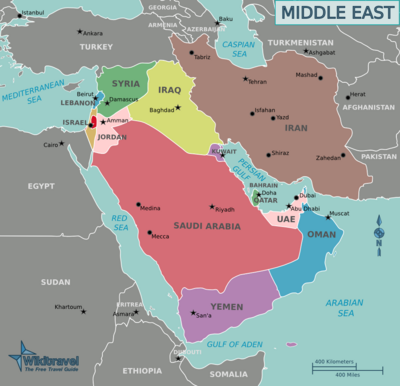
Obama’s weak foreign policy may lead to WAR in the Middle East

Map of Middle East
Map of Middle East

First article from the left-wing Huffington Post. (H/T Gateway Pundit)

Excerpt:

In its first year, the Obama administration cut funding for democracy and governance programming in Egypt by more than half, from $50 million in 2008 to $20 million in 2009 (Congress later appropriated another $5 million). The level of funding for civil society programs and non-governmental organizations (NGOs) was cut disproportionately, from $32 million to only $7 million. Though funding levels for 2010 are not yet available, they are expected to show an increase to $14 million, says Stephen McInerny, the director of advocacy at the Project on Middle East Democracy. He notes that the Bush administration slashed economic aid to Egypt in the 2009 budget but kept the funding for democracy and governance programs constant, while Obama cut funding to those programs in an effort to make the cuts more proportional and under pressure from the American embassy in Cairo.

Second article, from the LA Times. (H/T Gateway Pundit)

Excerpt:

The Obama administration said for the first time that it supports a role for groups such as the Muslim Brotherhood, a banned Islamist organization, in a reformed Egyptian government.

[…]The statement was an acknowledgment that any popularly accepted new government will probably include groups that are not considered friendly to U.S. interests, and was a signal that the White House is prepared for that probability after 30 years of reliable relations with Egyptian President Hosni Mubarak.

Third article, from National Review. (H/T Hyscience)

Excerpt:

Hamas’s overt intervention in Egypt is an alarming development, although a predictable one. It is worth pointing out that Hamas is not merely colluding with the Muslim Brotherhood. Hamas is the Muslim Brotherhood. That, of course, will not be what you hear from our foreign-policy experts, such as Obama adviser Bruce Riedel, who are busily sculpting their narrative about how the Brotherhood — the font on modern jihadist terror — has renounced violence and is really nothing for us to be very concerned about. But the stubborn fact is that Hamas is the most prominent of the Brotherhood’s Palestinian branches, whose operations long predated Hamas and brought Hamas (a/k/a, the Islamic Resistance Movement) into being.

So that’s what’s happening in Egypt… Hamas is moving in to take control, just like Hezbollah controls Lebanon (now). But why now? Why didn’t this happen when George W. Bush was President?

Well, Barack Obama is no George W. Bush.

Let’s review:

  • Obama insulted our British allies
  • Obama insulted our Afghan allies
  • Obama backed Iran’s suppression of pro-democracy protestors
  • Obama did nothing when Russian tanks rolled through Georgia
  • Obama did nothing when Hezbollah took over Lebanon
  • Obama backed the socialist Zeyala in Honduras
  • Obama met with Chavez, Ortega and Morales and kept silent while they insulted the United States
  • Obama did nothing while Turkey became increasingly Islamicized
  • Obama cut funding to democracy and governance programs in Egypt

And what is the end game of all of this weakness and moral equivalence?

Excerpt:

The circle is now complete. This week Barack Obama truly became what many people believe he was all along, the long lost second term of Jimmy Carter’s presidency.

[…]First he criticized the weakened leader of Egypt, Hosni Mubarak. Next Obama threatened to emasculate Mubarak’s standing with the Egyptian military by reducing US financial aid if Mubarak didn’t allow the protests and revolution in the streets to continue.

Obama followed up by tacitly signaling that he supports the violent Islamic protests which are backed by the Shariah-compliant extremists of the Moslem Brotherhood, which is the only real opposition party in Egypt to the thirty-year dictator Mubarak. After that, like Carter, Obama showed constant indecision and weakness, which is having the result of undermining our allies and empowering the forces of insanity and evil on the ground in Egypt and other destabilized countries in the region like Tunisia, Lebanon and Jordan.

Just like Carter, Obama got us to this point by undermining our only ally in the area, Israel, and empowering all of her regional enemies for the first two years of his presidency. That undermining has led us directly to these out of control events.

At this moment, of the four nations that border Israel, two of them, Syria and Lebanon, are client states of Iran waging constant war and the other two which both have brokered peace are facing internal turmoil, Jordan is facing Islamic protests in her streets and the relatively stable tourist destination Egypt, is exploding in revolution.

The way Obama is handling the Egyptian crisis there can only be one outcome. The Moslem brotherhood will seize total control of the nation and turn the Arab world’s most populace country into a totalitarian Islamic theocracy just like Iran. Egypt’s fall will be a strategic disaster for the US because Egypt borders Israel and controls the vital Suez Canal which connects the Indian Ocean to the Mediterranean Sea. The Suez is one of the most vital water-ways in the entire world because it is the shipping lane that allows Middle East oil to get to the consumer countries in Europe.

If Egypt falls to this kind of governance total war will quickly come to the Middle East with catastrophic strategic and economic consequences for the whole world.

Strength doesn’t cause wars – weakness causes wars. When you are strong, aggressors know that aggression will cause them plenty. Obama, and his constant apologizing and appeasing and siding with terrorists and dictators, is what REALLY causes wars.