
Tag Archives: 2012

White House used Mitt Romney’s Romneycare as a blueprint for Obamacare

MSNBC reports that Obamacare was designed using Romney’s health care plan as a blueprint.

Excerpt:

Newly obtained White House records provide fresh details on how senior Obama administration officials used Mitt Romney’s landmark health-care law in Massachusetts as a model for the new federal law, including recruiting some of Romney’s own health care advisers and experts to help craft the act now derided by Republicans as “Obamacare.”

The records, gleaned from White House visitor logs reviewed by NBC News, show that senior White House officials had a dozen meetings in 2009 with three health-care advisers and experts who helped shape the health care reform law signed by Romney in 2006, when the Republican presidential candidate was governor of Massachusetts. One of those meetings, on July 20, 2009, was in the Oval Office and presided over by President Barack Obama, the records show.

“The White House wanted to lean a lot on what we’d done in Massachusetts,” said Jon Gruber, an MIT economist who advised the Romney administration on health care and who attended five meetings at the Obama White House in 2009, including the meeting with the president. “They really wanted to know how we can take that same approach we used in Massachusetts and turn that into a national model.”

[…]The White House visitor logs suggest that, if Obama officials didn’t talk directly with Romney, senior presidential aides did consult with others — like Gruber — who played important roles in helping to craft and implement the Massachusetts law.

In addition to Obama himself, the meetings attended by Gruber were presided over by the president’s chief economic adviser, Lawrence Summers, then budget director Peter Orzag and Nancy-Ann DeParle, the president’s chief adviser on health care, the records show. Gruber was also given a $380,000 contract by the Obama administration in 2009 to work with Congress on drafting a new federal law based on the Massachusetts law, records show.

Another Romney administration adviser consulted by the White House was Jon Kingsdale, a health-care expert who was appointed in 2006 by one of Romney’s Cabinet secretaries, Thomas Trimarco, to serve as executive director of the Commonwealth Health Insurance Connector Authority — the state agency charged with implementing the new Massachusetts health-care law.

Let’s have a quick re-cap of Romneycare, shall we?

The libertarian Cato Institute think tank explains why Obamacare and Romneycare are identical in many ways.

Excerpt:

As part of his liberal phase when governor of Massachusetts — political principles have been ever-flexible for Romney — he orchestrated passage of legislation with eerie similarities to ObamaCare. Massachusetts mandates purchase of insurance, decides what benefits must be offered, and maintains a complex system of subsidies and penalties. Declared Boston Globe columnist Adrian Walker, the two programs are “not identical, but they’re certainly close kin.” MIT economist Jonathan Gruber, who advised both Gov. Romney and President Obama on health care, asserted: “Basically, it’s the same thing.”[…]Alas, even the former governor’s constitutional scruples are suspect. In 1994 he backed a federal mandate. His concern about the overweening federal government apparently was not so finely developed then.

[…]However, paying for more benefits for more people inevitably makes medicine more expensive. Costs for Commonwealth Care, the Massachusetts government’s subsidized insurance program alone are up a fifth over initial projections. Last year State Treasurer Timothy P. Cahill wrote: “The universal insurance coverage we adopted in 2006 was projected to cost taxpayers $88 million a year. However, since this program was adopted in 2006, our health-care costs have in total exceeded $4 billion. The cost of Massachusetts’ plan has blown a hole in the Commonwealth’s budget.”

[…]State finances have not collapsed only because RomneyCare spread the costs widely, forcing virtually everyone in and out of the state to share the pain. Cahill cited federal subsidies as keeping the state afloat financially. Indeed, a June study from the Beacon Hill Institute concluded that “The state has been able to shift the majority of the costs to the federal government.” The Institute pointed to higher costs of $8.6 billion since the law was implemented. Just $414 million was paid by Massachusetts. Medicaid (federal payments) covered $2.4 billion. Medicare took care of $1.4 billion.

But even more costs, $4.3 billion, have been imposed on the private sector — employers, insurers, and residents. This estimate is in line with an earlier study by the Massachusetts Taxpayers Foundation, which figured that 60% of the new costs fell on individuals and businesses.

As expenses have risen, so have premiums. Noted Kuttner, “because serious cost containment was not part of the original package, premium costs in the commonwealth have risen far faster than nationally — by 10.3%, the most recent year available.” Economists John F. Cogan, Glenn Hubbard, and Daniel Kessler figured that RomneyCare inflated premiums by 6% from 2006 to 2008. This at a time where the state-subsidized Commonwealth Care was displacing private insurance for many people, thereby reducing demand, which should have reduced cost pressures.

Unfortunately, noted the Beacon Hill Institute, “private companies have no choice but to pass the higher costs onto the insured. Some of these costs fall in the double-digit range.” That naturally displeased public officials, since it undercut their claim to have solved Massachusetts’ health care problems.

And the Boston Herald notes that Romneycare caused the loss of 18,000 jobs. (H/T Michelle Malkin)

Excerpt:

The Bay State’s controversial 2006 universal health-care plan — also known as “Romneycare” — has cost Massachusetts more than 18,000 jobs, according to an exclusive blockbuster study that could provide ammo to GOP rivals of former Gov. Mitt Romney as he touts his job-creating chops on the campaign trail.

“Mandating health insurance coverage and expanding the demand for health services without increasing supply drove up costs. Economics 101 tells us that,” said Paul Bachman, research director at Suffolk University’s Beacon Hill Institute, the conservative think tank that conducted the study. The Herald obtained an exclusive copy of the findings.

“The ‘shared sacrifice’ needed to provide universal health care includes a net loss of jobs, which is attributable to the higher costs that the measure imposed,” said David Tuerck, the institute’s executive director.

…Despite Romney’s vaunted business acumen as a successful venture capitalist, Bachman said the former governor “was a little naive about what would become of the law.”

The Beacon Hill Institute study found that, on average, Romneycare:

  • cost the Bay State 18,313 jobs;
  • drove up total health insurance costs in Massachusetts by $4.311 billion;
  • slowed the growth of disposable income per person by $376; and
  • reduced investment in Massachusetts by $25.06 million.

And from the Heartland Institute, an article showing how Romneycare could actually lead to single-payer health care in Masachusetts.

Excerpt:

The 2006 reform jeopardized the solvency of private health plans in the Bay State. Unfortunately, insurers’ solvency is not something patients, physicians, and voters have reason to observe closely, so the political class suffers from perverse incentives once it starts micromanaging health insurance. As a result, higher costs have been passed on through higher per capita spending and premium growth.

According to the state’s 2010 annual report, today “per capita spending on health care in Massachusetts is 15 percent higher than the rest of the nation, even when accounting for wages and spending on medical research and education in Massachusetts.” Indeed, Professor John F. Cogan of Stanford University has concluded the 2006 reform led to premium growth 6 percent higher in Massachusetts than in the rest of the United States between 2006 and 2008.

Because it was politically intolerable to allow premiums to rise in line with the costs of Romneycare, the state’s insurance commissioner denied 235 of 276 rate increase requests in April 2010. For a short time, no new policies were offered, and plans suffered significant losses. The next month, Blue Cross Blue Shield of Massachusetts, the state’s largest carrier, announced a $55 million provision for anticipated losses in the second quarter alone.

Of the 12 largest carriers, five were already operating at a loss. At this point, even if the state allows Blue Cross Blue Shield of Massachusetts to increase rates in line with medical costs, my analysis concludes the carrier will become insolvent in the vicinity of 2017. Other carriers will soon follow.

Clever campaign speeches and witty debate zingers today don’t cancel out a liberal leftist record on policy yesterday.
Herman Cain in first place in new South Carolina and Virginia polls

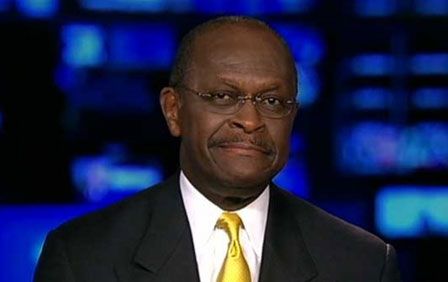
Presidential candidate Herman Cain

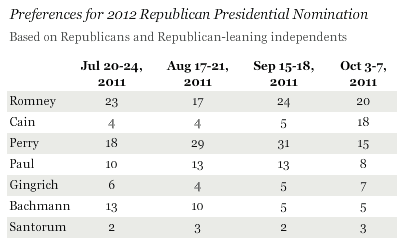
Here’s the new Virginia poll, where Herman Cain is tied for first place.

Excerpt:

Businessman Herman Cain has surged into the top tier of presidential candidates in Virginia, according to a new poll of the state, moving into a tie in the Republican nomination contest with former Massachusetts Gov. Mitt Romney.

Texas Gov. Rick Perry has faded considerably.

The Quinnipiac University Poll of Virginia released Tuesday shows Romney and Cain at 21 percent apiece among Republican voters, while Perry sits at 11 percent–less than half the support he registered in the same poll a month ago.

Rep. Ron Paul (Texas) gets 9 percent, while Rep. Michelle Bachmann (Minn.) and former House speaker Newt Gingrich receive 7 percent apiece.

[…]“Herman Cain is moving up the ladder at breakneck speed,” said Peter A. Brown, assistant director of the Quinnipiac University Polling institute, in a news release.

Virginia is a swing state… so this is impressive.

And a new poll in South Carolina, where Herman Cain leads Romney by 1 point.

Excerpt:

Businessman Herman Cain has edged out former Massachusetts Gov. Mitt Romney in the first primary state of the South, according to a new poll released Tuesday.

The conservative radio talk show host received 26% support in the Palmetto State poll, only one percentage point ahead of Romney and within the margin of error for the American Research Group survey, indicating the two are statistically tied.

South Carolina is slated to go fourth in the nation’s primary and caucus calendar, preceded by Iowa, New Hampshire, and Nevada.

The longest-serving Texas Gov. Rick Perry placed third with 15% support, followed by former House Speaker Newt Gingrich at 8%, Texas Rep. Ron Paul at 7%, and Minnesota Rep. Michele Bachmann at 5%.

[…]When the survey is narrowed to Republican respondents who consider themselves likely primary voters, Cain and Romney are tied at 27% each.

I am hoping that Romney stalls out… as I’ve blogged before, Romney is liberal on everything from abortion, to gay rights, to gun control, to global warming to government-run health care. The man is really more of a moderate-to-liberal Democrat, ideologically, and we don’t need that right now.

Related posts

Video and transcript of Herman Cain’s Value Voter Summit speech

Did you see Herman Cain’s speech at the Value Voter Summit? (transcript linked)

Part 1:

Part 2:

Excerpt:

And so the pursuit of happiness, just like my parents pursued their definition of happiness. Mom was a domestic worker. Dad was a barber, a janitor and a chauffeur. When Dad walked off of that small farm, Dad went to pursue his American dream with the only kind of equity he had — sweat equity. And he was able to achieve his American dream, he and my mother. And Dad wanted to give us a little bit better start in life, and they did. And Dad wanted to make sure that one day he could buy a whole house for the family.

You see, growing up in Atlanta, most of the time we lived in what my brother and I called a half a house. It was a six-room house with three rooms on one side, three rooms on the other side. We lived in half of it. My brother and I, being typical kids, used to say: Dad, why do we live in a half a house? (Laughter.) Dad said: It’s a duplex. (Laughter.) Because we didn’t know that Dad was saving for his dream, which was to one day buy a whole house for the family; and he did. Dad knew that the pursuit of happiness meant working those three jobs.

And Dad also knew that the pursuit of happiness meant the three things that they instilled in my brother and I if you want to achieve your American dream; and that is, your belief in God, belief in yourself and belief in the greatest country in the world, the United States of America. And we are exceptional!

And:

A reporter asked me just yesterday: Well, aren’t you angry — (laughter) — about how America has treated you?

AUDIENCE MEMBER: (Laughs.)

MR. CAIN: I said: Sir, you don’t get it. (Laughter.) I have achieved all of my American dreams and then some — (cheers, applause) — because of the great nation United States of America. (Cheers, applause.) What’s there to be angry about? Angry? (Applause continues.)

America’s — one of America’s greatest strengths is its ability to change. We have weathered those changes. That’s what makes this nation great.

And:

Now Mr. Cain, what are you going to do about Iran?

Well, here’s what I’m going to do about Iran. I’m going to utilize a capability that we have that most people are unaware of. I learned about these capabilities when I served on an advisory board for the Strategic Air Command before they changed it to STRATCOM. We are the only nation in the world that has the ballistic missile detection capability at sea as well as on land — better than any other country in the world. We have the ability to upgrade those ballistic missile defense systems on all of our AEGIS warships, and we have the ability to double the number of AEGIS warships and strategically place them anywhere in the world to detect missiles fired from those locations toward a friend or toward us and knock it out of the sky before it reaches its apex.

And so I would upgrade — make it a priority to upgrade all of our AEGIS surface-to-air ballistic missile defense capability on all of our warships all the way around — all the way around the world, make that a priority, and then say to Ahmadinejad: Make my day. (Extended cheers, applause.)

And:

They want you to believe that we can’t do this. Just like three months ago I was — the pundits, the political pundits said Herman Cain can’t get the nomination, Herman Cain cannot win the presidency, because he doesn’t have high name-ID, he doesn’t have a kajillion dollars and he’s never held public office.

But let me tell you what the American people are saying. They don’t care about a katrillion dollars! America wants to raise some Cain, not raise more money! (Cheers, applause.) That’s what the voters are saying. (Cheers, applause.)

Read the whole thing! Especially for those people who don’t think they need to know what an AEGIS-enabled warship is. Herman Cain knows, because he worked on missile ballistics for the Department of the Navy.

Believe it: the reliable Gallup poll has Cain down by 2

From Gallup:

Cain trails liberal Romney by two points

Steve Ertelt from Life News notes some other recent polls.

Excerpt:

The tidal wave of recent support for Republican presidential candidate Herman Cain is manifesting itself in two new polls showing the pro-life businessman now running competitively with pro-abortion President Barack Obama.

The first poll, conducted by the firm Poll Position, shows Cain beating Obama in a potential head-to-head matchup by a 43.3 percent to 41.3 percent margin. In the results the firm found in its automated voice survey technology poll, Cain takes a whopping 24 percent of the African-American vote — a much higher percentage that actual Republican presidential candidates have received in elections past.

[…]Meanwhile, a new Rasmussen poll shows Cain has pulled within three points of Obama in its most recent national telephone survey of likely voters. The latest 2012 hypothetical matchup finds the president earning 42% support, while Cain picks up 39% of the vote. Seven percent (7%) prefer some other candidate, and 12% are undecided.

“The latest results represent the best showing for Cain who appears to be experiencing a surge of support among Republican voters. Late last month, the former radio host trailed the president 39% to 34%.  Obama held a seven-point lead a month earlier and led Cain by 18 points in March,” Rasmussen notes.

“Cain draws support from 70% of Republican voters, while Obama picks up the vote from 79% of Democrats. Voters not affiliated with either party are evenly divided between the candidates. Eighty-five percent (85%) of Tea Party voters support Cain, but 55% of non-members prefer Obama,” Rasmussen continued.

Cain likely would do better against Obama, but the Rasmussen poll shows some Republican voters are concerned about his “9-9-9” tax reform plan, as most of those polled agree that if it becomes law, Congress won’t wait long to raise the tax rates higher.  Fifty-six percent (56%) of GOP voters favor Cain’s plan, but 66% of all voters think Congress would raise tax rates within five to 10 years of the plan’s adoption.

The businessman has acknowledged and addressed that concern, saying  his plan would require a two-thirds vote in Congress to raise taxes.

Rasmussen polls show Obama  leads all of the current GOP hopefuls except former Massachusetts Governor Mitt Romney with whom he is essentially tied.  New numbers on the Romney-Obama match-up will be released tomorrow, Rasmussen indicates.

If you want to know why he is surging, watch the speech, or read the transcript.

Related posts