How is secular left socialism going in Germany?

Americans can learn which policies work and don’t work by looking at policies that have been tried in other times and places. That way, we can avoid the mistakes that other people have already made. That’s one of the reasons why people like Thomas Sowell so much – he is always talking about which policies work, and which ones don’t. And in Germany, it’s mostly policies that don’t.

Here’s a fun article from Victor Davis Hanson, writing for the Daily Signal. If you’re like me, you already know Dr. Hanson from his writings on military history. But he likes policy, too.

He says:

 Today I’d like to talk about the crisis facing Europe, specifically its self-implosion across the spectrum—energy, population, fertility, defense. Germany, for example, has been systematically shutting down its nuclear plants and, for a while, its natural gas electrical generation plants.

If you know your energy policy, then you know that natural gas and nuclear power are the two power sources pushed by conservatives. They are safe and reliable, and they are also zero emission. Best of all for me, they don’t kill bats, birds and other animals. Birds are my favorite animals, and that’s a huge reason why I hate wind and solar power – they kill birds in large numbers.

More:

the net result of all of this deliberate turn to wind and solar, at the expense of fossil fuels and nuclear, is that it costs about four times more to use electricity in Germany than it does on average throughout the United States. That’s not the only problem.

Germany is deindustrializing. And by that I mean it’s losing about 200,000 jobs in its auto industry due to these high energy prices and regulations. Its green mandates, especially electric vehicle mandates, have revolutionized the car industry, in the sense that they’re not selling abroad as they did in the past.

When you raise the prices of gas and electricity, it raises the price of all production of goods, and transportation of goods. The funny thing is that this has been going on for some time. I remember talking about Angela Merkel’s failed policies with an international student from Germany with I was in grad school. And they never pulled out of their death spiral! It’s still going now.

Anyway, the higher cost of gas and electricity is having big effects:

In addition to that, Germany’s disarmed. They only have about 125 attack aircraft. They have very few armored vehicles. Their active military is only about 180,000 soldiers.

They have 84 million people in the country. The fertility rate is getting very close to 1.4. I know we have problems here in the United States at 1.6, but 1.4.

And they don’t have borders. They have had a million to 2 million illegal aliens just prance into Germany, especially during the last years of the Merkel chancellorship. In terms of percentage of foreign-born, Germany has more foreign-born than does the United States, which doesn’t have a border in the south, at least until Donald Trump comes in. Twenty percent of the German population is foreign-born.

We have a new administration now, and if you look at the picks for Department of the Interior, and Secretary of Energy, then we should be getting some action on developing our own supply of clean energy. Let’s hope that we don’t make the same mistakes that the Germans made.

By the way, if people ask you “why are you a conservative?” it’s nothing to be ashamed of. You don’t have to bring up Bible verses, religious beliefs, or moral issues. Start with economic policies. Just tell them that conservative policies are policies that allow you to have a job, earn money, and spend it how you like. And when they ask you for an example, you can talk about energy policy, and how things are going in free countries that produce a lot of energy (like Norway) vs un-free countries that don’t develop a lot of energy (like Germany). Norway’s GDP per capita is $90,500 (great), but Germany’s is $61,900 (trash). That’s why we want to be like Norway, and we don’t want to be like Germany.

By arguing for conservative fiscal policies, you often will get an opportunity to argue for conservative social policies. Once people see that you have done your homework in one area, they will be more welcoming of your views in other areas. At the very least, you win whenever you can show your work.

Conservative policy is just “let’s do what works” and “let’s not do what does not work”. Secular leftist policy is “do what feels good” and “do what makes people like me”, but that often produces very bad results, especially for the next generation.

Image source: Clean Energy Wire (January 2023)

Wikipedia co-founder, who holds PhD in philosophy, returns to Christianity

Who is Larry Sanger? Larry Sanger is the co-founder of Wikipedia, and he holds a PhD in philosophy from the Ohio State University. Although he was raised in a Christian home, he did not get good answers to his many questions from Christian leaders. In fact, they foolishly made him feel badly for asking questions. He decided to take another look at the arguments for Christian theism.

Here’s the story from Evolution News:

As I found myself returning to the old arguments for the existence of God, I did not slap myself on the forehead and say, “Oh! It turns out that this is a great argument! I guess I believe in God after all!” Even today I deny that, individually, the traditional arguments for the existence of God are particularly persuasive. But I began to examine them in new versions.

I was impressed by a lecture by philosopher of science and well-known apologist Stephen Meyer, who presented versions of the cosmological argument and the fine-tuning argument. Science says the Big Bang was the beginning of the universe. But whatever had a beginning has to have had an explanation. As this is the beginning of matter itself, it cannot have a material cause; thus it must have an immaterial cause (whatever that might be like).

Similarly, certain features of the universe that are absolutely necessary to explaining how fundamental natural laws operate are physical constants. Physicists tell us that if the values of those constants were different, then various things could not have happened; for example, atoms could not have formed, or stars could not have ignited and given off light and heat. But scientists have never offered an explanation for these constants.

He mentions Stephen C. Meyer, so let’s talk about that.

I want you, the reader, to consider that the arguments of Stephen C. Meyer, and the people like him, do work on non-Christians. If you are still batting around “arguments” from people like Aquinas and C.S. Lewis, then you are trying to build a wall with spaghetti, instead of with bricks. The new arguments are much better than what you learned in Sunday school. They are much better than what you heard from your parents and pastors. They are much better than what you read in popular Christian books. Much better than anything a seminary professor could teach you.

If you haven’t put in the time on the new scientific arguments, then you better get moving, because there has been a huge revolution in the way that people think about the Big Questions of life. We covered some of them on the Knight and Rose Show, but you’ll be better off getting yourself a book like “The Comprehensive Guide to Science and Faith”. That book is one stop shopping.

More:

This is a greatly condensed summary; I developed these ideas in much greater depth. But beyond such details, what I dwelled upon more than anything is the fact that the arguments taken together are far more persuasive than I had understood. Individually, the arguments might seem relatively weak. As I said, the Argument from Contingency only shows that a necessary being exists. The Argument from Causality shows only that the universe had a cause outside of itself. The Argument from Design shows only that the universe has some sort of designer or other. An Argument from Morality might add that the designer is benevolent, to some degree, in some way, but not even necessarily personal. But what happens when we combine all the arguments to make a unified case for the existence of God? I’m not sure the idea had ever dawned on me, certainly not with its present vividness. Taken together, the arguments point to a necessary being that exists apart from space, time, and matter. This is the very cause of the universe, which was designed according to orderly abstract laws. Ever more complex properties emerge, one from another, with great beauty and rationality—rationality that exhibits various mind-like features. This order can even be described as good, a cosmos indeed, because life and its preservation seem to be part of the plan, and life is the very standard of value.

And this is the exciting part – he’s going to be a regular contributor at Evolution News:

Editor’s note: We are delighted to welcome Wikipedia co-founder Larry Sanger as a new contributor. The following is excerpted from his essay, “How a Skeptical Philosopher Becomes a Christian” at LarrySanger.org. See also, “Wikipedia Co-Founder Blasts ‘Appallingly Biased’ Wikipedia Entry on Intelligent Design.”

I love stories like this. I’ve talked this over with Rose. Neither of us grew up in Christian homes, so we had complete freedom to puzzle these things out on our own, and only act according to what we discovered. In my case, I explained to a youth pastor early on that in my family, we liked to argue. So, he gave me apologetics books, and said that in Christianity, there was a long tradition of debating.

I puzzled through these books at my own pace, never having to be forced to go to church, never having to put on a show, and never having to get my Christianity secondhand from people who were terrible at it. I got it straight from the Bible, not from anybody’s words or behaviors. And in the end, it stuck very well. In fact, it never even bothered me that Christianity lost me reputation with other people. After all, they couldn’t defend their views in a debate. Sometimes I think it’s better to do it this way.

Stephen C. Meyer answers objections to arguments for a Designer

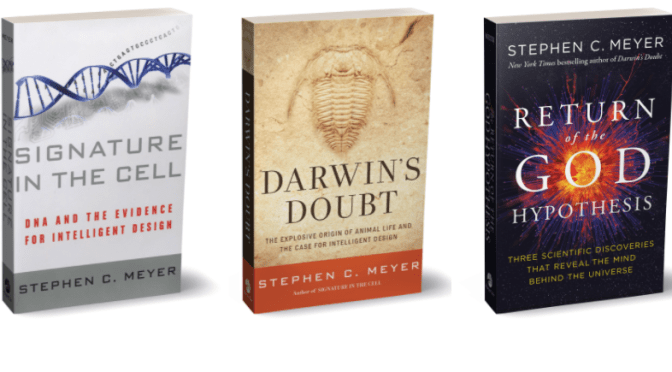
If I had to pick the strongest defender of Christianity operating today, I would pick Dr. Stephen C. Meyer. His recent book “Return of the God Hypothesis” defends three arguments for a Creator / Designer of the universe. But there have been some criticisms of those arguments. In this conversation, Justin Brierley asks Dr. Meyer to respond to those criticisms.

Here is the video:

Here is the description:

Justin Brierley interviews controversial philosopher of science Dr Stephen Meyer, about his recent book “Return of the God Hypothesis”. Stephen shares the latest advances in the field of “Intelligent Design”, ranging from design inferences that can be drawn from the origin of the universe, the fine-tuning of the universe, the information content of the living cell, and even from attempts of atheist materialists to try to avoid the God Hypothesis!

And here are the topics, with timestamps:

00:00:00 Coming up…
00:00:40 Introduction
00:01:08 Darwinism is in trouble
00:05:42 Isn’t I.D. God of the gaps?
00:09:03 What about the Dover School trial?
00:13:21 Has the I.D. stigma changed?
00:15:57 Big Bang points to design?
00:23:44 Objections to beginning & cause of the universe
00:30:04 Is there a bias against God?
00:32:31 Fine-tuning points to design?
00:37:14 Puddle objection to design
00:42:38 “C.R.A.P.” objection to design
00:45:40 Multiverse defeats design?
00:52:42 About The Surprising Rebirth of Belief in God podcast
00:54:29 Own-goals from trying to avoid design
00:56:29 Origin of life points to design?
01:03:56 Dawkins is wrong about life arising by chance
01:09:15 What about naturalistic models of life?
01:12:23 Aesthetic objections to I.D.
01:15:47 Paul Davies’ views on I.D.
01:19:53 Conclusion
01:23:46 Next!

If you watch this, leave a comment and let me know what you thought of it.