Memorial Day: Medal of Honor recipients John Basilone and Hector Cafferata

I write military history posts every once in a while, to remind people to honor those who fought for our freedoms. If you check out my “What I am Reading” page on this blog, then you’ll see that I’ve been reading a fair number of books about the Korean War west of Chosin, and Guadalcanal. These were both Marine actions, so for Memorial Day, let’s talk about one Marine from each action.

Chronologically, the battle of Guadalcanal comes first. This engagement involves naval conflicts as well as land conflicts. I’ve read several books about it; “Neptune’s Inferno: The U.S. Navy at Guadalcanal” (naval), “The Cactus Air Force: Air War over Guadalcanal” (air), and “Midnight in the Pacific: Guadalcanal — The World War II Battle That Turned the Tide of War” (land). I also play a simulation game called “War on the Sea” where I get to control the American navy and air force. And I have already pre-ordered a new wargame about it: “Guadalcanal: The Battle for Henderson Field“.

The operation starts in August 1942, two months after the Americans scored a shocking victory against a superior Japanese force at the Battle of Midway, sinking 4 Japanese carriers in exchange for the loss of one, the USS Yorktown.
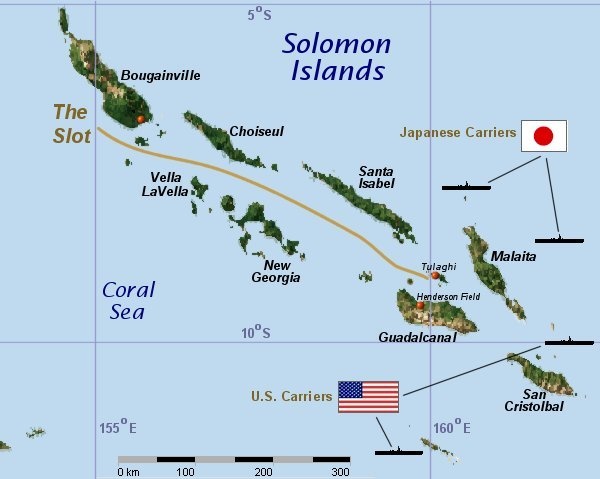
Solomon Islands, Guadalcanal, Henderson Field
Map of Guadalcanal, August 1942, showing Henderson Field, key to Operation Watchtower

(Image source credit for above Solomon Islands map)

In early August 1942, Operation Watchtower targeted the Japanese-held Solomon Islands, primarily Guadalcanal, where Japan had established a foothold and was building an airfield to threaten Allied supply lines to Australia. The Japanese, having expanded rapidly across the Pacific since Pearl Harbor, held the strategic initiative, with strong garrisons and naval dominance in the region. Their air forces, including the Mitsubishi Zero, outmatched early American aircraft like the Wildcat in maneuverability and range. Japan’s navy, with formidable carriers and battleships, held a slight edge over the U.S. Pacific Fleet, depleted after Pearl Harbor but bolstered by carriers like the Enterprise and Hornet.

One figure who really stood out to me during the land campaign was an enlisted Marine named John Basilone.
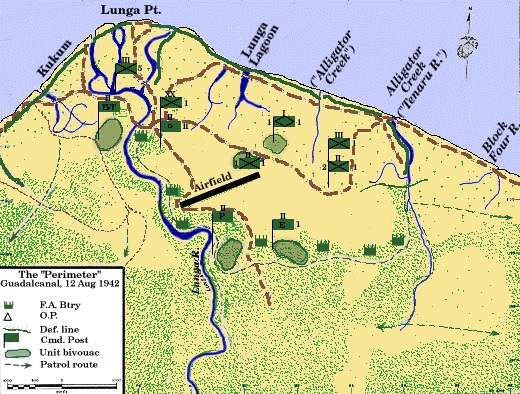
Lunga Perimeter Guadalcanal
Lunga Perimeter, Guadalcanal, 1942, showing the jungle terrain where John Basilone fought for three days against overwhelming odds

I saw a new New York Post article about Basilone authored by Rich Lowry, so let’s see what he has to say:

Born in Buffalo and raised in New Jersey by his Italian-American parents, he enlisted in the Army in the 1930s as a teenager. Then, after a stint as a civilian, he signed up for the Marines in 1940.

During the Battle of Guadalcanal in 1942, he almost single-handedly held off a massive assault by a Japanese regiment against two machine gun sections he commanded.

[…]When the Japanese disabled one of the American gun crews, Basilone moved another machine gun into position and personally manned it, and also repaired another gun under heavy fire.

When they needed more supplies, Basilone ran through Japanese lines to get the ammunition, defending himself with his Colt .45.

He fought for days and, by the end, he and his comrades had basically annihilated the Japanese attackers.

Basilone lost his asbestos gloves in the chaos and still handled the searing machine gun barrels, sustaining burns on his hands.

[…]Nash Phillips, a private who was wounded in the fight, recalled, “Basilone had a machine gun on the go for three days and nights without sleep, rest or food.”

He was awarded the Medal of Honor for that action (citation), but he wasn’t done serving his country:

Basilone was awarded the Medal of Honor and afforded, appropriately, a hero’s welcome back in the States. He participated in the campaign to sell war bonds.

His conduct at Guadalcanal would be more than enough valor in one life for the rest of us, but Basilone wanted back in the fight.

The Marines told him he was more valuable at home and denied his request. Basilone insisted, and the Marines eventually relented.

He was a machine gun section leader again in February 1945, on the first day of the invasion of Iwo Jima, a godforsaken hunk of volcanic rock in the middle of the Pacific. The dug-in Japanese chewed up the Americans on the beaches.

Basilone flanked a Japanese blockhouse, climbed atop it, and took it out on his own. He then led a Marine tank out of a minefield, before getting fatally hit.

For this action, he posthumously received the Navy Cross. The citation refers to him as “stouthearted and indomitable,” and praises “his intrepid initiative, outstanding skill, and valiant spirit of self-sacrifice.”

The war against Japan was one of our most noble wars. Prior to our entry in the war, Japan was already invading neighboring countries, and committing atrocities against unarmed civilians. We had every right to fight back once they attacked us, and to use every means necessary to stop their brutal aggression.

Since there is still space in this blog post, let’s fast forward a few years to the Korean War, and look at a famous battle in it, the Battle of the Chosin Reservoir. For this  theater, I recommend several books from my reading list. The best one is “On Desperate Ground: The Marines at The Reservoir, the Korean War’s Greatest Battle“. And I also liked “Colder Than Hell: A Marine Rifle Company at Chosin Reservoir” and “The Last Stand of Fox Company: A True Story of U.S. Marines in Combat“. There are actually two battles going on at the reservoir, one with the U.S. Marines on the west side of the reservoir, and one with the U.S. Army on the east side of the reservoir.

So, recall that the Korean War started with an invasion by North Korean communists against peaceful South Korea. America stepped in to defend South Korea from this aggression.

In late November 1950, the Battle of the Chosin Reservoir unfolded in North Korea’s frozen mountains, where the U.S. 1st Marine Division, under Major General Oliver P. Smith, faced a dire situation. Following the successful Inchon landing, General Douglas MacArthur and Major General Edward “Ned” Almond, pursued an aggressive push to the Chinese border at the Yalu River. MacArthur ignored October 1950 intelligence of 120,000+ Chinese troops crossing the Yalu, while Almond’s orders to advance disregarded the frozen, mountainous terrain.
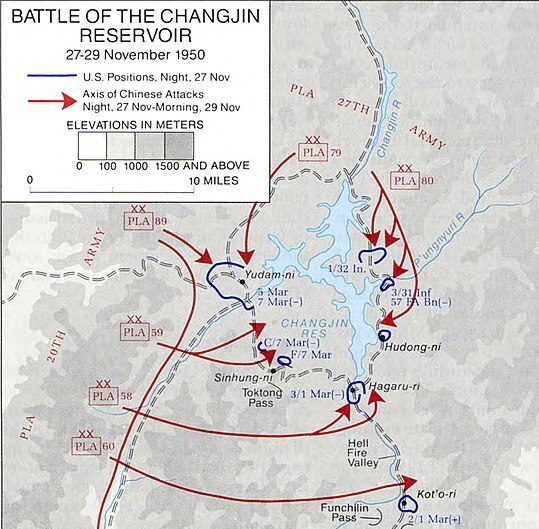
Map of Battle of the Changjin reservoir
Map of the Battle of the Chosin Reservoir, 27–29 November 1950, showing the Marines’ retreat from Yudam-ni to Hagaru-ri, with Toktong Pass held by Barber’s Fox Company

Make sure you find Toktong Pass in the image! It’s important!

By late November, 30,000 UN troops, including 20,000 Marines, were strung along a narrow 78-mile-long mountainous road from Hungnam to Yudam-ni, with key positions at Hagaru-ri and Toktong Pass. The Chinese held the initiative, outnumbering UN forces 10-to-1 in places. Bitter cold weather (-30°F) limited the U.S. air advantage, with Marine Corsairs from Hagaru-ri’s airfield providing vital support. Smith’s cautious advance, defying Almond’s dismissal of the Chinese (“Don’t let a bunch of Chinese laundrymen stop you!”), ensured supply stockpiles and an airfield at Hagaru-ri, critical for evacuations and reinforcements. His foresight preserved unit cohesion and saved 15,000 Marines from annihilation.

If you noticed that phrase “preserved unit cohesion”, I’ll just give you a hint that the U.S. Army forces east of Chosin were more beholden to the recklessness of MacArthur and Almond, and made no provisions for the Chinese ambush. Unit cohesion was lost and our forces were annihilated. You can read all about that in “East of Chosin: Entrapment and Breakout in Korea, 1950“. It’s a tough book, but shows the value of planning and caution when dealing with unknown enemies in mountainous terrain during the winter.

I previously blogged about William Barber and his Fox Company‘s heroic stand at Toktong Pass. Captain Barber’s Fox Company held Toktong Pass for five days against 1,400 Chinese, allowing 8,000 trapped Marines in the north to move south down the road to escape defeat. Fox Company received only minimal support from light helicopters, because of the cold, snowy weather and roadblocks to the north and south.
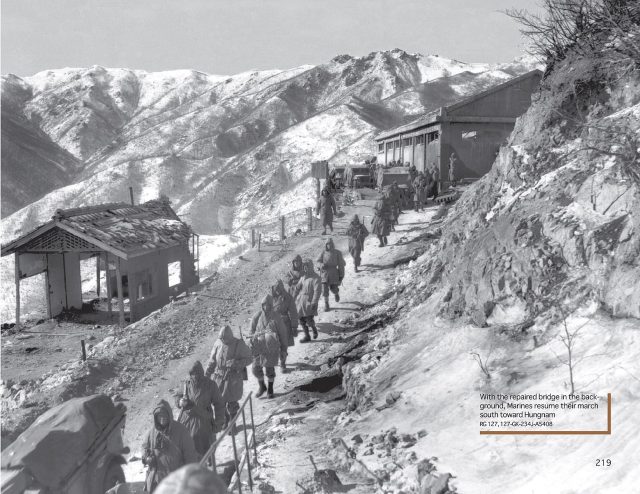
127-GK-234J-A5408 Treadway bridge through Funchilin Pass on December 9, 1950.jpg
Funchilin Pass, Chosin Reservoir, December 1950, showing the frozen terrain similar to Toktong Pass

So today let’s take a look at one of the Fox Company Marines who held the Toktong Pass for 5 days, with this article from Task and Purpose:

On Thanksgiving 74 years ago, at the height of the Korean War, the sound of gunfire abruptly woke Marine Pvt. Hector Albert Cafferata Jr. He and his squad held Fox Hill during the Battle of Chosin Reservoir, and a regimental-sized Chinese People’s Volunteer Army — a force of approximately 1,400 soldiers — sprung an ambush two hours past midnight.

Cafferata, then 23, was assigned to Company F, 2nd Battalion, 7th Marines, 1st Marine Division. He and over 200 Marines were tasked with protecting the Toktong Pass, an escape route through the Nangnim Mountains near the Chosin Reservoir in modern-day North Korea.

An initial hail of gunfire, grenades, and mortars knocked out nearly everyone in Cafferata’s squad, creating a weak spot in the defense perimeter, but Cafferata continued fighting, without a jacket in the pre-dawn winter cold. The Washington Post reported that fellow wounded Marine Kenneth Benson was initially blinded by a grenade blast during the attack but continued helping Cafferata by reloading his rifle.

Cafferata also landed on a desperate but ingenious way to send enemy grenades back toward the enemy.

“For the rest of the night, I was batting hand grenades away with my entrenching tool while firing my rifle,” Cafferata said in a 2001 interview with Florida’s Charlotte Sun newspaper. “I must have whacked a dozen grenades that night with my tool. And you know what? I was the world’s worst baseball player.”

Described as “Stouthearted and indomitable” in his Medal of Honor award citation, Cafferata managed to repel the ambush single-handedly, though it was temporary. The Chinese soldiers launched a vicious second wave in the morning hours.

During the fierce fighting, a grenade landed near a group of wounded Marines, and Cafferata threw it back under heavy fire. This time, it detonated after leaving his hand and severely wounded his right arm and hand with shrapnel. That didn’t stop him, though.

“Courageously ignoring the intense pain, he staunchly fought on until he was struck by a sniper’s bullet and forced to submit to evacuation for medical treatment,” reads the award citation.

Before getting evacuated, Cafferata is credited with killing 15 enemy soldiers and wounding several others. In Peter Collier’s 2003 book “Medal of Honor: Portraits of Valor Beyond the Call of Duty,” Cafferata’s Marine officers recalled how they counted about 100 dead Chinese soldiers where he had held the line. Still, they did not report that number because “they thought that no one would believe it.”

His Medal of Honor citation is here.

So, it’s Memorial Day, and it’s a time for Americans to take time out to think about the respect and gratitude that we owe to people who risked their lives for their friends.

We owe our liberties in large part to the American heroes who fought against imperialism and communism. It’s sad that we have so many people going through our schools and our universities, and coming out with ignorance of these heroes, and a lack of patriotism.

As a non-white legal immigrant to the United States, I’ve made it a major part of my life to go back in time and learn about the sacrifices of the people in our armed forces. You should make the effort, too. I don’t watch television, I am not subscribed to any streaming services, and with RARE exceptions, I don’t watch modern movies. My head is always in the past, learning about people who lived tougher lives than mine, and performed greater deeds fighting against evil than I ever will.

Reading this post and sharing it on social media would be a good start! Many Americans leave school unaware of the sacrifices of our heroes in the armed forces. Let’s share their stories to inspire gratitude in the next generation.

New study: chimp genome is 14.9 percent different from human genome

How do people decide that all of life is the product of blind forces like mutation and selection? Many people encounter the blind forces narrative in government-run schools at an age where they are not qualified to investigate anything themselves, at must rely on adults. And what kinds of “evidence” do the adults use on them? Does that “evidence” stand up over time?

When I was in high school, we had the choice to study 2 or 3 of the hard sciences: physics, biology or chemistry. I chose physics and chemistry, because I didn’t want my young Earth creation views being assaulted by adults who held the red marking pen. At the time, I was in a secular left country, and my non-Christian working parents only wanted to hear that I was getting the highest marks. Recognizing that the odds of overturning Darwinism in my public schools were against me (for now), I declined to participate in biology indoctrination, and threw myself into math and computer science instead. (I still scored near the top in physics and chemistry) Everything worked out fine for my career, and I eventually went back and got a biology education on my own, from the strong position of having a full time job that paid me more than the government school teachers.

But during high school, I heard about what my less careful friends were learning about in the biology classroom. One of my best friends, a Muslim named Shareef, told me about how he had learned that the chimp genome was only 1% different from the human genome. To him, this was proof of common ancestry, and showed that a naturalistic origin of the diversity of life was likely. He went on to get with a rowdy crowd, eventually dropping out of his engineering degree after 1 year where he performed poorly. Many people embrace evolution because it gives them moral license to drink a lot, and play the fool, which is bad for their grades. It was bad for his grades, and he got into more trouble later.

Well, at the time, I didn’t have the evidence to contradict Shareef about the chimp genome. But now I do!

Here is the latest evidence in Evolution News from Casey Luskin, who you might remember because he was a guest on the Knight and Rose Show.

[N]ew data reported in a recently published Nature paper by Yoo et al. has overturned this previous claim. The new findings reveal that human DNA is far more different from chimp DNA than previously thought.

Many times over the years, I’ve discussed how this 1 percent claim about humans and chimps is likely wrong. It is also misleading. No matter how similar humans might be to chimps at the genetic level, anyone who has been to the zoo knows already that chimps and humans are vastly different. After all, we’re the ones writing scientific papers about them—not the other way around. So common sense alone dictates that there is something misleading about that number and how it is used.  But the new data show that the previous statistic isn’t just misleading. It’s flat-out false.

As I will elaborate in a subsequent article, this team of researchers has published “complete” sequences of ape genomes that were created ‘from scratch’ rather than using the human genome as a template. As a result, for the first time we can attempt a much more accurate assessment of the true degree of difference between the human and chimp genomes.

The results are groundbreaking:

  • At least 12.5 percent and possibly up to 13.3 percent of the chimp and human genomes represent a “gap difference” between the two genomes. That means there’s a “gap” in one genome compared to the other, often where they are so different, they cannot even be aligned.

  • There are also significant alignable sections of the two genomes that show “short nucleotide variations” which differ by only about 1.5 percent. We can add this difference to the “gap difference,” and calculate a 14 percent to 14.9 percent total difference between human and chimp genomes. This means that the actual difference between human and chimp DNA is 14 times greater than the often-quoted 1 percent statistic. 

It’s true that large portions of the human genome are still only about 1.5 percent genetically different from the chimp genome. We’ll explore what that means in a subsequent post. But the new data reveal just how little this one fact tells us about the overall picture. We now know that major portions of the two genomes — 12.5 percent to 13.3 percent of the human genome, in fact — are so different that arguably the sections are unalignable and/or not directly present in one genome or the other.

And he has subsequent articles dealing with the details:

So, if this is something you or your children have ever encountered, it might be worth familizarizing yourself with the response: that the original estimates were based on using the human genome as a “target” and ignored the new evidence of gap differences. You can always come back to Casey’s articles if you need more evidence.

I hope you also see how you have to play the game as a Christian, in terms of strategy. When I was young, I didn’t have the parents or the experts to help me deal with the government school teachers. I was alone! And in many ways, I’m still alone now. But even so, every Christian has to navigate the world as it is, guarding their beliefs until the time when they are strong enough to make their claims in public. Now, I have no problem butting heads with the atheists in my workplace – they’re terrified of me. But that’s the result of a long journey of reading books, listening to podcasts and watching debates, and keeping up with the data on all of these controversial questions.

So, I recommend to people to get a copy of Luskin’s book “The Comprehensive Guide to Science and Faith“. And if you haven’t checked out the Discovery Institutes classes in biology and chemistry for students, you should do it. The default path for most young people in America is just to believe a lot of lies and half-truths served up to them by failure-to-launch teachers whose salaries based on whether their students can be tricked into voting for bigger government. They have an agenda.

I should mention that Shareef did eventually become a Christian, although he is still pretty liberal politically.

Stephen C. Meyer lectures on intelligent design and the origin of life

A MUST-SEE lecture based on Dr. Stephen C. Meyer’s book “Signature in the Cell“. One of my favorite 6 arguments for a Creator and Designer is the origin of the simplest replicating living system. When you look into the cell, what you’ll find is carefully sequenced components that for complex structures, like proteins. In this lecture, you’ll learn all about this “biological information”.

I highly recommend watching the lecture, and looking at the slides. The quality of the video and the content is first class. There is some Q&A (9 minutes) at the end of the lecture.

Topics:

  • intelligent design is concerned with measuring the information-creating capabilities of natural forces like mutation and selection
  • Darwinists think that random mutations and natural selection can explain the origin and diversification of living systems
  • Darwinian mechanisms are capable of explaining small-scale adaptive changes within types of organisms
  • but there is skepticism, even among naturalists, that Darwinian mechanisms can explain the origin of animal designs
  • even if you concede that Darwinism can account for all of the basic animal body plans, there is still the problem of life’s origin
  • can Darwinian mechanisms explain the origin of the first life? Is there a good naturalistic hypothesis to explain it?
  • there are at least two places in the history of life where new information is needed: origin of life, and Cambrian explosion
  • overview of the structure of DNA and protein synthesis (he has helpful pictures and he uses the snap lock blocks, too)
  • the DNA molecule is composed of a sequence of bases that code for proteins, and the sequence is carefully selected to have biological function
  • meaningful sequences of things like computer code, English sentences, etc. require an adequate cause
  • it is very hard to arrive at a meaningful sequence of a non-trivial length by randomly picking symbols/letters
  • although any random sequence of letters is improbable, the vast majority of sequences are gibberish/non-compiling code
  • similarly, most random sequences of amino acids are lab-proven (Doug Axe’s work) to be non-functional gibberish
  • the research showing this was conducted at Cambridge University and published in the Journal of Molecular Biology
  • so, random mutation cannot explain the origin of the first living cell
  • however, even natural selection coupled with random mutation cannot explain the first living cell
  • there must already be replication in order for mutation and selection to work, so they can’t explain the first replicator
  • but the origin of life is the origin of the first replicator – there is no replication prior to the first replicator
  • the information in the first replicator cannot be explained by law, such as by chemical bonding affinities
  • the amino acids are attached like magnetic letters on a refrigerator
  • the magnetic force sticks the letters ON the fridge, but they don’t determine the specific sequence of the letters
  • if laws did determine the sequence of letters, then the sequences would be repetitive
  • the three materialist explanations – chance alone, chance and law, law alone – are not adequate to explain the effect
  • the best explanation is that an intelligent cause is responsible for the biological explanation in the first replicator
  • we know that intelligent causes can produce functional sequences of information, e.g. – English, Java code
  • the structure and design of DNA matches up nicely with the design patterns used by software engineers (like WK!)

There are some very good tips in this lecture so that you will be able to explain intelligent design to others in simple ways, using everyday household items and children’s toys to symbolize the amino acids, proteins, sugar phosphate backbones, etc.

Proteins are constructed from a sequence of amino acids:

A sequence of amino acids forming a protein

Proteins sticking onto the double helix structure of DNA:

Some proteins sticking onto the sugar phosphate backbone

I highly, highly recommend this lecture. You will be delighted and you will learn something.

Here is an article that gives a general overview of how intelligent design challenges. If you want to read something more detailed about the material that he is covering in the lecture above related to the origin of life, there is a pretty good article here.

There is a good breakdown of some of the slides with helpful flow charts here on Uncommon Descent.

Positive arguments for Christian theism