What kind of man is Christian athlete Lolo Jones trying to date for marriage?

I saw that 38-year-old athlete named Lolo Jones was complaining about how hard it was for her to find a husband. Apparently, she’s been trying very hard to get married all along, and has not had any success. Let’s take a look at her Instagram page and Twitter page, then her previous boyfriend, and see what she’s doing wrong.

So, here’s her Instagram. She claims to be a Christian, but it’s a constant stream of glamorous pictures of herself, many featuring swimwear or workout apparel. Her Twitter feed is more of the same. Lots of inconsequential things about herself. What she had for breakfast. When she got up from sleeping. That she prefers voice notes to texts. What video games she likes. Etc. The only mention of God I saw is when God helped her win a gold medal. Because that’s what God’s priority was in the world that day – her happiness. Is that what the Bible teaches – that it’s God job is to make his human pets happy? That seems to be a popular view among the books that Christian women are reading today. But is that what Jesus was telling us about God with his life?

Anyway, why aren’t marriage-minded men interested in her?

What marriage-minded men are looking for

So, I have a list of questions that I use when evaluating women for wife and mother roles. I’m trying to see whether the woman is capable of making a marriage to me achieve the goals that God has for his world and his creatures. Right now, the primary threats to God’s view of the world and us that I see are atheism, feminism and socialism. (I’m open to adding or subtracting from this list)

I’m looking for capabilities like these in a wife:

  • demonstrate the existence of God objectively using philosophical arguments and scientific evidence
  • demonstrate the truth about who Jesus was and his resurrection using historical evidence
  • answer philosophical, scientific and historical objections to the Christian worldview
  • explain why other major religions and ideologies are false
  • understand and defend the Bible’s teachings about moral issues (chastity, abortion, divorce, etc.) using philosophical arguments and/or scientific evidence
  • explain her Christian role models and what they have done for Christ and his Kingdom that makes you admire them
  • explain what your goal is for your children, and what you intend to do to achieve those goals
  • explain male and female roles in marriage, what you have done to prepare to perform your roles, and how you evaluate marriage candidates for performance of their roles

So, looking at her Instagram and Twitter, I don’t see anything relevant to a Christian marriage enterprise there. Bikini photos and tweets about silly personal details are unrelated to the Christian marriage enterprise. Even when she promotes virginity, she talks about herself, which is not rationally persuasive to anyone else, since it’s just her subjective opinion. The right way to persuade people that the Bible is correct about sex and sexuality, (and I’ve been doing that for 12 years on this blog), is by appealing to evidence, such as the evidence from research papers.

Lolo Jones So Good Looking
Lolo Jones “He’s So Good Looking”

What is she looking for in a man?

Lots of Christian women like to talk about their desire for marriage, but their actions are not focused on choosing men who demonstrate ability to perform husband and father roles, e.g. – defending truth, providing, charitable giving, chastity, sobriety, romantic love, selflessness, mentoring, etc. What about Lolo?

Consider Lolo’s comments about a man she is impressed by:

Double Agents rookie Nam has been described as “hot” (by Wes), “a physical specimen” (Jay) and “built like a statue” (Kam). But what does his partner, fellow newbie Lolo Jones, think of the Ultimate Beastmaster competitor?

“My teammate’s kind of growing on me. I don’t know if it’s because I’ve seen him come out of the shower a few times, but I’m really liking this chemistry we have,” the Olympian stated during this week’s Challenge episode. “He’s so good-looking.”

[…]Lolo (wants) him to pursue her (since she’s the lady), but he hasn’t.

“I’m throwing everything out his way, but he’s just stoic,” she admitted in a confessional.

If you click through to that article, you’ll see her postive reaction to how “good-looking” this man is. She bends her head forward, and lifts up both arms in excitement. She’s not excited by (or respectful of) marriage-related capabilities or willingness to commit. She’s not raving about a man’s chastity or his sobriety or his theology or his apologetics ability or his mentoring of other Christians or his charitable giving. She’s excited by his height and his appearance.

Her last boyfriend was apparently a basketball player. He’s 7 years younger than she is, 6’7″ tall, and he can really put a basketball into the basketball hoop. But is that relevant for making a marriage that impacts the world for Christ and His Kingdom? Not at all. What a man does in marriage is teach people (church, university, workplace, etc.) about the truth of God’s existence, his character and his interaction with his creatures in history. Men are equipped to be persuasive with reason and evidence when discussing behaviors that cause harm to children, like abortion, divorce, promiscuity, same-sex parenting, etc.  Men are equipped to defend the policies that promote marriage and family, like low tax rates, limited government, the rule of law, etc. Men invest in other Christians, partnering with them to promote Christian truths and Christian convictions to those who don’t accept them. And men know how to help and support their wives as they do their mothering and ministry.

Serious Christian men do not marry women who don’t understand the importance and value of marriage-related capabilities and achievements.

1 Samuel 16:7
1 Samuel 16:7

It’s very important for conservative marriage activists like Mark Regnerus, Brad Wilcox, Greg Stanton, pious pastors, etc. to understand that for Christian men there is more to being a wife and mother than holding a Bible, attending church and singing in the choir. I am a man who has the marriage character and the marriage ability. I can pull the trigger on a commitment – I’m equipped to do that, and do it well. But I want my marriage to fight against atheism, feminism and socialism. Lolo Jones is fit and attractive. She is not equipped for a Christian marriage.

The psychological motivation of those who embrace postmodernism

Can a person be postmodern and a Christian? Not for long

Famous analytical philosopher John Searle has written a book “Mind, Language And Society: Philosophy In The Real World”, explaining what’s factually wrong with postmodernism. In the introduction, he explains what postmodernism is, and what motivates people to accept postmodernism.

He writes:

[…][W]hen we act or think or talk in the following sorts of ways we take a lot for granted: when we hammer a nail, or order a takeout meal from a restaurant, or conduct a lab experiment, or wonder where to go on vacation, we take the following for granted: there exists a real world that is totally independent of human beings and of what they think or say about it, and statements about objects and states of affairs in that world are true or false depending on whether things in the world really are the way we say they are. So, for example, if in pondering my vacation plans I wonder whether Greece is hotter in the summer than Italy, I simply take it for granted that there exists a real world containing places like Greece and Italy and that they have various temperatures. Furthermore, if I read in a travel book that the average summer temperature in Greece is hotter than in Italy, I know that what the book says will be true if and only if it really is hotter on average in the summer in Greece than in Italy. This is because I take it for granted that such statements are true only if there is something independent of the statement in virtue of which, or because of which, it is true.

[…]These two Background presuppositions have long histories and various famous names. The first, that there is a real world existing independently of us, I like to call “external realism.” “Realism,” because it asserts the existence of the real world, and “external” to distinguish it from other sorts of realism-for example, realism about mathematical objects (mathematical realism) or realism about ethical facts (ethical realism). The second view, that a statement is true if things in the world are the way the statement says they are, and false otherwise, is called “the correspondence theory of truth.” This theory comes in a lot of different versions, but the basic idea is that statements are true if they correspond to, or describe, or fit, how things really are in the world, and false if they do not.

The “correspondence theory of truth” is the view of truth assumed in books of the Bible whose genre is such that that they were intended by the authors to be taken literally, (with allowances for symbolism, figures of speech, metaphors, hyperbole, etc.).

But what about the postmodernists, who seek to deny the objectivity of external reality?

More Searle:

Thinkers who wish to deny the correspondence theory of truth or the referential theory of thought and language typically find it embarrassing to have to concede external realism. Often they would rather not talk about it at all, or they have some more or less subtle reason for rejecting it. In fact, very few thinkers come right out and say that there is no such thing as a real world existing absolutely, objectively, and totally independently of us. Some do. Some come right out and say that the so-called real world is a “social construct.”

What is behind the denial of objective reality, and statements about external reality that are warranted by evidence?

It is not easy to get a fix on what drives contemporary antirealism, but if we had to pick out a thread that runs through the wide variety of arguments, it would be what is sometimes called “perspectivism.” Perspectivism is the idea that our knowledge of reality is never “unmediated,” that it is always mediated by a point of view, by a particular set of predilections, or, worse yet by sinister political motives, such as an allegiance to a political group or ideology. And because we can never have unmediated knowledge of the world, then perhaps there is no real world, or perhaps it is useless to even talk about it, or perhaps it is not even interesting.

Searle is going to refute anti-realism in the rest of the book, but here is his guess at what is motivating the anti-realists:

I have to confess, however, that I think there is a much deeper reason for the persistent appeal of all forms of antirealism, and this has become obvious in the twentieth century: it satisfies a basic urge to power. It just seems too disgusting, somehow, that we should have to be at the mercy of the “real world.” It seems too awful that our representations should have to be answerable to anything but us. This is why people who hold contemporary versions of antirealism and reject the correspondence theory of truth typically sneer at the opposing view. 

[…]I don’t think it is the argument that is actually driving the impulse to deny realism. I think that as a matter of contemporary cultural and intellectual history, the attacks on realism are not driven by arguments, because the arguments are more or less obviously feeble, for reasons I will explain in detail in a moment. Rather, as I suggested earlier, the motivation for denying realism is a kind of will to power, and it manifests itself in a number of ways. In universities, most notably in various humanities disciplines, it is assumed that, if there is no real world, then science is on the same footing as the humanities. They both deal with social constructs, not with independent realities. From this assumption, forms of postmodernism, deconstruction, and so on, are easily developed, having been completely turned loose from the tiresome moorings and constraints of having to confront the real world. If the real world is just an invention-a social construct designed to oppress the marginalized elements of society-then let’s get rid of the real world and construct the world we want. That, I think, is the real driving psychological force behind antirealism at the end of the twentieth century.

Now, I’ll go one step further than Searle.

People, from the Fall, have had the desire to step into the place of God. It’s true that we creatures exist in a universe created and designed by God. But, there is a way to work around the fact that God made the universe and the laws that the universe runs on, including logic, mathematics and natural laws. And that way is to deny logic, mathematics and natural laws. Postmodernists simply deny that there is any way to construct rational arguments and support the premises with evidence from the real world. That way, they imagine, they are free to escape a God-designed world, including a God-designed specification for how they ought to live. The postmoderns deny the reliable methods of knowing about the God-created reality because logic and evidence can be used to point to God’s existence, God’s character, and God’s actions in history.

And that’s why there is this effort to make reality “optional” and perspectival. Everyone can be their own God, and escape any accountability to the real God – the God who is easily discovered through the use of logic and evidence. I believe that this is also behind the rise of atheists, who feign allegiance to logic and science, but then express “skepticism” about the origin of the universe, the fine-tuning of the universe, objective morality, the minimal facts concerning the historical Jesus, and other undeniables.

Marine Captain earned Medal of Honor fighting communists in North Korea

First, let’s go from the top down to set the context for the profile of William E. Barber.

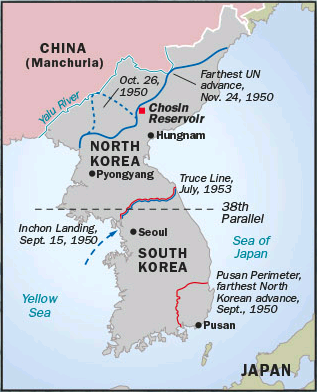
Map of the Korean War

In the summer of 1950, North Korean communists launch a completely unprovoked attack across the 38th parallel against their peaceful, democratic neighbors, the South Koreans. The Americans immediately sent an invasion force by sea to drive them out. The North Koreans easily manage to take over the capital Seoul, and the allies are left with only one port in the southeast – Pusan. In September of 1950, American forces land an invasion force at Inchon, cutting off the North Korean invasion force surrounding Pusan. The North Koreans retreat, and there is hope that American forces will be home by Christmas. But then, unbeknownst to the Americans, the Chines communists  invade North Korea from the north and surround the American forces near the Chosin reservoir, threatening to annihilate an entire Marine division.

The Marines at Yudam-Ni are surrounded and must retreat to Hagaru-Ri

As you can see from the map, there are a whole bunch of American troops fighting to the north/east and south/west of the Chosin Reservoir. The marines near Yudam-Ni need to retreat along a road called the MSR (main supply road) back to Hagaru-Ri. But in order to conduct that retreat, they have to hold onto the vital Toktong pass, which is overwatched by Fox company from their position on Fox Hill. Can Charlie company and Fox company hold off the entire Chinese 59th division (10,000 men) with only two companies (about 250 men each)?

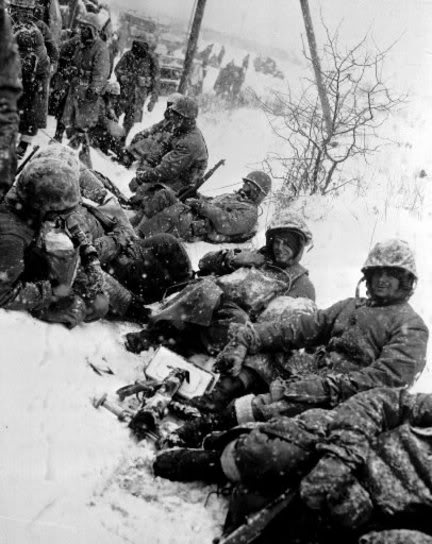
U.S. Marines "The Chosin Few", December 1950
U.S. Marines “The Chosin Few”, December 1950

Well, the book I read (which Dina gave me for Christmas), was about Fox company and their defense of the Toktong pass. This is what the leftist New York Times had to say about the man in charge of Fox company (“F company”) in a 2002 article:

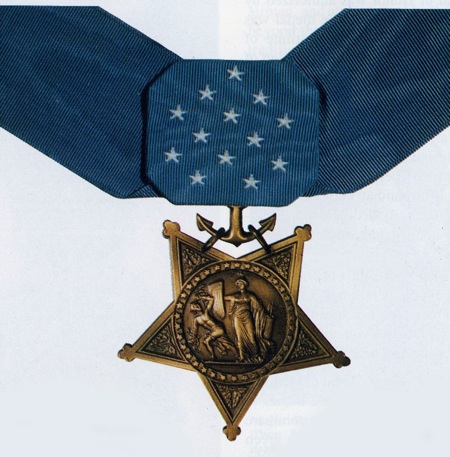
Col. William E. Barber, who won the Medal of Honor for his leadership of a vastly outnumbered company under siege on a snowy hilltop in one of the worst defeats in Marine history, the Battle of the Chosin Reservoir in 1950, died on April 19 at his home in Irvine, Calif. He was 82.

The cause was bone-marrow cancer, said Jerry Courtier, a friend who hopes to write Colonel Barber’s biography.

The reservoir is south of the Yalu River, which separates North Korea from China. After the Americans had pushed the North Koreans almost to the Yalu, 150,000 Chinese troops unexpectedly crossed the river into North Korea. Colonel Barber’s unit, Company F of the Second Battalion of the Seventh Marines, First Marine Division, was on a hill that commanded the Toktong Pass, a vital gap between Yudam Ni and Hagaru Ri, two towns separated by 78 miles.

The stakes were huge. If F Company yielded its position, 8,000 marines at Yudam Ni would be cut off from the 3,000 at Haguru Ri by tens of thousands of Chinese troops.

Through five days and six nights in subzero weather and often swirling snow, Colonel Barber, then a captain, inspired his men, outnumbered more than five to one, to cling to their tenuous positions. He was shot in a bone near his groin on the second day but continued to make the rounds of the hill. He likened the wound to a bee sting.

When the unit was ordered to withdraw and fight its way to safety, Captain Barber refused. Three times, the enemy broke through the line, only to be repulsed.

”I knew that we could probably hold, and I knew that if we didn’t hold we could exact a very heavy toll,” he said in an interview in 1976 with The Los Angeles Times.

His citation for the nation’s top medal said that he commanded his men from a stretcher. But Hector A. Cafferata Jr., who as a rifleman won the Medal of Honor in the same battle, insisted that Captain Barber refused the stretcher.

”He walked the line, he kept us together,” said Mr. Cafferata, who was beside Captain Barber when he was shot.

In the mayhem, the Chinese blew whistles, beat cymbals and tooted bugles as they repeatedly attacked. Coffee froze before men could drink it, and some of the wounded died because plasma froze with no way to thaw it.

When the battle was over, more than 1,000 enemy soldiers were dead. Of Captain Barber’s original 240 men, 82 were able to walk away.

Gen. Raymond G. Davis, who was a lieutenant colonel in the Marines, received a Medal of Honor for leading the unit that rescued F Company.

William Earl Barber was born on Nov. 30, 1919, in Dehart, Ky. He attended what is now Morehead State University in Morehead, Ky., for two years and enlisted in the Marines, at the age of 21, in 1940.

He was so good at shooting a rifle that he was made a weapons instructor. After volunteering for parachute training, he demonstrated such proficiency that he became a parachute instructor.

In World War II, he was promoted to sergeant in 1942 and commissioned a second lieutenant in 1943. He was a rifle platoon commander at Camp Pendleton, Calif., when his unit was shipped to the Pacific.

Colonel Barber was in the first wave to hit Iwo Jima, where he was wounded twice. He received the Silver Star for bravery in addition to two Purple Hearts. At a ceremony on the 50th anniversary of the battle in 1995, he said:

”I am older now, as you are, but I can still see the colors of that February morning. The sky. The island. And sometimes I think I can hear the noise of battle.”

He was treated in Japan for his wounds and returned to the United States, where he worked as a recruiter, among other positions. He was promoted to captain in 1949 and was in the force that occupied Japan.

When he joined F Company in Korea, he saw a raggedy unshaven bunch and immediately ordered the the troops to shave, shine their shoes and look like marines. He suggested that his new charges resembled Pancho Villa’s bandits.

”He was one tough guy,” Mr. Cafferata said. ”He was by the book.”

He was by the book. He enlisted in the Marines because he was grateful to his country for allowing him to escape poverty and go into college, and he wanted to give something back.

You can read a review of the book I read about Fox company, and read about some of the details of what it was like for those men. You’ll never look at your own troubles the same way again. You can also read about Barber’s Medal of Honor citation here.

The Medal of Honor, Navy and Marines variant

So, now that I am done with that book, I have moved on to another Korean War book that Dina gave me, this one about George company. The Korean War might have been our most just war – defending a peaceful democratic ally from a totalitarian communist regime. You just have to compare North Korea and South Korea today to understand the stakes. North Korea is basically a godless concentration camp that tortures and murders its people if they so much as think the wrong thoughts about the atheist state. South Korea is free and prosperous, where the people have human rights, like the right to free speech and freedom of religion.

It’s important for me to read about the hardships that real heroes face, so that I don’t complain too much about my own tiny struggles. When you read about the struggles of great American soldiers, so many good things happen to you. Your own problems get smaller, your humility and gratitude get bigger. And you are reminded about why America is a great country, and what American character is really like. These things are not taught by leftists in the public schools. They are not talked about by leftists in the mainstream media. They are not presented by leftists in the Hollywood film industry. If you want to know the real America, you have to find it yourself.