
What do scientific studies show about the long-term effects of gender-affirming care?

I like to write posts to record evidence that I can use when having debates about controversial topics. Thursday night, I was reading The Federalist, as usual, and found an interesting post by Eddie Scarry. He reported that the far-left Washington Post was claiming that people who get “gender-affirming” care are very happy in the short term. But what about in the long-term?

Excerpt:

On Thursday the paper published what it called “one of the largest randomized samples of U.S. transgender adults to date about their childhoods, feelings and lives.” The survey took place last year from Nov. 10 to Dec. 1, among 515 U.S. adults who identify as trans and another 823 U.S. adults who did not.

There were a lot of depressing statistics about respondents who are less likely than regular people to say their childhoods were happy and who are more likely to say they often feel anxious. But the ultimate takeaway was that the vast majority of those who said they had “transitioned” away from their natural sex, 78 percent, were “more satisfied” with their lives than before the transition process.

That survey is just from “last year”. I would imagine that people who take out student loans to study English also feel great during their years at college… but they don’t feel the same when they graduate and have to find a job to pay those loans back. And that’s the real question… what is the effect of chopping off body parts in the long-term? Fortunately, we have a study for that.

More:

A person who decides to live in ways that make him feel more like the opposite sex isn’t a one-and-done. That’s something that has to be examined over an extended period of years. As far as actual genital surgery goes — in theory, the most fulfilling type of “transition” — only one study has done that to date.

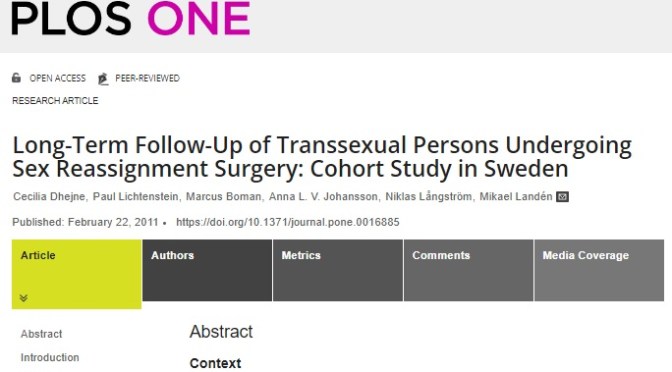
Over the course of 30 years, six Swedish doctors and scientists tracked the outcomes of 324 transgender people who had received sex surgeries — 191 male subjects and 133 female subjects. Each subject was cross-referenced with 10 random control subjects of the sex that the trans subject was impersonating. For example, a woman would be a control subject for a man who had had surgery to make himself look more like a woman.

The results were devastating.

Subjects who underwent surgery were more likely than the control subjects to receive inpatient care for a psychiatric disorder, to be convicted of a crime, and to develop cardiovascular disease. The mortality rate by suicide was most striking: Transgender subjects were roughly 20 times more likely to have committed suicide within 10 years of their operations.

“This study found substantially higher rates of overall mortality, death from cardiovascular disease and suicide, suicide attempts, and psychiatric hospitalisations in sex-reassigned transsexual individuals compared to a healthy control population,” the authors concluded. “This highlights that post surgical transsexuals are a risk group that need long-term psychiatric and somatic follow-up.” They noted that surgery and experimental cross-sex hormones may provide some relief for transgender people, but that such treatment is “apparently not sufficient to remedy the high rates of morbidity.”

They have the link to the study right in the quotation above. So next time you get asked about this issue, refer to the long-term study.

Sometimes people prefer to read individual stories about individual people to get an idea of what’s behind the statistics. If you like that, consider this recent story from the New York Post, about an individual who received “gender-affirming care” of the sort that the Washington Post would approve of.

Excerpt:

Transgender flight attendant Kayleigh Scott — who gained fame after appearing in a United Airlines commercial — was found dead Monday in her Colorado home. She was 25.

Scott, who shared her transition story for a 2020 Trans Day of Visibility video produced by United, declared in a 2:30 a.m. Instagram post that she was planning to end her life.

[…]Scott made headlines in 2020 when United featured her as a part of its diversity campaign.

Scott said she credited United for helping her transition.

“My life changed for the better when I came to United as a flight attendant. With the support from the company, our business resource group for LGBTQ+ employees, and all of my loving co-workers,” Scott said at the time. “I was able to break free from the chains that helped me and to this day, I’m living confidently. It’s my true self.”

Everything was wonderful in the short-term. Celebrate diversity. Celebrate pride. Be affirming and non-judgmental and tolerant. That’s what people wanted in the short-term.

Here’s the long-term:

“2022 has been a year packed with upset and difficulty,” wrote Scott in a New Year’s Eve Facebook post. “I saw too much death & loss in my life, I came to realize I work a meaningless job for a company that doesn’t value me as an employee.”

United Airlines didn’t make a virtue-signaling publicity video about that post. The Human Rights Campaign didn’t turn that quote into a publicity stunt. Naturally. The people who affirm recklessness turn their backs on you when the consequences of your choices appear. People who like to party and be happy in the moment don’t want to deal with the fallout of the bad decisions that they told you to make.

Christians tell young people to keep to the moral boundaries, because we want them to be happy in the long-term. In the short-term, we look like the mean, judgmental bad guys. But in the long-term, we are vindicated. Gay activists and gay activism organizations affirm the reckless decisions of young people because they want to be liked and to feel good. But they don’t really love the people they affirm. They don’t want what’s best for other people in the long-term.

Well, that’s the example of long-term consequences for one person. I’m a studies man, myself. I like to argue from studies. If you’re like me, then my previous post about self-ending rates of people who received “gender-affirming care” might also be useful to you.

Is the federal government interested in monitoring speech?

My first read every day is The Federalist, and there I found a very interesting article by Margot Cleveland. In it, she reveals some research that The Federalist has been doing about the federal government’s plans to monitor speech. Not just the speech of journalists and politicians, but also churches, and even individuals. What would they do with this information?

Excerpt:

Our government is preparing to monitor every word Americans say on the internet—the speech of journalists, politicians, religious organizations, advocacy groups, and even private citizens. Should those conversations conflict with the government’s viewpoint about what is in the best interests of our country and her citizens, that speech will be silenced.

[…]Research by The Federalist reveals our tax dollars are funding the development of artificial intelligence (AI) and machine-learning (ML) technology that will allow the government to easily discover “problematic” speech and track Americans reading or partaking in such conversations.

Then, in partnership with Big Tech, Big Business, and media outlets, the government will ensure the speech is censored, under the guise of combatting “misinformation” and “disinformation.”

Here’s how they found out what the government is doing:

The federal government has awarded more than 500-plus contracts or grants related to “misinformation” or “disinformation” since 2020. One predominant area of research pushed by the Department of Defense involves the use of AI and ML technology to monitor or listen to internet “conversations.”

Originally used as a marketing tool for businesses to track discussions about their brands and products and to track competitors, the DOD and other federal agencies are now paying for-profit public relations and communications firms to convert their technology into tools for the government to monitor speech on the internet.

What’s troubling about this for me is the not only that truth-tellers would be censored, or labeled “domestic terrorists” and harassed by law enforcement. That’s already happening in the United States. Just look at the Twitter Files revelations. My concern is the freezing of bank accounts as coercion. That’s already happening in Canada. And it would be even easier to do if we converted to a digital currency, that was used by all of our banks.

Here’s a Wall Street Journal article:

“Central-bank digital currency” doesn’t exactly roll off the tongue. But you might want to get used to saying it. These so-called CBDCs, or digital versions of dollars, yuan, euros, yen or any other currency, are coming, say those who study them. And depending on how they are designed and rolled out, their impact on the banking system could be profound.

[…]The U.S. is studying the issue and has run trials of various technologies to enable a digital currency, although Fed chair Jerome Powell has indicated the U.S. central bank has no plans to create one, and won’t do so without direction from Congress.

[…]First, there is the obvious issue of privacy. A digital currency could allow governments to track every transaction a person makes, no matter how minute. This level of transparency would be a powerful disincentive to using these currencies for crime or fraud, but it could also open the door to new kinds of social control, especially in countries with already-scant protections for human rights.

For example, says Dr. Prasad, a government could make it impossible to spend the digital currency on things the ruling party deems problematic… The government also could make transacting with certain people difficult or impossible—China already has a social credit system that ranks citizens algorithmically, and punishes them in various ways.

Here’s Joe Biden’s position on digital currency, reported by NBC News:

The Biden administration is putting its support behind the research and development of a “U.S. Central Bank Digital Currency,” or CBDC.

The move is part of a sweeping executive order President Joe Biden signed Wednesday instructing the federal government to explore possible uses of and regulations for digital assets like cryptocurrencies.

And here’s Ron DeSantis’ position on digital currency, reported by Townhall:

Florida Gov. Ron DeSantis on Monday moved to protect The Sunshine State from the Biden administration’s potential “weaponization of the financial sector” through a Central Bank Digital Currency.

The legislative proposal would amend the state’s Uniform Commercial Code to prohibit the use of federal or foreign CBDC and calls on other states to join in the fight by instituting similar prohibitions.

There are very clear differences between Democrats and Republicans on the issues of surveillance, censorship, coercion and totalitarianism. Something to think about, as we approach the 2024 elections. Choose wisely.

Young people are more likely than older people to think that women power has gone too far

If I asked you whether young people or old people are more in favor of feminism, I’ll bet that the majority of you would answer “young people”. Because you would say that old people are more traditional than young people. But that’s not what a recent survey found. There’s an article about it in the New York Post, although the original article comes from an Australian news web site.

Excerpt:

A surprising number of people in younger generations believe that women’s rights have gone too far, with a new survey revealing gender equality progress could be at risk of stalling.

New research conducted by Ipsos UK and the Global Institute for Women’s Leadership at King’s College London found that over half of people in younger generations believe the push for equality is now negatively impacting men and that they are being expected to do “too much” to support progress.

The survey collated the responses from more than 22,500 people aged 16-74 across 32 countries, including approximately 1000 people from Australia.

According to the results, 52 percent of Gen Z and 53 percent of Millennials agree that “we have gone so far in promoting women’s equality that we are discriminating against men”.

This is compared to 46 percent of Gen X and 40 percent of Baby Boomers.

The article is in favor of the women power movement, and it expresses shock and horror that anyone could ever have a reason to disagree with it.

What does this mean? Well, I think older people have an out-of-date view of just how much society (government and other institutions) has done to give preferential treatment to women at the expense of men.

To take just one example, about 60% of undergraduate degrees are being given to women, with men getting only 40%.

The American Enterprise Institute reports:

  • For every 100 women who earn bachelor’s degrees from US colleges and universities, there are 73 men.

  • For every 100 women who earn master’s degrees from US colleges and universities, there are 65 men.

  • For every 100 women who earn doctor’s degrees from US universities, there are 85 men.

  • For every 100 women who are recent college graduates but not in the labor force, there are 108 men.

  • For every 100 women with an advanced degree but not in the labor force there are 114 men.

When I looked into what was causing this, I found out that men underperform women on classroom tests, but men outperform women on standardized tests. Studies have shown that teachers (85% women) discriminate against boys in the classroom, and that’s why boys underperform girls on classroom-administered tests. But on standardized tests, boys do better, because there is no discriminator present and the grading is more fair.

Hypergamy

The problem with this discrimination against men is that women typically like to “marry up”. They are looking for men who have more education and better careers and higher salaries than they have.  When the number of desirable men shrinks, it becomes harder and harder for women to lock one down. That’s the law of supply and demand. When the supply of marriage-ready men (good education, good job, good savings) shrinks, the price of a marriage-ready man goes up. The price of goods always goes up when there is a shortage. And right now there is definitely a shortage of educated men with good careers and lots of savings. Discrimination against men by feminists, feminist laws and feminist policies caused this shortage.

It’s the younger generations who are seeing firsthand how discrimination against men makes relationships, much less marriage, harder to achieve. Sadly, the older generations aren’t paying attention. If men aren’t doing well, then women aren’t going to be able to find men to marry and start families with. What satisfies women in the long run is family. Marriage and family are dying in the west, and young people understand that feminism was the murder weapon. Young people understand this, because they see relationships and marriage drying up.

It’s not just the left-wing feminists who want the discrimination against men to remain. Pro-marriage feminists, including many “chivalrous” Christians (men and women) also want feminist discrimination against men to remain. They blame the retreat from relationship and the decline of marriage on MEN, not on feminism. Until this changes, don’t expect relationships and marriage to return.