
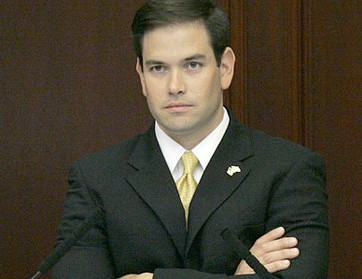
Marco Rubio’s amazing maiden speech in the US Senate

Florida Senator Marco Rubio

Human events reported on Florida Senator Marco Rubio’s first speech on the floor of the US Senate today, and it was AWESOME. (H/T Kathleen McKinley)

Full story:

Freshman Florida Republican Senator Marco Rubio delivered his maiden speech on the floor of the Senate yesterday and it was a speech all GOP presidential contenders should watch.

It was the best speech of the 2012 presidential cycle, except the person who delivered it has all but ruled himself off of the 2012 ticket on numerous occasions.

The GOP presidential field has been criticized for not having passion or conviction, and Rubio’s speech lit up the normally staid Senate chamber to the extent that this is possible. It had a clear argument, an emotional arc, personal tie-ins, and was delivered with conviction. Too often, even in the GOP, politicians talk about American exceptionalism as if it is an academic exercise.

Not Rubio.

Rubio owned it, his words personified it, and his speech was delivered in a way that led one who was watching to to think Rubio was humbled and still awed at America’s exceptional past and promise.

As Republicans learned in 2008, words and stories matter. It draws a public who does not get caught up in the drudgery of modern American politics in to care about the democratic process.
Add in the fact that Rubio is young and a minority, which are the two groups Republicans do most poorly with, and the speech and the messenger become even more dynamic, compelling, symbolic and important.

Rubio said he came “from a hard working and humble family” that “was neither wealthy nor connected,” but that he “grew up blessed in two important ways:” He had a strong and stable family and was born in America.

He realized that “America is not perfect” and “ti took a bloody civil war to free over 4 million African Americans who lived enslaved … and it would take another hundred years after that before they found true equality under the law.”

Rubio then movingly talked about how people who came to give their children a better life contributed to an “American miracle.”

He spoke of how a “16-year-old boy from Sweden, who spoke no English and had only five dollars in his pocket, was able to save and open a shoe store,” and “today, that store, Nordstrom is a multi-billion dollar global retail giant.”

He spoke of a “a young couple with no money and no business experience decided to start a toy business out of the garage of their home, and, “today, that company, Mattel, is one of the world’s largest toy manufacturers”

He spoke of the “French-born son of Iranian parents created a website called AuctionWeb in the living room of his home,” and, “today, that website now called eBay stands as a testament to the familiar phrase, ‘Only in America.'”

Rubio then talked movingly of the American dream and personified it by putting faces on the dream.

He said it was “story of the people who cleaned our office last night” who work hard so they can send their kids to college.”

He said it was “the story of the people who served your lunch today” who “work hard so that one day their children will have the chance to own a business.”

He said, in a reference to his father, the American Dream was also the “story of a bartender and a maid in Florida, whose son now serves here in this Senate, and who proudly gives his testimony as a firsthand witness of the greatness of this land.”

He then pivoted and said while “most great powers have used their strength to conquer other nations” America “is different” for America, “power also came with a sense that to those that much is given, much is expected.”

Rubio said that America’s greatness can be found anywhere in the world, “when someone uses a mobile phone, email, the Internet, or GPS” or “when a bone marrow, lung or heart transplant saves a life.”

Rubio then talked about how he “grew up in the 1980s, a time when it was morning in America” and that the 1980s, like the American century, faced challenges and triumphs but it was a “century where American political, economic and cultural exceptionalism made the world a more prosperous and peaceful place.”

He spoke of how the country is headed toward the wrong direct and that “we do stand now at a turning point in our history, one where there are only two ways forward for us. We will either bring on another American century, or we are doomed to witness America’s decline.”

Rubio said that since “every single one of us is the descendant of a go-getter,” “of dreamers and believers,” and “of men and women who took risk and made sacrifices because they wanted to leave their children better off than themselves” that “we are all the descendants of the men and women who built the nation that changed the world” whether “hey came here on the Mayflower, a slave ship, or on an airplane from Havana.”

Rubio then quoted John F. Kennedy about how America is the “watchmen on the walls of world freedom” and asked if America declined, “who will serve as living proof that liberty, security, and prosperity are all possible together,” or “lead the fight to confront and defeat radical Islam that “abuses and oppresses women, has no tolerance for other faiths and seeks to impose its views on the whole world,” or stand up for children who “are used as soldiers and trafficked as slaves?”

Rubio asked, if America declines, “who will create the innovations of the 21st century?”

He answered that nobody will because “there is still no nation or institution in the world willing or able to do what we have done.”

“Now, some say that we can no longer afford the price we must pay to keep America’s light shining,” Rubio said. “Others say that there are new shining cities that will soon replace us.”

“I say they are both wrong,” Rubio emphatically said because the world “still needs America,” “still needs our light,” and “still needs another American century” and “with God’s help, that will be our legacy to our children and to the world.”

You can watch the video here. The full transcript is here. READ THE WHOLE THING if you can’t watch the video.

You’ll recall that this blog has been a strong supporter of Marco Rubio since the day he announced his candidacy. He, along with Michele Bachmann, Paul Ryan, Allen West and Jim Demint, are my favorite Republicans. I’m probably forgetting some, but those are the ones that come to mind. I think if I had to choose someone who best matched my views across the board, that would be Michele Bachmann. But Marco Rubio best matches my personal story, and my opinion of the United States of America.

Here’s my post on the day he won the seat: Marco Rubio wins Florida Senate race – first tea party senator!

And here’s my post on the day he announced he was running: Conservative Marco Rubio announces for Florida Senate seat.

He will be a great Senator. And some day, maybe he’ll be even more. IFYKWIMAITYD.


How Barack Obama gave top campaign donors government jobs

Left-leaning Politico reports on corruption, cronyism, nepotism and patronage appointments in the Obama administration.

Excerpt:

Telecom executive Donald H. Gips raised a big bundle of cash to help finance his friend Barack Obama’s run for the presidency.

Gips, a vice president of Colorado-based Level 3 Communications, delivered more than $500,000 in contributions for the Obama war chest, while two other company executives collected at least $150,000 more.

After the election, Gips was put in charge of hiring in the Obama White House, helping to place loyalists and fundraisers in many key positions. Then, in mid-2009, Obama named him ambassador to South Africa. Meanwhile, Level 3 Communications, in which Gips retained stock, received millions of dollars of government stimulus contracts for broadband projects in six states — though Gips said he had been “completely unaware” that the company had received the contracts.

More than two years after Obama took office vowing to banish “special interests” from his administration, nearly 200 of his biggest donors have landed plum government jobs and advisory posts, won federal contracts worth millions of dollars for their business interests or attended numerous elite White House meetings and social events, an investigation by iWatch News has found.

These “bundlers” raised at least $50,000 — and sometimes more than $500,000 — in campaign donations for Obama’s campaign. Many of those in the “Class of 2008” are now being asked to bundle contributions for Obama’s reelection, an effort that could cost $1 billion.

As a candidate, Obama spoke passionately about diminishing the clout of moneyed interests. Kicking off his presidential run on Feb. 10, 2007, he blasted “the cynics, the lobbyists, the special interests,” who had “turned our government into a game only they can afford to play.”

“We’re here today to take it back,” he said.

Say one thing in public, and do the opposite in private. Don’t believe the words of a candidate in their stump speeches. Look at their voting record, and their legislative initiatives, and their ratings from non-partisan organizations, such as the Club For Growth, Citizens Against Government Waste, and the National Taxpayer’s Union. Don’t vote based on pleasant sounding words and pleasant appearances, do the research.

Does God’s omniscience conflict with human free will?

This question was sent to me by a friend from the Phillipines while I as on Facebook, on Tuesday night.

Here’s the setup for the question, from Come Reason ministries.

Excerpt:

Hello,

Christian doctrine holds that God is all knowing (1 John 3:20), and humans have free will (Deuteronomy 30:19 is my favorite example). however, at my favorite apologetics debate board, I have seen skeptics raise an objection to these points several times. the basic logic behind their arguments is this:

  1. A being with free will, given two options A and B, can freely choose between A and B.
  2. God is omniscient (all-knowing).
  3. God knows I will choose A.
  4. God cannot be wrong, since an omniscient being cannot have false knowledge.
  5. From 3 and 4, I will choose A and cannot choose B.
  6. From 1 and 5, omniscience and free will cannot co-exist.

I have read many counter-arguments from apologetics sites, but they were either too technical (I couldn’t understand them), or not satisfying. so, I was wondering what would your input be on this issue?

Thank you,

Justin

Ever heard that one? Here’s Lenny Eposito’s answer:

Hi Justin,

Thanks for writing. This is a great question as it shows how even those who appeal to logic can have biases that blind them. Let’s examine this argument and see if it follows logically.

Premises 1 and 2 in your outline above are the main premises to the argument and are not disputed. The Christian worldview argues that every human being is a free moral agent and is capable of making choices simply by exercising their will, not under compulsion or because of instinct. Also, it is a long held doctrine of Christianity that God is all-knowing. The Bible says that God knows “the end from the beginning (Isaiah 46:10).” For omniscience to be truly knowledgeable it must be correct knowledge, so premise number 4 is also granted.

However, point number 5 is where the logic falters. Those who argue in this manner make the mistake of thinking that because God possesses knowledge about a specific matter, then he has influenced it. That does not follow at all. Just because God can foresee which choice you will make, it does not mean you couldn’t still freely choose the other option.

Let me give you an example. I have a five year old son. If I were to leave a chocolate chip cookie on the table about a hour before dinner time and my son was to walk by and see it, I know that he would pick up the cookie and eat it. I did not force him to make that decision. In fact, I don’t even have to be in the room at all. I think I know my son well enough, though, to tell you that if I come back into the kitchen the cookie will be gone. His act was made completely free of my influence, but I knew what his actions would be.

In examining the argument, the assumption is made in premise 3 that because God knows I will choose A somehow denies me the choice of B. That is the premise that Christianity rejects. Omniscience and free will are not incompatible and it is a non-sequitor to claim otherwise.

Thank you Justin for this interesting question. I pray that you will continue to defend the gospel of our Lord and may He continue to bless you as you seek to grow in Him.

That’s a great answer and should work in ordinary conversations.

More technical

J.W. Wartick maps out the arguments more fully with symbolic logic here on his Always Have A Reason blog. But I’ll just excerpt the gist of it.

Excerpt:

It is necessarily true that if God knows x will happen, then x will happen. But then if one takes these terms, God knowing x will happen only means that x will happen, not that x will happen necessarily. Certainly, God’s foreknowledge of an event means that that event will happen, but it does not mean that the event could not have happened otherwise. If an event happens necessarily, that means the event could not have happened otherwise, but God’s foreknowledge of an event doesn’t somehow transfer necessity to the event, it only means that the event will happen. It could have been otherwise, in which case, God’s knowledge would have been different.

[…]Perhaps I could take an example. Let’s say that I’m going to go to classes tomorrow (and I do hope I will, I don’t like missing classes!). God knows in advance that I’m going to go to classes tomorrow. His knowledge of this event means that it will happen, but it doesn’t mean that I couldn’t choose to stay in and sleep for a while, or play my new copy of Final Fantasy XIII, or do something more useless with my time. If I chose to, say, play Final Fantasy XIII (a strong temptation!), then God simply would have known that I would play FFXIII. His knowledge does not determine the outcome, His knowledge is simply of the outcome.

If we choose A, God would foreknow A. If we choose B, God would foreknow B. His foreknowledge of our choices is contingent on our making free choices.

I had to learn symbolic logic and Bayes’ theorem in college for my computers science degrees, and it’s pretty useful for understanding these philosophers. Philosophy is a lot like computer science, at least for analytical philosophy.

UPDATE: Here’s another one from Sam Harper. I would click through just to read his funny author profile.