

How is single-payer government-run healthcare working for Canada in 2023?

I always get excited when the annual report on Canadian healthcare comes out. A lot of people in my office love single payer healthcare. Except they don’t know how it works in countries that have tried it. They imagine that it works well. They love the idea that healthcare will be free for them. But when I get my hands on a good study, it means a lot of fools are about to get a beat down.

Here’s the latest from the Fraser Institute, reported by True North:

Canadians are waiting longer than ever to see a healthcare specialist and receive treatment in 2023, according to a recent Fraser Institute report.

The Fraser Institute polled physicians from 12 specialties and ten provinces for almost three decades.

This year, the data collected from January to June consisted of 1,269 physicians responses. The report, titled Waiting Your Turn: Wait Times for Health Care in Canada, 2023 Report, showed the results of this year’s survey.

A median wait time of 27.7 weeks between referral from a general practitioner and receipt of treatment was reported in 2023. This is longer than the 27.4 weeks reported in 2022. This year’s wait time is the longest recorded in the survey’s history and is 198% longer than the 9.3-week wait time documented in 1993.

The 27.7 week number is the total of two different delays. The delays to get referred to a specialist, and the delay to get actual treatment:

The 27.7-week total was broken down into two segments – a referral by a general practitioner to consultation with a specialist takes 14.6 weeks, followed by consultation with a specialist and receiving treatment, which takes 13.1 weeks.

Well, there’s a saying in business. You can have a product or a service fast, or you can have it good, or you can have it cheap. Pick two out of 3. So, Maybe Canadian healthcare is not fast, but maybe it’s good, and maybe it’s cheap.
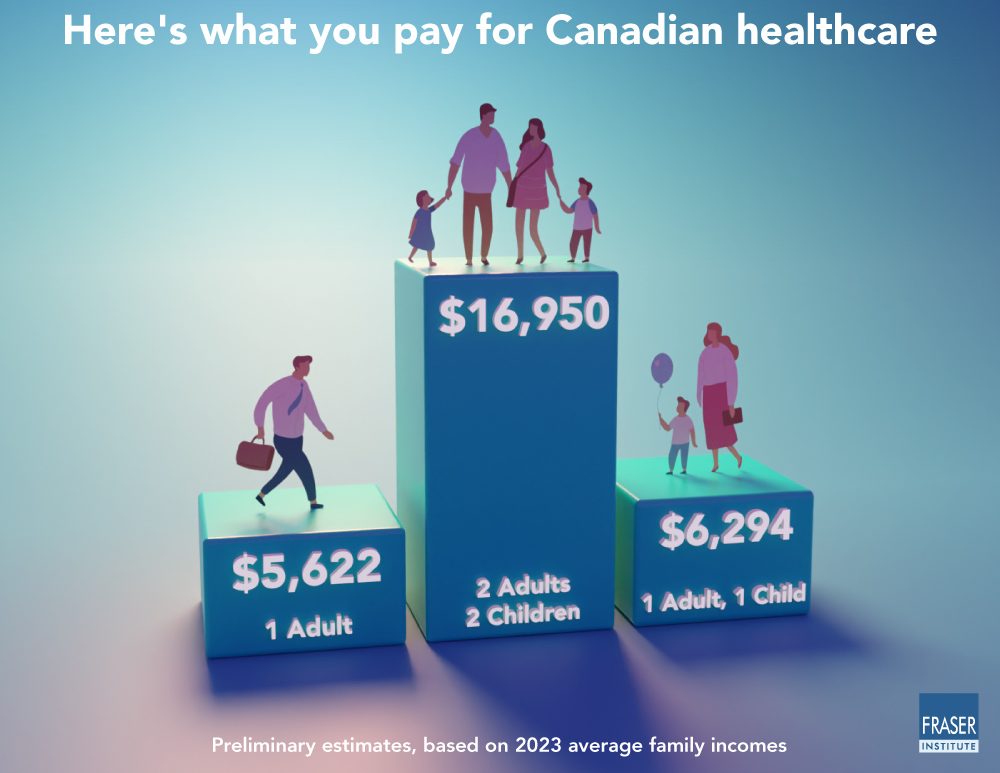
Cost of Single Payer Health Care in Canada per Household

Let’s turn to the Fraser Institute again:

  • Canadians often misunderstand the true cost of our public health care system. This occurs partly because Canadians do not incur direct expenses for their use of health care, and partly because Canadians cannot readily determine the value of their contribution to public health care insurance.

  • In 2023, preliminary estimates suggest the average payment for public health care insurance ranges from $5,373 to $17,039 for six common Canadian family types, depending on the type of family.

  • Between 1997 and 2023, the cost of public health care insurance for the average Canadian family increased 4.2 times as fast as the cost of clothing, 2.1 times as fast as the cost of food, 1.8 times as fast as the cost of shelter, and 1.7 times as fast as the average income.

  • The 10 percent of Canadian families with the lowest incomes will pay an average of about $644 for public health care insurance in 2023. The 10 percent of Canadian families who earn an average income of $80,946 will pay an average of $7,715 for public health care insurance, and the families among the top 10 percent of income earners in Canada will pay $44,314.

OK, so Canadians aren’t getting healthcare fast, and they’re not getting healthcare cheap. Maybe they’re getting really really good healthcare, though.

Here are the numbers from a new study from the non-profit Angus Reid Institute, in partnership with the Canadian Medical Association:

  • Most Canadians believe health care has worsened in the country over the last decade. Currently, 68 per cent of Canadians believe this, an increase from the 42 per cent who said the same in 2015.
  • The Angus Reid Institute’s Health Care Access Index, first created one year ago, finds three-in-ten (29%) facing Chronic Difficulty accessing the health care they say they need. One-in-three (34%) are facing fewer, but still some, barriers, while just one-in-six (16%) have little trouble with finding and receiving care from Canada’s health system.
  • Half of Canadians either don’t have a family doctor (19%) or struggle to see the one they have (29%).
  • Persistent problems in the health care system have left seven-in-ten (68%) pessimistic there will be improvements to the system in the next two years and more than half (56%) doubtful things will change for the better even five years down the line.
  • Those who believe their province does a poor or terrible job measuring health care performance (68%) significantly outnumber those who instead believe their provincial government is doing great or good on this front (24%). Two-thirds (67%) believe health care performance would be improved by their province making key health care performance indicators publicly available.

I know that a some Americans like to pick political leaders and policies based on their feelings. They want to feel good. They want to be liked. People who like single payer tend to be people with enormous student loan balances for worthless non-STEM degrees. They work in easy jobs in the public sector. They join labor unions because they’re scared of competition and accountability. Many of them work in daycare or they teach little children, because they don’t want to be challenged by adults. When you look at the numbers on healthcare in different countries, it’s very clear what works and what doesn’t work. Americans need to be smarter than Canadians. We have to vote based on reason and evidence.


David French wants Christians who accept Jesus’ definition of marriage to be persecuted

If you’ve been following David French’s writing closely, you’ll know that he no longer supports public policies that are consistent with the Christian worldview. In this post, we’ll take a look at Jesus’ definition of marriage, then we’ll see whether David French thinks that Jesus knows more about the definition of marriage than the Democrat party.

First, what does Jesus think about marriage?

Here’s what Jesus says about marriage.

Matthew 19:1-11:

1 Now when Jesus had finished these sayings, he went away from Galilee and entered the region of Judea beyond the Jordan.

2 And large crowds followed him, and he healed them there.

3 And Pharisees came up to him and tested him by asking, “Is it lawful to divorce one’s wife for any cause?”

4 He answered, “Have you not read that he who created them from the beginning made them male and female,

5 and said, ‘Therefore a man shall leave his father and his mother and hold fast to his wife, and the two shall become one flesh’?

6 So they are no longer two but one flesh. What therefore God has joined together, let not man separate.”

7 They said to him, “Why then did Moses command one to give a certificate of divorce and to send her away?”

8 He said to them, “Because of your hardness of heart Moses allowed you to divorce your wives, but from the beginning it was not so.

9 And I say to you: whoever divorces his wife, except for sexual immorality, and marries another, commits adultery.”

10 The disciples said to him, “If such is the case of a man with his wife, it is better not to marry.”

11 But he said to them, “Not everyone can receive this saying, but only those to whom it is given.

To be a Christian, minimally, is to be a follower of Jesus Christ. That means that we accept what Jesus teaches, on whatever he teaches about. We don’t overturn the teachings of Jesus in order to make people who are rebelling against God feel better about their rebellion. It is central to the Christian worldview that Christians care more about what God thinks of them than what non-Christians think of them. In fact, Christians are supposed to be willing to endure suffering rather than side with non-Christians against God’s authority.

Here’s an article from The Federalist by conservative Christian lioness Megan Basham.

She writes:

[P]erhaps no one has done more to further the idea that Christians should not let the God they worship influence their policy views than one-time defender of traditional marriage, David French.

[…]As a political pundit, French has been singularly influential in evangelical establishment circles, referenced regularly not only in Christianity Today’s pages and podcasts but also giving speeches at Southern Baptist seminaries and winning praise from outlets such as The Gospel Coalition as “one of the few Christians who is able to bring gospel-centered arguments into the public square.”

In all three of his essays on RMA in the last week, French reveals that he, too, has evolved on marriage and… discourages Christians from resisting the enshrinement of gay marriage into U.S. law.

French… adds, “Religious belief is not the same thing as declaring civil law … I don’t want the law to discriminate against those Americans who sincerely hold different views of sexual morality, sexuality, and marriage and organize their lives and their institutions accordingly.”

What does David French think about same-sex marriage as public policy?

French reveals that… believes [the Obergefell ruling’s] argument for ushering in an entirely new form of marriage, unknown to previous ages, was well-founded. He writes that as far back as 2004, he believed, “In a diverse, pluralistic republic, granting the same rights to others that we’d like to exercise ourselves should be the default posture of public advocacy and public policy.”

Now that the fundamental transformation of marriage has taken place, French argues it should be permanent: “It would be profoundly disruptive and unjust to rip out the legal superstructure around which they’ve ordered their lives,” he writes.

When it comes to policy, David French thinks that the Democrat party’s definition of marriage is better than Jesus’ definition of marriage.

Previously, I noted how the Alliance Defending Freedom thinks that the “Respect for Marriage Act” will threaten the religious liberty of Christian organizations:

The so-called Respect for Marriage Act is a misnamed bill that expands not only what marriage means, but also who can be sued for disagreeing with the new meaning of marriage.

While proponents of the bill claim that it simply codifies the 2015 Obergefell decision, in reality it is an intentional attack on the religious freedom of millions of Americans with sincerely held beliefs about marriage.

The Respect for Marriage Act threatens religious freedom and the institution of marriage in multiple ways:

  • It further embeds a false definition of marriage in the American legal fabric.
  • It opens the door to federal recognition of polygamous relationships.
  • It jeopardizes the tax-exempt status of nonprofits that exercise their belief that marriage is the union of one man and one woman.
  • It endangers faith-based social-service organizations by threatening litigation and liability risk if they follow their views on marriage when working with the government.

The truth is the Respect for Marriage Act does nothing to change the status of same-sex marriage or the benefits afforded to same-sex couples following Obergefell. It does much, however, to endanger religious freedom.

David French  wants Christians who agree with Jesus about the definition of marriage to be persecuted by the secular left state. That’s why he supports this Democrat party legislation.

Now, if you listened to the episode of the Knight and Rose show that Rose and I did defending the definition of marriage then you will know that there are good science-based secular reasons for preferring Jesus’ definition of marriage. But David French ignores that evidence in his published work.

Back to Megan Basham in The Federalist:

Leaving aside how this same argument could have been applied to Dred Scott, it’s interesting that French repeatedly references “LGBT families” in his essays (a phrase that naturally brings up sympathetic associations) without specifically treating the question of how children come to be a part of these sterile couplings or how they fare once they are present. In fact, the only passing allusion he makes to children in these households is positive, as when he says, “Millions of Americans are living stable, joyful lives in LGBT families.”

It has been said many times (but it cannot be said enough apparently) that the law’s compelling interest in acknowledging marriage at all is not to sanction romantic attachment between various individuals. It is to recognize the sexually reproductive union of men and women in order to foster the arrangement that best cultivates individual flourishing, which, in turn, creates a flourishing society.

Right, and that’s why Rose and I talked about that evidence in our podcast. But if you are expecting David French to understand what marriage is, and how to interact with scientific evidence on the effects of non-traditional unions on children, you’re expecting too much. In Christian apologetics, we know how to make a case for what the Bible teaches about God’s existence from scientific evidence, such as the Big Bang cosmology and the cosmic fine-tuning. Mainstream scientific data. We do the same thing when it comes to the abortion question. Serious Christians know how to be persuasive to non-Christians. That’s why we are able to defend the Bible’s teachings without capitulating to peer pressure from the secular left.

Basham concludes:

There is no need to rehearse the litany of evidence that children raised apart from their married, biological mothers and fathers fare worse on all manner of social, educational, and developmental outcomes. But it might be necessary to start speaking forthrightly about the more specific emerging evidence that children conceived via donorship suffer from “profound struggles with their origins and identities” and that those raised in same-sex households are more likely to experience depression, anxiety, and sexual abuse.

French never mentions these children. Nor does Dalrymple. Nor does the Christianity Today essay. Nor has Sen. Blunt. Yet this is the dystopian, domino effect of redefining marriage so that Christians may assure themselves they are pluralists in good standing, on the right side of rapidly devolving modern history.

If you want to hear a decent case for the traditional definition of marriage based on evidence, check out the podcast that Rose and I did about it here.

If you only have 15 minutes, this short video from Katy Faust makes the case:

And she has an excellent article about it in the Daily Signal. It’s too bad that Christians look to David French for leadership. I would rather rely on Megan Basham and Katy Faust. And it’s not David French who will be defending religious liberty at the Supreme Court. It’s Kristen Waggoner of the ADF.

New study: parent’s political ideology significantly affects adolescent mental health

If you like to get into debates with secular leftists in the office, like I do, then you need a lot of STUDIES. Secular leftists are taught that conservatives and Christians have not done any work to form their views, whereas all the smartest people are secular leftists, because they are data-based. So, let’s take a look at a new study on political ideology, and see who produces better results?

This research seems to be some sort of collaboration between the moderate Institute for Family Studies, and the far-left Gallup polling company.

Here is the PDF of the publication.

And Fox News has an article about it:

Parenting styles and political beliefs can play a major role influencing teenagers’ mental health, new research from Gallup says.

A June 2023 study surveying 6,643 parents and 1,580 adolescents found that conservative and very conservative parents were the “most likely to adopt the parenting practices associated with adolescent mental health,” the research reported in the Institute for Family Studies found.

“Adolescents with very conservative parents are 16 to 17 percentage points more likely to be in good or excellent mental health compared to their peers with very liberal parents,” the report said. “Only 55% of adolescents of liberal parents reported good or excellent mental health compared to 77% of those with conservative or very conservative parents.”

Why would conservative parents produce such a huge beneficial result for their children? Well, I would guess it’s because conservative parents are more firm about having a vision for how their children are raised. They want their kids to do well in school, follow the law, and serve others. All things that will help them in the real free market world of serving customers. But conservative parents also reject “don’t judge” compassion and moral relativism. Whereas secular leftist parents take an “anything goes” approach to raising their kids, conservatives are more strict about truth, and moral values. Secular leftist parents hate the idea of punishment. They just want their kids to like them.

More:

Conservative parents were more likely to adopt an “authoritative parenting style, characterized by both warmth and a high level of discipline,” Gallup economist and study author Jonathan Rothwell explained to Fox News Digital.

“Parents who set boundaries, establish routines, convey warmth and affection, and enforce rules effectively report a less contentious relationship with their adolescent child than parents who do not do these things, and this relationship is recognized by that child to be stronger and more loving. Each of the two factors related to parenting practices has a similar effect on the relationship as an index of adverse experiences, related to parental drug abuse, death, or abandonment,” he described in the report.

Liberal parents, however, scored lowest in the survey, primarily because they were least likely to report successfully disciplining their child.

Homes with conservative parents will typically be homes where there is a “Constitution” of the relationship. And I mean a recognized authority that governs how the relationship will proceed. And that authority compels each adult to deny themselves, and sacrifice their own interests, in order to serve others, and keep the relationship amicable and stable. Secular leftists don’t have that, because they are trying to claw happiness out of everyone and everything around them. Secular leftists have no rules, and no reason to sacrifice your own interests for anyone or anything else. It’s basically the Wild West. And in the Wild West, no one has an obligation to love anyone else when it doesn’t feel good to them to do the work.

More:

Teens’ mental health outcomes were 8 percentage points lower when parents reported having difficulty disciplining their child.

“By contrast, conservative parents enjoy higher quality relationships with their children, characterized by fewer arguments, more warmth, and a stronger bond, according to both parent and child reporting,” the report said.

While 80% of very conservative parents said their child did not get their way in an argument, only 53% of liberal parents could say the same. The most conservative parents were also more likely to report showing affection to their children every day.

I would think that a lot of these secular left parents are really just secular left single moms. Either by premarital sex with the hot bad boys, or by frivolous divorce. Even secular leftist women with men in the home will prevent those men from “judging” and “punishing” the children. Women are just not as good as men (generally speaking) at disciplining children. Secular leftist women might think that they are strong, independent boss babes who don’t need no man, but the results show very different outcomes.