Republicans legislators pushing good bills forward and blocking bad bills

What kinds of bills do Republicans pass? Let’s take a look at a couple.

The first story is about North Dakota Republican Senator John Hoeven, and it’s from the Washington Times.
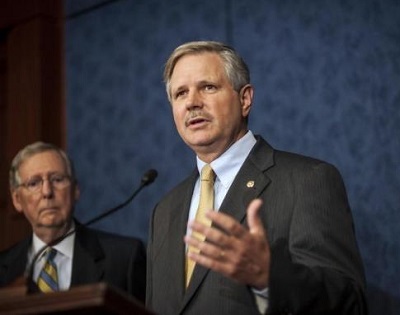
North Dakota Senator John Hoeven
North Dakota Senator John Hoeven (right)

Excerpt:

Senators approved the Keystone XL pipeline in a momentous vote Thursday as nine Democrats bucked their party leaders and joined Republicans in backing the long-stalled project, setting up an eventual showdown with President Obama, who has vowed a veto.

The vote marks the first major accomplishment for the Senate Republican majority, who carefully selected the pipeline to put at the top of the agenda in hopes of preparing Democrats for even bigger tests with Mr. Obama.

“This took a bipartisan effort to get done. That’s what the people want,” said Sen. John Hoeven, the North Dakota Republican who sponsored the legislation.

The 62-36 vote is a high-water mark for the pipeline, which had never before cleared the Senate on a binding vote, and just two months ago fell to a Democratic filibuster.

The bill still must be combined with a House version that passed the chamber this month before it heads to Mr. Obama.

This is a bill that creates jobs, lowers the price of gas, makes us less dependent on foreign sources of oil and it doesn’t harm the environment.

Having a job is good because when you earn your own success, you are usually happier than you would be receiving money from the government. Lower gas prices are good, because you can spend the money you safe on useful things, like date night with your wife, or maybe a gift for your mom or dad. Making us less dependent on foreign oil is good, because some of these nations we buy oil from don’t like us very much, and that’s putting it nicely. We really should not be buying oil from Venezuela, for example. And finally, it’s a good idea to conserve nature as it is, because we all like animals, trees, flowers, etc., and we should keep it all clean. A pipeline is safer for moving oil than using trains – fewer environmental disasters.

Next story is about Texas senator Ted Cruz, and it’s from the Daily Signal.
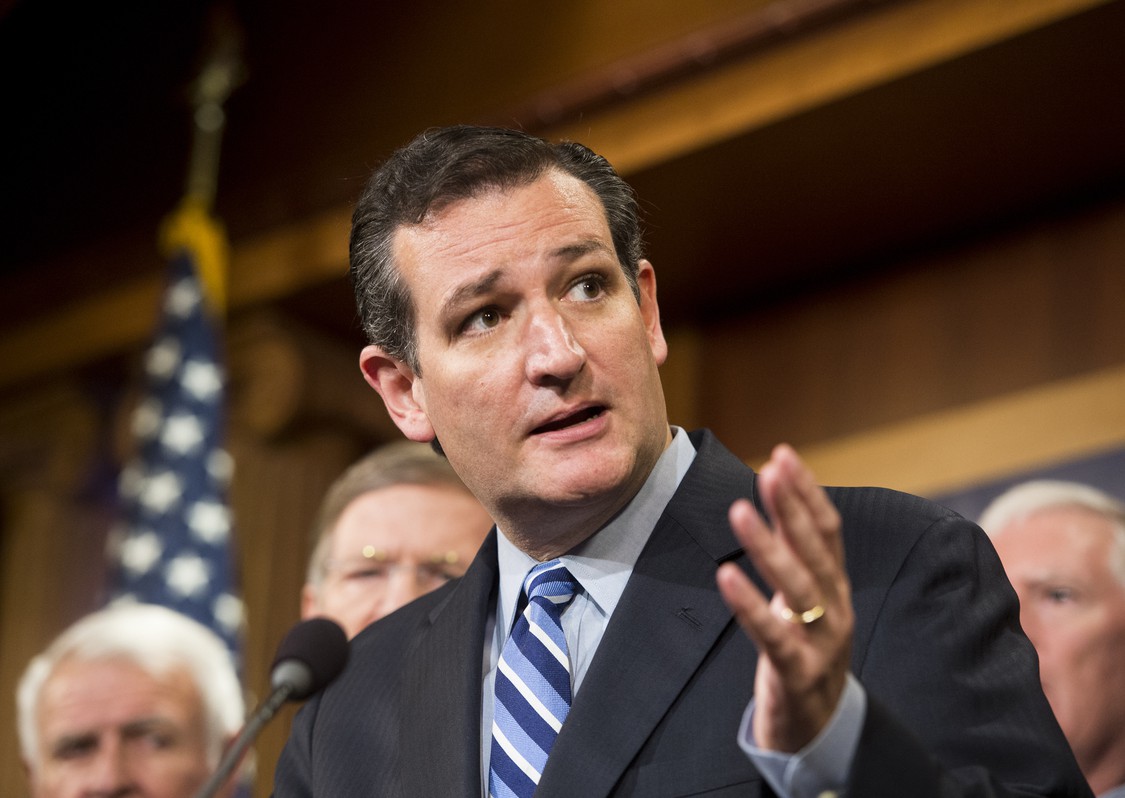
Texas Senator Ted Cruz

Excerpt:

Sen. Ted Cruz wants to protect taxpayers from political targeting by the Internal Revenue Service. The Texas Republican introduced legislation yesterday making it crime to engage in such behavior as questions still linger about the full extent of the IRS scandal.

This is not the first time Cruz has offered this type of legislation. In February 2014, he introduced amendments to the STOP Identity Theft Act. Those measures, however, were defeated by Democrats and did not make it out of the Senate Judiciary Committee.

“Free speech is not a partisan issue. The IRS has no business meddling with the First Amendment rights of Americans,” Cruz said during last year’s debate.

With a new Republican Senate majority, Cruz is hopeful that this time the language will pass independently as a bill. In a press release, Cruz blasted the lack of action by President Obama and his administration in response to the IRS scandal.

“In May 2013, President Obama declared the IRS’s illegal targeting of conservative groups ‘intolerable and inexcusable,’ yet to this date no one has been held accountable for it,” Cruz said in a statement.

Cruz’s bill would make it a crime for any IRS employee to willfully target anyone based solely on political beliefs. Any employee found in violation would be subject to a fine, up to 10 years in prison, or both.

“This is a well thought out amendment to the IRS code to try and deter and punish the type of naked political targeting engaged in by Lois Lerner and other IRS employees,” said Hans von Spakovsky, manager of the election law reform initiative and senior legal fellow at The Heritage Foundation.

I think it’s a good idea for government not to be used as a weapon to punish people who want less government and more freedom. Don’t you?

Last one is about Republican Congressman Steve King of Iowa, as reported by Doug Ross.

Iowa Congressman Steve King

Excerpt:

“We’re extremely pleased that Congressman King has introduced the National Right to Work Act, intensifying a growing debate about labor law and worker freedom in our country. This legislation would enshrine the common-sense principle – already enforced in nearly half of U.S. states – that no worker should be compelled to join or pay dues to a union just to get or keep a job.

“In an age of legislative overreach, this is one of the shortest bills ever introduced. A National Right to Work Act does not add a single word to federal law. It simply removes language in the National Labor Relations Act that gives union officials the power to extract dues from nonunion workers as a condition of employment.

“Voluntary association is a quintessential American ideal and the case for Right to Work has always rested on the principles of employee freedom, but passage of a National Right to Work law will also pay economic dividends. Studies demonstrate that workers in Right to Work states enjoy greater private sector job growth and higher disposable incomes than their counterparts in states without Right to Work protections.

“The Right to Work principle is also popular with the public. Polls consistently show that 80 percent of Americans and union members support the principle of voluntary unionism.

“A National Right to Work Act enshrines worker freedom while providing significant economic benefits for workers. The National Right to Work Committee is mobilizing its 2.8 million members to call on their Congressperson to support the National Right to Work Act.”

Evidence shows that right-to-work states are more attractive to job creators, which results in lower unemployment in states that adopt right-to-work.

Meanwhile, in Virginia, Republican legislators blocked three pro-abortion bills.

If you missed my recent post on four good things that Republican governors are doing, I recommend reading that as well.

William Lane Craig explains the doctrine of penal substitutionary atonement

Probably one of the most common questions that you hear from people who don’t fully understand Christianity is this question: “why did Jesus have to die?”. The answer that most Christians seem to hold to is that 1) humans are rebelling against God, 2) Humans deserve punishment for their rebellion, 3) Humans cannot escape the punishment for their rebellion on their own, 4) Jesus was punished in the place of the rebellious humans, 5) Those who accept this sacrifice are forgiven for their rebelling.

Are humans rebellious?

Some people think that humans are not really rebellious at all, but it’s actually easy to see. You can see it just by looking at how people spend their time. Some of us have no time for God at all, and instead try to fill our lives with material possessions and experiences in order to have happy feelings. Some of us embrace just the parts of God that make us feel happy, like church and singing and feelings of comfort, while avoiding the hard parts of that vertical relationship; reading, thinking and disagreeing with people who don’t believe the truth about God. And so on.

This condition of being in rebellion is universal, and all of us are guilty of breaking the law at some point. All of us deserve to be separated from God’s goodness and love. Even if we wanted to stop rebelling, we would not be able to make up for the times where we do rebel by being good at other times, any more than we could get out of a speeding ticket by appealing to the times when we drove at the speed limit, (something that I never do, in any case).

This is not to say that all sinners are punished equally – the degree of punishment is proportional to the sins a person commits. However, the standard is perfection. And worse than that, the most important moral obligation is a vertical moral obligation. You can’t satisfy the demands of the moral law just by making your neighbor happy, while treating God like a pariah. The first commandment is to love God, the second is to love your neighbor. Even loving your neighbor requires you to tell your neighbor the truth – not just to make them feel good. The vertical relationship is more important than the horizontal one, and we’ve all screwed up the vertical relationship. We all don’t want God to be there, telling us what’s best for us, interfering with our fun. We don’t want to relate to a loving God if it means having to care what he thinks about anything that we are doing.

Who is going to pay for our rebellion?

The Christian answer to the problem of our rebellion is that Jesus takes the punishment we deserve in our place.

However, I’ve noticed that on some atheist blogs, they don’t like the idea that someone else can take our punishment for us to exonerate us for crimes that we’ve committed. So I’ll quote from this post by the great William Lane Craig, to respond to that objection.

Excerpt:

The central problem of the Penal Theory is, as you point out, understanding how punishing a person other than the perpetrator of the wrong can meet the demands of justice. Indeed, we might even say that it would be wrong to punish some innocent person for the crimes I commit!

It seems to me, however, that in other aspects of human life we do recognize this practice. I remember once sharing the Gospel with a businessman. When I explained that Christ had died to pay the penalty for our sins, he responded, “Oh, yes, that’s imputation.” I was stunned, as I never expected this theological concept to be familiar to this non-Christian businessman. When I asked him how he came to be familiar with this idea, he replied, “Oh, we use imputation all the time in the insurance business.” He explained to me that certain sorts of insurance policy are written so that, for example, if someone else drives my car and gets in an accident, the responsibility is imputed to me rather than to the driver. Even though the driver behaved recklessly, I am the one held liable; it is just as if I had done it.

Now this is parallel to substitutionary atonement. Normally I would be liable for the misdeeds I have done. But through my faith in Christ, I am, as it were, covered by his divine insurance policy, whereby he assumes the liability for my actions. My sin is imputed to him, and he pays its penalty. The demands of justice are fulfilled, just as they are in mundane affairs in which someone pays the penalty for something imputed to him. This is as literal a transaction as those that transpire regularly in the insurance industry.

So, it turns out that the doctrine of substitionary atonement is not as mysterious or as objectionable as everyone seems to think it is.

New study: new climate change model finds IPCC model predictions too hot

Here is a report on a new study on global warming, from Phys.org.

They write:

A major peer-reviewed climate physics paper in the first issue (January 2015: vol. 60 no. 1) of the prestigious Science Bulletin (formerly Chinese Science Bulletin), the journal of the Chinese Academy of Sciences, exposes elementary but serious errors in the general-circulation models relied on by the UN’s climate panel, the IPCC. The errors were the reason for concern about Man’s effect on climate. Without them, there is no climate crisis.

The IPCC has long predicted that doubling the CO2 in the air might eventually warm the Earth by 3.3 °C. However, the new, simple model presented in the Science Bulletinpredicts no more than 1 °C warming instead – and possibly much less. The model, developed over eight years, is so easy to use that a high-school math teacher or undergrad student can get credible results in minutes running it on a pocket scientific calculator.

The paper, Why models run hot: results from an irreducibly simple climate model, by Christopher Monckton of Brenchley, Willie Soon, David Legates and Matt Briggs, survived three rounds of tough peer review in which two of the reviewers had at first opposed the paper on the ground that it questioned the IPCC’s predictions.

When the paper’s four authors first tested the finished model’s global-warming predictions against those of the complex computer models and against observed real-world temperature change, their simple model was closer to the measured rate of global warming than all the projections of the complex “general-circulation” models:

Next, the four researchers applied the model to studying why the official models concur in over-predicting global warming. In 1990, the UN’s climate panel predicted with “substantial confidence” that the world would warm at twice the rate that has been observed since.

[…]The measured, real-world rate of global warming over the past 25 years, equivalent to less than 1.4° C per century, is about half the IPCC’s central prediction in 1990.

[…]The new, simple climate model helps to expose the errors in the complex models the IPCC and governments rely upon. Those errors caused the over-predictions on which concern about Man’s influence on the climate was needlessly built.

So what are the specific errors in the IPCC model?

These:

Among the errors of the complex climate models that the simple model exposes are the following –

The assumption that “temperature feedbacks” would double or triple direct manmade greenhouse warming is the largest error made by the complex climate models. Feedbacks may well reduce warming, not amplify it.

The Bode system-gain equation models mutual amplification of feedbacks in electronic circuits, but, when complex models erroneously apply it to the climate on the IPCC’s false assumption of strongly net-amplifying feedbacks, it greatly over-predicts global warming. They are using the wrong equation.

Modellers have failed to cut their central estimate of global warming in line with a new, lower feedback estimate from the IPCC. They still predict 3.3 °C of warming per CO2 doubling, when on this ground alone they should only be predicting 2.2 °C – about half from direct warming and half from amplifying feedbacks.

Though the complex models say there is 0.6 °C manmade warming “in the pipeline” even if we stop emitting greenhouse gases, the simple model – confirmed by almost two decades without any significant global warming – shows there is no committed but unrealized manmade warming still to come. There is no scientific justification for the IPCC’s extreme RCP 8.5 global warming scenario that predicts up to 12 °C global warming as a result of our industrial emissions of greenhouse gases.

Once errors like these are corrected, the most likely global warming in response to a doubling of CO2 concentration is not 3.3 °C but 1 °C or less. Even if all available fossil fuels were burned, less than 2.2 °C warming would result.

Conclusion:

Dr Willie Soon, an eminent solar physicist at the Harvard-Smithsonian Center for Astrophysics, said: “Our work suggests that Man’s influence on climate may have been much overstated. The role of the Sun has been undervalued. Our model helps to present a more balanced view.”

I think it’s a credit to the scientific enterprise that they grilled this paper with peer-review, and then allowed it to stand, even though if it becomes widely-known and accepted, it will dry up their grant money. They rely on a crisis in order to obtain research money, and what this new, simpler model shows is that there is no crisis. It’s bad for the scientists’ wallets, but good for science as a whole. Respect++.