The psychological motivation of those who embrace postmodernism

Can a person be postmodern and a Christian? Not for long

Famous analytical philosopher John Searle has written a book “Mind, Language And Society: Philosophy In The Real World”, explaining what’s factually wrong with postmodernism. In the introduction, he explains what postmodernism is, and what motivates people to accept postmodernism.

He writes:

[…][W]hen we act or think or talk in the following sorts of ways we take a lot for granted: when we hammer a nail, or order a takeout meal from a restaurant, or conduct a lab experiment, or wonder where to go on vacation, we take the following for granted: there exists a real world that is totally independent of human beings and of what they think or say about it, and statements about objects and states of affairs in that world are true or false depending on whether things in the world really are the way we say they are. So, for example, if in pondering my vacation plans I wonder whether Greece is hotter in the summer than Italy, I simply take it for granted that there exists a real world containing places like Greece and Italy and that they have various temperatures. Furthermore, if I read in a travel book that the average summer temperature in Greece is hotter than in Italy, I know that what the book says will be true if and only if it really is hotter on average in the summer in Greece than in Italy. This is because I take it for granted that such statements are true only if there is something independent of the statement in virtue of which, or because of which, it is true.

[…]These two Background presuppositions have long histories and various famous names. The first, that there is a real world existing independently of us, I like to call “external realism.” “Realism,” because it asserts the existence of the real world, and “external” to distinguish it from other sorts of realism-for example, realism about mathematical objects (mathematical realism) or realism about ethical facts (ethical realism). The second view, that a statement is true if things in the world are the way the statement says they are, and false otherwise, is called “the correspondence theory of truth.” This theory comes in a lot of different versions, but the basic idea is that statements are true if they correspond to, or describe, or fit, how things really are in the world, and false if they do not.

The “correspondence theory of truth” is the view of truth assumed in books of the Bible whose genre is such that that they were intended by the authors to be taken literally, (with allowances for symbolism, figures of speech, metaphors, hyperbole, etc.).

But what about the postmodernists, who seek to deny the objectivity of external reality?

More Searle:

Thinkers who wish to deny the correspondence theory of truth or the referential theory of thought and language typically find it embarrassing to have to concede external realism. Often they would rather not talk about it at all, or they have some more or less subtle reason for rejecting it. In fact, very few thinkers come right out and say that there is no such thing as a real world existing absolutely, objectively, and totally independently of us. Some do. Some come right out and say that the so-called real world is a “social construct.”

What is behind the denial of objective reality, and statements about external reality that are warranted by evidence?

It is not easy to get a fix on what drives contemporary antirealism, but if we had to pick out a thread that runs through the wide variety of arguments, it would be what is sometimes called “perspectivism.” Perspectivism is the idea that our knowledge of reality is never “unmediated,” that it is always mediated by a point of view, by a particular set of predilections, or, worse yet by sinister political motives, such as an allegiance to a political group or ideology. And because we can never have unmediated knowledge of the world, then perhaps there is no real world, or perhaps it is useless to even talk about it, or perhaps it is not even interesting.

Searle is going to refute anti-realism in the rest of the book, but here is his guess at what is motivating the anti-realists:

I have to confess, however, that I think there is a much deeper reason for the persistent appeal of all forms of antirealism, and this has become obvious in the twentieth century: it satisfies a basic urge to power. It just seems too disgusting, somehow, that we should have to be at the mercy of the “real world.” It seems too awful that our representations should have to be answerable to anything but us. This is why people who hold contemporary versions of antirealism and reject the correspondence theory of truth typically sneer at the opposing view. 

[…]I don’t think it is the argument that is actually driving the impulse to deny realism. I think that as a matter of contemporary cultural and intellectual history, the attacks on realism are not driven by arguments, because the arguments are more or less obviously feeble, for reasons I will explain in detail in a moment. Rather, as I suggested earlier, the motivation for denying realism is a kind of will to power, and it manifests itself in a number of ways. In universities, most notably in various humanities disciplines, it is assumed that, if there is no real world, then science is on the same footing as the humanities. They both deal with social constructs, not with independent realities. From this assumption, forms of postmodernism, deconstruction, and so on, are easily developed, having been completely turned loose from the tiresome moorings and constraints of having to confront the real world. If the real world is just an invention-a social construct designed to oppress the marginalized elements of society-then let’s get rid of the real world and construct the world we want. That, I think, is the real driving psychological force behind antirealism at the end of the twentieth century.

Now, I’ll go one step further than Searle.

People, from the Fall, have had the desire to step into the place of God. It’s true that we creatures exist in a universe created and designed by God. But, there is a way to work around the fact that God made the universe and the laws that the universe runs on, including logic, mathematics and natural laws. And that way is to deny logic, mathematics and natural laws. Postmodernists simply deny that there is any way to construct rational arguments and support the premises with evidence from the real world. That way, they imagine, they are free to escape a God-designed world, including a God-designed specification for how they ought to live. The postmoderns deny the reliable methods of knowing about the God-created reality because logic and evidence can be used to point to God’s existence, God’s character, and God’s actions in history.

And that’s why there is this effort to make reality “optional” and perspectival. Everyone can be their own God, and escape any accountability to the real God – the God who is easily discovered through the use of logic and evidence. I believe that this is also behind the rise of atheists, who feign allegiance to logic and science, but then express “skepticism” about the origin of the universe, the fine-tuning of the universe, objective morality, the minimal facts concerning the historical Jesus, and other undeniables.

Christians need to know what happens to our rights in secular left nations

This week, I had a conversation with a Christian leader who explained to me that Christians need to avoid getting involved in “culture wars” and “politics”, and just focus on being nice and loving everyone. “Just love everybody” he assured me. “What’s the point of being divisive?” So, I thought it might be a good idea to review what happens to Christians in countries that follow his advice.

Read this article from The Public Discourse. The article just came out this week, and it’s written by Dr. Päivi Räsänen, a member of the Finnish parliament.

She writes:

I have been a member of the Finnish Parliament for twenty-nine years. During that time, I have witnessed a dramatic change in the value system undergirding our modern society. From the protection of life to the defense of marriage, the changes we are living through are undeniable, with far-reaching implications for us all. And it’s evident that the general atmosphere toward Christianity grows increasingly hostile every day. Only ten years ago, I could not have imagined that I would soon be summoned to my country’s Supreme Court to defend my religious convictions.

“Has somebody occupied Finland?” My six-year-old grandson asked me this in June 2019 when he saw a giant rainbow flag, the biggest we had seen to date, flying over our home city of Riihimäki, Finland. At that same time, the majority church of our country, the Finnish Evangelical Lutheran Church, officially published its support of a Helsinki “pride” event, which disappointed and shocked many (including me).

Before our very eyes, the church was assuming a position contrary to its own confession that God designed marriage for one man and one woman. If the authority of God’s Word is undermined, the question becomes not only about marriage or gender, but also about the path to salvation and eternal life. Every person, including the LGBT community, has the right to hear the whole truth of God’s Word. While I briefly considered leaving my church, I was convinced that it was better to stay aboard and try to wake up those who had fallen asleep, not jump out of a sinking boat.

This was why I wrote a tweet, in which I directed a question to my church leadership. I wanted to exercise my basic right to free speech to publicly ask how they reconciled their activities with biblical teaching. The main content of my post was a photo of verses 24–27 of Romans Chapter 1, where the Apostle Paul teaches that homosexual relations are sinful. A citizen filed a criminal complaint in response to my tweet, and more complaints quickly followed.

These complaints resulted in eighteen months of police investigation and thirteen hours of interrogations. As a former government minister, sitting parliamentarian, and grandmother, I found the situation unreal. Just a few years before, I had been in charge of the police as Minister of Interior, and now I was sitting in the police station being interrogated, with the Bible on the table in front of me.

And it goes on.

I can’t possibly quote enough of her post to tell you all you need to know. All I want to say is that I’ve been watching how people are responding to Megan Basham’s book. On Twitter, a lot of Megan’s attention recently has been focused on J. D. Greear – a pious pastor who is always trying to be nuanced, sounding good to Democrats, and watering down the Bible’s teachings so he can be popular and well-liked. For pastors like this, Christianity is primarily a vehicle for signaling virtue. They talk about the parts that make people like them, they affirm non-Christians in their rebellion against God. To them, Christianity is not about being faithful, or being an ambassador. It’s not about self-sacrificial obedience at all.

Since Christianity is so easy for these “don’t judge” and “just love everyone” pastors, they have no idea what happens to people who tell the truth (with evidence) about things like abortion, socialism, atheism, feminism, Darwinism, LGBT, etc. They can’t understand it. How could God allow anything unhappy to happen to people who “just love everyone” they wonder.

I brought up the case of Bill Dembski to one of these people recently. Dembski advocated for intelligent design, and was thrown out of Baylor University, because they were committed to naturalistic Darwinism. He said “Dembski got what was coming to him. He wasn’t collegial enough with his Darwinian colleagues”. They don’t think of people who take a hit to their reputations or careers to stay faithful as heroes. They don’t understand them. “Why would you even talk about origins?” they wonder. “Why not just say happy things, instead of knowledge things?”

Anyway, I don’t want any of my readers to be this naive about what happens if we listen to these virtue-signaling pastors at election time. If you let the secular left become the government, then you will lose your liberty to even make a case against the secular left on controversial issues. How do you stop the secular left from becoming the government? You learn how to make an evidential case for the truth claims of the Bible that will be convincing to people who won’t believe the Bible, but will believe the evidence. Even Jesus told people who didn’t believe his words to believe his works. That’s our model.

Whatever it is that the secular left is talking about: global warming socialism, radical feminist misandry, abortion and infanticide, LGBT, etc. you have to be ready with convincing evidence from outside the Bible to convince them that Christian position on these issues is reasonable. Otherwise, they will think we are irrational idiots and trample over our rights. We have to get to work, and step one is to stop listening to people like J. D. Greear, Russell Moore, David French, and the like. They are not interested in providing evidence to non-Christians, and advocating for free speech and religious liberty. They are out for their own happiness and popularity.

Progressive white women report high levels of mental illness in 2020 Pew survey

I have the most amazing video for you to see. It’s a crazy left-wing activist doxing a libertarian lesbian woman wearing a breathe-through mask. First, let’s take a look at the video. Then, we’ll look at a recent survey reported by Pew Research in 2020, which assesses how mentally stable far-left feminist women are (self-reported). Then, I’ll make some comments for unmarried men.

OK, so here is the video, which was shared by the woman who was doxed. So it’s OK for me to share it, since the doxed woman didn’t care about it.

So, is this crazy woman rare? Or is she common?

Progressive white women and mental illness

Feminist web site Evie Magazine reported on the some 2020 findings by Pew Research (left-wing pollster):

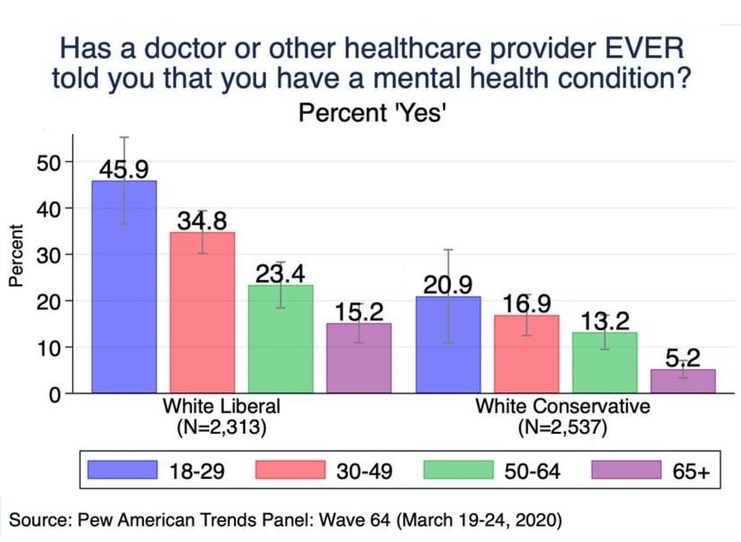
A 2020 Pew Research study reveals that over half of white, liberal women have been diagnosed with a mental health condition at some point.

[T]he study, which is titled Pew American Trends Panel: Wave 64, was dated March 2020 — over a year ago.

The study, which examined white liberals, moderates, and conservatives, both male and female, found that conservatives were far less likely to be diagnosed with mental health issues than those who identified as either liberal or even “very liberal.”

[…]White women, ages 18-29, who identified as liberal were given a mental health diagnosis from medical professionals at a rate of 56.3%, as compared to 28.4% in moderates and 27.3% in conservatives.

Here’s the part of the data I thought was most interesting:

White Liberal Women

Who would marry a crazy person?

So, the point about this that I want to make is… who is going to marry these mentally ill progressive white women? Being a good wife and mother takes a certain amount of connection to reality. It takes a certain amount of empathy, compassion, and rationality. These progressive white women don’t have any of that. So, who is going to marry them? I know that there are thirsty progressive men (and thirsty conservative men who fake being progressive), who will go ahead and hit it and quit it. Pump it and dump it. But how many men would commit to someone who’s mentally ill?

And in fact, that’s exactly what we’re seeing with the marriage rates:

Marriage rates in the United States over time

That’s for America, but things are even worse in countries that have slid further toward the secular left edge of the political spectrum.

When you look at marriage rates in Canada and Europe, you understand that men are even LESS likely to choose marriage when they have to pay over 50% of what they earn in taxes. And so the marriage rate is declining. I think young, unmarried women in Canada and Europe want to raise taxes in order to get free stuff from government. Single mother welfare, food stamps, abortions, contraceptives, IVF, breast enlargements, etc. Some feminists are even asking for free cosmetic surgery. With a big enough government, they don’t have to marry at all. Big government leaves them free to play the field, without having to care about finding a good man. But what if taxes get so high that the few good men those women passed over for 40 years simply can’t afford to take on a wife and support multiple children he didn’t father? Paying for things like a stay-at-home wife and homeschooling, etc. is expensive. Men can’t afford a wife, and also pay for goodies for all the single progressive women with mental illnesses.

Conservative men want nothing to do with daycare and public schools – we know that those facilities are dominated by progressive women. And we don’t want trouble from feminist lawyers and feminist judges in the divorce courts. Divorce is very expensive for men. And we may never see our children again. Then there are the progressive white women in the workplace, who get very bitter with men as a result of getting wrecked by bad boys. Even if we find a good wife, we still have to deal with all these progressive white women with mental illnesses in positions of power. Is it worth it to take risks like this? It depends on the reward, I guess. There comes a point where the juice isn’t worth the squeeze.