Scott Walker: eliminate NLRB, enact national right-to-work, ban federal public sector unions

Wisconsin Governor Scott Walker

I hope that by the end of this post, everyone will consider whether it makes more sense to elect someone who says they will do something conservative as President that they have already done in their state, as Governor.

The story is from the Daily Caller.

Excerpt:

Republican presidential hopeful Scott Walker promised Monday to go far beyond what he did to rein in union power in Wisconsin if elected to lead the country.

The plan includes eliminating the National Labor Relations Board (NLRB), eliminating federal employee unions and implementing a national right-to-work law. It will also do away with federal workers being allowed to do union work on taxpayer time.

[…]The plan would go far beyond the career defining reforms Walker pursued in 2011 during his first term as governor of Wisconsin. The changes to labor policy in the state, known as Act 10, mostly just outlawed mandatory union dues for state public employees.

[…]Critics have argued the NLRB unfairly benefits unions, often at the expense of employers and their workers. This includes changes to union elections, contracting and the franchise model. Walker also promised to outlawmandatory union dues for all public and private workers. A policy known as right-to-work.

[…]Walker also plans to end the policy which allows government workers to do union work on taxpayer time. The practice is known as “official time” on the federal level.

“In 2012, taxpayers subsidized 3,395,187 hours of ‘official time’ time spent working for the union or lobbying,” Walker noted. “That cost the taxpayers $156 million.”

“While the IRS was busy harassing conservative organizations they also had more than 200 federal employees whose only work was for the big government union bosses,” Walker continued. “How about the Department of Veterans Affairs? While more than 600,000 veterans were facing delays for medical care in the VA system, more than 250 federal employees.”

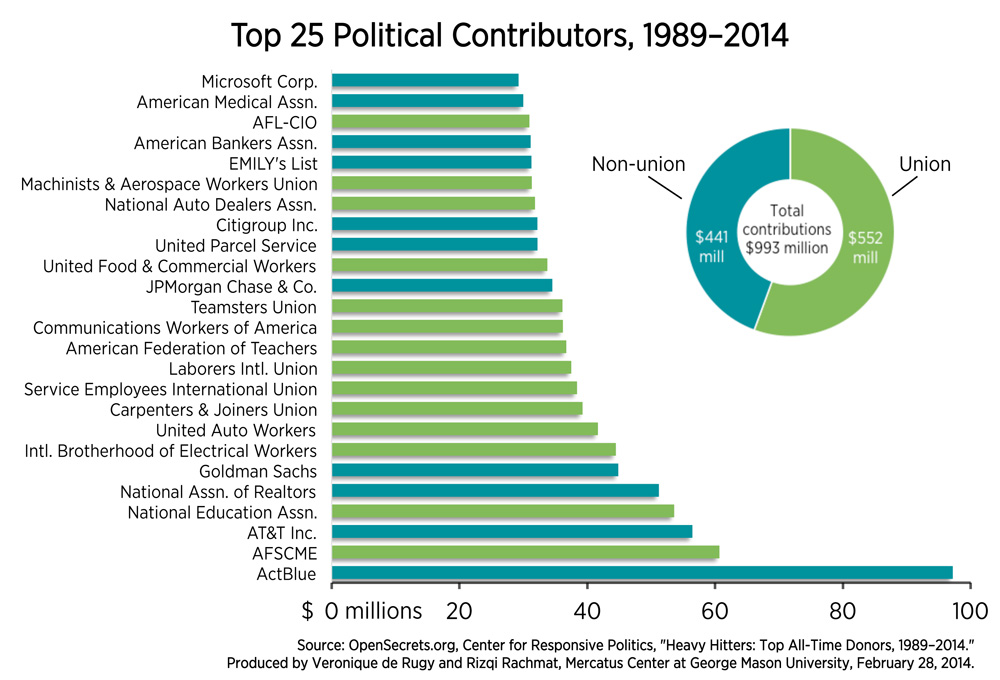
There’s no question in my mind that Walker has the strongest record of activism as a fiscal conservative in the GOP primary. He is only proposing to do at the federal level what he already has done at the state level. No other candidate has the record of past performance that Walker has. Been there, done that – wrote a book about it. It’s very important that we get the public sector unions out of politics, because they are always pushing for bigger and bigger government, which means higher taxes for you and your children. And of course the unions are pro-abortion and anti-natural-marriage. By the way, workers like right-to-work: a recent Gallup poll found that non-union workers are happier with their work than forced-unionized workers.

I expected Walker to do this if he were elected President, which is why he was my first choice for so long. (He is now #2, behind my #1 pick Bobby Jindal) It’s a shame that he had to tip his hand, because it will make it harder for him to win in the general election, now. I really think I might have to put him back in as my #1 choice because I think that getting rid of NCLB and public sector unions would be such an Earth-shattering conservative move. This truly would be on the level of some of the radically leftist policies that Obama pushed for. I trust Walker to do what he says, because of his record of achievement in Wisconsin along these same lines. This is not just talk.

People should have understood what they were getting in Scott from his past record, but I fear that many Republican voters (not evangelicals, of course) are not looking into the candidates’ backgrounds. They are being swayed by charismatic talk from leftist clowns like Donald Trump. They should be looking for proven leaders who have made good things happen at the state level – as governors, preferably.

By the way, Walker is one of one three candidates who has a plan to repeal and replace Obamacare. The other two are Jindal (of course) and Rubio.

Related videos

Anyway, for the rest of this post, I want to include a few short, 5-minute, videos on capitalism and unions. These are all from Prager University, and I hope they help you to understand why you need to support the free enterprise system, and oppose public sector unions.

George Mason University professor of economics Walter Williams on “Is Capitalism Moral?”:

Entrepreneurship guru George Gilder on “Why Capitalism Works”:

City College of New York professor of political science Daniel DiSalvo on how unions influence politics:

Stanford University professor of political science Terry Moe on how teacher unions oppose the interests of students:

Please look into these issues, and consider supporting either Scott Walker, Bobby Jindal or Ted Cruz for President in the general election. These guys understand economics, and will get good things done if elected President.

Related posts

What is Jesus’ view of the definition of marriage?

Does government provide incentives for people to get married?
This is marriage as Jesus taught it, stupid Buzzfeed leftists

I noticed that there is some silly video put out by the atheists at BuzzFeed where a bunch of people claiming to be Christians deny that Jesus has any authority in their worldview.

Here’s what Jesus says about marriage.

Matthew 19:1-11:

1 Now when Jesus had finished these sayings, he went away from Galilee and entered the region of Judea beyond the Jordan.

2 And large crowds followed him, and he healed them there.

3 And Pharisees came up to him and tested him by asking, “Is it lawful to divorce one’s wife for any cause?”

4 He answered, “Have you not read that he who created them from the beginning made them male and female,

5 and said, ‘Therefore a man shall leave his father and his mother and hold fast to his wife, and the two shall become one flesh’? 6 So they are no longer two but one flesh. What therefore God has joined together, let not man separate.”

7 They said to him, “Why then did Moses command one to give a certificate of divorce and to send her away?” 8

He said to them, “Because of your hardness of heart Moses allowed you to divorce your wives, but from the beginning it was not so.

9 And I say to you: whoever divorces his wife, except for sexual immorality, and marries another, commits adultery.”

10 The disciples said to him, “If such is the case of a man with his wife, it is better not to marry.”

11 But he said to them, “Not everyone can receive this saying, but only those to whom it is given.

To be a Christian, minimally, is to be a follower of Jesus Christ. That means that we accept what Jesus teaches, on whatever he teaches about. We don’t overturn the teachings of Jesus in order to make people who are rebelling against God feel better about their rebellion. It is central to the Christian worldview that Christians care more about what God thinks of them than what non-Christians think of them. In fact, Christians are supposed to be willing to endure suffering rather than side with non-Christians against God’s authority. So really not sure what the BuzzFeed non-Christians are doing in that video.

Matt Walsh had a fine article about the Buzzfeed video.

He said:

As Christians, our goal is not to avoid being like the big bad “other Christians,” but to strive to be like Christ Himself. This is one of the advantages to having an Incarnate God. He went around acting and speaking and teaching and generally functioning in our realm, thereby giving us a model to follow. This is the model of a loving and merciful man, and also a man of perfect virtue who fought against the forces of evil, condemned sin, defended his Father in Heaven with sometimes violent force, spoke truth, and eventually laid down His life for those He loved (which would be all of us).

[…]This is what it means to believe in Christ. Not just to believe that He existed, but to believe that Christ is Truth itself, and that everything He said and did was totally and absolutely and irreversibly true forever and always. Many Christians today — not only the ones in the video, but millions alongside them — seem to think we can rightly claim to have “faith” in Jesus or a “relationship” with Him while still categorically denying much of His Word. This is a ridiculous proposition. We can’t declare, in one breath, that Christ is Lord, and in the next suggest that maybe God got it wrong on this or that point. Well, we can make that declaration, but we expose our belief as fraudulent and self-serving. We worship a God we either invented in our heads, which is a false idol, or a God who is fallible, which is a false idol.

If you really accept Jesus as God, then you can’t think he is wrong when he explains what marriage is. Period. End of issue.

Real Christians don’t make excuses for sin. Real Christians present the gospel. The gospel is that all men have rebelled against God and fallen short of perfect submission to and obedience of him. For this, they deserve to be separated from God eternally. Jesus paid the price for this rebellion on the cross, and anyone who accepts him as Savior and Lord will be with God eternally after they die. There is no salvation apart from Jesus. That’s what Christians say. And they say it regardless of how weird they look, and how many non-Christians don’t like them for saying it.

Did Australia’s ban on guns lower violent crime rates and lower suicide rates?

Gun ownership up, gun violence down

Someone asked me about what I thought of Australia’s experience banning the use of handguns for self-defense against criminals, and so I thought I would link to an article from The Federalist, then explain what peer-reviewed studies say about the issue.

Let’s start with The Federalist.

It says:

The argument, as Vox’s headline puts it, is “Australia confiscated 650,000 guns. Murders and suicides plummeted.”

The piece, along with many gun control advocates, cites a Harvard University study whose conclusion begins with this line: “It does not appear that the Australian experience with gun buybacks is fully replicable in the United States.” Not a great start for Vox’s angle, but I digress.

The study doesn’t conclude that “murders and suicides plummeted” in Australia after the 1996 gun ban, as Vox claims in its headline. Instead, it focuses solely on firearm-related murders and suicides.

After the gun ban, violent crime rates were up:

Yes, as with the gun-happy United States, the murder rate is down in Australia. It’s dropped 31 percent from a rate of 1.6 per 100,000 people in 1994 to 1.1 per 100,000 in 2012.But it’s the only serious crime that saw a consistent decline post-ban.

In fact, according to the Australian government’s own statistics, a number of serious crimes peaked in the years after the ban. Manslaughter, sexual assault, kidnapping, armed robbery, and unarmed robbery all saw peaks in the years following the ban, and most remain near or above pre-ban rates. The effects of the 1996 ban on violent crime are, frankly, unimpressive at best.

It’s even less impressive when again compared to America’s decrease in violent crime over the same period. According to data from the U.S. Justice Department, violent crime fell nearly 72 percent between 1993 and 2011. Again, this happened as guns were being manufactured and purchased at an ever-increasing rate.

So although you have fewer firearm-related deaths when you disarm law-abiding civilians, violent crime increases, because there is now NO deterrence to criminals. Even a criminal with a knife can rob, rape and murder someone who is unarmed.

What about suicide rates?

Look:

The Australian gun ban’s effect on suicide in the country isn’t any better. While Vox repeats the Harvard study’s claim that firearm-related suicides are down 57 percent in the aftermath of the ban, Lifeline Australia reports that overall suicides are at a ten-year high. The Australian suicide prevention organization claims suicide is the leading cause of death for Australians 15 to 44 years old. So, while Australians kill themselves with firearms less often, it seems they don’t actually take their own lives any less often than before the ban.

So, overall suicides are not down, people simply found other ways to kill themselves. So the gun ban had no effect on the overall suicide rate. But it did raise the violent crime rate. Should we be surprised by this? Actually, this is consistent with peer-reviewed research.

The peer-reviewed research

Whenever I get into discussions about gun control, I always mention two academic books by John R. Lott and Joyce Lee Malcolm.

Here is a paper by Dr. Malcolm that summarizes one of the key points of her book.

Excerpt:

Tracing the history of gun control in the United Kingdom since the late 19th century, this article details how the government has arrogated to itself a monopoly on the right to use force. The consequence has been a tremendous increase in violent crime, and harsh punishment for crime victims who dare to fight back. The article is based on the author’s most recent book, Guns and Violence: The English Experience (Harvard University Press, 2002). Joyce Malcom is professor of history at Bentley College, in Waltham, Massachusetts. She is also author of To Keep and Bear Arms: The Origins of an AngloAmerican Right (Harvard University Press, 1994).

Upon the passage of The Firearms Act (No. 2) in 1997, British Deputy Home Secretary Alun Michael boasted: “Britain now has some of the toughest gun laws in the world.” The Act was second handgun control measure passed that year, imposed a near-complete ban on private ownership of handguns, capping nearly eighty years of increasing firearms restrictions. Driven by an intense public campaign in the wake of the shooting of schoolchildren in Dunblane, Scotland, Parliament had been so zealous to outlaw all privately owned handguns that it rejected proposals to exempt Britain’s Olympic target-shooting team and handicapped target-shooters from the ban.

And the result of the 1997 gun ban:

The result of the ban has been costly. Thousands of weapons were confiscated at great financial cost to the public. Hundreds of thousands of police hours were devoted to the task. But in the six years since the 1997 handgun ban, crimes with the very weapons banned have more than doubled, and firearm crime has increased markedly. In 2002, for the fourth consecutive year, gun crime in England and Wales rose—by 35 percent for all firearms, and by a whopping 46 percent for the banned handguns. Nearly 10,000 firearms offences were committed.

[…]According to Scotland Yard, in the four years from 1991 to 1995 crimes against the person in England‟s inner cities increased by 91 percent. In the four years from 1997 to 2001 the rate of violent crime more than doubled. The UK murder rate for 2002 was the highest for a century.

I think that peer-reviewed studies – from Harvard University, no less – should be useful to those of us who believe in the right of self-defense for law-abiding people. The book by economist John Lott, linked above,compares the crime rates of all U.S. states that have enacted concealed carry laws, and concludes that violent crime rates dropped after law-abiding citizens were allowed to carry legally-owned firearms. That’s the mirror image of Dr. Malcolm’s Harvard study, but both studies affirm the same conclusion – more legal firearm ownership means less crime.

For a couple of useful graphs, check out this post over at the American Enterprise Institute.