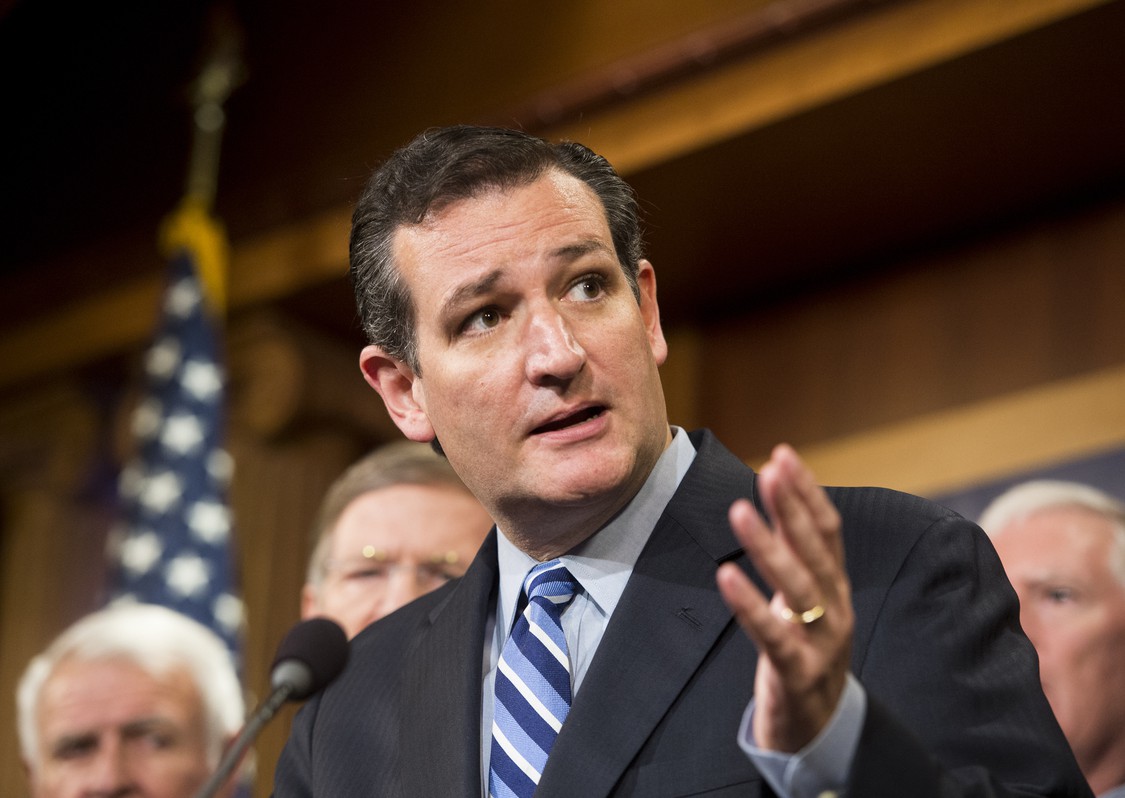
Watch Ted Cruz disagree with an Iowa farmer on the issue of ethanol subsidies

Ted Cruz and Mike Lee go to war against amnesty
Ted Cruz and Mike Lee on their way to defeat an amnesty bill

My friend Bruce posted a dazzling video, which I have included below. It shows Ted Cruz at the Iowa caucuses having a tense discussion with an Iowa farmer who is opposed to Cruz’s policy of repealing federal subsidies for ethanol, which is made from Iowa corn.

Notice how Cruz respects the man, looks him in the eye, and does not appear anxious to move on. He believes that he is right, and he respects the other man as a rational agent. He thinks that if he explains his view, then the other man will agree with him on the merits of his argument. The farmer’s opposition is not a marketing problem to Ted Cruz. It’s an evidence problem to Ted Cruz. Cruz doesn’t think that there is any difference in the dignity or worth of himself and this man. He approaches him like an equal, and he believes that he owes this man an answer. He wants this man’s vote, and he is not willing to bribe him with taxpayer money in order to get it. He is lifting the man upward – asking him “what kind of country do you want this to be?” instead of telling him what taxpayer money Cruz will give him for his vote. It is the complete opposite of what Trump, Clinton and Sanders do with voters.

The Resurgent has a story on it about what to notice in the video:

People covering Ted Cruz say he doesn’t leave any event until the last question has been answered. In this video, Cruz is confronted by an angry farmer questioning his stand against Ethanol subsidies.

Cruz’s deep knowledge of the topic, his ability to calm the man down and get him to really listen, combined with his confidence in his own solutions win the man over.

Notice the constant eye contact. This is why Cruz can govern. On the stump, Washington fears him. On the floor of the Senate, the establishment hates him. But one-on-one, more often than not, Cruz can convince people he’s right.

Here is the clip from the most recent debate where Cruz explained his policy to the people of Iowa:

This is not your typical politician. This is something different.

I have a number of friends who are supporters of Marco Rubio, the establishment GOP candidate.

Marco Rubio regularly teams up with Democrats:

What my Rubio-supporting friends are telling me is that all these past actions are no big deal. They say that America has become a less conservative country, so we need to run a less conservative establishment candidate like Marco Rubio in order to win. I understand and agree that America is a less conservative country. We’ve drifted away from our roots and lost the vision of the Founders, which made us so great. But I don’t think that less conservative policies – be they social, fiscal or foreign policy policies – produce better results than more conservative policies.

Socialism doesn’t work

Take a look at this article about Venezuela, which appeared in the radically leftist Washington Post.

It says:

The only question now is whether Venezuela’s government or economy will completely collapse first.

The key word there is “completely.” Both are well into their death throes. Indeed, Venezuela’s ruling party just lost congressional elections that gave the opposition a veto-proof majority, and it’s hard to see that getting any better for them any time soon — or ever. Incumbents, after all, don’t tend to do too well when, according to the International Monetary Fund, their economy shrinks 10 percent one year, an additional 6 percent the next, and inflation explodes to 720 percent. It’s no wonder, then, that markets expect Venezuela to default on its debt in the very near future. The country is basically bankrupt.

That’s not an easy thing to do when you have the largest oil reserves in the world, but Venezuela has managed it. How?

[…]The first step was when Hugo Chávez’s socialist government started spending more money on the poor, with everything from two-cent gasoline to free housing.

[…]Chávez turned the state-owned oil company from being professionally run to being barely run. People who knew what they were doing were replaced with people who were loyal to the regime, and profits came out but new investment didn’t go in.

Do you know who supports spending tons of taxpayer money on public works projects and welfare, in order to buy votes? Democrats. Do you know who supports nationalizing private industry, especially health care and energy? Democrats. These are Democrat Party policies and they failed. They failed spectacularly. This failure is something that any ordinary American can understand, if anyone bothered to explain the cause and effect of economic policies to them.

And that’s exactly what Ted Cruz is doing in that video, with that ordinary voter. And to the great credit of Iowa voters, they voted for Ted Cruz even when he didn’t promise to give them taxpayer-funded goodies. That, my friends, is character. Iowa has character. They rose to his challenge, because they have Iowa values. Not New York Values.

Here is the real Donald Trump and his New York values, by the way:

Donald Trump promised more subsidies for ethanol to the people of Iowa, in order to get them to overlook his New York values. And the people of Iowa gave Ted Cruz the win.

So, the bottom line is this. I don’t believe that the superiority of conservative policies is difficult to demonstrate to ordinary people. I think that the average, run-of-the-mill American adult in the political center can be persuaded, so long as they give us time, and so long as we have the right man or woman to do the persuading. Give Cruz a chance to persuade them. We don’t have to take the American people as they are. We can try to shift them to the right, by listening to their concerns, and then persuading them with evidence.

Michael Licona on ancient biography and harmonizing Bible contradictions

Lets take a closer look at a puzzle

Brian Auten posted the latest lecture by Dr. Michael Licona at Apologetics 315. Brian’s site has the MP3 file (48 minutes, 44.5 Mb). I can make a smaller version for anyone who wants it.

Here is the video and my point-form summary.

The topic:

  • Contradictions do not affect the minimum facts case for the resurrection, although they are troubling
  • Most people respond to alleged contradictions by trying to harmonize them
  • Most verses that appear contradictory can be harmonized successfully
  • Some verses cannot be harmonized successfully without really damaging the texts
  • Christians should not gloss over these few real contradictions nor pretend that they don’t exist
  • How should we respond to the verses that cannot easily be harmonized?

Genre considerations:

  • The genre of the gospels is “ancient biography”
  • Ancient biography is not the same genre as modern biography
Insignificant differences

1. Contradictions vs. Differences:

  • In ancient biography, if a source mentions one person’s name, it does not mean that other people were not present
  • Example: one woman versus two women at the tomb, an account may only mention one woman when there are two
  • That is a difference, not a contradiction

2. Time compression:

  • in ancient biography, writers are allowed to leave out events in order to compress time
  • Some gospels omit details (guy version) and other gospels give more details (girl version)
  • For example, the cursing of the fig tree in Mark and Matthew

3. Narrative flow:

  • the ancient biographer’s style was to link together events into a narrative, even if they are slightly out of order
  • This means that the ordering matters less to ancient biographers than forming a coherent narrative
  • For example, the prediction by Jesus that Peter would deny him

Significant differences:

1. Biography allows for portrait painting

  • When people paint portraits, they sometimes use illustrations or imagery to convey the person’s character
  • For example, Shakespeare adds things to his history of Julius Caesar to make it more dramatic
  • For example, the genealogies in Matthew, the portrait of Jesus in the garden in John

2. Even if there are contradictions in an account it doesn’t mean that the basic facts are undermined

  • For example, even if we don’t know for sure if one thief or two thieves cursed Jesus, no one doubts that he was crucified
  • The basic details of the story are not affected by apparent contradictions

Then there is a period of Questions and Answers.

New study: Bernie Sanders’ budget would raise taxes $13.6 trillion over a decade

Democrats took control of government spending in 2007

It’s very strange to me that young people seem to like Bernie Sanders’ rhetoric so much. Have they really considered what his budget would require?

Here’s an article from the Washington Free Beacon that talks about a non-partisan study from the Tax Foundation think tank.

Excerpt:

(I., Vt.) proposed tax plan would raise taxes by $13.6 trillion over the next decade and reduce the economy’s size by 9.5 percent, according to an analysis by the Tax Foundation.

While on the campaign trail, the senator has proposed $18 trillion in spending over the next decade. His plan includes $15 trillion for a government-run single-payer health care plan and trillions more for Social Security, roads and bridges, higher education, paid family and medical leave, and private pension funds, to name just a few.

Sanders’ proposed tax plan will increase marginal tax rates and the cost of capital, a move that will significantly reduce GDP, lower wages, and eliminate jobs.

According to the Tax Foundation, Sanders aims most of his tax provisions at high-income households, creating four new income tax brackets with rates of 37 percent, 43 percent, 48 percent, and 52 percent. Additionally, Sanders would tax capital gains and dividends for households with income over $250,000 and create a 2.2 percent income-based health care premium.

However, as Sanders has admitted, his plan also includes tax increases on the middle class. “We will raise taxes. Yes, we will,” Sanders said at the CNN town hall last weekend.

“A majority of the revenue raised by Sanders plan would come from a new 6.2 percent employer-side payroll tax, a new 2.2 percent broad-based income tax and the elimination of tax expenditures relating to healthcare,” the analysis explains.

According to a recent report from the Congressional Budget Office, even without Sanders’ tax plan the nation’s economy is projected to expand at a rate much lower than in recent decades. Sanders’ plan would lower the growth rate further, as its proposed marginal tax rate increases on labor and capital would reduce GDP by 9.5 percent in the long term.

“At the center of my campaign is how we’re going to raise wages,” Sanders said at the first Democratic debate. “Yes, of course, raise the minimum wage, but we have to do so much more, including finding ways so that companies share profits with the workers who helped to make them. And then we have to figure out how we’re going to make the tax system a fairer one.”

“And in my view what we need to do is create millions of jobs by rebuilding our crumbling infrastructure; raise the minimum wage to $15 an hour; pay equity for women workers; and our disastrous trade policies, which have cost us millions of jobs; and make every public college and university in this country tuition-free,” he said.

After accounting for reductions in economic growth, Sanders’ plan would lead to 12.84 percent lower after-tax incomes for all taxpayers, 6 million fewer full-time jobs, and an 18.6 percent smaller capital stock.

Let’s take a look at a few of these from the perspective of a non-clown.

Minimum wage

You know, you don’t have to be an economics genius to understand that this man is a fool – the equivalent of a clown trying to take control of a nuclear power plant. Just look at his position on minimum wage. Every economist understands that raising the minimum wage causes businesses to lay off workers. Why? Because they have to pay for the higher minimum wage somehow. Either they lay off workers and scale back their business, or they charge consumers more. When you charge consumers more, they buy less of what you’re selling. So, usually it means laying off workers.

This Daily Signal article explains what happened when liberal cities raised their minimum wage rates.

Payroll tax

Raising the rate o the employer payroll tax means that employers will basically have to pay more for the same labor. They X labor out of their employees now, and paying Y wages. After Sanders, they will be getting X labor still, but paying a higher Y in wages. What will they do? They will simply let go of their least productive employees and scale back their business, maybe expanding abroad and sending jobs to a country where they are taxed less.

This article from the Fraser Institute explains what happens when companies have to pay more to employ workers.

Tariffs

Bernie Sanders thinks that consumers should pay more for consumer goods. That’s what happens when you slap tariffs on goods manufactured in other countries. Consumers and businesses end up paying more for the same product, leaving less money for other things that you need for your family.

Here’s a post that explains why free trade is best for consumers.

Single payer health care

Single payer health care is supported by economic illiterates in the Democrat and Republican parties – both Sanders and Trump support it. What single payer does is allow government workers to take a cut of every transaction between you and your doctor, effectively imposing a tax on medical treatment without adding any value. It would be as if every transaction between you and Amazon.com were to be funneled through the government to see if you were allowed to buy what you wanted, and for how much. Obviously, we would have to hire government workers to make decisions about your Amazon purchases, to make you wait in line behind others who wanted the same items, and to process payments to Amazon.

Just read this Boston Globe article about the costs of Vermont’s (failed) proposal to have single-payer health care.

Public Works

Henry Hazlitt’s book “Economics in One Lesson” explains the problem with taxing the private sector to build public works.

Henry Hazlitt’s Economics in One Lesson, chapter 4, entitled “Public Works Mean Taxes”.

Excerpt:

Therefore, for every public job created by the bridge project a private job has been destroyed somewhere else. We can see the men employed on the bridge. We can watch them at work. The employment argument of the government spenders becomes vivid, and probably for most people convincing. But there are other things that we do not see, because, alas, they have never been permitted to come into existence. They are the jobs destroyed by the $10 million taken from the taxpayers. All that has happened, at best, is that there has been a diversion of jobs because of the project. More bridge builders; fewer automobile workers, television technicians, clothing workers, farmers.

And consider Chapter 5 as well, entitled “Taxes Discourage Production”.

In our modern world there is never the same percentage of income tax levied on everybody. The great burden of income taxes is imposed on a minor percentage of the nation’s income; and these income taxes have to be supplemented by taxes of other kinds. These taxes inevitably affect the actions and incentives of those from whom they are taken. When a corporation loses a hundred cents of every dollar it loses, and is permitted to keep only fifty-two cents of every dollar it gains, and when it cannot adequately offset its years of losses against its years of gains, its policies are affected. It does not expand its operations, or it expands only those attended with a minimum of risk. People who recognize this situation are deterred from starting new enterprises. Thus old employers do not give more employment, or not as much more as they might have; and others decide not to become employers at all. Improved machinery and better-equipped factories come into existence much more slowly than they otherwise would. The result in the long run is that consumers are prevented from getting better and cheaper products to the extent that they otherwise would, and that real wages are held down, compared with what they might have been.

There is a similar effect when personal incomes are taxed 50, 60 or 70 percent. People begin to ask themselves why they should work six, eight or nine months of the entire year for the government, and only six, four or three months for themselves and their families. If they lose the whole dollar when they lose, but can keep only a fraction of it when they win, they decide that it is foolish to take risks with their capital. In addition, the capital available for risk-taking itself shrinks enormously. It is being taxed away before it can be accumulated. In brief, capital to provide new private jobs is first prevented from coming into existence, and the part that does come into existence is then discouraged from starting new enterprises. The government spenders create the very problem of unemployment that they profess to solve.

Why anyone would consider a man who has never held a private sector job for any length of time is beyond me. That article explains that Sanders has only ever collected unemployment or worked in government jobs. My cashier at Chick-Fil-A understands more about economics than this fool.