I’m sure that I don’t have to tell anyone this, but Wikipedia is not a reliable website, if you are looking up topics like religion, science or policy. If you need to prove this to anyone, then bookmark this post. Because we’re going to take a look at a new study by the Media Research Center, that clearly shows how wikipedia is biased against Christians and conservatives.
A new study by Media Research Center Free Speech America found that Wikipedia, the encyclopedia behemoth, has effectively blacklisted all right-leaning media from being used as source material, exclusively relying on leftist, legacy media notoriously known to spread misinformation and attack opponents of the left.
Among the effectively blackballed media sources are Breitbart, The Daily Caller, Daily Mail, Newsmax, OANN and the Media Research Center. Meanwhile, leftist media like The Atlantic, Jacobin, Mother Jones, Pro-Publica, The Guardian and National Public Radio (NPR) are given the green light. This blatant misinformation means that Wikipedia is purposely feeding Americans information exclusively through the lens of one side of the political spectrum—the left.
Positioning themselves as arbiters of truth, Wikipedia and its editors have effectively institutionalized a blacklisting system utilizing a “Reliable sources/Perennial sources” page that forbids the use of some of the most popular media sources on the right when editing Wikipedia pages. Their claims? Right-leaning sources are not “reliable,” and in some cases literally “blacklisted” — Wikipedia’s actual word — from use on the platform altogether. The predictable effect? Conservatives, Republicans and Trump appointees are smeared, maligned and slandered by the most popular online source for information about people.
I still use Wikipedia for finding out about famous historical battles, or different kinds of animals, but not for anything else. It’s just not a reliable web site. Plus, they are always begging for money. Never give them a cent!
Well, Rose and I finished reading Dr. John West’s new book “Stockholm Syndrome Christianity”, and we recorded an interview with him about the topics he discusses in the book. One of the topics he is passionate about is how Christian colleges can maintain their Christian identity. He worked at a college that slid into secular leftism. It’s hard on Christian students.
So, how can a Christian student avoid going to a college where they will face opposition from professors and administrators?
As a former professor at an evangelical Christian university, I am sometimes asked by concerned parents to recommend a good Christian college for them to consider for their children. Because the spiritual health of specific colleges and universities can change radically over time, and because there can be a wide diversity of views even among different academic departments on the same campus, it is not always possible to provide specific recommendations.
What I can provide are questions you can ask if you or your teens are seeking to find a biblically-faithful college or university. Don’t just rely on marketing materials produced by the college or university! Those materials will invariably stress how the institution integrates the Christian faith with learning in everything it does. These marketing materials may or may not reflect the actual situation on the campus. At the Christian university where I taught, the marketing materials became more and more explicitly Christian while the actual Christian faithfulness of the university was getting less and less.
If you know the right questions to ask, you can cut through the PR and gain a more accurate perception of what is actually going on. The following questions are a good place to start.
Here are the ten questions:
What are the statements of faith and behavioral expectations that all faculty, staff, and board members must sign and agree to abide by?
How many members of the theology or Bible departments belong to the Evangelical Theological Society (ETS)?
How many members of the philosophy department belong to the Evangelical Philosophical Society (EPS)?
How many members of the science faculty (especially the biology faculty) are skeptical of Darwinian evolution or supportive of the idea that nature shows clear evidence of intelligent design?
Does the college offer chapel services, and is attendance by students required?
How many speakers at chapel or official university-sponsored events during the past academic year addressed each of the following topics: (a) the trustworthiness and/or historical accuracy of the Bible; (b) biblical standards against sex outside of marriage and for sexual chastity and faithfulness; (c) biblical standards against transgenderism and homosexuality; (d) Christian teaching on the sanctity of human life, including abortion, infanticide, and euthanasia; (e) the persecution of Christians both inside and outside of the United States, and the importance of defending religious liberty; (f) positive Christian teaching on racial equality and reconciliation as well as critiques of unbiblical ideas such as “Critical Race Theory” and calls for racial/ethnic separatism and superiority (from both left and right).
Does the campus health center provide (a) abortion referrals, (b) referrals to Planned Parenthood, (c) referrals to LGBTQ groups, or (d) contraceptives to unmarried students?
What student clubs has the college approved?
What books are assigned in courses?
What are the policies regulating student speech?
And this is the one that stood out to me:
6. How many speakers at chapel or official university-sponsored events during the past academic year addressed each of the following topics: (a) the trustworthiness and/or historical accuracy of the Bible; (b) biblical standards against sex outside of marriage and for sexual chastity and faithfulness; (c) biblical standards against transgenderism and homosexuality; (d) Christian teaching on the sanctity of human life, including abortion, infanticide, and euthanasia; (e) the persecution of Christians both inside and outside of the United States, and the importance of defending religious liberty; (f) positive Christian teaching on racial equality and reconciliation as well as critiques of unbiblical ideas such as “Critical Race Theory” and calls for racial/ethnic separatism and superiority (from both left and right).
Before actually attending a college, it can be hard to know what is taught in the classrooms there. But the topics addressed by speakers at official campus events will tell you a lot about the viewpoints dominant among the faculty and administration. If campus speakers are not regularly being brought in to explain and defend key Christian beliefs under attack in our culture, that is another huge warning sign. Also pay attention to the point of view of the speakers being brought in. Just because campus speakers are addressing one of the topics above does not mean they are doing so in a way consistent with biblical teaching. When it comes to other topics, especially political topics where Christians disagree (for example, the best way to fight poverty, or American foreign policy), pay attention to whether the university hosts Christian speakers with a range of views, including those on the politically conservative side of the spectrum.
This one is also important to me:
8. What student clubs has the college approved?
The student clubs allowed on a Christian college campus will reveal a lot. For example, does the college have a club that promotes the agenda of the LGTBQ movement? More positively, does the college have a club devoted to pro-life issues or apologetics (such as a chapter of the national apologetics ministry Ratio Christi)? You might also want to look at the student newspaper
These two questions matter to me, because I work with groups like Ratio Christi in order to bring in Christian speakers to address some of the topics that he talked about in Question 6. It’s actually better to enforce orthodoxy through persuasion and evidence than it is to enforce it by writing rules on a page. If the apologetics speakers hold events, that will equip the students to think carefully about these topics, so that they don’t roll over for feelings and peer approval.
If this kind of concern affects you, then check out the article, and go over it with your child. There’s no sense sending your child into a difficult situation that will make it harder for them to get their education, without being indoctrinated.
I always get excited when the annual report on Canadian healthcare comes out. A lot of people in my office love single payer healthcare. Except they don’t know how it works in countries that have tried it. They imagine that it works well. They love the idea that healthcare will be free for them. But when I get my hands on a good study, it means a lot of fools are about to get a beat down.
Canada Universal Coverage Government Run Single Payer Healthcare Health Care Wait Times
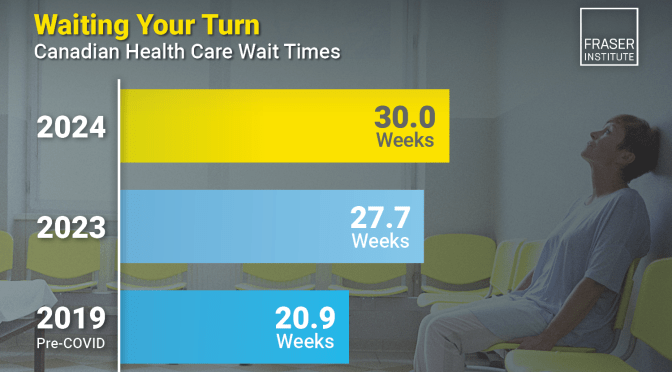
In 2024, physicians across Canada reported a median wait time of 30.0 weeks between a referral from a GP and receipt of treatment. Up from 27.7 in 2023.
This is 222% longer than the 9.3 week wait Canadian patients could expect in 1993.
The national 30 week total wait is comprised of two segments. Referral by a GP to consultation with a specialist: 15.0 weeks. Consultation with a specialist to receipt of treatment: 15.0 weeks.
After seeing a specialist, Canadian patients waited 6.3 weeks longer than what physicians consider to be clinically reasonable (8.6 weeks).
Across 10 provinces, the study estimated that patients in Canada were waiting for 1.5 million procedures in 2024.
Patients also suffered considerable delays for diagnostic technology: 8.1 weeks for CT scans, 16.2 weeks for MRI scans, and 5.2 weeks for Ultrasound.
Well, there’s a saying in business. You can have a product or a service fast, or you can have it good, or you can have it cheap. Pick two out of 3. So, Maybe Canadian healthcare is not fast, but maybe it’s good, and maybe it’s cheap.
Canada Universal Coverage Government Run Single Payer Healthcare Health Care Cost Taxes
Canadians often misunderstand the true cost of our public health care system. This occurs partly because Canadians do not incur direct expenses for their use of health care, and partly because Canadians cannot readily determine the value of their contribution to public health care insurance.
In 2024, preliminary estimates suggest the average payment for public health care insurance ranges from $4,908 to $17,713 for six common Canadian family types, depending on the type of family.
Between 1997 and 2024, the cost of public health care insurance for the average Canadian family increased 2.2 times as fast as the cost of food, 1.7 times as fast as the average income, and 1.6 times as fast as the cost of shelter. It also increased much more rapidly than the cost of clothing, which has been falling in recent years.
OK, so Canadians aren’t getting healthcare fast, and they’re not getting healthcare cheap. Maybe they’re getting really really good healthcare, though.
Here are the numbers from a recent study from Ipsos, a major Canadian pollster:
An Ipsos survey for the Montreal Economic Institute is showing that Canadians’ opinions about their provincial healthcare systems have not improved in 2024 compared to last year. As in 2023, we find that less than half (48%) of Canadians are satisfied with their provincial healthcare system, with only 8% saying they are very satisfied. This proportion is even lower among women (43%), as well as residents of the Atlantic (30%).
Well, they are getting garbage healthcare. And they are not actually paying for healthcare. They are paying massive amounts of taxes for access to a waiting list for healthcare. And they get in line behind refugees who cannot even speak English, and have paid nothing in taxes. That’s what happens when you have universal-coverage government-run healthcare. That’s how it actually works in real life.
And sometimes they even die while waiting for healthcare. Here is an article from the Toronto Sun from January 2025:
Close to 15,500 people died waiting for health care in Canada between April 1, 2023 until March 31, 2024, according to data compiled by SecondStreet.org via Freedom to Information Act requests across the country.
However, SecondStreet.org says the exact number of 15,474 is incomplete as Quebec, Alberta, Newfoundland and Labrador don’t track the problem and Saskatchewan and Nova Scotia only provided data on patients who died while waiting for surgeries – not diagnostic scans.
SecondStreet.org says if it extrapolates the unknown data, then an estimated 28,077 patients died last year on health care waiting lists covering everything from cancer treatment and heart operations to cataract surgery and MRI scans.
I know that a some Americans like to pick political leaders and policies based on their feelings. They want to feel good. They want to be liked. People who like government-run healthcare tend to be people with enormous student loan balances for worthless non-STEM degrees. They work in easy jobs in the public sector. They join labor unions because they’re scared of competition and accountability. Many of them work in daycare or they teach little children, because they don’t want to be challenged by adults. When you look at the numbers on healthcare in different countries, it’s very clear what works and what doesn’t work. Americans need to be smarter than Canadians. We have to vote based on reason and evidence.




 WINTERY KNIGHT