
Category Archives: News

Trump will inherit many foreign policy disasters

Is Barack Obama focused on protecting the American people?

The most difficult mistakes for Trump to fix will be the foreign policy blunders committed by the last administration – the creation of wars in other countries and the the supporting of our enemies (giving assault weapons to drug cartels, giving nuclear weapons to Iran, etc.) that are the most difficult to make right.

Consider this article from the Daily Signal.

It lists 5 crises created by the Obama administration in the last 8 years:

  1. ISIS in Iraq and Syria
  2. Afghanistan War
  3. Ukraine-Russia War
  4. Saudi Arabia-Yemen War
  5. Campaigns Against Terrorists in Africa

There was no “Islamic State” in Iraq or Syria when president Bush left office. Iraq and Syria, along with Egypt and Libya, were stable. Libya had just voluntarily given up their WMD programs without a shot being fired, because of concern that Bush would invade them, too. But then Obama became president and withdrew our troops from Iraq. What happened next? Genocide, rape and sex-trafficking on a scale unimaginable to naive American progressives.

Excerpt:

1. ISIS in Iraq and Syria

In response to rapid territorial gains made by the Islamic State during the first half of 2014, the U.S. and allied countries began a military campaign against the terrorist group, relying primarily on airstrikes and support of local ground forces.

As of Nov. 2, the U.S. coalition has conducted nearly 16,000 airstrikes in Syria and Iraq, the countries where ISIS maintains its largest presence.

The Defense Department reports that as of Aug. 31, the total cost of operations related to defeating ISIS is $9.3 billion and the average daily cost is $12.3 million.

Trump inherits the military campaign against ISIS during a crucial phase, as the U.S. undertakes missions to take back key territory controlled by the militants.

[…]In Syria, the Obama administration is supporting 30,000 Syrian-Kurdish and Syrian-Arab fighters, who announced last weekend they were launching a campaign to liberate the ISIS capital in Raqqa. There are roughly 300 U.S. special operations forces on the ground in the country.

The moves to take back ISIS’ remaining strongholds showcase the extent to which Obama has prioritized the counter­terrorism mission in Syria over efforts to help resolve the country’s civil war, which has resulted in as many as a half a million deaths.

On Monday, in a press conference, Obama acknowledged his Syria policy “has not worked.”

Another blunder by the Obama administration occurred with his decision to take a naive, pacifist stance with Russia. Obama and Clinton were following the liberal playbook, which states that the best way to stop a bully from being aggressive is to bow down to him and grovel. This is literally how progressives think about foreign policy – they think that weaknesses causes tyrants to back off, and that strength causes tyrants to arm up and attack their neighbors.

How well this the progressive view work with Russia?

3. Ukraine-Russia War

Europe’s only active war has resulted in the deaths of nearly 10,000 soldiers and civilians on both sides.

The conflict started in 2013, when Ukrainian President Viktor Yanukovych, under pressure from Russia, suspended talks on a trade deal with the European Union. Thousands of protesters hit the streets in the following days, supporting closer ties with the West.

The protests turned violent, and Yanukovych fled the capital, Kiev. Russia annexed Crimea in 2014, and pro-Russian rebels began to seize territory in eastern Ukraine. Separatists in the eastern regions of Donetsk and Luhansk eventually declared independence.

Two cease-fire accords are not being observed. The Obama administration’s policy has been to support a German and French-led effort to negotiate a settlement to the war, and maintain pressure on Russia by working with the European Union to uphold sanctions imposed on Moscow for its annexation of Crimea. The Obama administration has also delivered Ukraine tens of millions of dollars in nonlethal aid, but has not provided weapons.

Obama isn’t providing Ukraine with weapons, because his progressive playbook says that Russia will be more likely to attack if they stand to take more losses to anti-tank weapons. That’s how people on the secular left think. They make decisions based on what makes them feel superior and what makes them look idealistic to others – not based on what works.

But there’s more. Hillary Clinton and Marco Rubio championed an idealistic intervention in Libya. They thought that if we got rid of Libya’s dictator, then there would be a spontaneous uprising of peaceful Muslim democracy-lovers. So they ordered air strikes with no ground invasion, and guess what they got?

Islamic State taking root in the anarchy they created:

5. Campaigns Against Terrorists in Africa

Obama has described his efforts to destroy al-Qaeda’s core leadership as one of the successes of his national security policy. But the terrorist threat has spread to new regions in recent years, prompting a U.S. military response, and Trump will have to decide how to proceed.

Unrelated campaigns in Libya and Somalia are prime examples of the diffuse threat.

In Libya, the U.S. has conducted more than 360 airstrikes in support of pro-government forces trying to expel ISIS from the coastal Libyan city, Sirte. A small number of U.S. special operations forces are also providing on-the-ground support.

Since the 2011 American intervention in Libya that led to the death of the country’s deposed dictator leader, Muammar Gaddafi, the country has been plagued by instability.

Today, the U.S. is supporting a project to build a unity government in Libya. But the unity government has not yet won the approval of Libya’s various rival factions.

“Libya is a quintessential civil war,” Middle East expert Pollack said. “ISIS makes their home in civil wars.”

Separately, in another African nation, Somalia, the U.S. has been engaged for more than a decade in an air campaign against al-Shabab, an affiliate of al-Qaeda. The group is responsible for one of the deadliest attacks in Africa, when in 2013 it struck a mall in Nairobi, Kenya.

The terrorist group spawned in 2005, taking advantage of chaos in a country that has been split apart by civil war for 25 years.

This year, The Washington Post reports, the U.S. has conducted more than a dozen airstrikes and drone strikes against al-Shabab.

According to The New York Times, as part of a multifront war against militant Islam in Africa, American forces are also involved in helping to combat al-Qaeda in Mali, Niger, and Burkina Faso and Boko Haram in Nigeria, Cameroon, and Chad.

Although progressives like to style themselves as being “anti-war”, they actually cause a lot of wars and deaths with their misguided idealistic military interventions. Obama inherited a peaceful situation in Russia and in the Middle East, but he screwed everything up.  To stop wars you must understand military issues. Just because a person says they don’t like war, it doesn’t mean that they know what actions to take to avoid war.

Worst president ever leaves Trump a looming economic crisis

Is Barack Obama focused on protecting the American people?

Consider this article from the Wall Street Journal, which discusses the latest CBO (Congressional Budget Office) report.

Massive budget deficits:

One lesson is that the days of easy deficit reduction are over. The annual deficit in 2016 rose for the first time in three years—by $148 billion to $587 billion. That’s 3.2% of GDP, up sharply from 2.5% last year. Mr. Obama has been able to ride falling defense spending from reduced military deployments overseas, but Pentagon outlays were flat in 2016. Military spending will probably have to increase in future years, no matter who wins Tuesday, to meet the growing challenges from Russia, China and Iran.

Looming entitlement crisis:

Mr. Obama will also leave town having failed over eight years to do anything to slow the booming burden of Social Security, Medicare and Medicaid. Outlays for those three programs grew by $75 billion last year, or about 4.2%. They now account for 10% of the entire U.S. economy, the highest level ever, and rising.

More spending on welfare programs:

The President’s main contribution has been to put Medicaid on hyperspeed by expanding its coverage through ObamaCare. CBO’s budget gnomes report that Medicaid spending has climbed by nearly 40% in a mere three years—to $368 billion in 2016. That doesn’t include what the states are obliged to chip in.

Higher taxes and more regulations (e.g. – Dodd-Frank) killed economic growth:

Another lesson is that faster economic growth is essential to a healthier fisc. One reason for the deficit rebound in 2016 is that federal revenues increased by a mere $18 billion or less than 1%. Individual income-tax receipts were flat, while corporate income taxes fell by $44 billion or 13% as business profits sagged. This is what happens when the economy sputters at about a 1% growth rate for most of a year.

Massive spending:

Growth that slow couldn’t keep up with spending that increased 4.5% or $166 billion in 2016. Federal outlays were 20.9% of the economy for the year, up from 20.4% in 2014. A Republican Congress has kept that figure down from the heights of the Obama-Nancy Pelosi stimulus, but it is now set to take off again as more Baby Boomers start collecting Social Security and Medicare. (Millennials, get ready to pay even higher taxes throughout your working life.)

Looming crisis caused by rising interest rates:

This era may be ending as a new President takes office. The Fed may raise rates in December, and bond yields have been rising. Outlays for net interest on the debt increased by $23 billion or 9% in 2016, largely due to faster inflation. But inflation is still tame. If it begins to rise, the debt-financing burden will explode with more than $14 trillion of Treasury debt outstanding, much of it short-term. In January CBO said that if interest rates are 100 basis points above their projections each year for the next decade, the Treasury will have to pay an average of more than $160 billion per year.

And it’s not just fiscal matters. Investors Business Daily adds to the list of problems that Obama will pass on to Trump.

Low wages, high unemployment:

Obama, like every Democrat running for office, claimed to be the champion of the middle class, and that instead of “trickle down” economics, he’d growth the economy from the “middle out.” Instead, middle class wages stagnated throughout Obama’s term in office, with real median household income today exactly where it was when Obama took office.

And despite Obama’s constant bragging about the “longest” stretch of private sector job growth, the 15.5 million private sector jobs added since February 2010 hasn’t even kept pace with population growth — which climbed 17.5 million over that time. As a result, more than 14 million people have dropped out of the labor force since Obama took office. In fact, without the huge decline in labor force participation under Obama, the unemployment rate would be more like 10%, rather than the official 4.9%.

Higher health care costs and more health care regulations on businesses:

ObamaCare was supposed to be Obama’s grand legacy, showing how government could be a force for good. Instead, it’s become an epic failure that will have to dealt with by the next president. The reforms Obama said would repair a “broken” health system have themselves broken it. Premiums in the newly government-run individual market are up an average 22% nationwide, and at rates of 50%, 60%, even 113% in some states — increases unheard of before ObamaCare. Insurance markets that were once vibrantly competitive are now dominated by one or two carriers. ObamaCare has made Medicaid, an already terrible health program, worse by dumping millions more into it. ObamaCare’s taxes, mandates, and regulations are suffocating businesses.

Foreign policy disasters:

A list of Obama’s foreign policy failures would fill a volume, but here are just a few: Obama in 2011 prematurely removed troops from Iraq, creating a power vacuum later filled by ISIS; he let Iran’s covert nuclear weapons program continue, starting a nuclear arms race in the Mideast; after Obama called ISIS a “jayvee team,” it grew in clout and territory as a result of Obama’s neglect; Obama’s intervention in Libya during that country’s civil war led to the country becoming a terrorist haven, with no real government; he and Hillary Clinton pushed the “reset button” with Russia’s Vladimir Putin, and Russia launched hostile actions against its neighbors in Crimea and Ukraine, and threats to the Baltic states; Obama has signaled ambivalence over protecting traditional allies in Asia, leading to China arming up and bullying it neighbors. With massive defense cuts Obama put in place, it’s safe to say the U.S. hasn’t been this weak since the nadir of the Carter years.

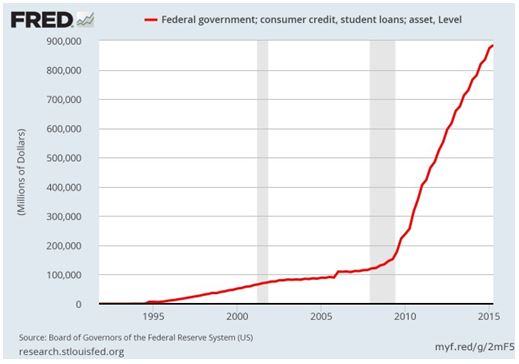
This is not even to mention the $1.3 trillion dollar student loan bubble:

Federal student loans skyrocketed under Obama

And yet another Democrat-caused mortgage lending crisis:

Another Democrat-caused mortgage lending crisis
Another Democrat-caused mortgage lending crisis is on the horizon

Democrats are always in favor of making it easy for people to borrow money, and leaving taxpayers on the hook to cover it. Are there enough people working to cover these debts? Has Obama been focused on helping to lower taxes and reduce regulations for job creators, so they can create new jobs? How will the millennials respond to being forced to pay for all the debt incurred by the man they voted for?

Skeptical astrophysicist assesses the fine-tuning argument in Cosmos magazine

Christianity and the progress of science

This article appeared in Cosmos Magazine. (H/T Uncommon Descent)

It is written by the naturalist co-author of the new Cambridge University Press book “A Fortunate Universe: Life in a Finely-Tuned Cosmos”.

Excerpt:

As a cosmologist, I can use [the] immutable laws of physics to evolve synthetic universes on supercomputers, watching matter flow in the clutches of gravity, pooling into galaxies, and forming stars. Simulations such as these allow me to test ideas about the universe – particularly to try to understand the mystery of dark energy (more on this later).

[…]So now, I invite you to join me in imagining a universe, a universe slightly different to our own. Let’s just play with one number and see what happens: the mass of the down-quark. Currently, it is set to be slightly heavier than the up-quark.

[…]If we start to ratchet up the mass of the down-quark, eventually something drastic takes place. Instead of the proton being the lightest member of the family, a particle made of three up-quarks usurps its position. It’s known as the Δ++. It has only been seen in the rubble of particle colliders and exists only fleetingly before decaying. But in a heavy down-quark universe, it is Δ++that is stable while the proton decays! In this alternative cosmos, the Big Bang generates a sea of Δ++ particles rather than a sea of protons. This might not seem like too much of an issue, except that this usurper carries an electric charge twice that of the proton since each up-quark carries a positive charge of two-thirds.

As a result, the Δ++ holds on to two electrons and so the simplest element behaves not like reactive hydrogen, but inert helium.

This situation is devastating for the possibility of complex life, as in a heavy down-quark universe, the simplest atoms will not join and form molecules. Such a universe is destined to be inert and sterile over its entire history. And how much would we need to increase the down-quark mass to realise such a catastrophe? More than 70 times heavier and there would be no life. While this may not seem too finely tuned, physics suggests that the down-quark could have been many trillions of times heavier. So we are actually left with the question: why does the down-quark appear so light?

Things get worse when we fiddle with forces. Make the strength of gravity stronger or weaker by a factor of 100 or so, and you get universes where stars refuse to shine, or they burn so fast they exhaust their nuclear fuel in a moment. Messing with the strong or weak forces delivers elements that fall apart in the blink of an eye, or are too robust to transmute through radioactive decay into other elements,

Examining the huge number of potential universes, each with their own unique laws of physics, leads to a startling conclusion: most of the universes that result from fiddling with the fundamental constants would lack physical properties needed to support complex life.

Here’s another one a bit later:

And there is another structural issue to consider – our universe is flying apart. Two things affect the rate of expansion: the amount of matter which acts as a brake, and dark energy which acts as an accelerator. Dark energy is winning so our universe is expanding at an accelerating rate.

What this means is that in the early days of the universe, the rate of expansion was slower, slow enough to allow matter to condense into stars, planets and people. But if the universe had been born with only a touch less matter, it would have rapidly expanded, thinning out to less than one hydrogen atom per universe.

On the other hand, if the universe had been born with only a touch more matter, that would have caused it to re-collapse before the first stars could form. In short, the early universe was on a knife-edge, poised between these possible outcomes. What emerged was the Goldilocks expansion rate: not too fast, not too slow.

Later on in the article, the skeptical naturalist astrophysicist evaluates the most popular rebuttal to the scientific evidence: the multiverse.

He concludes:

To some, the picture of the multiverse is comforting, naturally explaining the puzzle of our own fine-tuning. But at present, we have no idea whether this immense sea of universes exists, and they may always be beyond the reach of experiment and observation; if this is the case, is the multiverse more philosophical musing than robust science?

Now, in my experience talking to atheists, especially to the computer science atheists in my office, they simply don’t care that the multiverse cannot be tested or observed. They would rather believe in something that cannot be tested or observed than to go along with the scientific evidence that can be tested and observed. When I try to ask them why they are not interested in conforming their worldview to scientific evidence, they hold up their Star Trek mugs, and their Star Wars DVDs, and say “science will figure it out”. But Star Trek and Star Wars are science fiction, not science – more like fantasy, really.

I have been able to dig down into the worldviews of the naturalists I know who seem to prefer science fiction to science. And at the very core of their worldview I find two things: 1) a desire to dispense with external reality (including science) as a constraint on their seeking of pleasure in this life, and 2) a desire to feel smug about not believing in myths and legends. Unfortunately, I have never met an atheist who did not prefer speculation and fantasy to experimental science, when confronted with scientific evidence that falsifies naturalism. I think that’s a lesson for us all – just because a person is capable at programming a computer (which is good), it doesn’t make a science-fiction / fantasy worldview true.