
Category Archives: News

Michael Behe: can Darwinian mechanisms account for the origin of new features?

I’ve found a new article on intelligent design, and I didn’t find it in my regular online haunts for science news: Evolution News and Mind Matters. This time, it’s an article by Dr. Michael Behe, writing in the American Spectator, of all places. His topic is this: how do Darwinists explain the origin of new body types and new organ types? Do they have the naturalistic mechanisms they need to do the work?

Here’s the article from American Spectator.

Here’s the thing to be explained:

As one prominent evolutionary biologist wrote in a leading science journal just a few years ago, “Modern evolutionary theory … has little to say about the actual history of life, especially the emergence of new levels of biological complexity, and nothing at all about the origin of life.” But those are exactly the most intriguing questions! Why, after more than a century and a half, does Darwin’s theory still fail to account for the mysteries it had promised to explain?

I looked up that quote and it does indeed come from this article in a science journal. The problem is, how do you come up with a complicated design like a bat’s ability to fly, or a whale’s ability to live under water? Do the Darwinists have a mechanism?

He says it doesn’t work for complicated designs, because small aimless steps don’t create a design:

The stumbling block is that the mechanism Darwin proposed to account for differences — “natural selection” sifting random mutations — is quite the feeble tool. It can only work, in Darwin’s words, “by numerous, successive, slight modifications,” that is, one single aimless step at a time. If that first mutation is helpful, then great, it can grope for another step. But when a long line of coordinated changes is required to build an intricate system, selection has no power to look ahead.

This myopic mechanism seemed reasonably promising way back in Darwin’s day, when comparatively little of life’s complexity was known, and when the foundation of life, the cell, was thought to be a simple glob of jelly, dubbed “protoplasm.” Maybe protoplasm could be expanded smoothly here, shrunk there, and molded a little at a time into whatever shape was needed, the way a potter might shape soft clay on a wheel.

Yet modern biology has revealed that cells are preternaturally sophisticated assemblages — literally automated, miniaturized factories. In the case of reproductive cells, they contain the tremendous number of complex machines (yes, actual machines, made of molecules) and instructions needed to build whatever kind of plant or animal they generate. Just try to think up a realistic way to retool a computer-controlled factory that is making cars into one that makes helicopters or submarines — one nut or bolt, one line of computer code, one tiny, random alteration in the factory at a time. That’s the magnitude of the problem facing Darwinian explanations for bats and whales and many other creatures.

This makes me think about what would happen if I had to write code one letter at a time by throwing a bowling ball at the keyboard. You could hope to get the letters in the right order for something to compile and run, but problem not something like bat flight.

His article is actually about what modern materialists / naturalists are doing to try to save the idea of no-designer from all this emerging complexity. He looks at several of their proposed extensions of Darwinian theory, and explains why they don’t work.

This is the one that stood out to me:

Another EES idea is “Natural Genetic Engineering.” Advocates of NGE point out that many of the tools molecular biologists use to manipulate DNA in a lab (to clone it, sequence it, and so on) are harvested from life, because cells are already endowed with a sophisticated box of tools to build and propagate life. If humans can use those cellular tools for their own purposes, the thinking goes, maybe cells can use them to direct their own evolution — to rearrange and improve their own DNA.

But the elegant tools are already there — where did they come from? And exactly how is an apparently unconscious cell supposed to direct itself to evolve when intelligent humans can barely make simple changes to cells without unexpected, damaging side effects? Meanwhile, in lab experiments where cells are allowed to grow and evolve on their own, over many generations they invariably change by degrading genes they already had, not by building complex new ones. When biologists observe life closely rather than invent stories, they see evolution working mainly by de-volution.

The other ones he looked at were even more crazy. Well, if you’re interested in understanding how to critically evaluate scientific theories like Darwinism, then take a look at his article. But, if you are already working in a biology department, it might be a good idea to be careful who you discuss this with. It might negatively impact your career to question this ancient, evidence-resistant theory of origins.
Does neuroscience provide support for physicalism or dualism?

When it comes to the problem of mind, there are some people who maintain that the mind is just reducible to the physical brain. Those are physicalists, also known as materialists. And then there are those who defend dualism, which is the idea that you are a non-material soul, and you have a body (which includes your brain). Who is right? Well, let’s take a look at the science and see.

This post is from Mind Matters, and it’s written by Dr. Michael Egnor.

He says:

Neurosurgeon Wilder Penfield (1891‒1976), who pioneered epilepsy surgery at the Montreal Neurological Institute in the mid-20th century, asked this very question: What does the brain do? He explored the question during eleven hundred “awake” brain operations over four decades. He needed patients to be awake so that he could communicate with them, to be sure that he was not damaging vital tissue while removing the tissue that was prone to epileptic seizures.

Penfield could do brain surgery while a patient is awake because the brain has no pain sensors. A local anesthetic (similar to the novocaine used in dentists’ offices) ensures that there is no pain in the scalp either during the surgery. Neurosurgeons still do this type of surgery today.

While epilepsy patients were awake and their responses to brain stimulation could be observed, he mapped their brains using electrical probes to find and remove seizure foci but also to determine which parts of the patients’ brains did what. He could answer questions like “What part of the brain makes us move our muscles?”, “What part of the brain enables us to see?” and “What part of the brain enables us to have memories and emotions?”

What fascinated Penfield is not so much what he found—i.e., which parts of the brain caused movement, perception, memory and emotions—but what he didn’t find.

Penfield could find no part of the brain that, when stimulated, caused patients to think abstractly—to reason, think logically, do mathematics or philosophy or exercise free will.

He noticed the same thing about epileptic seizures as about stimulation during surgery. Patients who were having seizures did all sorts of things—they jerked their muscles, they saw flashes of light or had unusual sensations on their skin. They even occasionally had specific memories and emotions. Then they fell unconscious.

But patients never had intellectual seizures. That is, they never had seizures that caused them to reason, think logically, or do mathematics or philosophy. There are no “calculus seizures” that cause them to uncontrollably take first derivatives. There are no philosophical seizures that cause them to uncontrollably contemplate Plato’s Republic.

Penfield asked the obvious question: why did brain stimulation only cause certain mental operations, like movement, perception, memory and emotion to happen, but not other ones, like abstract thought and free will?

It sounds like the brain is responsible for low-level interactions with the body itself. It reminds me of “device driver” software, which allows higher software to interact with hardware devices, like graphics cards and hard drives. What the progress of neuroscience seems to show is that the brain is doing device driver work, but something else is doing higher operations. And that something else is what substance dualists like me would call a “mind”.

There are lots of good philosophical arguments for minds, such as consciousness, direct first-person access to your thoughts, persistent identity over time that does not depend on your (changing) physical body, the intentionality problem (thinking about something else is not something that a material system can do), as well as free will. And there are more of those, too.

But it’s nice to see that there are scientific arguments as well. By doing the neuroscience, we can find out what the brain controls, and what it doesn’t control.

I thought this part of the article was interesting:

Penfield started out as a materialist, like most scientists do, but, as he learned more about the mind and the brain he became a dualist. He concluded in his book Mystery of the Mind (1975) that the mind is something separate from the brain, and that there are aspects of the mind that don’t come from the brain but are spiritual in nature. As he put it, “The mind must be viewed as a basic element in itself . . . That is to say, it has a continuing existence.” (p. xxi.)

The article mentions a new book coming out in June 2025, entitled “The Immortal Mind”. And I’ve already contact one of the authors of the book to see if we can get them to come on the Knight and Rose Show to tell us about all of this scientific research. I hope that will help our listeners to be able to have good evidence-based conversations about this fascinating area of disagreement between theists and atheists.

Distinguished chemistry professor lectures on God’s existence at Harvard

When I was just starting out my career in America, I ordered dozens of audio lectures featuring Christian scholars defending the Christian worldview on the university campus. These lectures were recorded on audio cassettes. And they came to my house in a box. I would put them into my tape player and listen to them, then rewind the tapes and listen again. And these lectures are still going on.

Today I wanted to blog about a recent lecture given by a famous chemistry professor named James Tour. You might have heard of Dr. Tour. He has a stellar career doing research in nano technology at Rice University.

Here’s his biography. I can only excerpt a little, because it’s very, very long:

James M. Tour, a synthetic organic chemist, received his Bachelor of Science degree in chemistry from Syracuse University, his Ph.D. in synthetic organic and organometallic chemistry from Purdue University, and postdoctoral training in synthetic organic chemistry at the University of Wisconsin and Stanford University. After spending 11 years on the faculty of the Department of Chemistry and Biochemistry at the University of South Carolina, he joined the Center for Nanoscale Science and Technology at Rice University in 1999 where he is presently the T. T. and W. F. Chao Professor of Chemistry, Professor of Computer Science, and Professor of Materials Science and NanoEngineering. Tour has about 650 research publications and over 200 patents.

I figured that the average senior scientist doing research at a university has about 40 peer-reviewed publications, and Grok agreed with that, citing a survey from Nature from 2018, which found that senior scientists (15+ years post-PhD) average 20–50 peer-reviewed publications. So, 650 is a TON of publications! And what’s exciting is that his research is actually solving problems in the private sector.

Anyway, here is an article from the Harvard Sentinel, about his recent lecture at Harvard University, on the topic of the existence of God:

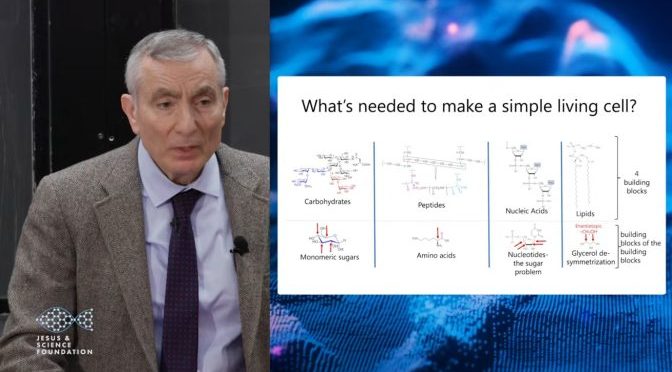
On April 1st, Rice University chemistry professor James Tour visited Harvard to deliver a guest lecture on the existence of God. During his lecture, which was hosted by Christian student group Harvard Undergraduate Faith and Action (HUFA), Tour presented what he called a scientific challenge to the current explanations for life’s origin, and he discussed the myriad of unanswerable dilemmas within the presumed scientific consensus.

Tour, who was raised in a secular Jewish home but converted to Christianity, began by introducing his religious background and his ongoing nanotechnology research. He then overviewed the current state of research on the origin of life.

Here is the very important point. He made sure to say that he is not arguing from a current gap in naturalistic scenarios for the origin of life. He is arguing that the more our knowledge increases, the less plausible naturalistic scenarios for the origin of life are. In other words, it’s the progress of science that is making things harder for the naturalist / materialist. And Dr. Tour ought to know, since he’s one of the scientists making the progress.

But wait, there’s more – a minimal facts case for the resurrection:

With this, Tour transitioned to the historical evidence for the Bible being true. According to Tour, there are three claims concerning the Bible upon which most academic religious scholars agree: first, Jesus died by crucifixion; second, the disciples of Jesus asserted that Jesus rose from the dead, and they were willing to die for that assertion; and third, there were individuals who previously did not follow Jesus but converted after asserting that Jesus rose from the dead and appeared to them. They, too, died for that assertion. None of the disciples, in any record—including in their recorded thoughts—recanted before being killed.

“No man dies for what he knows to be a lie,” Tour stated.

It’s great to see a professional scientist arguing for an inference based on the facts that “most academic religious scholars” agree on. And why do they agree on them? They agree on them because these facts pass the standard historical criteria for ancient biographies. These facts are recorded early. They appear in multiple sources. Many of them are supported by enemies, or outside the Bible. Many of them are embarassing to the authors of these biographies.

Here’s the full lecture:

And I noticed that he’s speaking at another famous university on April 15th: Cornell University. And he’s apparently on a speaking tour, because his previous stops at Princeton and Dartmouth and Yale.

And I thought this 1 minute interaction with an agnostic professor at one of these talks was really a good window into what Christianity is really about. It’s about taking up God’s priorities in the little opportunities that you have.

He also has a weekly podcast! Find out all about him here.