I really enjoyed this interview of Dr. Stratton from the Apologetics 315 podcast. I’ve had non-Christians in previous workplaces raise the problem of free will vs divine sovereignty. After all, they say, how can humans be responsible for their choices if God is all-powerful? If God is all-powerful, then surely he must control everything, and there’s no space for free will. Right?
In this episode, Brian Auten and Chad Gross interview Tim Stratton of Free Thinking Ministries. They discuss the topic of Molinism as it relates to God’s sovereignty, human free will, and why it matters. Tim’s book on the subject is Human Freedom, Divine Knowledge, and Mere Molinism: A Biblical, Historical, Theological, and Philosophical Analysis.
1:03 – Intro to Tim Stratton
1:41 – Why Molinism on the podcast?
3:20 – Welcome to Tim Stratton
3:54 – How Tim became a Christian
9:37 – God as a maximally great being
10:43 – Tim’s dissertation
11:18 – What does Tim find compelling about Molinism?
12:42 – The Mere Molinism Facebook group
16:14 – What is the problem that Molinism is trying to solve?
22:47 – How to briefly summarize Molinism?
23:41 – Defining terms: Middle knowledge and counterfactuals
31:39 – Scriptures that affirm counterfactuals / middle knowledge
41:53 – Why us the term “mere” Molinism?
46:22 – Can Molinism be applied to salvation?
48:21 – Does this chess analogy work?
52:10 – Objection: Molinism is not derived from scripture
58:23 – Objection: Who cares? That’s just for scholars and theologians
1:02:45 – How Molinism saved Tim’s marriage
1:06:20 – Where to find Tim’s resources
Tim Stratton’s reconciliation of divine sovereignty and free will is interesting to me. He keeps God as the sole initiator of salvation. And that’s good. But it also makes sure that human who resist God’s leading are responsible for their choice to resist God, and that’s also good. We want salvation to be 100% by faith alone in Christ alone. But we don’t want God to be the cause of people not being saved. On Stratton’s view, God wants everyone to be saved. If anyone is saved, it’s because God did ALL THE WORK to lead them and secure their salvation with the death of Jesus on the cross. But, on Stratton’s view, humans do get a choice – the choice to trust God or not. And so, if a person is not saved, then it’s their fault – not God’s.
If you hear this challenge from non-Christians, be sure to listen to the podcast. You can find a written version of his argument on his web site, Free Thinking Ministries.
First, a news story – and then we’ll see how the accelerating universe relates to the existence of God.
Excerpt:
Three astrophysicists who discovered that the universe’s expansion is accelerating rather than decelerating, as had been expected, win the Nobel Prize in physics.
Adam Riess was sure he’d spotted a blatant error in his results. It was 1997, and the young post-doc’s measurements of distant, exploding stars implied that the universe was expanding at a faster and faster rate, instead of slowing down, as he had expected.
It wasn’t an error at all. Instead, what was at fault were some basic assumptions about the workings of the universe.
On Tuesday, the Johns Hopkins University astrophysicist received the Nobel Prize in physics for the revolutionary discovery and its implications, along with team leader Brian Schmidt of Australian National University and astrophysicist Saul Perlmutter of UC Berkeley and Lawrence Berkeley National Laboratory, who had reached the same conclusion independently.
At the time of their work, astrophysicists believed that the rate of expansion of the universe — set in motion by the Big Bang 13.7 billion years ago — would be slowing down as matter was pulled together by gravity. The goal at the time was to figure out how rapid the deceleration was.
What the two teams found instead was that the expansion of the universe was accelerating — an observation that could best be explained by the existence of a mysterious “dark energy” that pushes matter farther and farther apart.
Many scientists had thought that, just as the universe started with the Big Bang, it would end with a Big Crunch — with gravity pulling all the matter in the universe inward.
Does anyone remember that week that I wrote those posts about “Why I am not a… <insert some religion here>”? I explained why I was not all kinds of different religions and denominations, including Roman Catholicism, Calvinism, Hinduism, Judaism, Islam, etc. Everyone was offended and we fought about it. Ah, I remember it well.
Now let’s apply science to the Hindu religion and see if they go together, especially this new discovery about the expansion of the universe.
Why I am not a Hindu
Hindu cosmology teaches that the universe cycles between creation and destruction, through infinite time.
The closest cosmological model conforming to Hindu Scriptures is the eternally “oscillating” model of the universe.
The “oscillating” model requires that the universe exist eternally into the past.
So that’s one reason why I am not a Hindu. And now we have more scientific confirmation that there is no cycle of universes coming into being and going out of being.
The absolute origin of the universe out of nothing is also incompatible with Buddhism and Mormonism and maybe other religions. They also require an eternally existing universe.
And modern cosmology disagrees with atheism, too
I think it’s important for all of you to be familiar with the scientific evidence for the Big Bang. It will help you with your cosmological argument, and it will help you to refute many, many other religions that require eternal universes, including atheism.
According to the Secular Humanist Manifesto, atheism is committed to an eternally existing universe, (See the first item: “Religious humanists regard the universe as self-existing and not created.”). If something non-material brought all existing matter into being, that would be a supernatural cause, and atheists deny that anything supernatural exists. The standard Big Bang theory requires that all the matter in the universe come into being out of nothing. The Big Bang has been confirmed by experimental evidence such as redshift measurements, light element abundances and the cosmic microwave background radiation. This falsifies eternal models of the universe, which are required by atheist Scriptures.
The experimental evidence that confirms the Big Bang creation out of nothing falsifies many worldviews. Those who care about evidence will have to choose some other religion that is compatible with what we know from science today.
If you define morality as “whatever I want to do” then you’ll always be “moral”
I spent some time talking to an atheist millennial recently. He considers himself a moral person, and he is very helpful to others. I asked him to define morality, and he said that morality was feeling good, and helping other people to feel good. I was trying to think of a way to punch a hole in his feelings-based utilitarianism. How could I show him that happy feelings are not a good basis for morality?
Now, you’re probably thinking that abortion is the most obvious example of something that is morally wrong – it’s just killing a baby because adults don’t want to take responsibility for their foolish pursuit of pleasure. But atheists typically don’t think of unborn children as people. They usually believe in naturalistic evolution, and they are committed to a view of reality where the universe is an accident, human beings are accidents, there are no objective human rights, and biological evolution progresses because the strong survive while the weak die. So you aren’t going to be able to generate a moral standard that includes compassion for weak unborn children on that scenario. If the rule is “let’s do what makes us happy”, and the unborn child can’t voice her opinion, then the selfish grown-ups win.
Instead, I decided to focus on fatherlessness. I asked him whether he thought that fatherlessness harmed children. Surprisingly, he said that it didn’t, and that he had a relative who was doing a great job raising fatherless kids. I asked him if he had ever looked at the research on what father absence does to children. He hadn’t. Then I asked him if a system of sexual rules based on “me feeling good, and other people around me feeling good”, was likely to protect children. He went silent.
Well, that was the end of that conversation. And I think it was a nice window into how millennials – who are absolutely clueless about what research says about sex, dating, marriage and parenting – think about relationships. They’re making decisions based on their feelings, then acting surprised when their “common sense” decisions based on happiness “in the moment” blow up in their faces, and destroy the lives of their children, including their unborn children.
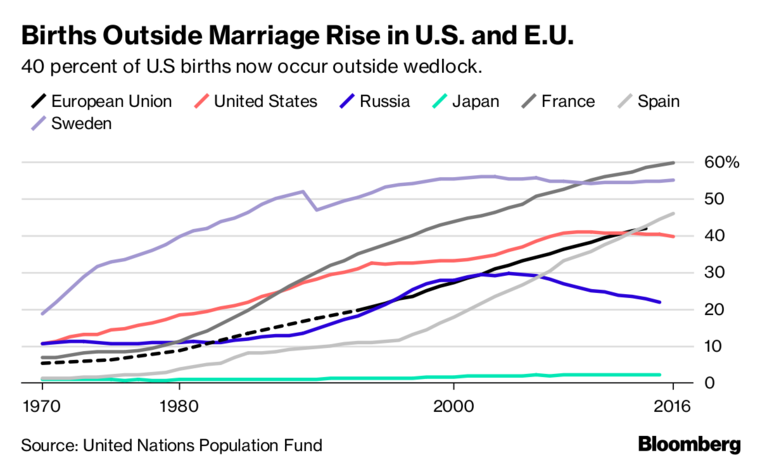
Unfortunately, young people are having children outside of a marriage commitment more and more.
Out-of-wedlocks births rising as cohabitation replaces marriage
Forty percent of all births in the U.S. now occur outside of wedlock, up from 10 percent in 1970, according to an annual report released on Wednesday by the United Nations Population Fund (UNFPA), the largest international provider of sexual and reproductive health services. That number is even higher in the European Union.
The EU has a higher rate of fatherless births because they have high taxes and big government to allow women to have children without having to commit to a husband:
The EU likely sees more births out of wedlock because many member countries have welfare systems that support gender-balanced child care, said Michael Hermann, UNFPA’s senior adviser on economics and demography, in an interview. Public health care systems, paid paternal leave, early education programs and tax incentives give unwed parents support beyond what a partner can provide.
More welfare and more government services make it easier for women to pursue relationships with men who aren’t interested in marriage. Hot bad boys who give them all the tingles. Big government makes those boring, predictable marriage-ready men dispensable. Big government also makes it much harder for a man who does marry to afford a stay-at-home mother for his kids, because he has to pay higher taxes for big government.
More:
The data show such births in the U.S. and EU are predominantly to unmarried couples living together rather than to single mothers, the report says.
[…]Jones also noted that the rise in births outside of marriage is closely correlated to delays in childbearing. “Women are claiming their ground professionally,” she said. “Delaying motherhood is a rational decision when you consider the impact it can have on your career, and that’s contributing to this trend.”
[….]The traditional progression of Western life “has been reversed,” said John Santelli, a professor in population, family health and pediatrics at Columbia’s Mailman School of Public Health. “Cohabiting partners are having children before getting married. That’s a long-term trend across developing nations.”
Regardless of marital status, more couples are choosing not to have kids at all. The U.S. fertility rate hit a historic 30-year low last year, according to the Centers for Disease Control and Prevention. Hermann said the rise in births outside of wedlock has actually mitigated the decline in fertility, which “would be much steeper if women weren’t having children outside marriage.”
What’s interesting about this anti-marriage article is that they have nothing to say about the research showing that cohabitation – and also marriages that occur after a period of cohabitation – are inferior to no-cohabitation marriages. People who are serious about self-control, and who are serious about committing through thick and thin, tend to have longer lasting marriages. But we don’t prioritize chastity, fidelity and self-sacrificial commitment anymore, because that relationships that require self-denial make us unhappy.
The article concludes: “We can’t go back to the ’50s”. Right. Because if feelings-based “morality” is assumed, then any choice between adult happiness and children’s happiness will favor the adults. Today’s young people carefully AVOID any evidence that contradicts their new “happiness-morality”. They act surprised when their unstable relationships dissolve, leaving children separated from their fathers. Marriage requires that both partners have a system of morality that puts the commitment above happy feelings. People have to be accustomed to doing things that feel bad, just because they are good and moral things to do according to an objective standard of morality. The new atheist morality of happy feelings doesn’t develop the character needed for commitment.
If you ask an atheist millennial, they think they are doing a great job of being “moral”. They don’t see the messes they are making for children as something that they are causing themselves, with their own foolish feelings-based decision-making. They think they know everything about relationships through their feelings. They think that they are exempt from the patterns of cause and effect in the peer-reviewed research.


 WINTERY KNIGHT