Category Archives: News

The psychological motivation of those who embrace postmodernism

Can a person be postmodern and a Christian? Not for long

Famous analytical philosopher John Searle has written a book “Mind, Language And Society: Philosophy In The Real World”, explaining what’s factually wrong with postmodernism. In the introduction, he explains what postmodernism is, and what motivates people to accept postmodernism.

He writes:

[…][W]hen we act or think or talk in the following sorts of ways we take a lot for granted: when we hammer a nail, or order a takeout meal from a restaurant, or conduct a lab experiment, or wonder where to go on vacation, we take the following for granted: there exists a real world that is totally independent of human beings and of what they think or say about it, and statements about objects and states of affairs in that world are true or false depending on whether things in the world really are the way we say they are. So, for example, if in pondering my vacation plans I wonder whether Greece is hotter in the summer than Italy, I simply take it for granted that there exists a real world containing places like Greece and Italy and that they have various temperatures. Furthermore, if I read in a travel book that the average summer temperature in Greece is hotter than in Italy, I know that what the book says will be true if and only if it really is hotter on average in the summer in Greece than in Italy. This is because I take it for granted that such statements are true only if there is something independent of the statement in virtue of which, or because of which, it is true.

[…]These two Background presuppositions have long histories and various famous names. The first, that there is a real world existing independently of us, I like to call “external realism.” “Realism,” because it asserts the existence of the real world, and “external” to distinguish it from other sorts of realism-for example, realism about mathematical objects (mathematical realism) or realism about ethical facts (ethical realism). The second view, that a statement is true if things in the world are the way the statement says they are, and false otherwise, is called “the correspondence theory of truth.” This theory comes in a lot of different versions, but the basic idea is that statements are true if they correspond to, or describe, or fit, how things really are in the world, and false if they do not.

The “correspondence theory of truth” is the view of truth assumed in books of the Bible whose genre is such that that they were intended by the authors to be taken literally, (with allowances for symbolism, figures of speech, metaphors, hyperbole, etc.).

But what about the postmodernists, who seek to deny the objectivity of external reality?

More Searle:

Thinkers who wish to deny the correspondence theory of truth or the referential theory of thought and language typically find it embarrassing to have to concede external realism. Often they would rather not talk about it at all, or they have some more or less subtle reason for rejecting it. In fact, very few thinkers come right out and say that there is no such thing as a real world existing absolutely, objectively, and totally independently of us. Some do. Some come right out and say that the so-called real world is a “social construct.”

What is behind the denial of objective reality, and statements about external reality that are warranted by evidence?

It is not easy to get a fix on what drives contemporary antirealism, but if we had to pick out a thread that runs through the wide variety of arguments, it would be what is sometimes called “perspectivism.” Perspectivism is the idea that our knowledge of reality is never “unmediated,” that it is always mediated by a point of view, by a particular set of predilections, or, worse yet by sinister political motives, such as an allegiance to a political group or ideology. And because we can never have unmediated knowledge of the world, then perhaps there is no real world, or perhaps it is useless to even talk about it, or perhaps it is not even interesting.

Searle is going to refute anti-realism in the rest of the book, but here is his guess at what is motivating the anti-realists:

I have to confess, however, that I think there is a much deeper reason for the persistent appeal of all forms of antirealism, and this has become obvious in the twentieth century: it satisfies a basic urge to power. It just seems too disgusting, somehow, that we should have to be at the mercy of the “real world.” It seems too awful that our representations should have to be answerable to anything but us. This is why people who hold contemporary versions of antirealism and reject the correspondence theory of truth typically sneer at the opposing view. 

[…]I don’t think it is the argument that is actually driving the impulse to deny realism. I think that as a matter of contemporary cultural and intellectual history, the attacks on realism are not driven by arguments, because the arguments are more or less obviously feeble, for reasons I will explain in detail in a moment. Rather, as I suggested earlier, the motivation for denying realism is a kind of will to power, and it manifests itself in a number of ways. In universities, most notably in various humanities disciplines, it is assumed that, if there is no real world, then science is on the same footing as the humanities. They both deal with social constructs, not with independent realities. From this assumption, forms of postmodernism, deconstruction, and so on, are easily developed, having been completely turned loose from the tiresome moorings and constraints of having to confront the real world. If the real world is just an invention-a social construct designed to oppress the marginalized elements of society-then let’s get rid of the real world and construct the world we want. That, I think, is the real driving psychological force behind antirealism at the end of the twentieth century.

Now, I’ll go one step further than Searle.

People, from the Fall, have had the desire to step into the place of God. It’s true that we creatures exist in a universe created and designed by God. But, there is a way to work around the fact that God made the universe and the laws that the universe runs on, including logic, mathematics and natural laws. And that way is to deny logic, mathematics and natural laws. Postmodernists simply deny that there is any way to construct rational arguments and support the premises with evidence from the real world. That way, they imagine, they are free to escape a God-designed world, including a God-designed specification for how they ought to live. The postmoderns deny the reliable methods of knowing about the God-created reality because logic and evidence can be used to point to God’s existence, God’s character, and God’s actions in history.

And that’s why there is this effort to make reality “optional” and perspectival. Everyone can be their own God, and escape any accountability to the real God – the God who is easily discovered through the use of logic and evidence. I believe that this is also behind the rise of atheists, who feign allegiance to logic and science, but then express “skepticism” about the origin of the universe, the fine-tuning of the universe, objective morality, the minimal facts concerning the historical Jesus, and other undeniables.

Report: Biden’s student loan vote buying scheme could cost taxpayers $1 trillion

If anyone asked me which school was the best to do an MBA, I would say the Wharton School of Business at University of Pennsylvania. Well, they just released an assessment of Biden’s massive pre-election vote buying scheme. You might have heard that the total cost of this scheme would be around 400-500 billion dollars. But that’s not what Wharton says.

Here’s an article about it from Business Insider:

President Joe Biden’s plans to forgive student loans could cost more than $1 trillion, according to estimates by the Penn Wharton Budget Model.

Biden’s plan to cancel up to $10,000 in debt for people earning less than $125,000 a year, rising to $20,000 for Pell Grant recipients, would cost between $469 billion and $519 billion over the 10-year budget window, depending on whether it covers future students who haven’t started their studies yet, according to the model.

This is higher than its previous estimates.

Here’s where the extra 500+ billion comes from:

The plan would additionally create a new income-driven repayment (IDR) plan, under which they would pay back a maximum of 5% of the portion of their earnings that lies above 225% of the poverty line, up from the current 10% and 150%.

[…]If the Department of Information automatically enrolled borrowers in the IDR program, costs could actually reach $520 billion, according to the model.

That additional $520 billion would take the total costs of the student loan forgiveness plan to over $1 trillion, Wharton said.

It’s an election year. I guess the Democrats don’t think that their other election integrity measures (Zuck Bucks, ballot drop-offs, expanding mail-in voting, denying access to election observers, Big Tech “fact checks”, FBI election interference, etc.) will work. So they have to enslave generations yet unborn to pay for more Democrat votes. Democrats are the party of slavery. They really believe in enslaving people to pay for their reckless, irresponsible decisions.

Free health care? How much does Canada’s universal system cost?

I had a talk with a Canadian recently about health care. He had a lot to say about his own country’s free health care system, and how wonderful it was to not have to pay for health care. I was skeptical about the rosy picture he painted. After all, I have friends in Canada, and they have told me about their country’s high tax rates. And I’ve heard about the waiting lists, too. Let’s look at the evidence.

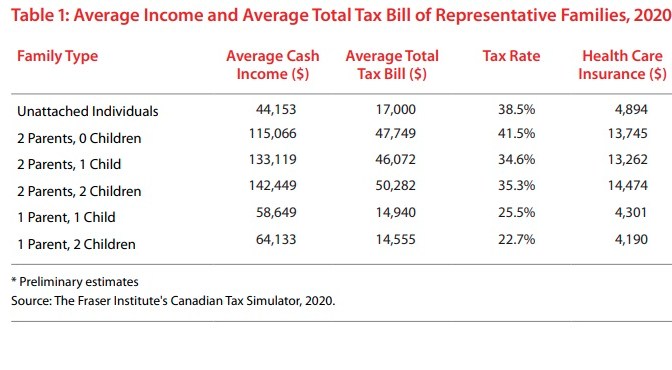
The Fraser Institute is a non-partisan think tank based in Canada that looks at policies to see whether they are achieving good results for Canadians. Each year they release statistics about the cost and performance of Canada’s health care system. The most recent report is for 2021 (preliminary numbers).

The report (PDF) says:

In 2021, the average unattached (single) individual, earning an  average income of $49,215, will pay approximately $4,296 for public health care insurance. An average Canadian family consisting of two adults and two children (earning approximately $150,177) will pay about $15,039 for public health care insurance.

Do Canadians really pay $15,039 per year for health care? Or are they paying to get on a waiting list for health care?

Let’s see another 2021 report, this one about health care wait times:

Specialist physicians surveyed report a median waiting time of 25.6 weeks between referral from a general practitioner and receipt of treatment—longer than the wait of 22.6 weeks reported in 2020. This year’s wait time is the longest wait time recorded in this survey’s history and is 175% longer than in 1993, when it was just 9.3 weeks.

The waiting time for a referral to a general practitioner to a specialist increased from 10.5 weeks in 2020 to 11.1 weeks in 2021. And the waiting time from seeing a specialist to actually getting treatment  increased from 12.1 weeks in 2020 to 14.5 weeks in 2021. And remember, this is Canadian health care. This isn’t the Mayo Clinic, the Cleveland Clinic, or Johns Hopkins. This is not the best health care in the world. That’s why Canadian politicians who swear their loyalty to the government health care system pack their bags and make for America when they need treatment. And they pay out of pocket for the best care.

Well, maybe these wait times are because the government is spending less on health care?

No. Actually, costs have been going up, and faster than other products and services.

Canada Health Care Costs Inflation 2021

Why is it going up? Well, like the public school monopoly, most of the money goes to administrators. There is no competitive free market system, where providers compete with each other for the dollars of their customers. No one cares about reducing costs to consumers while improving quality. Why would they? Canadians have zero choice in who gives them health care.

I did a quick search of Canadian news stories for the last week, to see what Canadians say about their health care system when they are talking to each other, instead of to Americans.

Here’s a story from the Globe and Mail, the more leftist of Canada’s national newspapers. (archived here)

It says:

One of the biggest problems such provinces are facing is a critical shortage of family doctors. One in five people in B.C. don’t have one, with more people pouring into the province every day. Last year, 100,000 people arrived – a record number that only exacerbates a desperate situation.

[…]According to Statistics Canada, 4.6 million people over the age of 12 did not have a family doctor in 2019.

[…]The shortage of physicians is a problem that has been growing over the years. Canada now ranks 51st in doctors per population, according to Index Mundi. In the 1970s, we ranked anywhere between fourth and eighth. The nursing shortage in Canada is just as severe.

And they confirm the Fraser Institute’s per-capita cost number:

The Organization for Economic Co-operation and Development has placed Canada 31st in hospital beds per population among the 38 countries that the OECD rank. In the meantime, according to the Canadian Institute for Health Information, total health care spending in the country was estimated to be $308-billion in 2021 – or $8,019 per Canadian. This number represents 12.7 per cent of our GDP, which puts our health care spending among the highest in the world.

$8,019 per Canadian! That’s “free health care”?

The article talks about British Columbia in particular:

B.C. Liberal MLA Shirley Bond pointed out that, on one day this week, almost every urgent- and primary-care centre in the city of Victoria was at capacity and not taking patients. The only one that was had a 4.5 hour wait.

My Canadian challenger said that Americans were dying in the streets, because they couldn’t get health care. But I think he was actually talking about his own country. Can you imagine not being able to get into an emergency room, or an urgent care provider? That’s what they have in British Columbia.

Where I live, I can go to 3 different hospital systems within 10 miles of my house. And that’s not counting the urgent care clinics on every city block. 24-hour pharmacies open on Easter at 3 AM. My health insurance costs $85 a paycheck. And when I needed an MRI, I got it the same week.

Still think you want Canadian health care? Still think you want a government monopoly to make everyone “equal”?