
Category Archives: News

For Independence Day, let’s learn about George Washington and the Battle of Trenton

My favorite book about the American Revolutionary war by far is called “1776”. It’s written by famous historian David McCullough. The part of the book that really stuck out to me was the Battle of Trenton. I think that this battle really defines the essential character of America, as seen in the decision-making of its great general and first President, George Washington.

In the book, I learned about how George Washington and his revolutionary army had suffered a string of defeats at the hands of the powerful Commonwealth army, and their mercenary allies. It was the middle of a freezing cold winter, and the many of the sickly and ill-equipped American troops were just days from having their enlistment contracts run out. Some of the troops were not waiting for their enlistments to expire, they were just deserting. In droves.

Washington was losing, and was just days from losing his Continental Army. If the Americans lost the revolutionary war, then it would mean that every man who signed the Declaration of Independence would be hanged as a traitor. The American revolutionaries had risked everything for liberty, and they were about to lose everything – their money, their property and even their lives.

I found a page that summarizes the battles leading up to the Battle of Trenton.

First battle, a defeat for Washington:

The Battle of White Plains

October 28, 1776

RESULT: BRITISH VICTORY

With the British army maneuvering to make his Harlem Heights position untenable, George Washington withdrew from the island of Manhattan, and established a new encampment further north near White Plains, New York.

On October 28, 1776, a flank attack by the British on this new position resulted in the collapse of Washington’s line. Thankfully, he was able to orchestrate an orderly withdrawal that preserved the army. Unfortunately, Washington’s retreat further exposed Fort Washington, which remained garrisoned on Manhattan.

Next, another defeat for Washington:

The Battle of Fort Washington

November 16, 1776

RESULT: BRITISH VICTORY

Following the defeat of George Washington’s army at White Plains, New York, British General William Howe focused his army’s attention on Fort Washington, the last post defended by the Continental army on Manhattan.  Although Washington hoped to abandon the fort, his officers convinced him that it needed to be held in order to keep British ships from ascending the Hudson River.

During a carefully-orchestrated, all-out attack on November 16, 1776, British and Hessian forces overwhelmed the fort’s garrison after vicious fighting. When he heard the attack begin, Washington, who had stationed himself across the Hudson River in New Jersey, travelled across the river to the enter the fort and personally inspect its defenses. Several officers accompanied Washington, including Generals Israel Putnam, Hugh Mercer, and Nathanael Greene. They convinced Washington to leave the fort just 30 minutes before it was surrounded.

And then, another defeat for Washington:

Evacuation of Fort Lee

November 20, 1776

RESULT: BRITISH VICTORY

After the fall of Fort Washington, George Washington made plans for the evacuation of Fort Lee, which stood across the Hudson River in New Jersey. In a letter written to John Hancock on November 19, 1776, the general wrote that “…Fort Lee was always considered as only necessary in conjunction with [Fort Washington]…,” and that it would be abandoned as soon as provisions and other supplies were removed.

Unfortunately, a large British force succeeded in scaling the heights close to the fort on November 20, 1776. Faced with superior numbers, Washington called for the immediate evacuation of the fort, which resulted in the loss of dozens of cannon, 2-300 tents, and 1,000 barrels of flour.

That brings us to the Battle of Trenton. Across the Delaware river from Washington’s army was an encampment of Hessian mercenaries, fighting for the British. The Hessians believed that Washington’s Continental army was in full retreat. The British generals had already written home to the King to tell him that the war was nearly over, and that they had won. But had they?

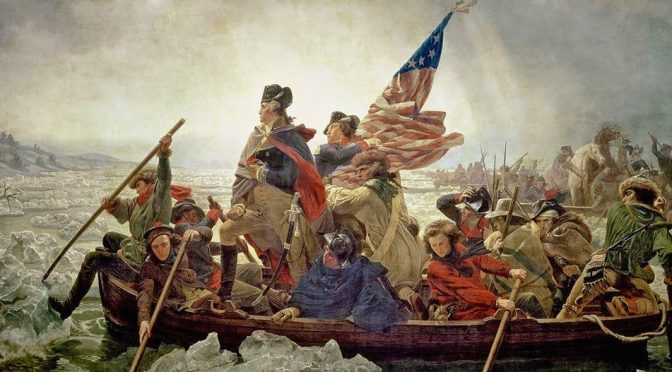
Washington crosses the Delaware

Here is what Washington decided to do on December 25th, 1776:

General George Washington’s commitment to cross the Delaware River on Christmas 1776 foreshadowed the many hardships faced as well as the eventual victory of the Continental Army during the American Revolution. At first glance, the decision to transport 2,400 Continental soldiers across an icy river in one night, directly into a severe winter storm of sleet and snow seems irrational.

Washington’s decision, however, was based on strategic motivation, understanding that the Continental Army desperately needed a victory after months of intense fighting with several significant defeats and no major victories. Washington also understood that the element of surprise was the only way that he and his army stood a chance of defeating the highly trained Hessian mercenaries.

On the morning of December 25, 1776, Continental soldiers woke up in their camps along the Delaware River to a frozen, snowy covered ground. Weather conditions worsened and temperatures continued to drop throughout the day. Late in the afternoon, the Continentals left their tents and began to form along the river in anticipation of the night’s events. Washington kept almost all of the details of the crossing a secret; as a result, none of the soldiers knew anything about their upcoming mission.

Washington’s crossing of the Delaware River on December 25, 1776 allowed his army to strike the Hessians at Trenton the next morning.

Washington’s plan was to cross the river at night, march to the nearby town of Trenton, New Jersey, and attack the Hessian garrison right before dawn. Time was Washington’s greatest enemy; to combat it his orders called for the various regiments to assemble at their designated crossing points no later than sunset. The close proximity to the crossing points allowed the soldiers to begin the journey immediately after nightfall struck and complete the crossing no later than midnight. Once across, Washington intended for the armies to reassemble and march approximately ten miles to Trenton, arriving there no later than five o’clock in the morning to achieve surprise. Despite his meticulous planning, the schedule failed almost before it even began.

Many of the regiments did not arrive at the river until well after dark. Additionally, a severe winter storm that included wind, rain, snow, hail, and sleet met the soldiers at the banks of the river significantly slowing their crossing. Many of the boats had to combat ice jams and unfavorable currents. To make matters even worse, the extreme darkness caused by the storm made it hard for the boatmen to see the opposite shore.

The necessity of using larger ferries to carry pieces of artillery across the river caused even more delays. Washington crossed the river with John Glover’s Marblehead mariners and upon arrival debated whether or not to cancel the entire operation because it was more than three hours behind schedule. Washington decided it was too costly to retreat and he painfully watched as his army continued to trickle across the river.

If you were standing by the river along with Washington watching his sick, frozen, ill-equipped army struggle across the Delaware, then you would probably think that Washington had lost the element of surprise. This attack was just taking too long to happen. Maybe Washington would give up his plan, because things hadn’t gone his way. But Washington didn’t quit – he persisted.

The Battle of Trenton, December 25, 1776
The Battle of Trenton, December 25, 1776 (click for larger image)

The Battle of Trenton

This is how the battle went down in Trenton, New Jersey:

Immediately following his famous crossing of the Delaware River, General George Washington marched the Continental Army to Trenton, New Jersey. The army’s forces included horses, guns, wagons, and soldiers, stretching for nearly one mile. The weather was worse than it had been crossing the river, but the army continued to proceed as Washington rode up and down the column pressing his men to carry on.

Shortly after eight o’clock on the morning of December 26, 1776, the Continental Army started its charge on the city. Three columns marched through thick snow with Washington personally leading the middle charge. As the soldiers pushed forward, artillery began to fire. At the same time, German drums urgently called the Hessians to arms. To his astonishment, Washington had maintained the element of surprise.

Immediately after the firing began, three Hessian regiments ran from their quarters ready to fight, quickly forming ranks. As the Hessians grouped, the Continental Army entered the city at two points: John Stark marched into the city on River Road from the west, while Nathanael Greene and Washington arrived from the north.

Andreas von Wiederholdt, a Hessian lieutenant, incorrectly reported to Colonel Johann Rall that the Continental Army had surrounded Trenton and there was no available route for retreat. As a result, Rall decided to counterattack Washington within the city and not retreat across Assunpink Creek. This proved to be costly as Washington’s forces occupied the highest ground in the city and had clear views of all of Rall’s movements.

Time after time, Washington countered Rall’s efforts to outflank the Continentals. Eventually, Washington’s forces overpowered the Hessians. Rall was mortally wounded and many of his soldiers broke ranks, fleeing from the fighting. Normally very disciplined, Rall’s regiment was confused and disoriented without their commander. They retreated to an orchard east of Trenton where they were forced to surrender.

Despite the large number of Hessians that escaped Trenton, Washington still won a crucial strategic and material victory. In only one hour of fighting, the Continental Army captured nearly nine hundred Hessian officers and soldiers as well as a large supply of muskets, bayonets, swords, and cannons. Washington ordered his soldiers to treat the Hessian prisoners in a humane manner, and the general quickly focused his attention on what to do next. Washington assembled all of his officers in Trenton to discuss whether they should attack another post, hold their position in Trenton, or retreat back across the Delaware. Washington decided that because of the condition of his army, the best move was to return to their camps across the River.

When the Continental Army returned to camp on the Pennsylvania side of the Delaware River, soldiers were exhausted. They had marched and fought for two straight days through rain, snow, sleet, and hail. Washington knew that his army had far exceeded expectations at Trenton and that they faced many more challenges going forward.

Washington won two more battles in rapid succession. Many of his troops re-enlisted because of these victories. There were many battles remaining to fight, and many hardships such as the winter at Valley Forge. But the Battle of Trenton was the turning point of the revolution. George Washington would not let a string of defeats stop him.


The desire to be “winsome” led to the persecution of Christians in America

We had a few wins in the Supreme Court, including one of them on the issue of free speech and religious liberty. I found an article about it that made me have a lot of thoughts about why this case went all the way to the Supreme Court – in a country where the rights to free speech and religious liberty are in the Constitution.

Here’s Kylee Griswold in The Federalist, talking about the recent Supreme Court decisions:

303 Creative has finally been decided, and Christians — and all Americans — won. In a 6-3 landmark decision on Friday, the Supreme Court ruled that graphic designer Lorie Smith can’t be compelled to affirm values that conflict with her deeply held religious beliefs about marriage by designing wedding websites for same-sex couples.

How did we get to the point where Christians can be dragged into courts, and lose, and lose, and lose their cases, until they finally win in the Supreme Court? Well, part of the problem is people who claim to be Christians, but act like non-Christians. People who don’t really KNOW whether Christianity is true or not – because they haven’t done the apologetics work. People who just claim Christianity, in order to virtue signal to others. And what happens when Christianity falls out of favor in the culture, and no longer gets them the admiration and validation they crave? Well, then they shift their allegiance to the secular left, but still keeping the language of Christians to describe their apostasy.

More:

It’s called “winsomeness.” Being winsome is not a novel idea, obviously, nor even a Christian one. To be winsome is to be charming, attractive, or appealing with one’s demeanor or character — an admirable goal, to be sure, and one that should apply to Christians.

But in coopting the idea into a veritable doctrine, Christian leaders morphed winsomeness from a desirable trait into a hermeneutic through which they judge all Christian conviction and conduct… winsomeness became a trump card in matters of spiritual significance. Religious and thought leaders, such as Russell Moore and David French among many others, became victims of the mind virus and infected hordes of others.

[…]The gist of the “winsome” ethos is that for Christians to be faithful, they must be perceived as kind and likable by the unbelieving world they hope to evangelize. And the symptoms are easy to identify. Appeasement to radicals. A tossing of other faithful Christians under the bus. Race-baiting wrapped in Christian-ese. An unwillingness to celebrate God-given victory if the “wrong” leader made it happen. Deference to tyranny. Hatred of masculinity. The list goes on.

Hatred of masculinity. Most people – even people in the church – like to cash out masculinity as mere protection and providing. It’s “servant leadership” according to a recent book by an evangelical egalitarian author. But masculinity doesn’t just mean protecting and providing. Masculinity also means moral leadership and spiritual leadership. It means defending morally good beliefs and actions, and fighting against morally evil beliefs and actions. It means defending truth claims, and fighting against lies. So, Christian men can’t be “winsomely” capitulating to the secular left on truth and morality. Not if they want to be masculine Christian men.

More:

But there’s a glaring problem with the “winsome” worldview: It ultimately measures a Christian’s fidelity to the gospel based on how he is perceived by God’s enemies — and in the process, it implies Christians who aren’t adored by their unregenerate neighbors are unloving.

So you put your obvious pronouns in your email signature because everyone else at work does it, and you don’t want to be known as “that bigot” in your office. Or you post a black box on Instagram because even though you know it serves more to divide people by the color of their skin than to unite them, it looks virtuous. Or you party at your gay friend’s wedding because even though you know that union defies God’s design for marriage, you don’t want to have an awkward conversation or risk jeopardizing a relationship. Or you say yes to a design job for a woman’s group that promotes abortions because you don’t want them to pass over you for the next opportunity.

[…]This version of Christianity doesn’t work. What you end up with on the one hand are craven Christians who pat themselves on the back for their likeability while being largely untethered from all principles save the approval of man (which conveniently endows worldly status and prestige, such as a perch at The New York Times).

What should we expect the Christian life to be like if we read the Bible? Well, according to people like Russell Moore, you should expect to go to the White House and meet with Barack Obama and smile with him, despite the fact that he voted for abortion of born-alive infants several times as a state senator in Illinois. It’s better to be liked by a pro-abortion radical like Obama, than to defend the argument that it should be illegal to abort unborn children. And consider people like David French. He gets articles in the New York Times, but he doesn’t defend the truth of Christianity or Christian moral values in those articles. He just wants to be liked by the secular leftist readers of the New York Times.

But what does the Bible really teach about standing up for the truth? Will it make non-Christians like you?

It no doubt would have been easier for Daniel and his buddies to have bowed to the statue of Babylonian King Nebuchadnezzar at his command. After all, showing respect and submission to the king would have cemented the young men in his good graces and perhaps given them spiritual sway down the road. But Daniel’s operating principle wasn’t likeability or world-defined niceness. It was a fear of God and undivided devotion that empowered the young Jewish exile to look a fiery death squarely in the face and say with confidence I will not bow.

My favorite passage about faithfulness in the Bible is 1 Corinthians 4:1-4. We did an episode of Knight and Rose Show where I talked about my favorite passages of the Bible, where I talked about that one. Check it out if you haven’t heard it already.

Christopher Hitchens debates William Lane Craig: Does God Exist?

Here is the video of the debate:

TOPIC: DOES GOD EXIST?

MY NOTES ON THE DEBATE: (WC = William Lane Craig, CH = Christopher Hitchens)

WC opening speech:

Introduction:

WC makes two contentions:
– there are no good arguments for atheism
– there are good arguments for theism

These topics are IRRELEVANT tonight:
– social impact of christianity
– morality of Old Testament passages
– biblical inerrancy
– the debate is whether god (a creator and designer of the universe) exists

1. cosmological argument
– an actually infinite number of past events is impossible
– number of past events must be finite
– therefore universe has a beginning
– the beginning of the universe is confirmed by science –  universe began to exist from nothing
– space, time, matter, energy began at the big bang
– the creation of the universe requires a cause
– the cause is uncaused, timeless, spaceless, powerful
– the cause must be beyond space and time, because it created space and time
– the cause is not physical, because it created all matter and energy
– but there are only two kinds of non-physical cause: abstract objects or minds
– abstract objects don’t cause effects
– therefore must be mind

2. teleological argument
– fine-tuned constants and ratios
– constants not determined by laws of nature
– also, there are arbitrary quantities
– constants and quantities are in narrow range of life-permitting values
– an example: if the weak force were different by 1 in 10 to the 100, then no life
– there are 3 explanations: physical law or chance or design
– not due to law: because constants and quantities are independent of the laws
– not due to chance: the odds are too high for chance
– therefore, due to design
– the atheist response is the world ensemble (multiverse)
– but world ensemble has unobservable universes, no evidence that they exist
– and world ensemble contradicts scientific observations we have today

3. moral argument
– objective moral values are values that exist regardless of what humans think
– objective values are not personal preferences
– objective values are not evolved standards that cultures have depending on time and place
– objective moral values and duties exist
– objective moral values and duties require a moral lawgiver

4. argument from resurrection miracle
– resurrection implies miracle
– miracle implies God
– 3 minimal facts pass the historical tests (early attestation, eyewitness testimony, multiple attestation, etc.)
– minimal fact 1: empty tomb
– minimal fact 2: appearances
– minimal fact 3: early belief in the resurrection
– jewish theology prohibits a dying messiah – messiah is not supposed to die
– jewish theology has a general resurrection of everybody, there is not supposed to be a resurrection of one person
– jewish theology certainly does not predict a single resurrection of the messiah after he dies
– therefore, the belief in the resurrection is unlikely to have been invented
– disciples were willing to die for that belief in the resurrection
– naturalistic explanations don’t work for the 3 minimal facts

5. properly basic belief in god
– religious experience is properly basic
– it’s just like the belief in the external world, grounded in experience
– in the absence of defeaters, those experiences are valid

Conclusion: What CH must do:
– destroy all 5 of WC’s arguments
– erect his own case in its place

CH opening speech:

1. evolution disproves biological design argument
– evolution disproves paley’s argument for a watchmaker

2. god wouldn’t have done it that way
– god wouldn’t have waited that long before the incarnation
– mass extinction and death before Jesus
– god wouldn’t have allowed humans to have almost gone extinct a while back in africa
– why insist that this wasteful and incompetent history of life is for us, that’s a bad design
– the universe is so vast, why would god need so much space, that’s a bad design
– there is too much destruction in the universe, like exploding stars – that’s a bad design
– the heat death of the universe is a bad design
– too many of the other planets don’t support life, that’s a bad design
– the sun is going to become a red giant and incinerate us, that’s a bad design

3. hitchens’ burden of proof
– there is no good reason that supports the existence of god
– all arguments for god can be explained without god
– atheists can’t prove there is no god
– but they can prove there is no good argument for god

4. craig’s scientific arguments don’t go far enough, they only prove deism, not theism
– the scientific arguments don’t prove prayer works
– the scientific arguments don’t prove specific moral teachings of christianity

5. if the laws of physics are so great then miracles shouldn’t be allowed
– good laws and miracles seem to be in contradiction

6. extraordinary claims need extraordinary evidence
– none of craig’s evidence was extraordinary

7. science can change, so craig can’t use the progress of science
– it’s too early for craig to use the big bang and fine-tuning
– the big bang and fine-tuning evidences are too new
– they could be overturned by the progress of science

8. craig wrote in his book that the internal conviction of god’s existence should trump contradicting evidence
– but then he isn’t forming his view based on evidence
– he refuses to let evidence disprove his view
– but then how can atheists be to blame if they don’t believe
– so evidence is not really relevant to accepting theism

9. the progress of science has disproved religion
– christianity taught that earth was center of the universe
– but then cosmology disproved that

Response to the big bang and fine-tuning arguments:
– was there pre-existing material?
– who designed the designer?

WC first rebuttal:

Reiterates his 2 basic contentions

CH agrees that there is no good argument for atheism
– then all you’ve got is agnosticism
– because CH did not claim to know there is no God
– and he gave no arguments that there is no God

CH’s evolution argument
– irrelevant to christianity
– Genesis 1 allows for evolution to have occurred
– christianity is not committed to young earth creationism
– the origin of biological diversity is not central to christianity
– st. augustine in 300 AD said days can be long, special potencies unfold over time
– also there are scientific reasons to doubt evolution
– cites barrow and tipler, and they say:
– each of 10 steps in evolution is very improbable
– chances are so low, it would be a miracle if evolution occurred

CH’s argument that god is wasteful
– efficiency is only important to people with limited time or limited resources
– therefore god doesn’t need to be efficient

CH’s argument that god waits too long to send Jesus
– population was not that high before jesus
– jesus appears just before the exponential explosion of population
– conditions were stable – roman empire, peace, literacy, law, etc.

CH’s argument that Craig’s scientific arguments only prove deism, not theism
– deism a type of theism, so those scientific arguments work
– all that deism denies is miraculous intervention

CH’s argument that Craig has a burden of proof
– theism doesn’t need to be proven with certainty
– must only prove best explanation of the evidence

CH’s citation of Craig’s book saying that evidence should not overrule experience
– there is a difference between knowing and showing christianity is true
– knowing is by religious experience which is a properly basic belief
– showing is done through evidence, and there the evidence does matter

CH’s rebuttal to the big bang
– there was no pre-existent material
– space and time and matter came into being at the big bang
– the cause must be non-physical and eternal
– cause of universe outside of time means = cause of universe did not begin to exist
– this is the state of science today

CH’s rebuttal to the fine tuning
– CH says scientists are uncertain about the fine-tuning
– craig cites martin rees, an atheist, astronomer royal, to substantiate the fine tuning
– the fine-tuning is necessary for  minimal requirements for life of any kind
– the progress of science is not going to dethrone the fine-tuning

CH’s argument about heat death of the universe
– duration of design is irrelevant to whether something was designed
– cars are designed, yet they break down
– design need not be optimal to be designed
– ch is saying why create if we all eventually go extinct
– but life doesn’t end in the grave on christianity

CH’s rebuttal to the moral argument
– CH says no obj moral values
– but CH uses them to argue against god and christians
– but CH has no foundation for a standard that applies to God and Christians

CH’s rebuttal to the resurrection argument
– empty tomb and appearances are virtually certain
– these are minimal facts, well evidenced using standard historical criteria
– best explanation of these minimal facts is the resurrection

CH’s rebuttal to religious experience
– prop basic belief is rational in the absence of defeaters
– so long as craig has no psychological deficiency, experience is admissible

CH first rebuttal:

it’s not agnosticism
– if there are no good arguments for theism
– then there is no reason for belief in god
– that is atheism
– everything can be explained without god

god wouldn’t have done it that way
– homo sapiens is 100K years old
– for 98K years, they had no communication from God
– lots of people died in childbirth
– disease and volcanos are a mystery to them
– life expectancy is very low
– they die terrible deaths
– their teeth are badly designed
– their genitalia are badly designed
– why solve the problem of sin by allowing a man to be tortured to death
– that’s a stupid, cruel, bumbling plan

lots of people haven’t even heard of jesus
– many of them die without knowing about him
– they cannot be held responsible if they do not know about jesus

the early success of christianity doesn’t prove christianity is true
– because then it applies to mormonism and islam, they’re growing fast

objective morality
– belief in a supreme dictator doesn’t improve moral behavior
– i can do moral actions that you can do
– i can repeat moral positions that you can say

religious people are immoral
– genital mutilation
– suicide bombing

moral behavior doesn’t need god
– we need to act moral for social cohesion
– it evolved for our survival
– that’s why people act morally
– it’s degrading to humans, and servile, to require god for morality

free will
– i believe in free will
– i don’t know why, because i can’t ground free will on atheism
– a bossy god seems to reduce free will because then we are accountable to god

WC cross-examination of CH:

WC why call yourself an atheist when you have no reasons?

CH because absence of belief is atheism

WC but agnosticism, atheism, verificationism all don’t hold that belief, which are you?

CH i think god does not exist

WC ok give me an argument for the claim you just made to know god does not exist

CH i have no argument, but i don’t believe in god because it depresses me to think he might be real

WC would you agree that absence of evidence is not evidence of absence?

CH no i don’t agree

WC moral argument: it’s not epistemology it’s the ontology – have you got a foundation for moral values and duties?

CH i do not, it’s just evolution, an evolved standard based on social cohesion

CH cross-examination of WC:

CH you said that the historical reports of jesus doing exorcisms are generally accepted – do you believe in devils?

WC i commit to nothing, what I am saying there historical concensus on the reports that jesus did exorcisms

CH what about the devils going into the pigs, do you believe that?

WC yes i do, but the main point i’m making is that the historical reports show that jesus acted with divine authority

CH do you believe in the virgin birth?

WC yes, but that’s not historically provable using the minimal facts methods, and i did not use the virgin birth in my arguments tonight, because it doesn’t pass the historical tests to be a minimal fact

CH do you believe that all the graves opened and dead people all came out?

WC not sure if the author intended that part as apocalyptic imagery or as literal, i have no opinion on it, have not studied it

CH do exorcisms prove son of god?

WC no, i am only saying that the historical reports show that jesus exercised authority and put himself in the place of god

CH  are any religions false? name one that’s false

WC islam

CH so some religions are wicked right?

WC yes

CH if a baby were born in saudi arabia would it be better if it were an atheist or a muslim?

WC i have no opinion on that

CH are any christian denominations wrong?

WC calvinism is wrong about some things, but they are still christians, i could be wrong about some things, i do the best i can studying theology so i’m not wrong

WC second rebuttal

Response to CH arguments:

no reasons for atheism
– no reasons to believe that god does not exist
– ch withholds belief in god

why wait so long before contacting humans with jesus
– population matters, not time – jesus waited until there was about to be a population explosion
– there is natural revelation (Romans 1) for those who lived before christ

what about those who never heard
– (Acts 17:22-31) god chooses the time and place of each person who is born to optimize their opportunity to know him based on how they will respond to evidence (this is called middle knowledge)
– those who haven’t heard will be judged based on general revelation

WC re-assess the state of his five arguments:

cosmological argument
– heat death of the universe won’t happen on christianity

moral argument
– if no objective moral standard, can’t judge other cultures as wrong
– no transcendent objective standard to be able to judge slavery as wrong

name an action argument
– e.g. – tithing
– the greatest command – love the lord your god your god with everything you’ve got
– atheists can’t do that, and that is the biggest commandment to follow

moral obligations
– there are no objective moral obligations for anyone on atheism
– on atheism, you feel obligated because of genetics and social pressure
– on atheism, we’re animals, and animals don’t have moral obligations

resurrection
– the belief in resurrection of 1 man, the messiah is totally unexpected on judaism
– they would not have made this up, it was unexpected

religious experience
– experience is valid in the absence of defeaters

CH second rebuttal:

faith and reason
– Tertullian says faith is better when it’s against reason

it’s easy to start a rumor with faith-based people
– mother teresa: to be canonized she needs to have done a miracle
– so there was a faked miracle report
– but everybody believes the fake miracle report!
– this proves that religious rumors are easy to start
– the resurrection could have started as a similar rumor by people wanting to believe it

name an action
– tithing is a religious action, i don’t have to do that

moral argument
– i can be as moral as you can without god
– i can say that other cultures are wrong, there i just said it
– without god, people would still be good, so god isn’t needed

religious people did bad things in history
– this church did a bad thing here
– that church did a bad thing there
– therfore god doesn’t exist

religion is the outcome of man’s struggle with natural phenomenon
– that is why there are so many religions

WC concluding speech

no arguments for atheism presented

What CH has said during the debate:
– god bad, mother teresa bad, religion bad

atheism is a worldview
– it claims to know the truth
– therefore it is exclusive of other views

what does theism explain
– theism explains a broad range of experiences
– origin of universe, CH has dropped the point
– fine-tuning, CH has dropped the point
– moral, CH says that humans are no different from animals – but an evolved standard is illusory, there are no actual moral values and standards, it’s just a genetic predisposition to act in a certain way – that’s not prescriptive morality
– resurrection, CH has dropped the point
– experience, craig tells his testimony and urges the audience to give it a shot

CH concluding speech

HITCHENS YIELDS HIS ENTIRE CONCLUDING SPEECH!

A question & answer Period followed end of the formal debate

Further study

Check out my analysis of the 11 arguments Hitchens made in his opening speech in his debate with Frank Turek.

Positive arguments for Christian theism