
Category Archives: News

Is Darwinian evolution compatible with Christian theism?

The message of many Christian elites about evolution is that Christians should go ahead and believe it. After all, it doesn’t make any difference. Science tells you how the heavens go, they say. And religion tells you how to go to Heaven, they say. But is it true? Or does Darwinism have implications that are are hostile to believe in Christian theism? Let’s see.

First of all, it’s important to understand that Darwinian evolution is fully naturalistic evolution. There is no room in Darwinian evolution for a Designer, or a design. Nature does it’s own gradual creating, and there is no room for jumps in biological complexity.

And what is the implication of a “clockwork” universe? Let the Darwinists tell you themselves.

William Provine says atheists have no free will, no moral accountability and no moral significance:

Let me summarize my views on what modern evolutionary biology tells us loud and clear — and these are basically Darwin’s views. There are no gods, no purposes, and no goal-directed forces of any kind. There is no life after death. When I die, I am absolutely certain that I am going to be dead. That’s the end of me. There is no ultimate foundation for ethics, no ultimate meaning in life, and no free will for humans, either.

Richard Dawkins says atheists have no objective moral standards:

In a universe of blind physical forces and genetic replication, some people are going to get hurt, other people are going to get lucky, and you won’t find any rhyme or reason in it, or any justice. The universe that we observe has precisely the properties we should expect if there is, at bottom, no design, no purpose, no evil and no good, nothing but blind, pitiless indifference… DNA neither knows nor cares. DNA just is. And we dance to its music. (Richard Dawkins, River Out of Eden: A Darwinian View of Life (1995))

Well, some people might point to prominent Christians like Howard Van Till and Karl Giberson as examples of people who believe in Darwinian evolution, but profess a belief in Christianity.

Here’s Dr. John G. West to discuss Howard Van Till, over at Evolution News:

In the early years of the intelligent design movement, one of the most significant critics of ID among evangelical Christian academics was Howard Van Till (1938-2024).

A physics professor at Calvin College (the campus chapel is pictured above), Van Till was the pre-eminent example of an evangelical Christian scientist in the 1990s who defended Darwinian evolution. Van Till still ends up being cited by some as an example of how an orthodox Christian can embrace Darwin.

The problem is that after retiring from Calvin, Van Till evolved well beyond Christianity. Indeed, he eventually evolved beyond theism.

By 2006, Van Till was declaring himself a freethinker. By 2016, he was identifying with what he called “a comprehensively naturalistic worldview,” which he described as a belief “that the physical universe is the only reality… and that it is not dependent on a non-corporeal, person-like Agent (the Abrahamic God, for example) to give it being or to guide its evolution.”

And here’s Karl Giberson:

One of the Christian scientists who liked to cite Van Till as a model for integrating Christianity with evolution was Karl Giberson. Also a physicist, Giberson has been a longtime associate of geneticist Francis Collins, with whom he coauthored a book. For many years, Giberson was a professor at Eastern Nazarene University, an explicitly evangelical Christian institution. He helped Francis Collins start the BioLogos Foundation to promote theistic evolution.

Giberson hasn’t yet slid as far down the slope as Van Till. But, sadly, he appears to be on the same trajectory.

In his book Saving Darwin (endorsed by Collins), Giberson denied the historic Christian teaching that humans were originally created good. In Giberson’s view, that can’t be true because it conflicts with Darwinian evolution. According to him, evolution is driven by selfishness, so humans must have been selfish and evil from the start. Giberson nevertheless maintained that he was a committed Christian.

But reading between the lines, his reasons for staying a Christian were rather shaky. He acknowledged poignantly: “my belief in God is tinged with doubts and, in my more reflective moments, I sometimes wonder if I am perhaps simply continuing along the trajectory of a childhood faith that should be abandoned.”

This part is scary. When you marry a theistic evolutionist, they might come to church with you. But they could just as easily be faking it to keep up appearances. Their commitment to Darwinian evolution is absolute, but the Christian theism is just acting:

So why did he stay a Christian? “As a purely practical matter, I have compelling reasons to believe in God. My parents are deeply committed Christians and would be devastated were I to reject my faith. My wife and children believe in God, and we attend church together regularly. Most of my friends are believers. I have a job I love at a Christian college that would be forced to dismiss me if I were to reject the faith that underpins the mission of the college. Abandoning belief in God would be disruptive, sending my life completely off the rails.” Note that Dr. Giberson’s “compelling reasons” to believe in God were sociological. They weren’t about whether Christianity is actually true.

Within a few years of writing Saving Darwin, Giberson resigned his post at the Christian university where he taught. In a book following his departure, Saving the Original Sinner (2015), Giberson made fairly clear that he now regards the Bible as a mish-mash of divergent stories from one particular tribe rather than a divinely inspired text featuring God’s authoritative message. He thinks if Christianity wants to survive it needs to evolve: “Christianity emerged in a different time and must be prepared to evolve like everything else.”

So, if you meet a Christian who believes in Darwinian evolution, make sure they understand the implications of Darwinian evolution, and what it means for the Christian worldview. The conflicts between Darwinian evolution and Christian theism are much more severe than just disagreeing with Bible stories.

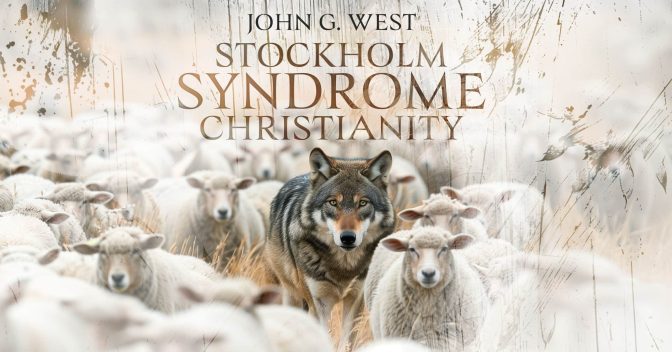
Knight and Rose Show #58: John West: Stockholm Syndrome Christianity

Welcome to episode 58 of the Knight and Rose podcast! In this episode, Wintery Knight and Desert Rose interview Dr. John West about his new book “Stockholm Syndrome Christianity”. If you like this episode, please subscribe to the podcast, and subscribe to our YouTube channel. We would appreciate it if you left us a 5-star review on Apple Podcasts or Spotify.

Podcast description:

Christian apologists Wintery Knight and Desert Rose discuss apologetics, policy, culture, relationships, and more. Each episode equips you with evidence you can use to boldly engage anyone, anywhere. We train our listeners to become Christian secret agents. Action and adventure guaranteed. 30-45 minutes per episode. New episode every week.

Episode summary:

Wintery Knight and Desert Rose welcome Vice President of the Discovery Institute Dr. John West to discuss his new book “Stockholm Syndrome Christianity”. He discusses how Christians are influenced by non-Christian ideas, key figures in the Stockholm Syndrome movement, how Christian institutions are captured by secular left, and strategies to combat the spread of Stockholm Syndrome Christianity.

Outline and transcript

Here is a transcript of the show (with timestamps) provided by TurboScribe AI. TurboScribe AI allows you to translate the transcript into many, many different languages. You can also export the transcript into many different formats, with optional timestamps.

Episode 58:

Speaker biographies

Dr. John West is Vice President of the Discovery Institute, and Managing Director of the Institute’s Center for Science & Culture, which he co-founded with Dr. Stephen C. Meyer in 1996. Dr. West was previously an Associate Professor of Political Science at Seattle Pacific University where he chaired the Department of Political Science and Geography. He earned his PhD in Government from Claremont Graduate University and BA in Communications from the University of Washington. Dr. West has written or edited twelve books, including “Darwin Day in America: How Our Politics and Culture Have Been Dehumanized in the Name of Science”. His newest book is “Stockholm Syndrome Christianity: Why America’s Christian Leaders Are Failing — and What We Can Do About It”.

Wintery Knight is a black legal immigrant. He is a senior software engineer by day, and an amateur Christian apologist by night. He has been blogging at winteryknight.com since January of 2009, covering news, policy and Christian worldview issues.

Desert Rose did her undergraduate degree in public policy, and then worked for a conservative Washington lobbyist organization. She also has a graduate degree from a prestigious evangelical seminary. She is active in Christian apologetics as a speaker, author, and teacher.

Videos:

Links:

Podcast RSS feed:

https://feed.podbean.com/knightandrose/feed.xml

You can use this to subscribe to the podcast from your phone or tablet. I use the open-source AntennaPod app on my Android phone.

Podcast channel pages:

Video channel pages:

Music attribution:

Strength Of The Titans by Kevin MacLeod
Link: https://incompetech.filmmusic.io/song/5744-strength-of-the-titans
License: https://filmmusic.io/standard-license

Evaluating William Lane Craig’s views on Genesis, Adam and Eve

I found a wonderful series of articles by someone I really trust on origins issues: Dr. Casey Luskin. He has a long history with the intelligent design movement, starting from when he was a college student. He has a BS and MS in Earth Sciences from the University of California, San Diego, a PhD in Geology from the University of Johannesburg, and a JD from the University of San Diego.

He has a series of articles up at Evolution News, about Dr. William Lane Craig’s new book “In Quest of the Historical Adam”. I’m not sure if he is done with the series, but I thought that it was a good time to look over what he’s already written.

In the first article he notes that “Craig convincingly argues that mainstream science can be reconciled with a traditional view of Adam and Eve” and “argues that Adam and Eve were real people who could have been members of Homo heidelbergensis”. Craig’s conclusion is that “it’s not scientifically problematic to take a truly “traditional” view of Adam and Eve”.

But Luskin has criticisms of Craig’s views on rival interpretations of Genesis, “As an old earther myself, I was concerned that Craig did not adequately engage with old earth interpretations” and “I believe that young earth creationists will feel that Craig badly misrepresents the scientific claims of their models”.

Craig’s handling of the science:

Craig’s book provides highly informed discussions of the paleoanthropological, archaeological, neurological, and genetic evidence regarding human origins, but his arguments often incorporate evolutionary assumptions which are doubtful. For example, Craig is too credulous towards evolutionary explanations of the origin of the human mind which amount to miracle mutations, as well as common evolutionary notions that pseudogenes are “junk DNA” that support common ancestry. He misses a key deficiency in evolutionary explanations: a conspicuous gap between the genus Homo and our supposed ape-like australopithecine ancestors in the hominid fossil record. Although Craig does not recognize it, key neurogenetic evidence raised in his book actually suggests a potent mathematical challenge to the Darwinian evolution of humans. I also believe he sells Homo erectus short as a potential candidate for Adam and Eve.

[…]Craig continues to rely upon BioLogos arguments that pseudogenes are “broken” and non-functional junk DNA that we share with apes, thereby demonstrating our common ancestry. Those arguments are increasingly contradicted by evidence presented in highly authoritative scientific papers which find that pseudogenes are commonly functional, and they ought not be assumed to be genetic “junk.” In relying upon dubious evolutionary arguments that are increasingly refuted by the technical literature, Craig may be repeating the very mistake that led previous evangelicals to think Adam and Eve did not exist.

There are 6 parts to the review. Here are the links to parts 2 through 6:

If you’re interested in the topics of Christianity and science, this is a great series to read. I love when someone trustworthy reads through a lot of stuff I don’t have time for (I have a day job as a software engineer!) and gives me an accurate summary of the strengths and weaknesses.