Category Archives: Commentary

The true story of Thanksgiving: Squanto’s miraculous path to Plymouth

"The First Thanksgiving at Plymouth" by Jennie Augusta Brownscombe (1914)
“The First Thanksgiving at Plymouth” by Jennie Augusta Brownscombe (1914)

God’s providence in action, as reported by Eric Metaxas in the Wall Street Journal.

Full text:

The story of how the Pilgrims arrived at our shores on the Mayflower—and how a friendly Patuxet native named Squanto showed them how to plant corn, using fish as fertilizer—is well-known. But Squanto’s full story is not, as National Geographic’s new Thanksgiving miniseries, “Saints & Strangers,” shows. That might be because some details of Squanto’s life are in dispute. The important ones are not, however. His story is astonishing, even raising profound questions about God’s role in American history.

Every Thanksgiving we remember that, to escape religious persecution, the Pilgrims sailed to the New World, landing at Plymouth Rock in 1620. But numerous trading ships had visited the area earlier. Around 1608 an English ship dropped anchor off the coast of what is today Plymouth, Mass., ostensibly to trade metal goods for the natives’ beads and pelts. The friendly Patuxets received the crew but soon discovered their dark intentions. A number of the braves were brutally captured, taken to Spain and sold into slavery.

One of them, a young man named Tisquantum, or Squanto, was bought by a group of Catholic friars, who evidently treated him well and freed him, even allowing him to dream of somehow returning to the New World, an almost unimaginable thought at the time. Around 1612, Squanto made his way to London, where he stayed with a man namedJohn Slany and learned his ways and language. In 1618, a ship was found, and in return for serving as an interpreter, Squanto would be given one-way passage back to the New World.

After spending a winter in Newfoundland, the ship made its way down the coast of Maine and Cape Cod, where Squanto at last reached his own shore. After 10 years, Squanto returned to the village where he had been born. But when he arrived, to his unfathomable disappointment, there was no one to greet him. What had happened?

It seems that since he had been away, nearly every member of the Patuxets had perished from disease, perhaps smallpox, brought by European ships. Had Squanto not been kidnapped, he would almost surely have died. But perhaps he didn’t feel lucky to have been spared. Surely, he must have wondered how his extraordinary efforts could amount to this. At first he wandered to another Wampanoag tribe, but they weren’t his people. He was a man without a family or tribe, and eventually lived alone in the woods.

But his story didn’t end there. In the bleak November of 1620, the Mayflower passengers, unable to navigate south to the warmer land of Virginia, decided to settle at Plymouth, the very spot where Squanto had grown up. They had come in search of religious freedom, hoping to found a colony based on Christian principles.

Their journey was very difficult, and their celebrated landing on the frigid shores of Plymouth proved even more so. Forced to sleep in miserably wet and cold conditions, many of them fell gravely ill. Half of them died during that terrible winter. One can imagine how they must have wept and wondered how the God they trusted and followed could lead them to this agonizing pass. They seriously considered returning to Europe.

But one day during that spring of 1621, a Wampanoag walked out of the woods to greet them. Somehow he spoke perfect English. In fact, he had lived in London more recently than they had. And if that weren’t strange enough, he had grown up on the exact land where they had settled.

Because of this, he knew everything about how to survive there; not only how to plant corn and squash, but how to find fish and lobsters and eels and much else. The lone Patuxet survivor had nowhere to go, so the Pilgrims adopted him as one of their own and he lived with them on the land of his childhood.

No one disputes that Squanto’s advent among the Pilgrims changed everything, making it possible for them to stay and thrive. Squanto even helped broker a peace with the local tribes, one that lasted 50 years, a staggering accomplishment considering the troubles settlers would face later.

So the question is: Can all of this have been sheer happenstance, as most versions of the story would have us believe? The Pilgrims hardly thought so. To them, Squanto was a living answer to their tearful prayers, an outrageous miracle of God. Plymouth Colony Governor William Bradford declared in his journal that Squanto “became a special instrument sent of God” who didn’t leave them “till he died.”

Indeed, when Squanto died from a mysterious disease in 1622, Bradford wrote that he wanted “the Governor to pray for him, that he might go to the Englishmen’s God in heaven.” And Squanto bequeathed his possessions to the Pilgrims “as remembrances of his love.”

These are historical facts. May we be forgiven for interpreting them as the answered prayers of a suffering people, and a warm touch at the cold dawn of our history of an Almighty Hand?

America is truly a blessed nation. Why this story is not taught in all the schools of the nation is beyond me.


Before the rise of secularism, Americans believed in conscience

Dissent, disagreement, conscience and religious liberty
The importance of respecting the conscience of others

In the last 50 years, America exchanged religious liberty for hedonism. We used to believe that conscience was a good thing, and we respected individual differences rooted in religious convictions. But today, secular leftist politicians, lawyers and judges attack Christians using the courts. Pro-lifers, pro-marriage business owners, and people expressing Christian convictions in public have all felt what it is like to have conscience attacked by the secular leftist state.

Let’s take a look at what things were like in a different time when moral convictions had not been destroyed by secular leftism.

Consider this article in The Federalist about a new movie called “Hacksaw Ridge”.

Excerpt:

Over last weekend, I saw the new Mel Gibson flick “Hacksaw Ridge.” Gruesome and at times overshadowed by lead actor Andrew Garfield’s awkwardness, “Hacksaw Ridge” was an ode to the age-old American custom of protecting dissent by protecting the conscience.

In an age when attacks upon conscience and religious liberty grow more and more fiery, the true tale of World War II hero Desmond Doss’ conscientious objection to killing is a reminder of the difficult stakes involved in ensuring that individual liberty is the presumption that government takes toward individuals, even during war.

“Hacksaw Ridge” is the story of Doss, a Seventh Day Adventist whose religion prohibited taking the life of a fellow human being. Doss, obviously a patriot, felt obligated to serve in World War II as a medic. Where war is the business of taking life, Doss saw his role as helping save lives. That he does, as his heroism is on full display in his military record and receiving the Medal of Honor from President Truman.

The article has 6 sections.

The first one makes the point about how things have changed:

1. The Conscience Is Sacred

Doss arrived at his pacifism through religious conviction. It was an ethical precept he arrived at by religious devotion and piety, which means his pacifism was not something arbitrarily considered. Throughout the movie, the tattered Bible he carried with him everywhere he went symbolized the solemnity of his beliefs. Standing before a court martial, he was willing to go to jail for his convictions.

This is important today because so much hostility is based in rejecting religious motivation around contentious issues such as sexuality. Liberals are inclined to believe that any and all opposition to the ever-expanding lexicon of the sexual revolution is based in animus. That’s hogwash. Today’s dissenters from the sexual revolution have no use for animus. Rather, they believe the purposes of sexuality and human embodiment are different than what secular progressivism teaches.

Doss’ sincerity is a reminder that the convictions people arrive at by religious motivation are not designed to be capricious, but are ordered toward certain ends that people will naturally disagree about.

Part 3 was also good, because it explains efforts by Republicans to pass laws like the Religious Freedom Restoration Act – laws that are opposed by atheists in the Democrat party:

3. It’s Good to Accommodate People’s Consciences

When almost court-martialed for insubordination, Doss insists that his desire all along was to be a medic. This request was eventually approved. In the movie, we see the U.S. government preserve a man’s conscience by assigning him a duty that did not violate it. The U.S. government was right to accommodate Doss where accommodations can be made. In this move, it recommitted itself to an important principle at the heart of our constitutional system: The presumption of liberty.

This means it is government’s burden to prove infringing upon a person’s liberty is absolutely necessary. In Doss’ case, it was deemed unessential for him to carry a weapon, so he served in a different capacity. This is at the heart of legislation like the Religious Freedom Restoration Act, which puts the burden on the government to prove its case and make every last accommodation where possible.

The problem with people on the secular left today is that they have no empathy. For them, other people have no right to disagree because it makes them feel bad – but they don’t see how jail time and fines amounting to hundreds of thousands of dollars makes the victim of their legal attacks feel bad:

5. Protecting Conscience Means Developing Empathy for Others’ Convictions

As the movie’s plot develops, Doss’ fellow soldiers come to understand that his motives aren’t sinister. They realize that, when freed to live faithfully, Doss is there to help save their lives. Throughout this, and when they learn of his sincerity, his enemies-turned-friends gained a greater understanding of Doss’ convictions. They came to understand the force of his resolve, which dampens their mockery.

In one visceral scene in particular, Doss and the most intense warrior in his battalion are in a foxhole together. There, in seeing Doss’ devotion to sacrifice and conscience, his enemy-turned-friend makes lighthearted gestures recognizing that Doss’ motives are pure. In the crucible of conflict, progress occurs.

As in the case of Doss, protecting conscience doesn’t mean you will agree with the conscience you’re protecting. In fact, disagreement underscores the very need for protection. If conscience and religious liberty are simply ideas our society supports when popular, such protections are easily undone.

One of my favorite passages in the Bible talks about conscience.

1 Corinthians 4:2:

1 This is how one should regard us, as servants of Christ and stewards of the mysteries of God.

2 Moreover, it is required of stewards that they be found faithful.

3 But with me it is a very small thing that I should be judged by you or by any human court. In fact, I do not even judge myself.

4 For I am not aware of anything against myself, but I am not thereby acquitted. It is the Lord who judges me.

You can clearly see in today’s gay rights movement the problem with the government choosing to favor sinful behavior over religious liberty. People who are involved in sinful lifestyles don’t have the ability to do the right thing when it comes to respecting others. Engaging in a sinful lifestyle corrupts the ability to be respectful of the human rights of others. The desire to feel good and be approved of is seen as more important than respecting the right of others to disagree.

Who knows how far the secular left would go to punish dissenters from gay marriage? Although the media doesn’t cover it, there have been countless episodes of violence and vandalism, workplace persecution and job terminations, not to mention an armed attack by a domestic terrorist at the Family Research Council building. Because people in a sinful lifestyle don’t respect conscience rights of those who disagree. Conversely, when a person stands alone for a moral virtue (e.g. – chastity), there is no desire to compel others.

Thinking practically about the gospel with an illustration from a war movie

The city of Mogadishu, in Somalia, Africa

I decided to re-post one of my favorite posts for Veteran’s Day / Remembrance Day.

First, let’s get an overview that helps us understand the context and goals of the mission we are going to discuss.

The scene is set in Somalia, Africa, in 1992. There a civil war between two warlords: Ali Mahdi and Mohammed Farah Aidid. The war has destroyed agricultural operations, and the people are starving. The United Nations are trying to help, but Aidid hijacks the food from UN aircraft so that he can use the food to gain control of the people. Hundreds of thousands of Somalis are dying of starvation. The UN requests American military forces to secure the air-dropped supplies so they can be distributed to the starving people.

In December 1992, President George H.W. Bush answers the call, sending 25,000 troops to Somalia to protect the food from the Somali warlords. However, in 1993, Bill Clinton is elected. He orders that the number of U.S. troops be reduced to 12,000. Following an attack by Aidid on Pakistani peace-keepers, the U.N. issues a resolution to capture those responsible. The U.S. armed forces have the arms and training to battle evil, so they get the call to capture Aidid and his lieutenants.

In late August 1993, Task Force Ranger is deployed to Mogadishu to capture Aidid and his lieutenants at the Olympic Hotel. The U.S. force consists of 440 troops from the Army Rangers and Army Delta Force special forces, commanded by General William Garrison. Garrison requested light armored units (Bradley Infantry Fighting vehicles) that would offer more protection than the unarmored HMMWV Humvees. Garrison was denied the light armor by the Clinton administration. Garrison requested heavier air support (AC-130 Spectre gunships) that would offer better fire support than the UH-60 Blackhawk miniguns. Garrison was denied the air support by the Clinton administration. The Clinton administration did not want the American forces to appear too heavily armed for the peace-keeping role.

The actual mission turned out to be much harder than it needed to be, because of the resources denied by the Clinton administration. Although the Aidid lieutenants were captured, Aidid himself escaped. Eighty-four American soldiers were wounded. Eighteen American soldiers were killed, and their bodies were dragged through the streets of Mogadishu. This was shown over and over by the media, and it undermined American resolve to help the Somali people. As a result, Clinton had the excuse he needed to retreat the American military.

(Source: Nova Online)

Two heroes lost their lives

Today, I want to talk about two of the men who lost their lives in Operation Gothic Serpent. They are Master Sergeant Gary I. Gordon and Sergeant First Class Randall D. Shughart – a Delta Force sniper team.

Here is a clip from the movie Blackhawk Down, which shows what happened to them:

The pilot of the downed Blackhawk was protected by the two men who volunteered to go in after him. They requested that they be inserted at the crash site, even though they knew that reinforcements were likely not going to be there in time to save them. They made the request to go and help the pilot three times before being allowed to go in. Their first two requests were denied by their commanding officer, because the odds against their survival were so overwhelming. The rescued pilot was later released by his captors, and the two heroes were awarded the Medal of Honor for their brave actions.

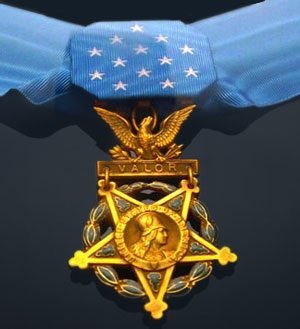
A Congressional Medal of Honor

Here is a description of the requirements to be awarded a Medal of Honor:

The Medal of Honor is the highest military decoration that may be awarded by the United States government. It is presented by the President of the United States, in the name of Congress, and is conferred only upon members of the United States Armed Forces who distinguish themselves through conspicuous gallantry and intrepidity at the risk of life above and beyond the call of duty:

  • While engaged in action against an enemy of the United States;
  • While engaged in military operations involving conflict with an opposing foreign force; or
  • While serving with friendly foreign forces engaged in an armed conflict against an opposing armed force in which the United States is not a belligerent party.

You can read the official details of their actions.

The point of this post

It is important for Christians to be familiar with real-world examples of people giving their lives in order to save the lives of others. When we see real-world examples of self-sacrifice, it helps us to understand what Jesus really achieved for us, and what he must have felt making that hard choice to volunteer to go in and rescue us. In general, my philosophy when it comes to the Bible is to make every effort to connect what the Bible says to the real world. We must not push Christianity into some far-off world of piety and feelings. We must make connections to real evidence and real life, so that what the Bible says becomes practical, and so that we have a deep friendship with and sympathy for God revealed in Jesus Christ. In real life, being willing to give your life to save someone else is hard. Understanding how that really happens will help us to value what Jesus has done for us.

Bible verses

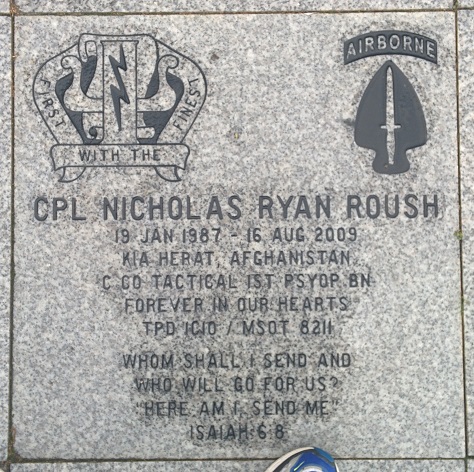
I saw this verse on the ground outside the Airborne & Special Operations Museum in Fayetteville, NC, where I went for my summer vacation in 2015. (Thanks to my friend Curby who hosted me)

Isaiah 6:8:

Then I heard the voice of the Lord saying, “Whom shall I send? And who will go for us?”

And I said, “Here am I. Send me!”

Here is the picture I took (yes, that is my running shoe):

“Here am I, send me” Isaiah 6:8

When confronted with an opportunity to imitate Christ in his self-sacrifice, we should think less about ourselves and our own desires, and take the opportunity to serve others effectively. We do not do what makes us happy, and we do not pursue fun and thrills. We do what heals, we do what helps others. We do not push away our responsibility to imitate Christ by caring for those in danger. Christianity is not just about “not doing bad things”. It’s the good things you do because of your relationship with Jesus that show your real allegiance, and give you the experience of being a Christian in deed.

And here is another good verse:

John 15:13:

13 Greater love has no one than this: to lay down one’s life for one’s friends.

If you get a chance to watch the movie Blackhawk Down, then do so. I highly recommend it. You can also read the book that the movie is based on.

I love the Medal of Honor books by Edward F. Murphy. He writes about all the people who have been awarded the Medal of honor in different wars: World War II, the Korean War, and the Vietnam War.

If you check my reading list, you’ll find that I usually read two military books for every one book on another subject.