

Category Archives: Commentary

Thinking practically about the gospel with an illustration from a war movie

The city of Mogadishu, in Somalia, Africa

I decided to re-post one of my favorite posts for Memorial Day.

First, let’s get an overview that helps us understand the context and goals of the mission we are going to discuss.

The scene is set in Somalia, Africa, in 1992. There a civil war between two warlords: Ali Mahdi and Mohammed Farah Aidid. The war has destroyed agricultural operations, and the people are starving. The United Nations are trying to help, but Aidid hijacks the food from UN aircraft so that he can use the food to gain control of the people. Hundreds of thousands of Somalis are dying of starvation. The UN requests American military forces to secure the air-dropped supplies so they can be distributed to the starving people.

In December 1992, President George H.W. Bush answers the call, sending 25,000 troops to Somalia to protect the food from the Somali warlords. However, in 1993, Bill Clinton is elected. He orders that the number of U.S. troops be reduced to 12,000. Following an attack by Aidid on Pakistani peace-keepers, the U.N. issues a resolution to capture those responsible. The U.S. armed forces have the arms and training to battle evil, so they get the call to capture Aidid and his lieutenants.

In late August 1993, Task Force Ranger is deployed to Mogadishu to capture Aidid and his lieutenants at the Olympic Hotel. The U.S. force consists of 440 troops from the Army Rangers and Army Delta Force special forces, commanded by General William Garrison. Garrison requested light armored units (Bradley Infantry Fighting vehicles) that would offer more protection than the unarmored HMMWV Humvees. Garrison was denied the light armor by the Clinton administration. Garrison requested heavier air support (AC-130 Spectre gunships) that would offer better fire support than the UH-60 Blackhawk miniguns. Garrison was denied the air support by the Clinton administration. The Clinton administration did not want the American forces to appear too heavily armed for the peace-keeping role.

The actual mission turned out to be much harder than it needed to be, because of the resources denied by the Clinton administration. Although the Aidid lieutenants were captured, Aidid himself escaped. Eighty-four American soldiers were wounded. Eighteen American soldiers were killed, and their bodies were dragged through the streets of Mogadishu. This was shown over and over by the media, and it undermined American resolve to help the Somali people. As a result, Clinton had the excuse he needed to retreat the American military.

(Source: Nova Online)

Two heroes lost their lives

Today, I want to talk about two of the men who lost their lives in Operation Gothic Serpent. They are Master Sergeant Gary I. Gordon and Sergeant First Class Randall D. Shughart – a Delta Force sniper team.

Here is a clip from the movie Blackhawk Down, which shows what happened to them:

The pilot of the downed Blackhawk was protected by the two men who volunteered to go in after him. They requested that they be inserted at the crash site, even though they knew that reinforcements were likely not going to be there in time to save them. They made the request to go and help the pilot three times before being allowed to go in. Their first two requests were denied by their commanding officer, because the odds against their survival were so overwhelming. The rescued pilot was later released by his captors, and the two heroes were awarded the Medal of Honor for their brave actions.
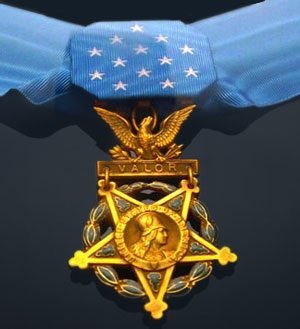
A Congressional Medal of Honor

Here is a description of the requirements to be awarded a Medal of Honor:

The Medal of Honor is the highest military decoration that may be awarded by the United States government. It is presented by the President of the United States, in the name of Congress, and is conferred only upon members of the United States Armed Forces who distinguish themselves through conspicuous gallantry and intrepidity at the risk of life above and beyond the call of duty:

  • While engaged in action against an enemy of the United States;
  • While engaged in military operations involving conflict with an opposing foreign force; or
  • While serving with friendly foreign forces engaged in an armed conflict against an opposing armed force in which the United States is not a belligerent party.

You can read the official details of their actions.

The point of this post

It is important for Christians to be familiar with real-world examples of people giving their lives in order to save the lives of others. When we see real-world examples of self-sacrifice, it helps us to understand what Jesus really achieved for us, and what he must have felt making that hard choice to volunteer to go in and rescue us. In general, my philosophy when it comes to the Bible is to make every effort to connect what the Bible says to the real world. We must not push Christianity into some far-off world of piety and feelings. We must make connections to real evidence and real life, so that what the Bible says becomes practical, and so that we have a deep friendship with and sympathy for God revealed in Jesus Christ. In real life, being willing to give your life to save someone else is hard. Understanding how that really happens will help us to value what Jesus has done for us.

Bible verses

I saw this verse on the ground outside the Airborne & Special Operations Museum in Fayetteville, NC, where I went for my summer vacation in 2015. (Thanks to my friend Curby who hosted me)

Isaiah 6:8:

Then I heard the voice of the Lord saying, “Whom shall I send? And who will go for us?”

And I said, “Here am I. Send me!”

Here is the picture I took (yes, that is my running shoe):
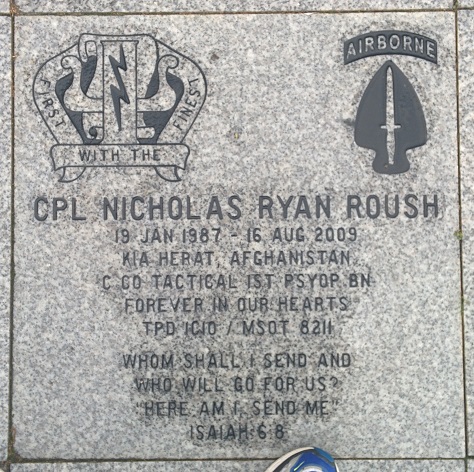
“Here am I, send me” Isaiah 6:8

When confronted with an opportunity to imitate Christ in his self-sacrifice, we should think less about ourselves and our own desires, and take the opportunity to serve others effectively. We do not do what makes us happy, and we do not pursue fun and thrills. We do what heals, we do what helps others. We do not push away our responsibility to imitate Christ by caring for those in danger. Christianity is not just about “not doing bad things”. It’s the good things you do because of your relationship with Jesus that show your real allegiance, and give you the experience of being a Christian in deed.

And here is another good verse:

John 15:13:

13 Greater love has no one than this: to lay down one’s life for one’s friends.

If you get a chance to watch the movie Blackhawk Down, then do so. I highly recommend it. You can also read the book that the movie is based on.

I love the Medal of Honor books by Edward F. Murphy. He writes about all the people who have been awarded the Medal of honor in different wars: World War II, the Korean War, and the Vietnam War.

If you check my reading list, you’ll find that I usually read two military books for every one book on another subject.


Even alpha male bad boys are disappointed by the Sexual Revolution

Marriage stability vs sexual partners,(Teachman et al. JAMF, August 2010)

Thanks to radical feminism’s dominance in the culture, young unmarried women are very disinterested in marriage. Many of them see marriage as boring, and children as restrictive of their freedom. Instead, young women want to make sure to use their young and fertile years to pack in as much fun and thrills as they can. So what sort of men do they choose to pursue?

This article from the UK Daily Mail illustrates the problem:

Women are often said to be the less shallow sex when it comes to what they find attractive.

But a study of an online gallery of ‘hot male commuters’ has found that the fairer sex are just as superficial as men – as they find muscles and money the sexiest male attributes.

The study based its findings on a website called Tube Crush, where women and gay men secretly take pictures of the capital’s attractive men on the London Underground.

[…]While the authors acknowledge that gay men also use the site, they say that female responses to the ‘hot commuters’ suggest females have not moved on in what they find attractive beyond ‘money and strength’ – despite their advancement in society.

Signs that the man is wealthy – such as a flashy watch or an expensive suit – were considered highly attractive by site users, as were powerful arm and chest muscles.

But the classic image of the ‘new man’ – a man holding a baby – or skinnier or nerdier types of man were far less represented.

Now, in my experience, men who are getting a lot of attention because of their looks are probably the least likely to be faithful, much less commit. If the man is putting in a lot of effort into his appearance (as opposed to his education, his career, his spiritual life, etc.), he’s probably doing it in order to get sexual access to a lot of women. He’s not looking to commit, in short. He’s looking to play the field. But it turns out that even the men who are successful at this are not happy with their success.

Consider this article from the UK Sun: (H/T Sarah)

It sounds like every young man’s idea of heaven: endless sex with a constant stream of gorgeous, up-for-it women who don’t even expect a pizza date before, or a conversation afterwards – and all via a tap on your smartphone.

Yet incredibly, a new generation of handsome, successful – and sexually prolific – Tinder-weary lads are claiming sex with hundreds of one-night stands is leaving them burned out, bored – and lonely.

Despite bedding a bevvie of beauties, they claim they’re desperate for lasting romance – and broody for children with a new wave of sexually-liberated young women who just don’t want to commit.

I got to know a group of these seemingly lucky men after I co-wrote the UK’s biggest ever academic study into more than 2,000 British men, released this week.

Called the Harry’s Masculinity Report, the survey was conducted by University College London and Harry’s, a new men’s grooming company that’s just launched in the UK.

Harry’s wanted to shatter the myths around masculinity, and discover what truly made modern men tick in 2017.

Here are some details:

One of these was Simone Ippolito, 25, from Bournemouth, a self-confessed Tinder “player” for two years.

The salesman and part-time model claimed: “When I first got Tinder two years ago, it was heaven. In three months I got 300 matches. They were coming so fast I couldn’t keep up.

“People on Tinder are only there for sex. I’ve been on 200 dates, and I get a result 99 per cent of the time.

“Getting sex is too easy. You get bored of it. Tinder takes all the pleasure out of flirting. It’s not fun anymore. Tinder is literally two glasses of wine then back home for sex. There is no emotion.

“It is boring, empty and lonely. You can’t have a nice conversation after mechanical sex. It’s just sex and go. Now I just want to stop it and settle down”.

Talking to other single men, it rapidly became clear that while dating apps like Tinder means it’s never been easier to get sex, it’s never been harder to fall in love.

This sentiment was echoed by Gary Barnett, 34, social media manager from Brighton, who’s been single for three months.

“For the first time ever in human history, sex is on tap,” he says.

“Nine times out of ten you don’t even have to go out on a date. If a girl likes your photos, they just come round.

“If you’re half attractive you’re bombarded with offers. You can go on Tinder dates every single night of the week.

“The social interaction is totally lacking. You can have sex and never talk again.

“They always ask the same three questions. ‘Hi how are you?’ ‘how’s your week been?’ or ‘I love your beard/tattoos’. That’s literally code for ‘do you want to f***?’

“That was really good for the first year. I filled my boots. After 50 Tinder dates, including 20 in the last two months with no sign of any ‘keepers,’ I’m over it. You get to the point where you can’t be bothered to do it anymore”.

Ah yes, the beard and tattoos. These are apparently very important for attracting women today. But it doesn’t work to attract a serious marriage-minded women to settle down with. Men are designed to want relationships with women. But not every woman is capable of having a relationship with a man. Especially after so many women have been taught by feminism not to prefer commitment-minded men who can perform the traditional male roles: protecting, providing and leading on moral and spiritual issues. Beards, muscles, shiny watches and tattoos might attract women, but it doesn’t make those women marriage-ready. In fact, the sort of women who are impressed with appearances are probably looking for fun. They are definitely NOT going to be comfortable with relationship obligations to a husband or children. To build a capacity for self-sacrificial commitment, you don’t practice having fun and thrills. You practice self-sacrificial commitment. You work on developing a worldview that makes self-sacrificial commitment rational, even when it goes against your self-interest. A worldview like Christianity, for example.

We already knew that women are unhappy with the dating scene today. And now we know that even the men who are “succeeding” are unhappy with it too, in the long term. The Sexual Revolution has messed up love and commitment for everyone.

J. Warner Wallace: I am not a Christian because it works for me

12231469_1518516371799768_1908477683_n

Here’s a must-read post from Cold-Case Christianity author J. Warner Wallace.

Excerpt:

Life on this side of my decision hasn’t always been easy. It’s been nearly seventeen years since I first trusted Jesus as Lord and Savior. I still struggle to submit my prideful will to what God would call me to do. Christianity is not easy. It doesn’t always “work” for me. There are times when I think it would be easier to do it the old way; easier to cut a corner or take a short cut. There are many times when doing the right thing means doing the most difficult thing possible. There are also times when it seems like non-Christians have it easier, or seem to be “winning”. It’s in times like these that I have to remind myself that I’m not a Christian because it serves my own selfish purposes. I’m not a Christian because it “works” for me. I had a life prior to Christianity that seemed to be working just fine, and my life as a Christian hasn’t always been easy.

I’m a Christian because it is true. I’m a Christian because I want to live in a way that reflects the truth. I’m a Christian because my high regard for the truth leaves me no alternative.

I think this is important. There are people who I know who claim to be Christian, but they are clearly believing that God is a mystical force who arranges everything in their lives in order to make them happy. They are not Christians because it’s true, but because of things like comfort and community. But people ought to become Christians because they think it’s true. Truth doesn’t necessarily make you happy, though. Truth can impose intellectual obligations and moral obligations on you. Seeing God as he really is doesn’t help us to “win” at life, as the culture defines winning.

Winning in Christianity doesn’t mean making lots of money, or being famous, or winning human competitions, or being approved of by lots of people. Winning for a Christian might involve things like building relationships with people and leading them to know that God exists and who Jesus is. That has no cash value, and it’s not going to make you famous. Actually, it will probably cost you money and time, and make you unpopular with a lot of people.

The Bible doesn’t promise that people who become Christians will be happier. Actually, it promises that Christians will suffer for doing the right things. Their autonomy will suffer, as they sacrifice their own interests and happiness in order to make God happy, by serving his interests. Christianity isn’t something you add on to your before-God life in order to achieve your before-God goals. When you become a Christian, you get a new set of goals, based on God’s character and his design for you. And although you might be very successful in the world as part of serving God, there is no guarantee of that. Christianity is not life enhancement.