Category Archives: Commentary

Does the Bible say that you should forgive someone who does not repent?

Kevin Lewis, a professor of Theology and Law at the conservative Biola University, was asked this question:

Recently, I was reading Dr. Kenneth Bailey’s “Jesus Through Middle Eastern Eyes” (IVP press 2008). When commenting on Matthew 6:12-13, he writes,

“It is a common human assumption that the violator of the rights of others must ask for forgiveness before the wronged party can be expected to accept the apology and grant forgiveness…But Jesus here asks the person wronged to forgive the one responsible for the wrongdoing when when there is no confession of guilt… There is a voice from the cross that echoes across history to all saying ‘Father forgive them for they know not what they do.’ Neither Pilate nor the high priest nor the centurion offered any apology to Jesus, yet he prayed for divine forgiveness…(p.125)”

And here’s his response in full, copied with permission from his Facebook note:

Regarding Bailey’s comments on Matthew 6:12, he errs by not considering the theological context of this statement and fails to consider any implied biblical conditions for forgiveness inherent in the statement. The text simply does not mean what he says it means. He is reading too much into the statement.
Bailey states, “Jesus here asks the person wronged to forgive the one responsible for the wrongdoing when there is no confession of guilt…”

Bailey errs. Here, Jesus is giving a model for prayer commensurate with the way His Kingdom works. Jesus teaches them to pray: “Forgive us our debts, as we also have forgiven our debtors.” This is a statement of the objective, “forgiveness,” without a discussion of any express or implied conditions to accomplish the objective. It is also a statement of the proper attitude of the Christian, that is, that we must have a demeanor of being willing to forgive, just as God was willing to forgive us. Bailey’s assertion that there is no “confession of guilt” or repentance is merely an unwarranted assumption.

Moreover, the use of “as” (Grk. hos) in the passage introduces a comparison between the way we forgive and the way God forgives. This comparative phraseology is employed elsewhere on the subject of forgiveness. For example, Ephesians 4:32 states that we should be “forgiving each other just as God in Christ also has forgiven” us. Here, the comparative “just as” (Grk. kathos) is employed and indicates our forgiveness is to be just like God’s forgiveness of us, which flows from a loving disposition. So in the same manner that God forgives, we must forgive. We are to be “imitators of God” (Eph. 5:1). See also Matthew 5:48 and Luke 6:36 for exhortations to imitate God.

To ascertain whether the Scriptures describe any conditions for forgiveness, one must search elsewhere in the Scriptures for comment. This is the nature of systematic theology. We need to examine what the entire Bible says on a given topic, such as forgiveness. And the Bible contains ample support for the notion that there are conditions for forgiveness.

First, regarding God and His forgiveness, it is undisputed in orthodox Christian theology that God does not forgive everyone. The doctrine of Hell is a sufficient proof of the lack of universal forgiveness by God.

Next, it is clear that God does not forgive without repentance. This doctrine is taught in a number of texts. For example, in Luke 13:3 Jesus says, “unless you repent, you will all likewise perish.” In Mark 1:15 John the Baptist commands that we must “repent and believe the Gospel.” The connection between repentance and forgiveness of sins (i.e. “salvation”) is seen throughout the Scriptures. For example, in Acts 2:38 repentance is directly connected as a condition for the remission of sins. For additional examples of this connection see Matthew 11:20-24; Luke 24:45-49; Acts 3:19; 8:22; 17:30-31; Romans 2:4-5; II Corinthians 7:10; II Tim. 2:25-26.

So since we are to be imitators of God and forgive in the same way God forgives, we would expect the Scriptures to be consistent, stating that the condition of repentance is required to be fulfilled before believers are required to forgive each other’s sins. It does.

Jesus stated in Luke 17:3, “If your brother sins, rebuke him; and if he repents, forgive him.” Here, the meaning is clear. The word “if” (Grk. ean) introduces the condition for a rebuke and for granting forgiveness. If (subjunctive) a person sins, we must (imperative) rebuke him, and if (subjunctive) he repents, we must (imperative) forgive him. This is as clear a statement as you will find on the subject. Forgiveness is conditioned upon repentance—and this is one of the same criteria that God requires before He forgives sin.

This principle of permitting believers to withhold forgiveness unless the condition of repentance is satisfied is also explicitly seen in Matthew 18:15-17. Compared with the Luke 17:3 text above, the situation is the same. If a brother sins, reprove him; if he listens to you, you have won your brother. Here, the word “reprove” is used rather than “rebuke” and the word “listen” is employed rather than “repent,” but the meaning is virtually identical to Luke 17:3. What we see in Matthew 18 is an escalation of the issue and the result if the person fails to repent (i.e. “listen”). If the person fails to repent, we are to shun him in all appropriate ways (v. 17).

These passages in Luke and Matthew give us the connection between sin, rebuke, repentance and forgiveness. Other biblical texts that merely mention “forgiveness” as a concept or an objective do not necessarily proffer every aspect of the doctrine of forgiveness. As such, they must be read in light of the clear conditions expressed in other passages.

Finally, I would make the case that it is harmful to a person to forgive him without requiring repentance. As seen above, the Bible is clear that sin requires a rebuke. Ignoring sin teaches sinners that sin does not bring consequences. This is harmful to their souls. Continuing to have the benefit of a righteous relationship with another and yet remain in sin against that person results in fostering a habituation of sinful inclinations in their soul, which God says brings about suffering and death.

Moreover, since the ultimate purpose of forgiveness is reconciliation, it is meaningless and harmful to forgive when no reconciliation may be had with the sinner. We cannot “walk together” in a biblical manner in righteous peace when the unrepentant sinner walks in unrighteousness. Necessarily, there is a conflict and a want of shalom. Their soul is headed in a different direction than the believer’s soul; they are walking away from God and we cannot have fellowship with darkness. God has no intimate fellowship with unrepentant people, and that is the model for Christians as well (See Matt. 18).

Regarding personal anger issues commonly raised by Christian psychologists, these types of psychologists unbiblically make unconditional forgiveness a part of therapy. By contrast, however, if a counselee will not forgive after the offending party has truly repented, the counselee sins, and this kind of unforgiveness may be one of the causes of his or her problems. But this is a separate issue from universal and unconditional forgiveness raised above.

Human beings in the image of God may be angry in appropriate ways (Eph.4:26, 31). There is a time to love and a time to hate (Ecclesiastes 3:8). The notion that Christians cannot ever hate, be angry, or lack forgiveness is an unbiblical concept. God Himself is eternally angry with sin, but He is certainly not a psychological basket case. He loves, hates, and is angry in appropriate ways. Our task as believers is to imitate this. Be angry with and hate sin appropriately (Rom. 12:9) and love what good appropriately. For example, righteous anger can evolve beyond the biblical limits to become malice, slander, and bitterness while, to give another example, an appropriate love of food can evolve beyond the biblical limits into gluttony.

Psychological problems arise from many issues other than lack of forgiveness. For example, a lack of trust in God that He has a particular instance of evil under His sovereign control can cause undue anxiety in one’s life. Also, if a counselee’s self worth is grounded in the shifting sand of how others treat him (i.e., badly) rather than being grounded in the fact that he is a divine image bearer and inherently valuable no matter how badly anyone treats him, he will likely fall into anxiety, depression, and other sorts of psychological maladies. Changing the biblical doctrine of forgiveness will not truly help a counselee. It only makes it worse.

Soli Deo Gloria

I agree with Kevin, and I think it is a helpful tool for people to insist on seeing some sort of repentance and restitution from someone who wrongs you before you trust them again. If they are not even sorry for what they’ve done, and they refuse to explain why what they did is wrong, then they can’t be forgiven, and you can’t trust them again.

I think this is the key passage – Luke 17:3-4:

Be on your guard! If your brother sins, rebuke him; and if he repents, forgive him.

And if he sins against you seven times a day, and returns to you seven times, saying, ‘I repent,’ forgive him.”

That’s Jesus speaking, there.

Also, I was having a debate with someone who disagrees with all this, and while debating with her, I thought of another example.

Luke 18:9-14:

And He also told this parable to some people who trusted in themselves that they were righteous, and viewed others with contempt: 

10 “Two men went up into the temple to pray, one a Pharisee and the other a tax collector. 

11 The Pharisee stood and was praying this to himself: ‘God, I thank You that I am not like other people: swindlers, unjust, adulterers, or even like this tax collector. 

12 I fast twice a week; I pay tithes of all that I get.’ 

13 But the tax collector,standing some distance away, was even unwilling to lift up his eyes to heaven, but was beating his breast, saying, ‘God, be merciful to me, the sinner!’ 

14 I tell you, this man went to his house justified rather than the other; for everyone who exalts himself will be humbled, but he who humbles himself will be exalted.”

So again, no forgiveness without repentance.

Forgiveness is what happens when someone who is sinned against treats the sinner as if he had never sinned. It is not on the balance sheet. It is not brought to mind. It is not held against them in the future. The forgiver trusts the sinner again as if the previous sin had never happened.

In divine (vertical) forgiveness, there is no forgiveness without repentance. There are Bible verses above to show that.

My argument is twofold. First, there is a clear teaching of Jesus explaining the sequence of sin and forgiveness. Repentance precedes forgiveness, between humans (Luke 17:3). The verses cited by the forgive without repentance crowd don’t show the mechanics of how to forgive, they are making the point that if you want God to forgive you, you should forgive others. The parable in Luke 18:9-14 affirms this again – repentance always precedes forgiveness.

Second, we have an obligation to imitate God, and that means imitating the way he forgives those who sin against him. When I raise that with the unconditional forgiveness crowd, they want to insist that there is a difference, that the word “forgive” means different things. I’m not convinced.

Finally, I do think that forgiving someone is obligatory if they sincerely repent, and even if they screw up again and again. So long as the repentance is sincere, (like if there is restitution and a genuine effort to show an understanding how the sin affected the wronged party in writing), then forgiveness should be automatic. Depending on how bad the sin is, there maybe be more to do than just say “I’m sorry”. If the repentance is genuine, then I think the person who is sinned against must forgive, if they expect to be forgiven by God for the things they repent of.

Alan E. Kurschner adds one final point about the unconditional forgiveness view. He argues that there is serious textual doubt about the originality of Luke 23:34a, a text used by the pro-unconditional-forgiveness crowd.He has a journal article coming out on it, but a synopsis of his argument is here.

He also wrote this in a comment on this blog:

Second, on Matt 6:15, this is what I have to say. Notice the then-clause: “neither will your Father forgive your sins.” This would require universalism on the Father’s part according to the unconditional interpretation given the first half: “But if you do not forgive others their sins.” Since everyone has wronged the Father is the Father required to forgive everyone even if they are not seeking forgiveness?

So I think the case for the forgiveness being conditional on repentance is pretty strong, especially when serious harm has been caused.
Dennis Prager: does the Bible say do not kill or do not murder?

I am hoping that a lady I am friends with who really likes the King James Bible will not read this post… but, here goes.

Dennis Prager’s column on the sixth commandment.

Excerpt:

Here is the text of commandment six — explaining why the King James translation is wrong:

You would think that of all the Ten Commandments the one that needs the least explaining is the sixth, because it seems so clear. It is the one that the King James Bible, the most widely used English translation of the Bible, translates as, “Thou shall not kill.”

Yet, the truth is the quite the opposite. This is probably the least well understood of the Ten Commandments. The reason is that the Hebrew original does not say, “Do not kill.” It says, “Do not murder.” Both Hebrew and English have two words for taking a life — one is “kill” (harag, in Hebrew) and the other is “murder” (ratzach in Hebrew).

The difference between the two is enormous. Kill means:

  1. Taking any life — whether of a human being or an animal.
  2. Taking a human life deliberately or by accident.
  3. Taking a human life legally or illegally, morally or immorally.

On the other hand, murder can only mean one thing: The illegal or immoral taking of a human life. That’s why we say, “I killed a mosquito,” not, “I murdered a mosquito.” And that’s why we would say that “the worker was accidentally killed,” not that “the worker was accidentally murdered.”

So why did the King James translation of the Bible use the word “kill” rather than “murder”? Because 400 years ago, when the translation was made, “kill” was synonymous with “murder.” As a result, some people don’t realize that English has changed since 1610 and therefore think that the Ten Commandments prohibits all killing.

But, of course, it doesn’t. If the Ten Commandments forbade killing, we would all have to be vegetarians, as killing animals would be prohibited. And we would all have to be pacifists — since we could not kill even in self-defense.

However, you don’t have to know how the English language has evolved to understand that the Ten Commandments could not have prohibited all killing.

A correct understanding of the commandment against murder is crucial because, while virtually every modern translation correctly translates the commandment as “Do not murder,” many people cite the King James translation to justify two positions that have no biblical basis: opposition to capital punishment and pacifism.The very same part of the Bible that contains the Ten Commandments — the Five Books of Moses, the Torah as it is known by Jews — commands the death penalty for murder, allows killing in war, prescribes animal sacrifice and allows eating meat.

Regarding capital punishment and the Bible, as I note in my Prager University course on capital punishment, the only law that appears in each one of the Five Books of Moses is that murderers be put to death. Opponents of the death penalty are free to hold the view that all murderers should be allowed to live. But they are not free to cite the Bible to support their view.

Yet, many do. And they always cite the Commandment, “Do not kill.” But that, as should now be abundantly clear, is not what the commandment says, and it is therefore an invalid argument.

Read the rest (it’s the same as the video).

This is related to his new video series for Prager University on the Ten Commandments. You can watch them all here. There’s one for each commandment, and an introduction. Prager University always does a nice job on these videos, and they are a nice, quick way to find out exactly what traditionally-minded people really believe, and why. Most kids in college will never even hear the other side to what their liberal professors say.

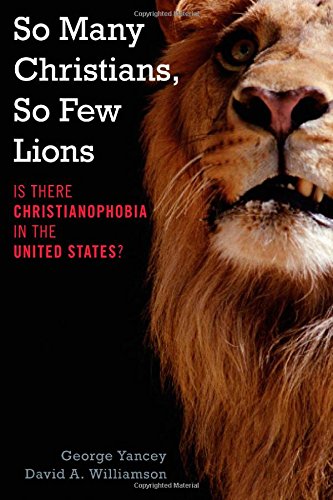
Sociologist George Yancey examines bias against Bible-believing Christians

So Many Christians, So Few Lions by George Yancey, PhD
So Many Christians, So Few Lions

There are three posts in the series, and I think these are all worth reading.

Let’s see the introduction to the series from the first post.

Over the next three blog entries, I am going to discuss the content of my latest book –So Many Christians, So Few Lions – Christianophobia in the United States. Actually the book has not come out yet, but will officially come out later this month. Obviously the focus of the book will be the nature of anti-Christian attitudes in the United States. In this first entry, I look at the contours of a basic level of animosity towards conservative Christians in the United States. My next entry will qualitatively explore the nature of Christianophobic attitudes. In my final entry I will consider the implications of this work, as well as other research and social events, for what it means about this type of anti-religious bigotry. For the balance of these blog entries, I will define Christianophobia as unreasonable hatred or fear of Christians.

The first post is here.

Here’s a snippet that explains which segment of our society is opposed to Christians who take the Bible seriously:

In another research project that I am currently working on, we asked college teachers how they would define a fundamentalist and how they would see a fundamentalist as different from other Protestants. Beyond basic stereotypical descriptions, these individuals tended to label fundamentalists as those who believed the Bible to be the literal word of God. According to the 2012 ANES, about a third of Americans have such a belief. If the respondents in the ANES use a similar definition of fundamentalism then the animosity exhibited by them is not directed at an extreme Christian fringe but against a substantial portion of the population.

What is as important as the extent of this animosity is who tends to possess this animosity. Those who listed Christian fundamentalists a standard deviation below the mean of the other groups are 79.4 percent white, 47.6 percent with a bachelor degree, 64.5 percent make at least $50,000 a year and 29.2 percent make at least $100,000 a year. All of these numbers are significantly higher than the percentages in the population without this animosity. Thus, those with anti-Christian hostility are whiter, better educated and wealthier than others in our society. These are majority group qualities indicating that those with anti-Christian animosity have more per-capita social power than the average person.

Remember that we not only explored animosity towards conservative Christians but also animosity towards other social groups. I found that those with relative hostility towards atheists are older, non-white, undereducated, political conservatives. Those with relative hostility towards Muslims tend to be older, nonblack political conservative males. Those with relative hostility towards Mormons are younger, non-whites political progressives. This provides some complexity to this discussion of potential religious bias and bigotry. For example, there appear to be just as many people with anti-Muslim hostility as there are with hostility towards conservative Christians. However those with potential Islamophobia do not seem to have a great deal of per-capita political power, unlike those with potential Christianophobia.

The second post is here.

Here’s a snippet that discusses whether the group identified in post one dehumanize Christians:

Several researchers and social thinkers have written about dehumanization. But the best conceptualization of dehumanization comes from Nick Haslem. He identified two types of dehumanization: animalistic and mechanical. A cursory reading of the answers from the respondents indicates that animalistic dehumanization fits their responses better than mechanical dehumanization. He identified five qualities of animalistic dehumanization – lack of culture instead of civility, coarseness instead of refinement, amorality instead of moral sensibility, irrationality instead of logic and childlikeness instead of maturity.

I do not have the space to explore all five of these qualities within the answers of my respondents (I did such an exploration in the book). But I will look at the last characteristic which is the notion that Christians are childlike instead of mature. Indeed my respondents tended to paint a picture of Christians being immature individuals led by powerful, manipulative leaders.

The leaders are deceptive and power hungry individuals who invoke “God” in a political sense to rally their supporters…They play to people’s emotions, daily. (Female, aged 26-35 with Bachelor degree)

Their movement’s leaders are the worst type of manipulative authoritarian scum and their millions of followers are sad, weak people who are all too willing to give up their self-respect and liberty for a fantasy. (Male, aged 26-35 with Bachelor degree)

In this way the respondents take away the agency of Christians by suggesting that they are weak individuals unable to resist the desires of evil leaders. Rather the respondents support an image of Christians as being children misled by bad parents.

This type of stereotyping fits quite well with some of the insults that my respondents used in describing Christians. For example, some variation of the term “brainwash” came up 137 times, from 125 respondents. Almost every time the term was used, it was to note the inability of Christians to think for themselves. For example, a female, aged 56-65 with a bachelor degree wrote, “I believe that this group is in general poorly educated and often brainwashed to the point of seeing no perspective but their own. Many allow themselves to become tools of charismatic, self serving leaders because they have been deprived of the education and tools to ever think otherwise.” This respondent, like many other respondents, have a stereotype of Christians reflecting them as unthinking imbeciles. It is a dehumanizing stereotype creating an image of Christians as not having full human capacities.

Beyond the notion of brainwashing, 66 of our respondents use the terms sheep and 5 of our respondents used the term lemmings to describe Christians as well.

[…]These numbers seem low considering that I have a sample of almost three thousand respondents; however, it should be noted that these comments comparing Christians to animals are unprompted. (It is also instructive to consider which terms were not used at all. For example, ape or gorilla was not used by any of the respondents to describe conservative Christians.) Closed ended questions providing respondents with the opportunity to characterize conservative Christians in animalistic terms would likely garner a nontrivial level of support. The comments about Christians as passive animals, combined with the relative willingness of the respondents to use the term brainwashed, occur often enough to provide some confidence that characterizations of Christians as unthinking passive followers are accepted within subcultures with high levels of Christianophobic animosity. If there is any doubt that there is an animalistic element to the type of dehumanizing occurring among my respondents, the use of these animals clearly indicates that Christians are not always seen as human.

The third post is here.

Here’s a snippet showing how this bias against Christians manifests itself:

It is well established that academics tend to be more politically progressive and secular than the general population. It is obvious that they are highly educated. So academia theoretically should be a place where we would find a higher than normal level of Christianophobia. This Christianophobia may manifest in discrimination against conservative Christians. A few years ago I conducted research suggesting that this is the case. I found that academics were willing to discriminate against a prospective candidate for an academic position if they found out that the candidate is a conservative Protestant. In fact, they were more willing to discriminate against conservative Protestants than against any other social group included in my survey. Their willingness to discriminate against those Protestants was even more powerful than their willingness to discriminate against political conservatives. Religious intolerance trumps potential political intolerance among academics.

Of course simply because academics state that they are open to discriminating against conservative Protestants does not mean that they actually engage in such discrimination. A survey is not sufficient evidence. However, Rothman and Lichter conducted research documenting that academics with socially conservative beliefs tend to be located in lower status occupational positions even after controlling for demographic variables and their level of productivity. If conservative Protestants are more likely to have socially conservative beliefs than other academics, a reasonable belief, then this research suggests systematic evidence that there are occupational disadvantages in academia to having conservative Christian beliefs. Since academics have a willingness to discriminate against those Christians, this disadvantage cannot merely be due to their inability to do science, as the common stereotype of Christians seems to imply, but discrimination from academics who may be motivated by Christianophobia is likely an important factor.

Buy the book if you find this a useful tool for your own discussions.

You may also like to watch this lecture featuring Dr. Yancey.