
Category Archives: Commentary

Does the Bible teach that all judging of other people is wrong?

Policeman investigates crime scene for evidence

Today, most people seem to think that the most wonderful thing is to not judge anyone else. We’re told that morality is like personal preference… you just choose what you like. There is no standard of morality that exists objectively, in the same way as mathematics or logic exists. And besides, even if there were, the only reason to judge someone else would be to hurt them. Right?

I found an interesting article about judging from Christian apologist Timothy Fox, on the Freethinking Ministries web site. He starts out right away with one very good reason for judging – judging allows people who have experience and demonstrated ability to help those who are making mistakes to get better.

Timothy writes:

When you study to be an educator, you have to spend a certain number of hours as a student teacher, under the guidance of a veteran teacher. I remember my cooperating teacher telling me one of my strengths was that I took criticism well and was very open to it. I was shocked to hear this! I wanted to tell him he was crazy and that I hate criticism! But I was also well aware that he was the master and I was the apprentice and that it was his responsibility to help me to be the best teacher I could be. So I needed his criticism. (And I received a lot of it!) Whenever he gave me feedback, positive or negative, it wasn’t intended to stroke my ego or hurt my feelings. It was so I can learn and improve, to keep doing the good and to change the bad.

The same goes for many other things, such as sports. Athletes have coaches that train and guide. But what about normal, everyday life? That’s when we want people to leave us alone. Don’t tell me how to live. Don’t judge me.

In my life, I’ve been able to have success at a few things. Education for sure – I have a BS and MS in computer science which has allowed me to earn a good living. Finances… well, I’ve made a lot of mistakes with investing, but I was able to succeed (eventually!) just by maxing out my 401K and Roth IRA contributions every year. And I’m just coming up on my 21st year of full time work. So when I give people advice, it’s usually in those areas, or maybe in apologetics.

But that advice is not always well-received. Usually, the people I’m advising just find themselves some nice yes-men and yes-women who will agree with them that having fun “in the moment” won’t close any doors down the road. It doesn’t work, but that’s how judging is received. Cut off the judge, and find yourself some yes-men and yes-women. And when your plan doesn’t work, just say that it wasn’t your fault.

People often cite a passage in the Bible about not making judgments, Matthew 7:1-6. But does it really say that?

1“Do not judge so that you will not be judged.

For in the way you judge, you will be judged; and by your standard of measure, it will be measured to you.

Why do you look at the speck that is in your brother’s eye, but do not notice the log that is in your own eye?

Or how can you say to your brother, ‘Let me take the speck out of your eye,’ and behold, the log is in your own eye?

You hypocrite, first take the log out of your own eye, and then you will see clearly to take the speck out of your brother’s eye.

“Do not give what is holy to dogs, and do not throw your pearls before swine, or they will trample them under their feet, and turn and tear you to pieces.

Here’s what Timothy Fox had to say about those verses:

Jesus’ point is not not to judge (note the double negative). It’s “Don’t be a hypocrite!” Verse 5 commands us to clean up our own junk, then to help clean up your friends’. He’s stating the obvious, that when you criticize people, they will turn around and criticize you back. So make sure your closet is clean first! And how do you know who the “dogs” and “pigs” are (v. 6)? Wouldn’t you have to judge them?

And then there is John 7:24: “Do not judge by appearances, but judge with right judgment.” Here Jesus is differentiating between proper and improper judgement. But he still commands to judge!

The reason for many of Paul’s letters is to correct some kind of nonsense going on in a church. In 1 Corinthians 5, he writes angrily that the church is not judging sin in their midst (and it’s quite the sin – go read it!). In verse 12, he rhetorically asks “Are you not to judge those inside [the church]?” And in the following verse, he plainly states to remove the “wicked person” from their midst. Here Paul is criticizing the church for not judging when they should have, even to the extent of excommunicating an unrepentant church member.

He concludes:

More often than not, the ones who cry “Don’t judge me!” the loudest are the ones who need it the most, whether it’s due to insecurity, pride, or flat-out rebellion. But let us not forget that Jesus was full of truth and grace. We desperately need both in our dealings with our brothers and sisters in Christ, when we give correction as well as when we receive it. It’s never pleasant to hear some hard (but loving) truth, but remember the first half of Proverbs 27:6: “Faithful are the wounds of a friend.” Do we like it? Of course not. But we need it. And more than that, the Bible commands it.

Obviously, it doesn’t feel good to admit you’re wrong, but if you want to achieve results, then the quickest way to do that is to listen to people who have already achieved results. The world isn’t as “random” as many people want to believe. You get to make choices, and there are best practices. When you see someone failing to achieve their goals, it doesn’t do them any good to tell them to follow their hearts and it’s not their fault when they fail. The best thing to do is to show them what to do differently, and help them to do it.

Guest post: Fred Rogers, the patron saint of niceness

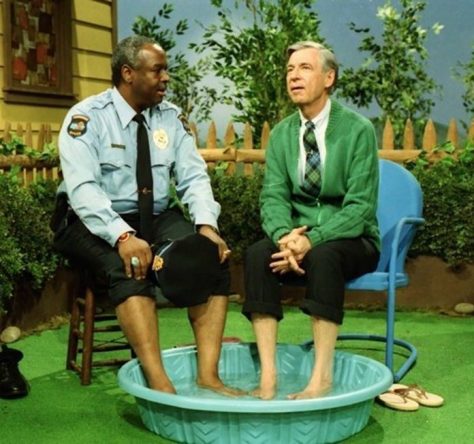
Fred Rogers and Francois Clemmons on the Mr. Rogers show

The following is a guest post by a friend who wants to remain anonymous. He is a Christian apologist who works in the software industry.


The marketing machine for the latest Tom Hanks movie portrayal of Mister Rogers is in full swing. And they’re trying hard to sell the movie to the Christian community. A recent Christian Post article claims:

‘Mister Rogers’ Neighborhood’ was Fred Rogers’ mission field, wife Joanne says

“One of the most important things we accept and know is that Fred was first and foremost a minister in the Presbyterian Church,” Joanne Rogers told The Christian Post.

The trouble with this is that if the show was Fred Roger’s mission field, he failed because people know him more for being nice than for preaching Jesus.

It’s telling that one of the most common “surprising facts” shared about Mr Rogers is that he was a Presbyterian minister. If we hadn’t been told this, we wouldn’t know it based on his work and legacy.

A commenter on Facebook writes:

His job was to do a kids show not to proselytize. Did Jesus go around preaching when He was called to be a carpenter? No He did His job.

I’m sure people asked Mr. Rogers what his motivation was and there’s nothing wrong with having private conversations about it and not using the television to preach. People don’t watch kids shows to be preached at. That would be a misuse of his platform! 😒

Is that true? Let’s take the case of Fred Rogers’s longtime friend and frequent show guest, Francois Clemmons. In addition to being a talented broadway actor, Francois Clemmons is proudly gay. And there’s no indication that Fred Rogers pressed Francois Clemmons to repent and turn to Jesus.

“He says he’ll never forget the day Rogers wrapped up the program, as he always did, by hanging up his sweater and saying, “You make every day a special day just by being you, and I like you just the way you are.” This time in particular, Rogers had been looking right at Clemmons, and after they wrapped, he walked over.

Clemmons asked him, “Fred, were you talking to me?”

“Yes, I have been talking to you for years,” Rogers said, as Clemmons recalls. “But you heard me today.”

“It was like telling me I’m OK as a human being,” Clemmons says. “That was one of the most meaningful experiences I’d ever had.””

Which is even more sad when you consider that Fred Rogers took a brave stand against racism

He found racism to be an important enough subject to import the foot washing example of Jesus but there’s no indication that he called Francois Clemmons to repent for his sinful lifestyle choice.

“But did Mr. Rogers ever condemn you?

No. He said, “Sometimes people do get married and they settle down, they live a different life. You can’t go to the those [gay] clubs. . .That may not be the answer for you, Franc; you have to consider something else. What, I’m not sure. But that may not be the route for you.””

I don’t expect, nor would I advocate for, Fred Rogers to do nothing but condemn Francois Clemmons. But it’s pretty telling that in all of their years working together, with Fred knowing Francois’s sexual orientation, that Fred never saw fit to tell him where his sinful lifestyle would eventually lead according to Scripture and plead with him to repent.

Fred Rogers is being lionized by popular media. You have to ask yourself why. Especially in a culture that still condemns Chick-fil-A for what its founder’s son said nearly a decade ago. The reason is not because Fred Rogers looked like Jesus. Quite the contrary. It’s because Fred Rogers was soft and effeminate. Fred Rogers is what the world wants Christians to look and act like so they can more easily push around and otherwise mold Christians.

Again, our commenter on Facebook responds:

A children’s show on a public network is no place to be preaching the gospel. Should a flight attendant spend all their time preaching and trying to convert people!? They have a job to do. If the Holy Spirit moves them to say something then fine but you’re going to turn people off if you’re acting like a salesperson and not doing your actual job! I am dead serious. The workplace is to be professional and do your job. If you want to preach be a preacher. Otherwise be careful how and when you bring it up. You have a whole private personal life on your time off to get involved in that kind of stuff!

Do we expect Christians to be sharing their faith all the time they are at work? No. Like every other profession the flight attendant has certain required duties to perform. But we are told to work as if for the glory of God (Colossians 3:23). At the very least that means that there is a mode of working that marks us as Christians. Part of that is the joy and peace that Fred Rogers displayed, yes, but that inevitably leads to others wondering about the source of that joy and peace (1 Peter 3:15). And that’s when an opportunity arises to explain to nonbelievers who Jesus is and why we should _want_ to pay the greatest price (Matthew 13:45-46) of giving up our own lives, characterized by sin (2 Timothy 2:25), to follow him.

If Francois Clemmons never felt judged by Fred Rogers then that is a serious condemnation on the ministry of Fred Rogers. It means, at the very least, that Fred Rogers was not doing his job in calling Francois to repentance so that he could come to a knowledge of the truth. The only truth that has any hope in saving anyone.

Why I admire people in the armed forces more than famous entertainers

I’ve noticed that many Christians can tell me a lot about famous entertainers. It doesn’t matter if it’s singers, musicians, actors, athletes, etc., they seem to know details of their biographies, achievements, etc. And it doesn’t really matter if those people are Christians, or whether they have performed actions consistent with a Christian worldview in their private lives.

Anyway, speaking for myself, I mostly admire two kinds of people. The first kind is the kind I blog about here all the time: Christian scholars engage non-Christians intellectually using logic and evidence. The second kind, as you can tell from my reading list, is people who distinguish themselves in conflict with those who oppose the principles and policies that allow me to live out my Christian life. And I am especially interested when people who are fighting evil (imperialists, Nazis, socialists, communists, leftists, etc.) exhibit Christ-like character in risking their lives to save others, or in giving their lives to save others.

Lt. Walt Chewning charges unto burning F-6F Hellcat to save trapped pilot

Anyway, today is November 10th, so I have a war story to tell you that happened on November 10th, 1943.

Lieutenant (later Lieutenant Commander) Walter Lewis Chewning of Cynwyd, Pennsylvania, steps on the burning fuel tank of an F6F-3 Hellcat flown by Ensign (later Lieutenant) Byron Milton Johnson of Potter, Nebraska to effect a successful rescue of the pilot on November 10, 1943. Johnson had flown out to USS Enterprise from Barbers Point, Hawaii, enroute to Makin Atoll in the Gilberts to support the United States Army invasion, which occurred on November 20, 1943. The afternoon of November 10, Johnson took off in F6F Hellcat Number 30 for a routine training exercise. He immediately developed engine trouble and requested an emergency landing. He was waved off three times as he struggled to maintain control, but his tail hook caught the third arresting gear wire, and Johnson’s Hellcat was slammed into the deck, coming to rest in the port catwalk. The plane came to rest on its external belly fuel tank, which started to leak. As the engine vibrated horribly as the propeller bent itself on the deck, sparks ignited the fuel. The hard landing had jammed Johnson’s canopy closed, shearing the retaining pin; he could not exit the plane. Chewning, who had joined the ship October 2, 1943 as Enterprise new catapult officer, scrambled out of the catwalk and came through the smoke. Stepping on the burning belly tank, he forced open the canopy and pulled Johnson to safety.

He received the two highest non-combat medals available:

Chewning was awarded the Navy and Marine Corps Medal for his actions.

He was a well-educated and accomplished person before joining the Navy:

Chewning played soccer and Lacrosse at Cornell while studying Mechanical Engineering, breaking his rib and left ankle in one game. He graduated in 1936 and studied at the Massachusetts Institute of Technology before joining the Navy in January 1941. He was the assistant to the Chief Engineer at the Naval Aircraft Factory in Philadelphia, Pennsylvania before joining USS Enterprise. He served as Enterprise’s catapult officer until December 1944, when he transferred to Dutch Harbor Naval Air Station in Alaska as ordinance officer. Chewning served in the Navy until December 1949; he also was awarded the Bronze Star. After the war he assisted research and development for various aeronautical companies, the United States Air Force, and the fledgling National Aeronautics and Space Administration. Motion picture film of the crash, taken from Enterprise’s bridge, was shown as part of the television program “Victory at Sea” on January 25, 1953. Chewning and Johnson gave interviews to several newspapers about the accident after the program aired.

You can see a video clip of the rescue here, from 5:35 to 6:00. I found a colorized version of the picture above here:

Lt. Walt Chewning charges unto burning F-6F Hellcat to save trapped pilot

This image was colourized from the original by Paul Reynolds.

What I thought was interesting about Chewning was how he had everything going for him in terms of his education and career, but he chose to join the Navy anyway, in order to defend his country from Japanese imperialism. Those who understand how the Japanese treated prisoners and conquered peoples will know which side of that conflict was good, and which side was evil. Chewning wasn’t some sort of loser who took risks for fun and thrills. It had to be a risk where the prize was worth the risk. And he had the humility to consider others better than himself, so that their life was worth the risking of his own. Many people on the secular left who like to talk about how generous, compassionate and virtuous they are are unable to make moral judgments against evils like Japanese imperialism – much less take self-sacrificial action against them.

I just think that it’s important for young Christians to have the right kind of heroes. The heroes who are promoted to young Christians by the cultural elites are not usually the right role models. And there is a reason for that. The secular leftists don’t want young Christians to be emulating people who excel according to the standards of the Christian worldview. We are in a religion where self-sacrificial love is the centerpiece. Taking trouble on yourself for someone else. Doing your job, when it goes against your own self-interest. Let’s not allow a bunch of godless socialist celebrities to pick and choose who we hold in high regard.