All posts by Wintery Knight

https://winteryknight.com/

Do naturalistic theories account for the minimal facts about Jesus’ resurrection?

Here’s a neat post from Ichtus77 on her blog of the same name. She lists 12 facts that are admitted by the majority of New Testament scholars across the broad spectrum of worldviews, including atheistic scholars.

Excerpt:

I am studying “the twelve facts” and want to get down what I’ve got so far. After the facts are displayed, we’re going to turn the whole thing into a logic puzzle.

Here are the 12 Facts:

  1. Jesus died by Roman crucifixion.
  2. He was buried, most likely in a private tomb.
  3. Soon afterwards the disciples were discouraged, bereaved and despondent, having lost hope.
  4. Jesus’ tomb was found empty very soon after his interment.
  5. The disciples had experiences that they believed were the actual appearances of the risen Christ.
  6. Due to these experiences, the disciples lives were thoroughly transformed. They were even willing to die for their belief.
  7. The proclamation of the Resurrection took place very early, from the beginning of church history.
  8. The disciple’s public testimony and preaching of the Resurrection took place in the city of Jerusalem, where Jesus had been crucified and buried shortly before.
  9. The gospel message centered on the preaching of the death and resurrection of Jesus.
  10. Sunday was the primary day of worshiping and gathering.
  11. James, the brother of Jesus and a skeptic before this time, became a follower of Jesus when he believed he also saw the risen Jesus.
  12. Just a few years later, Paul became a believer, due to an experience that he also believed was an appearance of the risen Jesus.

These are the facts that you see admitted in debates by atheistic historians, like in the debate between James Crossley and William Lane Craig.

The resurrection puzzle is like a Sherlock Holmes mystery. People deduce what happened from the evidence that is considered to be unimpeachable. The “minimal facts” that EVERYONE accept in debates. The reason why everyone accepts these facts is because they pass the historical criteria which are used everywhere by everyone to determine what is parts of historical writings are authentic. The historical tests for historical records take into account things like how many sources a asserted fact is in, and how early the sources are, and so on.

So the approach is like this:

1) Use historical tests to get undeniable historical facts
2) Try to explain the undeniable historical facts with a hypothesis

Like Sherlock Holmes says: “…when you have eliminated the impossible, whatever remains, however improbable, must be the truth.”

It’s the Sherlock Holmes method of doing history.

So, Ichtus77 lists the minimal facts, and in the rest of the post she surveys the following naturalistic hypotheses to see how well they can account for the minimal facts listed above.

Here are the naturalistic theories:

  • The Unknown Tomb theory
  • The Wrong Tomb theory
  • The Twin theory
  • The Hallucination theory
  • The Existential Resurrection and the Spiritual Resurrection theories
  • The Disciples Stole Body theory
  • The Authorities Hid Body theory
  • The Swoon theory
  • The Passover Plot theory

The main way that scholars argue for the resurrection is to list the minimal facts, and defend them on historical grounds, then show that there is no naturalistic hypothesis that explains them all. The resurrection hypothesis explains all the data.
What produces more fraud? The free market or government-run programs?

From National Review, an article examining how government programs like Medicare and Medicaid are ripe for fraud and waste.

Excerpt:

The three most salient characteristics of Medicare and Medicaid fraud are: It’s brazen, it’s ubiquitous, and it’s other people’s money, so nobody cares.

Consider some of the fraud schemes discovered in recent years. In Brooklyn, a dentist billed taxpayers for nearly 1,000 procedures in a single day. A Houston doctor with a criminal record took her Medicare billings from zero to $11.6 million in one year; federal agents shut down her clinic but did not charge her with a crime. A high-school dropout, armed with only a laptop computer, submitted more than 140,000 bogus Medicare claims, collecting $105 million. A health plan settled a Medicaid-fraud case in Florida for $138 million. The giant hospital chain Columbia/HCA paid $1.7 billion in fines and pled guilty to more than a dozen felonies related to bribing doctors to help it tap Medicare funds and exaggerating the amount of care delivered to Medicare patients. In New York, Medicaid spending on the human-growth hormone Serostim leapt from $7 million to $50 million in 2001; but it turned out that drug traffickers were getting the drug prescribed as a treatment for AIDS wasting syndrome, then selling it to bodybuilders. And a study of ten states uncovered $27 million in Medicare payments to dead patients.

These anecdotes barely scratch the surface. Judging by official estimates, Medicare and Medicaid lose at least $87 billion per year to fraudulent and otherwise improper payments, and about 10.5 percent of Medicare spending and 8.4 percent of Medicaid spending was improper in 2009. Fraud experts say the official numbers are too low. “Loss rates due to fraud and abuse could be 10 percent, or 20 percent, or even 30 percent in some segments,” explained Malcolm Sparrow, a mathematician, Harvard professor, and former police inspector, in congressional testimony. “The overpayment-rate studies the government has relied on . . . have been sadly lacking in rigor, and have therefore produced comfortingly low and quite misleading estimates.” In 2005, the New York Timesreported that “James Mehmet, who retired in 2001 as chief state investigator of Medicaid fraud and abuse in New York City, said he and his colleagues believed that at least 10 percent of state Medicaid dollars were spent on fraudulent claims, while 20 or 30 percent more were siphoned off by what they termed abuse, meaning unnecessary spending that might not be criminal.” And even these experts ignore other, perfectly legal ways of exploiting Medicare and Medicaid, such as when a senior hides and otherwise adjusts his finances so as to appear eligible for Medicaid, or when a state abuses the fact that the federal government matches state Medicaid outlays.

Government watchdogs are well aware of the problem. Every year since 1990, the U.S. Government Accountability Office has released a list of federal programs it considers at a high risk for fraud. Medicare appeared on the very first list and has remained there for 22 straight years. Medicaid assumed its perch eight years ago.

They waste money because it’s not their money – it’s your money. Private companies minimize waste because it is in their interest to minimize waste – they have to be competitive and be responsive to customers, or they don’t get paid. The profit motive reduces waste and fraud.

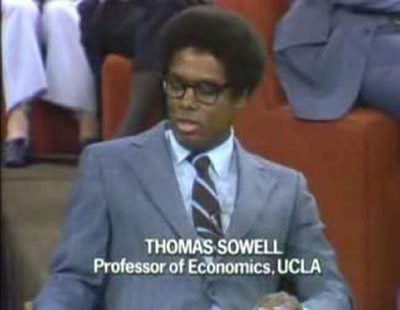
Thomas Sowell on health care: thinking beyond stage one

Young Thomas Sowell

Economist Thomas Sowell explains what socialized medicine means for all parties – and what evidence is ignored.

Excerpt:

The same preference for talking points, and the same lack of interest in digging into the facts about realities, prevails today in discussions of whether to have a government-controlled medical system.

Since there are various countries, such as Canada and Britain, that have the kind of government-controlled medical systems that some Americans advocate, you might think that there would be great interest in the quality of medical care in these countries.

The data are readily available as to how many weeks or months people have to wait to see a primary-care physician in such countries, and how many additional weeks or months they have to wait after they are referred to a surgeon or other specialist. There are data on how often their governments allow patients to receive the latest pharmaceutical drugs, as compared with how often Americans use such advanced medications.

But supporters of government medical care show virtually no interest in such realities. Their big talking point is that the life expectancy in the United States is not as long as in those other countries. End of discussion, as far as they are concerned.

They have no interest in the reality that medical care has much less effect on death rates from homicide, obesity, and narcotics addiction than it has on death rates from cancer or other conditions that doctors can do something about. Americans survive various cancers better than people anywhere else. Americans also get to see doctors much sooner for medical treatment in general.

Conservatives are the reality-based community.