
All posts by Wintery Knight

https://winteryknight.com/

Was withdrawing American troops from Iraq a good thing for world peace?

Control of Iraq (click for larger image)

I really enjoyed this article from David French in National Review.

It says:

In Tuesday night’s debate, Democratic vice-presidential nominee Tim Kaine defended the indefensible — a strategic retreat from Iraq that threw away the fruits of American military victory, helped enable a terrifying genocide, and empowered America’s enemies. Even worse, he did so while spouting a pack of deceptions and half-truths that exhibited a child’s understanding of American strategic interests.

Where to begin? First, it was stunning that Kaine brought up as an accomplishment America’s dramatically reduced overseas deployments — as if the only measure of strategic success is the number of Americans in harm’s way. He said it was a “very, very good thing” that instead of 175,000 deployed, we now have only 15,000.

Well, yes, if America’s enemies were defeated or contained. Instead, American retreat created power vacuums that our enemies filled. Jihadists control more territory, have more men under arms, and are more effectively attacking America and American allies than when Hillary Clinton became secretary of state. Those are facts that make American withdrawal look less like an accomplishment and more like an inexcusable retreat.

Moreover, we didn’t have to maintain 175,000 troops in the field to hold on to our hard-fought gains. Kaine made the choice binary — maximum or minimum. Yet our defeat of al-Qaeda in Iraq (the precursor to ISIS) was so comprehensive that the presence of only a small number of American combat troops could have prevented the kind of blitzkrieg we saw in 2014, when ISIS overran large parts of Iraq and Syria. There was never a question of keeping massive numbers of troops in the field. The question was whether we’d keep any troops in Iraq, and the Obama administration said no.

And that brings me to Kaine’s central deception. He still clings to the old, discredited line that America had no choice but to pull troops out of Iraq because the Bush-era “status of forces” agreement mandated their removal. Yet comprehensive reporting in the New York Times and The New Yorker magazine tells a very different story — of an administration that was unwilling to commit the roughly 10,000 to 16,000 (not 175,000) troops needed to maintain stability and of an Iraqi government that was unwilling to risk political capital at home for the sake of a merely nominal American presence. In other words, both sides blundered, badly.

As any number of strategic thinkers have noted, the results weren’t just predictable, they were predicted — by President George W. Bush himself. Speaking in 2007, Bush said that if troops were withdrawn before commanders said Iraq was ready, then:

  • It would mean surrendering the future of Iraq to al-Qaeda.
  • It would mean that we’d be risking mass killings on a horrific scale.
  • It would mean we allow the terrorists to establish a safe haven in Iraq to replace the one they lost in Afghanistan.
  • It would mean we’d be increasing the probability that American troops would have to return at some later date to confront an enemy that is even more dangerous.

All of these things happened. All of them. ISIS has committed genocide. It blitzed through Iraq, threatening Baghdad and even Kurdistan, and it has created a nation-sized jihadist terror state, one that is shrinking only because — yes — American troops have returned.

David French was deployed to Iraq, and saw Americans killed there. Then Obama pulled out our forces, giving the enemies of America a great victory. A bit later, the Islamic State (ISIL) formed, and began to take control, committing atrocities unthinkable to most of the naive people who voted for Obama. Retreat from Iraq created a mess, and we should learn from that failure. You can’t just pull Western troops out and expect everything to magically fix itself.

Muslim man proud of son for murdering his daughter after she married a Christian

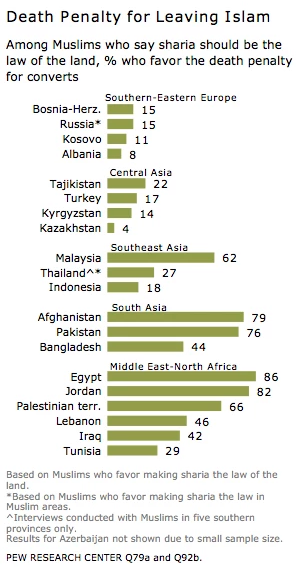
Leftist Pew Research: Should converts away from Islam be killed?

A friend sent me this article and it just made me so unhappy.

The article appeared in the Calgary Sun:

For two months, over the thunder of machines at the steel mill, the men taunted Mubeen Rajhu about his sister. Even now, they laugh at how easy it was to make him lose his temper.

Some people had seen Tasleem in their Lahore slum with a Christian man. She was 18, a good Muslim girl, out in public with a man. Even though the man had converted to Islam out of love for her, this couldn’t be allowed.

“Some guys got to know that his sister was having a relationship,” says Ali Raza, a co-worker at the mill. “They would say: ’Can’t you do anything? What is the matter with you? You are not a man.”’

Raza can barely contain a smile as he talks about the hours spent needling Rajhu.

“He used to tell us, ’If you don’t stop, I will kill myself. Stop!”’ Raza says.

He raises his voice to compete with the sounds of the coal-powered mill, and workers blackened by its dust gather to listen. They too smile. A few laugh at the memory of Rajhu’s outbursts.

“The guys here told him, ’It would be better to kill your sister. It is better than letting her have this relationship,”’ Raza says.

Rajhu told them he had bought a pistol, and one day in August he stopped coming to work.

Rajhu discovered that his sister had defied the family and married the Christian. For six days he paced. His rage grew. How could she?

He watched her laughing on the phone, ignoring their mother’s pleas to leave the man.

On the seventh day, he retrieved the pistol from where he had hidden it and walked up to his sister and with one bullet to the head, he killed her.

Killed her? He murdered a defenseless woman. This is the exact opposite of what a brother should do for a sister. Instead, he should use force to protect her from evil – not bring the evil himself.

But what was interesting was how everyone accepted it:

In the vast majority of cases, the “honour” killer is a man and the victim is a woman.

She is a sister who falls in love with a man not of her family’s choosing. She is a daughter who refuses to agree to an arranged marriage, sometimes to a man old enough to be her father. She is a wife who can no longer stay in an abusive marriage and divorces her husband.

He is a brother, like Rajhu, who cannot bear the taunts of other men brought up as he was, believing that women are subservient and must be kept in the shadows, their worth often measured by the number of sons they can produce. He is a neighbour, like Raza at the plant, who doesn’t think his friend did anything wrong in taking his sister’s life. He is a father, like Tasleem’s, who is angry about her killing not because she is dead, but because her death will reveal her “shame” to other members of the family and beyond.

The father says some terrible things about the daughter, and is completely oblivious to looking at things from her perspective.

In some places, it really is very difficult to be a Christian:

The man Tasleem married, Jehangir, fled the night she was killed. The gate to his home, barely a block from Tasleem’s, is padlocked. But the fallout from his love for Tasleem has engulfed the members of the small Christian community living in the area.

Earlier this month, just weeks after the killing, gunmen fired shots into their homes. No one was hurt, but no one has slept well since. In this majority Muslim country, Christians make up barely 5% of the population and in recent years have come under increasing attack by militants, who insist all non-Muslims are unbelievers. Yet Pakistan’s minorities, including Christians, are protected in the country’s constitution.

“We have been scared since the killing took place,” says a neighbour, Shahzia Masih, sitting in a small room decorated with pictures of Jesus and Mary. “There are just a few houses of Christians here, but we have nowhere else to go.”

I suppose that since I am tough on women choosing good men, someone might ask me what I would do if my sister married an atheist. Answer: I have a longstanding policy of always putting my relationships with Christians above family members who aren’t interested in Christianity. I naturally prefer to do things with people who don’t shush me when I want to be myself and speak about the beliefs that matter to me. I’m fine with people who let me be myself, family or non-family. I certainly don’t expect everyone to agree with me. All I ask is that if they want a relationship with me, that they not stifle me. I have atheists cousins that I play online games with, but they don’t shush me about my beliefs and moral views at all. My atheist aunt and uncle know that they can get me to do things if they let me talk about the things I care about. But they don’t have to agree with me, of course. Because they don’t believe what I believe. I like to say what I think, but I don’t want anyone to be scared into agreeing with me. I’m different from Islam and the secular left in that respect. You believe what you want, but let me believe what I want if you want me to be your friend. Surprising how many Muslims and progressives won’t take that deal.

I am pretty confident in Christianity as a worldview in the sense that I believe that if people put reason and evidence first, then they will arrive at Christianity. It doesn’t make any sense to try to coerce people into it… Jesus is the Son of God, and he had all the power in the world to coerce. He wasn’t willing to do it, not even to save his own life when he took on the form of a man in order to meet with his creatures and rescue them. That means something to me. You just have to read Philippians 2 to see that this unwillingness to use power, but to instead serve others, is at the core of Christian teaching.

Nebraska teen arrested for throwing her newborn baby out the window

Baby elephant rejected by his mother
This baby elephant is crying because he was rejected by his mother

The UK Daily Mail reports on a 16-year-old girl who allegedly threw her newborn baby out a second story window.

Excerpt:

A 16-year-old girl accused of throwing her newborn out of the window has been pictured in her mugshot.

Antonia Lopez, of Omaha, Nebraska, is being charged as an adult in the death of her daughter.

[…]Authorities believe Lopez went into labor on Friday, gave birth in her bedroom and threw her baby girl from the second floor of her apartment building.

Lopez then told her mother what had happened, according to authorities. Lopez’s mother found the baby in the grass, called 911 and gave the newborn CPR until paramedics arrived, police said.

[…]The baby had died by the time she was transported her to the hospital, paramedics said. She was then pronounced officially dead.

This is really sad. Have you ever thought about what it must be like for a little baby to be rejected by its own mother? And for the mother to not care about him, because she just wants to do what makes her happy, even though she made him? It’s horrible. Every baby should have a mother who welcomes him and takes care of his needs. Who else is there to take care of him, if not his own mother?

Amanda Prestigiacomo has a comment on this story at the Daily Wire, then I’ll say something that occurred to me.

Amanda writes:

The baby girl weighed only two pounds and was believed to be 27-28 weeks old at the time of her murder, according to the director of the neonatal intensive care unit at the Nebraska Medical Center, Dr. Ann Anderson-Berry. Murdering a baby inside a woman’s womb at this stage, called a third-trimester abortion, is legal in 12 states and the District of Columbia.

[…]Lopez was charged with murder: one count of felony child abuse resulting in death.

But all she really had to do was ask to have her baby murdered while she was still in her womb. This gruesome act is somehow interpreted as a “woman’s right to choose” on account of location of the baby at the time of the murder. Twelve different states—Iowa, Texas, Virginia, Alaska, Colorado, Mississippi, New Hampshire, New Jersey, New Mexico, Oregon, Vermont, West Virginia—and the District of Columbia, would have happily murdered the baby, injecting the baby with poison and ripping them apart limb-by-limb, with zero legal repercussions.

Third-trimester babies are completely viable to live outside of the womb and can feel pain.

As soon as I read this story, it made me think about the baby elephant who cried for 5 hours, because its mother tried to stomp it to death. Every time I think about that baby elephant, and it makes me cry. I don’t see how this story is any different, except it’s worse because it’s a person who was made in the image of God, and the people who tried the save the baby were not in time to save him.

Baby elephant's birthday is supposed to be happy
A baby elephant’s birthday is supposed to be happy

OK, I have another point about this. When I looked at the selfies of this teen in the UK Daily Mail article, the first thing that occurred to me was that this teen was interested in having fun, feeling good, getting attention, etc. The fact that her father is never mentioned anywhere made me think that no one was around to teach her to be responsible and to put the needs of others above her own pursuit of happiness. She didn’t see the baby as more important than her own happiness, even though it she chose the man who impregnated her, and she chose to have sex with that man. The baby wasn’t to blame for anything, he just wants to have a mother like all the other babies do. She has a moral obligation to take care of what she chose to make. He needs her to take care of him. It’s his birthday, for God’s sake!

When you look at the Bible, you see Jesus divesting himself of power, and coming as a man to serve others – to look out for their needs. Paul says that this example should be imitated by followers of Jesus in Phillipians 2:

Look at Philippians 2:1-11:

1 Therefore if there is any encouragement in Christ, if there is any consolation of love, if there is any fellowship of the Spirit, if any affection and compassion,

2 make my joy complete by being of the same mind, maintaining the same love, united in spirit, intent on one purpose.

3 Do nothing from selfishness or empty conceit, but with humility of mind regard one another as more important than yourselves;

4 do not merely look out for your own personal interests, but also for the interests of others.

5 Have this attitude in yourselves which was also in Christ Jesus,

6 who, although He existed in the form of God, did not regard equality with God a thing to be grasped,

7 but emptied Himself, taking the form of a bond-servant, and being made in the likeness of men.

8 Being found in appearance as a man, He humbled Himself by becoming obedient to the point of death, even death on a cross.

9 For this reason also, God highly exalted Him, and bestowed on Him the name which is above every name,

10 so that at the name of Jesus every knee will bow, of those who are in heaven and on earth and under the earth,

11 and that every tongue will confess that Jesus Christ is Lord, to the glory of God the Father.

OK, so what’s more important? Avoiding obligations to others, or taking care of the needs of others? Yes, there is time for having fun and doing fun things. But Christians need to be alert to those around them. Whenever someone close is in need, they have to consider it a calling from God, and act to help the person in need. In the case of the pregnant teen, it was her baby. The baby was conceived as a result of the teen’s decision. It’s just like buying a pet in the pet store – you own it, and it has a natural claim on you to provide for and protect it. You made the decision to make it (or with pets, you made the decision to own it). We all understand that taking care of babies is not fun and thrills. It’s work. But for Christians at least, we ought to be trained to see the needs of others as acceptable to us. We can’t always be running away from expectations, responsibilities and obligations.

In fact, I would recommend to young people that they get used to having to care for others, and not getting their way all the time. With practice, you can actually get to the point where you don’t resent having to care for the needs of others. Now, I don’t think you should commit yourself to more than you can handle, and that might mean that you take fewer risks, so you have more time and resources to help others who may need you. Don’t stress your resources, in short. But the point is that we need to be alert to the fact that there is something in Christianity that praises self-denial, and self-sacrifice. This is more important in Christianity than having fun, having peer approval, doing “interesting” things so that other people will be impressed. Manage your life wisely so you can take on someone else’s problems if you need to. Don’t take risks that will create situations that you can’t handle. But if a situation occurs, take it as a task from God to live out your faith. We ought to be different. There ought to be a difference between us and them.