
Do you remember the episode of Knight and Rose Show where we interviewed Dr. Günter Bechly about the Cambrian explosion? We were talking about naturalistic explanations for the explosions of new information at certain points in the fossil record. I mentioned that one paper had argued that the introduction of molecular oxygen into the early Earth’s atmosphere might explain the origin of all these new body plans and organ types.
Well, before we see the new paper, let’s start at the very beginning. What is the Cambrian explosion?
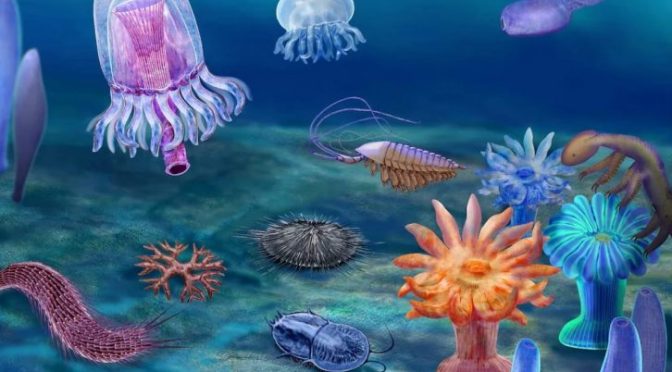
The Cambrian Explosion refers to an explosive event in Earth’s history. Around 530 million years ago, over a geologically brief window of roughly 5–10 million years, nearly all major animal body plans (phyla) appeared suddenly in the fossil record. These are new, complete body plans with new designs for things like hard shells, jointed limbs, compound eyes, digestive systems, nervous tissue, etc. And they came in without clear transitional precursors from the simpler life forms found in earlier strata.
So, what could have caused this? Well, in my computer lab, when we see new code in the Github repository, we know that a software engineer committed those changes and then pushed them into the code repository. But some people don’t like the idea of a Cosmic Software Engineer, so they try to come up with alternative explanations that are more comfortable for them.
In this case, one of the explanations that keeps coming up is that the introduction of a new gas into the atmosphere must have caused all this code to appear. Which gas? Oxygen!
Here’s the story from Casey Luskin, over at Science and Culture:
For many evolutionary biologists, that trigger is a sudden rise in atmospheric oxygen just before the Cambrian — and the claimed sudden rise of oxygen is enough to satisfy them that the Cambrian explosion is explained (or at least explained away).
Today’s post is about a new paper that gives us reasons to doubt it, and Casey explains:
The oxygen “trigger” theory for the Cambrian explosion has now taken another hit. A new paper in Proceedings of the National Academy of Sciences, “Breathing life into the boring billion: Direct constraints from 1.4 Ga fluid inclusions reveal a fair climate and oxygenated atmosphere,” suggests that oxygen might have been quite high long before the Cambrian period, casting doubt on the idea that it played a role as a trigger.
Casey quotes an article about the new paper, which explains that the researchers got samples of air trapped in ancient crystals that are 1.4 BILLION years old – much, much older than the Cambrian explosion. And what is in the samples? Molecular oxygen! And yes, this does show that the planet had more oxygen than expected at this much earlier time. Casey notes that if oxygen were the trigger to all this code being written in the blink of an eye, then why didn’t it happen when the oxygen was there 1.4 billion years ago?
Because oxygen doesn’t write code, duh!
And since we’re on the topic, in the episode with Dr. Bechly, I mentioned an article he wrote about an earlier (2023) paper that also disproved the oxygen explanation for massive amounts of new code. This was one of his famous “Fossil Friday” articles. Except here, he is talking about the Avalon explosion, not the Cambrian explosion. It turns out that there are tons of these explosions in the fossil record.
He wrote this:
Now a new study (Ostrander et al. 2023) by group of researchers from Denmark has overturned decades of evolutionary dogma and claims the exact opposite: “oxygen didn’t trigger multicellular organisms” (Anonymous 2023, UCPH 2023). What this study found was instead clear evidence of a lower oxygen content correlated with the Avalon Explosion of the Ediacaran biota. The authors summarize their surprising findings as: “Contrary to a classical hypothesis, our interpretations place the Shuram excursion, and any coeval animal evolutionary events, in a predominantly anoxic global ocean.” Co-author Christian Bjerrum commented “Specifically, it means that we need to rethink a lot of the things that we believed to be true from our childhood learning. And textbooks need to be revised and rewritten.
And again, there are lots of these explosions. He calls them “biological big bangs”. If you want to read his big article about all the different biological big bangs, you can find it here.
And he also did a long presentation on it, which is even better than our podcast episode, because he had pictures and graphs:
Well, that’s something for people to know about. You don’t want to make your view of the world based on speculations. We know what makes code appear. Software engineers make code appear. So people need to stop grasping at gasses and accept the way the world really is. Designs need a Designer.
If you watch his presentation twice, I’m pretty sure that you will remember it enough to make this case for design. And arguing from scientific evidence makes life more fun. Let the other team do the speculating, you stick with the scientific evidence.
Also, don’t forget about our episode on junk DNA with Casey Luskin.
 WINTERY KNIGHT
This is such a good topic
LikeLiked by 1 person