
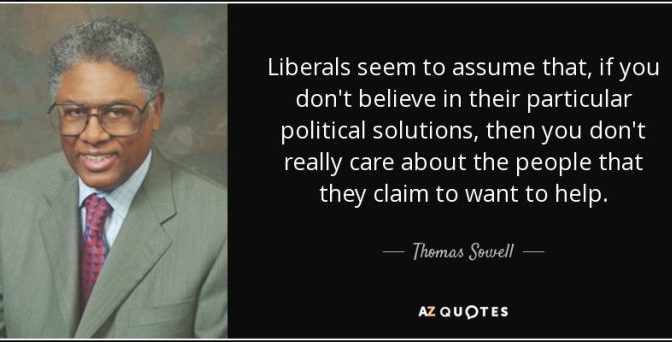
My favorite economist is Thomas Sowell, who is famous for making the findings of academic economists accessible to ordinary people. I always joke to my friends that Thomas Sowell books are like Lay’s potato chips – you can’t read just one. Well, if you’ve read Dr. Sowell’s flagship book “Basic Economics”, you know that the early chapters are about how prices work in the economy.
So, I thought I would link to a VERY good article on price controls by Thomas Sowell. If you’ve never read him, I think you’ll really enjoy how me makes sense of the world for you. Learning how the world works is fun – now you see how to make good decisions.
This is “An Ancient Fallacy: Price Controls” from Capitalism Magazine.
He writes:
Those old enough to remember the gasoline crisis of 1979 may recall sitting in long lines of cars at filling stations, waiting — sometimes for hours — to reach the pump. This was one of the most common consequences of price control throughout history — a shortage. Yet how many Americans ever made the connection between the price controls of the 1970s and the gasoline shortages of the 1970s? How many have noticed that they haven’t been waiting in gasoline lines since Ronald Reagan got rid of the price controls on oil?
Why do price controls cause shortages? There are basically two reasons: supply and demand.
People will not supply as much at a lower price as they will at a higher price. Some oil wells that will repay their costs and earn a profit when the price of oil is $25 a barrel will not cover their costs when the price is $15 a barrel. Some people who will rent out a bungalow in their backyard when rents are high will not bother when rents are low. Some farmers will give up farming when food prices are kept below the point where they can earn a living.
On the demand side, people will demand more when the price is kept artificially low by price controls. Before rent control laws were passed in Sweden, less than one-fourth of unmarried adults there had their own separate housing units, but afterwards more than half did. People buy more of anything that is cheaper. With more being demanded and less being supplied, shortages are inevitable, whether with housing, food, medical care or whatever.
It is not just the quantity supplied that declines under price controls. Quality also declines.
When there are more people trying to rent apartments than there are apartments for rent, landlords no longer have to maintain the appearance of their buildings. They do not need to pay for painting, repairs or maintenance as often as they did when there was no housing shortage and they needed to attract tenants.
Sometimes quality deterioration takes the form of waiting — not just cars waiting in line at filling stations, but also sick people remaining on waiting lists for months to get surgery or other medical treatment they need. Cheap medical care is one of the most expensive things there is.
So, if you force producers to charge less for what they are making, you might see a shortage, you might see a decline in quality, or you might see waiting lists.
Now, one of the examples that Sowell uses in his books is the example of rent control. This is when the government responds to people complaining that “the rent is too damn high” by forcing landlords to charge less. If you’re paying attention, then you can predict what will happen next. There will be a shortage of housing, because people with capital invest it in other places, rather than building and renting out places to live. Why? Because there is no money to be made by investing in renting properties when the government is pushing prices down.
So, let’s look at a reverse case, where price controls are removed. What would you expect to see when a country that has had rent control laws for a long time repeals it?
Well, Argentina just elected a new free market capitalist government, and they repealed their rent control laws.
Newsweek reports on what happened next:
Argentina’s recent repeal of rent control by libertarian President Javier Milei has led to a surge in housing supply, with the freedom to negotiate contracts, previously restricted, directly causing a drop in rental prices.
Milei, a self-described “anarcho-capitalist” known for his free-market approach, repealed the 2020 Rental Law, enacted by former leftist President Alberto Fernández, which had imposed restrictions on landlords and led to a significant decline in rental availability.
[…]For many locals, finding a new apartment had become “mission impossible.” But after the repeal, Buenos Aires saw a doubling of available rental units, and rental prices have stabilized. Under the new rules, landlords and tenants have more freedom to agree on lease terms. If the duration isn’t specified, it defaults to two years.
“We’ve seen a significant increase in rental apartments, and in some cases, we had to lower prices in pesos because of fewer viewings,” Soledad Balayan, head of the real-estate agency Maure Inmobiliaria, told Argentine newspaper La Nación.
Since Millei’s repeal of rent control laws took effect on December 29, the supply of rental housing in Buenos Aires has jumped by 195.23%, according to the Statistical Observatory of the Real Estate Market of the Real Estate College (CI).
If you guessed that repealing price controls on rental properties would reverse the shortage and cause an abundance of high quality properties, then you guessed right. This is how the world works! Naturally, as supply increases, consumers have a lot more choice, and they get the benefit of better quality at a lower price, because of increased competition among suppliers of rental properties.
The article notes that Joe Biden has proposed rent control at the federal level, which is exactly the kind of policy that you would epect his successor, Kamala Harris, to push if she is elected President. If you know someone who rents, maybe you should tell them about the consequences of rent control laws?
 WINTERY KNIGHT